
Red is the oldest color in art. Iron-rich red ochre was used to adorn bodies over 300,000 years ago, before Homo sapiens existed. Paleolithic artists used it to paint bison on the walls of Altamira cave in Spain 36,000 years ago. The Egyptians used it for wall paintings and cosmetics. The Romans regarded the mineral cinnabar, the source of vermilion, as having "great importance and sacred associations," according to Pliny the Elder (77-79 CE). But red's history is not just ancient. It is political. The brightest red in Renaissance Europe came from cochineal, a pigment made from crushed insects harvested in Mexico, where Aztec women used it to paint their lips and bodies, and outlying villages paid tribute to their rulers in kilos of the dye. When the Spanish conquered Mexico in 1521, they turned cochineal into a major export, claiming it came from a berry to protect their monopoly. By the 1570s, cochineal was one of the most profitable trading goods in Europe, and the crushed bugs that had painted Aztec lips were painting the robes of Christ in European cathedrals.
Red has always been the color of power, danger, and sacrifice. In the Renaissance, it was the most expensive pigment after ultramarine. Vermilion (mercury sulfide) was "as expensive as gold during medieval times." In the Baroque, it was the color of Christ's Passion. The red robe in El Greco's "The Disrobing of Christ" (1577-1579) is the focal point of the composition. In the 20th century, it was the color of revolution: Rothko's red canvases, the Soviet flag, the Red Army. This guide covers the history of red in art from prehistory to the present, from red ochre in Paleolithic caves to cinnabar and vermilion from Rome to China, cochineal and the Spanish colonial trade, red lake pigments like madder and kermes, the invention of cadmium red in 1910, and what red means in art today. For the broader sequence of how art got here, the art movements timeline puts the whole story in order.
Red Ochre: The First Color (300,000 BCE)
Iron-rich red ochre (hematite) was used by Homo erectus 300,000 years ago. This is the earliest evidence of pigment use by any hominin. Blombos Cave in South Africa (75,000 BCE) contains ochre-processing tools, including grindstones and abalone-shell containers used to mix the pigment. Altamira cave (36,000 BCE) has bison painted in red ochre. Lascaux (17,000 BCE) has red deer and horses. The pigment was everywhere because hematite is common in soils worldwide. You could find it in almost any riverbed.
Red was the first color humans used because it was the easiest to find, but it was also the most loaded. It is the color of blood, of life, of death. Red ochre was used in burial rituals in Neolithic cultures in Anatolia, China, Galilee, Spain, and Syria. It was applied to skulls and bones as part of funerary rites. The pigment's resistance to fading made it a symbol of immortality. A color that does not change while the body decays is a color that promises something.
The technique was simple. Red ochre was ground to a powder and mixed with water, blood, or animal fat to make paint. The same basic technique was used for 290,000 years, from Blombos Cave to the Renaissance. The consistency of the method is worth pausing on. For nearly all of human history, red paint was made the same way: find hematite, grind it, mix it with a binder. The industrial revolution changed everything else, but the basic chemistry of red ochre did not need changing. It was already permanent, already stable, already available. You can read more about these earliest periods in our guide to famous paintings and what they are about, which includes several works from antiquity.
Cinnabar and Vermilion: Rome, China, and the Mercury Trade
Cinnabar is the mineral source of vermilion. It is mercury sulfide (HgS), and it has been mined since at least the 10th millennium BCE. The most important mines were at Almadén, Spain, the largest mercury mine in the world, operated continuously from Roman times to 2003. The Romans used cinnabar for wall paintings. The Villa Boscoreale frescoes, now at the Metropolitan Museum of Art, use natural vermilion. Pliny the Elder mentions red more than any other color in "Natural History." It was, according to the Metropolitan Museum's research on cinnabar and vermilion, "the most expensive pigment used by the Romans for wall paintings."
China invented synthetic vermilion centuries before the West. Chinese alchemists were making it as early as the 4th century BCE by heating mercury and sulfur in a sealed container. The process was described by the Greek alchemist Zosima of Panopolis in the 4th century CE and the Persian alchemist Jabir ibn Hayyan in the 8th century. The East had synthetic vermilion while Europe was still grinding the natural mineral.
The chemistry of vermilion is the source of both its brilliance and its danger. It is HgS, mercury sulfide. It is toxic because of the mercury, but it is stable. It has a deep, warm red hue with good covering power and works in oil, watercolor, egg tempera, and fresco. It was the most widely used red pigment around the globe until the discovery of cadmium red in the early 20th century. In medieval Europe, vermilion was "as expensive as gold." The price reflected the cost of mining at Almadén, transport, and the laborious grinding and washing process. Synthetic vermilion was cheaper but still expensive, and still toxic. The Getty's history of red covers the trade routes and the alchemical origins in detail.
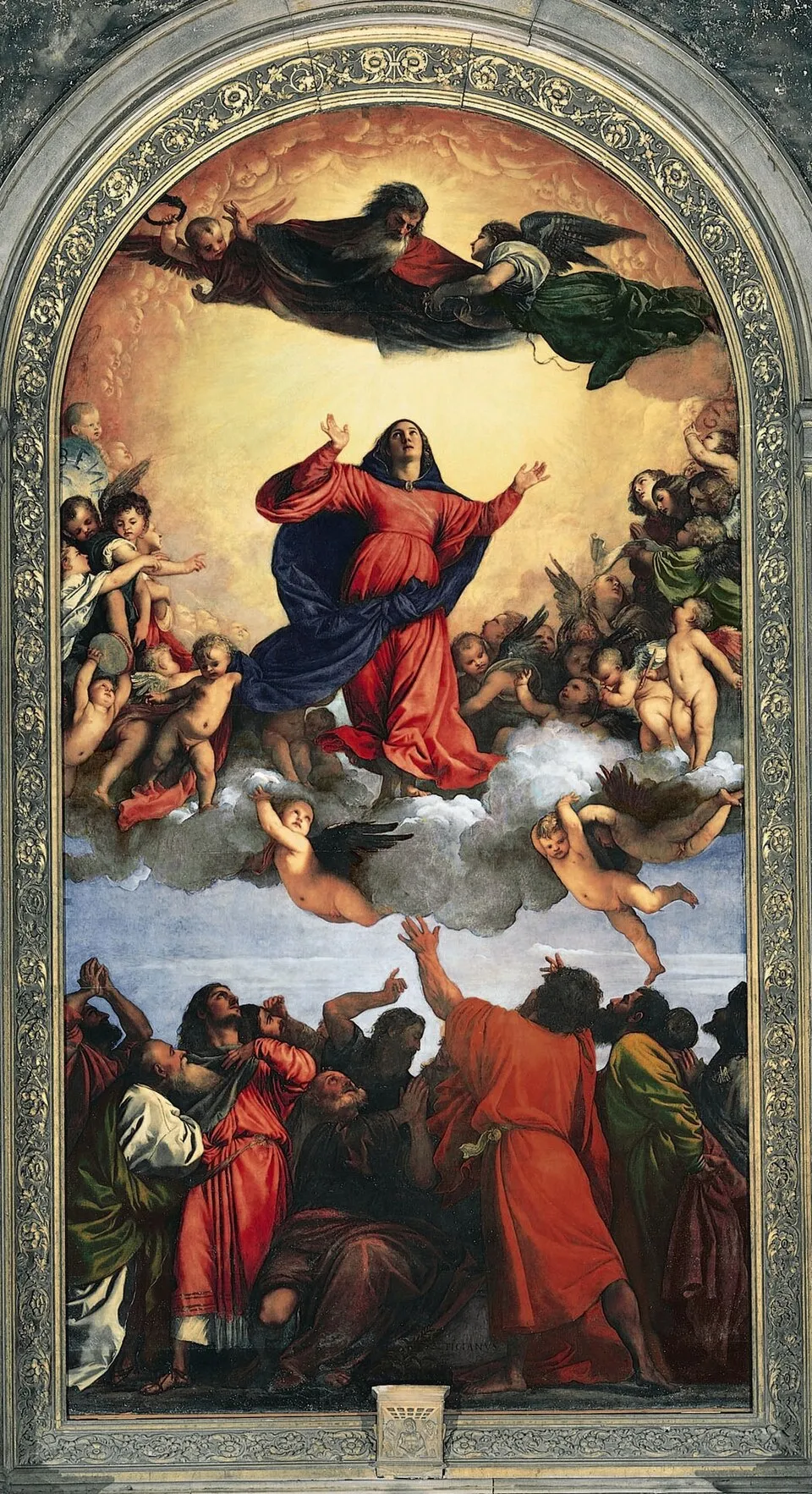
Titian, "Assumption of the Virgin" (1516-1518). Oil on panel, 690 x 360 cm. Santa Maria Gloriosa dei Frari, Venice. Image via Wikimedia Commons
Cochineal: The Aztec Red That Conquered Europe
Cochineal is a dye made from the crushed bodies of Dactylopius coccus, a scale insect that feeds on prickly pear cactus (nopal). The insect produces carminic acid, a brilliant scarlet dye. Cochineal was first harvested in the precolonial Americas. Mesoamerican peoples used it as early as 2000 BCE.
The Aztec trade in cochineal was extensive. Outlying villages paid tribute to Aztec rulers in kilos of cochineal and rolls of blood-red cloth. Aztec women used it to paint their lips and bodies. Local painters used it for codices and murals. The pigment was used to dye leather, furs, and feathers for Aztec nobility. When Cortés arrived in Tenochtitlan in 1519, red was everywhere. He wrote to King Charles V about the great marketplace: "They also sell skeins of different kinds of spun cotton in all colours, so that it seems quite like one of the silk markets of Granada." By 1523, cochineal was exported to Spain. The Spanish kept the source secret, claiming the dye came from a berry. By the 1570s, cochineal was one of the most profitable trading goods in Europe. Between 1575 and 1600, shipments out of New Spain measured in the tons. We are talking about a few trillion insect bodies a year.
In the 18th century, the French botanist Nicolas-Joseph Thiéry de Menonville raided the cochineal fields of New Spain, smuggled out infested nopal paddles, and exposed the secret. The revelation did not decimate the industry. It allowed other entrepreneurs to set up cochineal production elsewhere. The BBC's account of the insect that painted Europe red is worth reading for the full story of the trade and the secrecy.
In painting, cochineal was used as a red lake pigment, a transparent glaze applied on top of other reds to give oil paintings a deep crimson glow. Titian, Rubens, Rembrandt, Vermeer, and Velázquez all used cochineal-based lakes. Turner used it extensively and refused to stop even when he learned it was "quite fugitive" and susceptible to fading with light exposure. Many of Turner's reds have faded to pink. The cochineal he painted in the 1830s is not the cochineal you see in the museum today.
My view is that cochineal is a colonial pigment, and pretending otherwise is dishonest. The Aztecs invented it. The Spanish stole it. The Europeans painted with it. The red robes in Renaissance and Baroque paintings, Christ's Passion, the Virgin's mantle, the cardinals' vestments, were colored by crushed Mexican insects harvested by indigenous labor under Spanish colonial rule. The beauty of the color is inseparable from the violence of its production. This is not a political interpretation imposed on the material. It is the material history. For more on how art encodes social relations, see our guide to art and society.
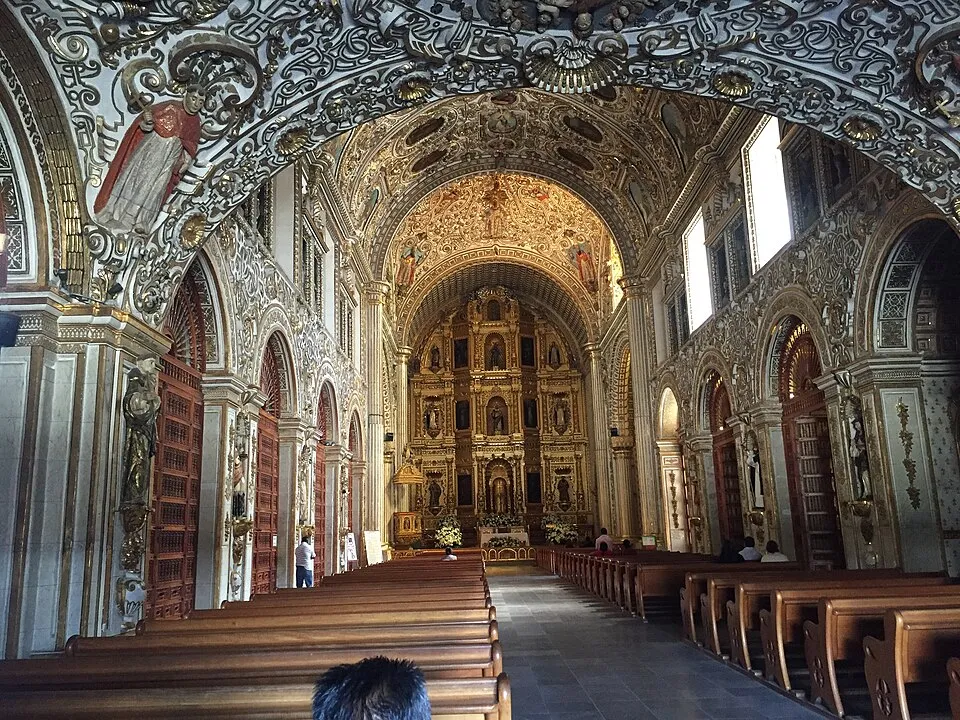
Church of Santo Domingo de Guzmán, Oaxaca, Mexico. The red interior tones are associated with cochineal dye production in the region. Image via Wikimedia Commons
Red Lake Pigments: Madder, Kermes, and the Dyers' Guilds
Madder (Rubia tinctorum) is a red dye from the roots of the madder plant. It has been used since antiquity. The earliest dyed fabrics from Egypt (3000 BCE) used madder. Madder lake was a common pigment in medieval and Renaissance painting. It was cheaper than cochineal but less brilliant.
Kermes is a red dye from the kermes insect (Kermes vermilio), native to the Mediterranean. Kermes was the European equivalent of cochineal before cochineal arrived from the Americas. The word "crimson" derives from "kermes." Kermes was used to dye the robes of cardinals and the uniforms of Roman soldiers. In medieval and Renaissance Europe, dyers' guilds guarded their recipes closely. The process of fixing red dye to wool and silk was a seemingly magical feat of alchemy. The mordant (alum, iron, or tin) determined the hue and permanence. A good red dye was worth more than its weight in gold.
The technical significance of red lake pigments is that they were transparent. They were used as glazes over opaque underlayers. This is what gives Renaissance and Baroque paintings their depth. The red of Christ's robe in Titian or El Greco is not a single layer of paint. It is a build-up of opaque vermilion under a transparent cochineal lake glaze. The layering is what produces the luminosity. You cannot get that effect with a single opaque red. For more on how this layering works, see our guide to oil painting techniques, which covers glazing in detail.

El Greco, "The Disrobing of Christ" (1577-1579). Oil on canvas, 285 x 173 cm. Toledo Cathedral. Image via Wikimedia Commons
Cadmium Red (1910) and the End of Vermilion
Cadmium red (cadmium selenide-sulfide) became commercially available in 1910. It was as brilliant as vermilion, as opaque, and non-toxic, unlike vermilion's mercury. It quickly replaced vermilion as the standard red pigment. Matisse adopted it immediately. "Red Studio" (1911), 181 x 219 cm, now at MoMA, is painted almost entirely in cadmium red. Rothko's "Red on Red" (1959) uses cadmium red to create a field of color that seems to vibrate. Mondrian and Bacon also adopted it.
Cadmium red was the first modern red: synthetic, stable, non-toxic, and affordable. It democratized red the way synthetic ultramarine democratized blue. But it also changed the character of red in painting. Cadmium red is flatter and more opaque than vermilion or cochineal lake. The luminous, layered reds of the old masters gave way to the flat, saturated reds of modernism. Matisse's "Red Studio" does not look like Titian's "Assumption." The difference is not just style. It is material. For the basics of how color works in painting, see our guide to color theory.
Red in 2026
Red still means what it has always meant: blood, danger, power, passion. The red of a Stop sign, the red of a fire extinguisher, the red of a political flag. All carry the weight of 300,000 years of pigment history. The meanings have not changed. What has changed is the material.
The search for a safe, durable, non-toxic inorganic red pigment continues. Mas Subramanian, the Oregon State University chemist who discovered YInMn blue in 2009, has been pursuing what he calls the "holy grail" of color research: a vivid, safe, durable red. His lab has produced yellows, oranges, greens, and purples by tweaking the YInMn chemistry, and in recent years he used a divalent chromium oxide found in lunar minerals as inspiration for a magenta pigment. As of 2026, a true non-toxic red that matches cadmium red's brilliance has not yet been achieved. The NSF-funded project to find it ran through 2025. The global pigment market was worth an estimated $44.68 billion in 2024, and whoever finds the safe red will capture a significant piece of it.
Cochineal is still used today, not in painting but in food coloring (E120), cosmetics, and textiles. The demand for "natural" dyes has revived cochineal production in Oaxaca, where indigenous farmers still harvest the insects from nopal cactus by hand. The same process the Aztecs used is still in operation. For more on where art and color are heading, see our guide to contemporary art trends in 2026, and for the companion piece to this article, read our guide to the history of blue.
Final Thoughts
Red is the oldest and most politically loaded color in art. Red ochre was the first pigment, used 300,000 years ago. Vermilion (mercury sulfide) was the Roman world's most expensive pigment, mined at Almadén and traded across empires. Cochineal, the Aztec red made from crushed insects, became Spain's most profitable colonial export after silver and gold, and colored the robes of Christ in European cathedrals. Cadmium red (1910) democratized the color but changed its character, from luminous and layered to flat and saturated. The search for a safe, non-toxic red continues in 2026, and it has not yet succeeded.
The history of red is the history of art's relationship to the body, to power, and to colonialism. It is a color that means blood, sacrifice, and revolution, and whose beauty is inseparable from its violence. Next time you see a Renaissance painting with a brilliant red robe, know that the red may come from mercury (vermilion), from Mexican insects (cochineal), or from plant roots (madder). Each has a story: of mining, of colonialism, of trade. The color is not just a color. It is a history.


