
Black was the second color humans painted with, after red ochre. The charcoal from their fires gave them the first black pigment, and they used it to draw animals on cave walls 30,000 years ago. The history of black in art is a history of reduction, from the charcoal bison of Lascaux to the black squares of Malevich and Reinhardt, from the darkness of cave interiors to the darkness of the gallery. But it is also a history of conflict. In 2016, the British artist Anish Kapoor acquired exclusive rights to use Vantablack for artistic purposes. Vantablack is a substance made of carbon nanotubes that absorbs 99.96% of light, making it the blackest substance ever made. Kapoor's exclusive deal outraged the art world. The British painter Stuart Semple responded by creating his own "blackest black" and making it available to everyone except Anish Kapoor. Semple's website requires buyers to confirm: "To the best of your knowledge, information and belief this material will not make its way into the hands of Anish Kapoor." The feud over who gets to use the blackest black is the latest chapter in a 30,000-year history of black in art.
Black is the color of absence, of negation, of the end. In painting, it is the color of outlines (charcoal drawings), of shadows (chiaroscuro), of the void (Malevich's "Black Square"). In the 20th century, it became the color of reduction. Reinhardt's "black paintings" (1960s) are the endpoint of a trajectory that begins with Malevich's "Black Square" (1915) and ends with the claim that painting has been reduced to its absolute minimum. This guide covers carbon black and prehistoric art, bone black and ivory black, Malevich's "Black Square" (1915), Reinhardt's "black paintings" (1960s), the Vantablack controversy (2016), Stuart Semple's Black 4.0, and what black means in art in 2026. For the companion piece, read our guide to the history of blue.
Carbon Black: The First Black (30,000 BCE)
Carbon black is the soot from burning wood, oil, or bone. It is the oldest black pigment, used in cave paintings at Lascaux (17,000 BCE), Chauvet (32,000 BCE), and Altamira (36,000 BCE). The pigment was made by burning wood in a restricted oxygen environment, collecting the soot, and mixing it with water, blood, or animal fat. The technique is simple, and the results are permanent. The black in Lascaux is as black today as it was 17,000 years ago.
Different sources produce different blacks. "Lamp black" is soot from burning oil in lamps. "Bone black" (or "bone char") is produced by burning animal bones in a low-oxygen environment. It has a dark blue-black hue. "Ivory black" was originally made from burning ivory (elephant tusks), and it was the finest and darkest black available. By the 19th century, "ivory black" was made from bone (not ivory), but the name persisted. Vine black is made from charred grapevines. All carbon blacks are forms of elemental carbon: chemically inert, non-toxic, and stable. They have been used for 30,000 years without degradation.
Carbon black was the first pigment that could produce a true black, not a dark brown or dark blue but an absolute absence of color. This made it essential for drawing (outlines, shadows) and for painting (chiaroscuro, depth). Without carbon black, the illusion of three-dimensionality in Western painting would not have been possible. For the broader context of where this fits in art history, see the art movements timeline.
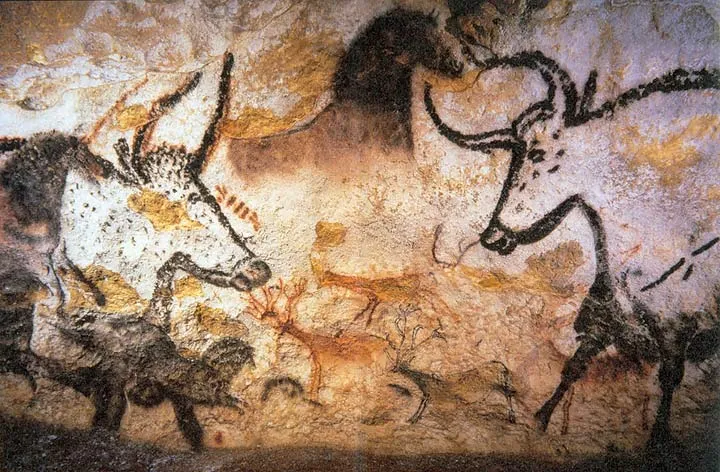
Lascaux cave paintings (c. 17,000 BCE). Charcoal and manganese dioxide on stone. Dordogne, France. Image via Wikimedia Commons
Malevich and the Black Square (1915)
Kazimir Malevich (1879-1935) painted "Black Square" in 1915. Oil on linen canvas, 79.5 x 79.5 cm, now at the Tretyakov Gallery, Moscow. It was first exhibited at the "Last Futurist Exhibition of Paintings 0,10" in Petrograd, December 1915 to January 1916, hung in the icon corner of the exhibition room. The painting is a black square on a white ground. Nothing else. Malevich described it as his "breakthrough work" and the inception of Suprematism, a movement that sought to "free art from the ballast of the objective world" by focusing solely on form.
The hanging position was deliberate. The icon corner is the traditional position of the most sacred image in a Russian Orthodox home. Malevich was replacing the icon with the black square, substituting art for religion. The gesture is as important as the painting. A black square in a corner is not just a painting. It is a claim about what can replace God.
Malevich painted four versions of "Black Square": 1915 (Tretyakov Gallery), 1923, 1929 (Tretyakov Gallery), and c. 1930-1932 (Hermitage). Each version differs slightly in size and texture. The 1915 version is cracked and aging. The black paint has developed a network of fine cracks that reveal the white ground beneath, making the "absolute" black look like a shattered mirror. The cracks are not a flaw. They are a reminder that even the most radical reduction of painting is subject to time.
"Black Square" is the most radical painting of the 20th century. It says: painting does not need to represent anything. It does not need a subject, a narrative, or even color. It needs only a surface and a mark. The black square is the end of painting, or the beginning. Every subsequent reduction of painting (Rauschenberg's white paintings, Reinhardt's black paintings, Ryman's all-white paintings) is a descendant of "Black Square." For more on this reduction tradition, see our guide to Minimalism.
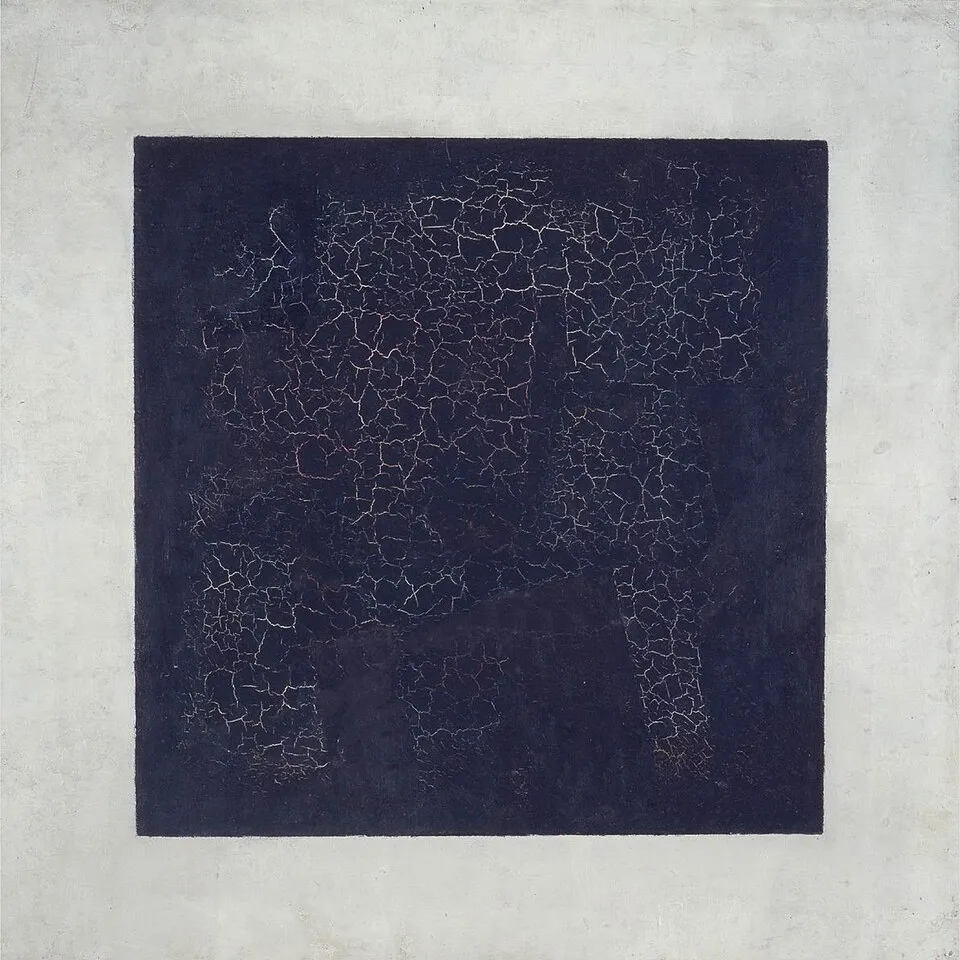
Kazimir Malevich, "Black Square" (1915). Oil on linen canvas, 79.5 x 79.5 cm. Tretyakov Gallery, Moscow. Image via Wikimedia Commons
Ad Reinhardt and the Ultimate Painting (1960s)
Ad Reinhardt (1913-1967) was an American Abstract Expressionist. In the last ten years of his life, Reinhardt painted only square, black paintings, what he called his "ultimate" paintings. "Abstract Painting" (1963), 152.4 x 152.4 cm, is at MoMA. The method is precise. Reinhardt mixed black oil paint with small amounts of red, green, or blue. He let the paint sit for weeks to separate pigment from solvent, poured off the solvent, and applied the concentrated paint in a smooth, matte surface that left no trace of the brush. The result is a canvas that appears uniformly black but is in fact a three-by-three grid of subtly different blacks: reddish in the corners, bluish in the vertical bar, greenish in the horizontal bar.
Reinhardt described his paintings as "a pure, abstract, non-objective, timeless, spaceless, changeless, relationless, disinterested painting, an object that is self-conscious (no unconsciousness), ideal, transcendent, aware of no thing but art." He said: "There is a black which is old and a black which is fresh. Lustrous black and dull black, black in sunlight and black in shadow." You can see the painting at MoMA's collection online.
Reinhardt's black paintings are the endpoint of modernism's reduction of painting. If Malevich's "Black Square" reduced painting to a single color, Reinhardt reduced it to a single color that is not even visible as a single color. It is a grid of blacks that the eye must work to distinguish. The painting demands slow looking. The viewer must spend time with it before the grid emerges from the apparent uniformity. This is the opposite of the Instagram-era artwork that must be legible in a second. Reinhardt's black paintings are a protest against speed. For help learning to look at this kind of work, read our guide to how to look at art for beginners.
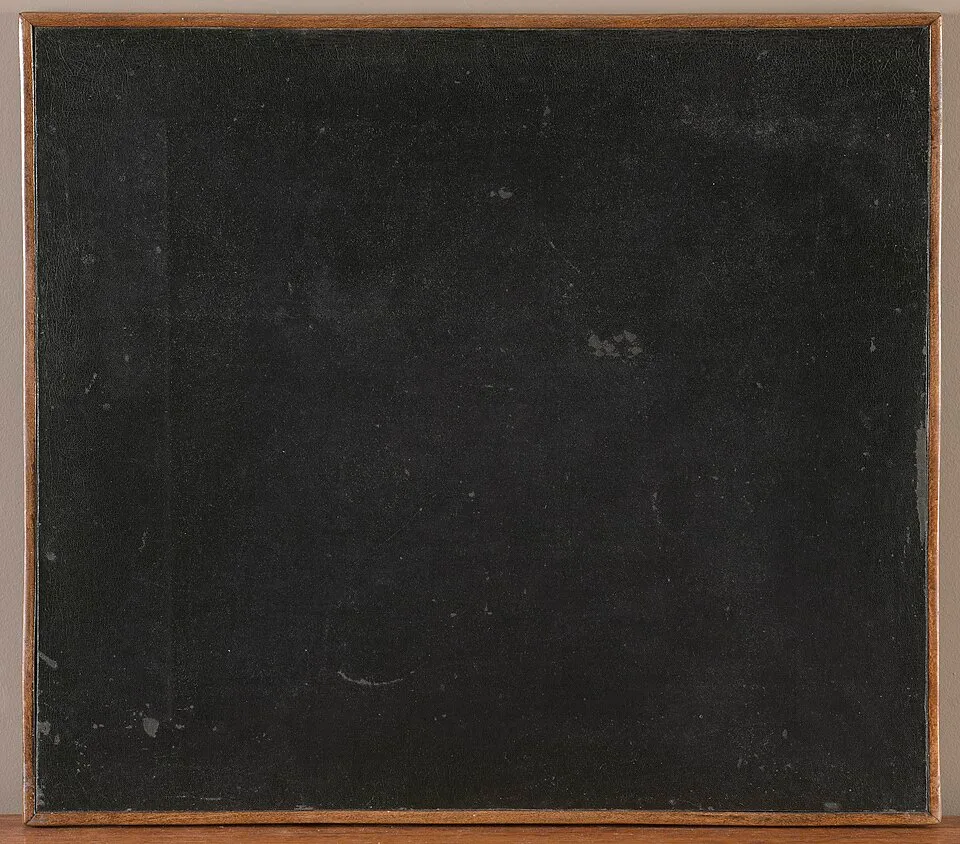
Paul Bilhaud, "Combat de nègres pendant la nuit" (1882). Oil on canvas. Often cited as the first monochrome painting. Wikimedia Commons. (Ad Reinhardt's "Abstract Painting" (1963) is not available on Commons due to copyright. It is viewable at MoMA's collection online.)
Vantablack and the Kapoor-Semple Feud (2016)
Vantablack was developed by Surrey NanoSystems in 2014. It is a coating of vertically aligned carbon nanotubes that absorbs 99.96% of light. A surface coated in Vantablack appears to have no dimensionality. Even sculptural forms look flat, like holes in space. It was originally developed for engineering applications (telescopes, infrared sensors) but was quickly recognized as an artistic material.
In 2016, Anish Kapoor acquired exclusive artistic rights to use Vantablack. The deal outraged the art world. Critics argued that no artist should have a monopoly on a color. The physicist and artist Diemut Strebe, working with engineers at MIT, created a blacker-than-Vantablack coating and made it available to all artists except Kapoor. Strebe's statement: "The project can also be interpreted as a statement against British artist Anish Kapoor's purchase of exclusive rights to a formula of carbon nanotubes as a material for artworks."
Stuart Semple, the British painter, responded by creating his own super-black acrylic paint. His first answer was Black 2.0 in March 2017, then Black 3.0 in 2019, which absorbed 99% of visible light. But Semple was not content to stop there. After seven years of development, he released Black 4.0, which absorbs 99.96% of visible light, matching Vantablack's performance. Black 4.0 costs $49.99 for a 150 ml bottle and is available to anyone except Anish Kapoor. Semple's website still requires buyers to confirm: "To the best of your knowledge, information and belief this material will not make its way into the hands of Anish Kapoor." Semple told Artnet News: "The stuff is so crazy I can't believe it's real. But it absolutely is, and it's mind-blowingly better than anything Kapoor is playing with." Black 3.0 is now discontinued, replaced by Black 4.0. The Collector's account of the Vantablack controversy covers the full history.
My view is that the Vantablack feud is not petty. It raises a real question about whether a color can be owned, and the answer should be no. Kapoor's exclusive deal is a commodification of a material that belongs to the history of art, not to one artist. The carbon nanotubes that make Vantablack black are the same element, carbon, that made the first black paintings in Lascaux 30,000 years ago. Claiming exclusive rights to a form of carbon is like claiming exclusive rights to a form of clay. The material precedes the artist. Semple's response, making a better black available to everyone, is the correct one. For the philosophical background on what makes a material into art, see our guide to the institutional theory of art.
Black as Darkness, Black as Statement
Chiaroscuro is the use of strong contrasts between light and dark in painting. Caravaggio (1571-1610) was the master. His paintings emerge from darkness, with figures lit by a single source. "The Calling of Saint Matthew" (c. 1599-1600), 322 x 340 cm, in the Contarelli Chapel at San Luigi dei Francesi in Rome, uses darkness as a structural element. The black background is not empty. It is active. It creates the drama. The National Gallery in London has a useful podcast on the history of black in art.
Rembrandt (1606-1669) used black not just for shadows but for psychological depth. "The Night Watch" (1642), 363 x 437 cm, at the Rijksmuseum, emerges from a dark background that gives the figures a sense of mystery and presence. The black is not the absence of light but the presence of meaning. Goya (1746-1828) made "The Black Paintings" (1819-1823), a series of 14 paintings made directly on the walls of his house, using black, brown, and earth tones. "Saturn Devouring His Son" (c. 1819-1823), 143.5 x 81.4 cm, at the Prado, is a vision of horror rendered in darkness. Goya's black is the color of despair, the darkness of a mind that has seen the worst of human nature.
Black in painting is not just a color but a tool for creating meaning. It can be the darkness from which figures emerge (Caravaggio), the depth in which they are embedded (Rembrandt), or the void into which they are consumed (Goya). Black is the color of painting's most powerful effects, and the color that is most easily dismissed as "just black." For more on these works, see our guide to famous paintings and what they are about.
Black in 2026
Carbon black is still the standard black pigment, the same soot that was used in Lascaux 17,000 years ago. Vantablack and Black 4.0 are niche materials used by a small number of artists. The blackest black is a curiosity, not a revolution. Most painters still use carbon black, and it is still the best black for most purposes. The Kapoor-Semple feud has produced a better paint (Black 4.0) and a useful debate about ownership, but it has not changed what most painters do.
Black still means what it has always meant: death, darkness, the void, the end. But it also means elegance, sophistication, and power. The black of a designer dress, the black of a luxury car, the black of an Apple product. All carry the weight of 30,000 years of pigment history. Black is the color that never goes out of style because it is the color that means the most.
Is black a color? Physicists say no. Black is the absence of light. Painters say yes. Black is a pigment like any other. The disagreement is productive. Black is the color that is not a color, and this paradox is what makes it the most philosophically loaded color in art. For more on where art is heading in 2026, see our guide to contemporary art trends in 2026.
Final Thoughts
Black is the second-oldest color in art. Carbon black from charcoal was used to draw animals on cave walls 30,000 years ago. It is the color of outlines, shadows, and the void. Malevich's "Black Square" (1915) made black the subject of painting: the end of representation, the beginning of abstraction. Reinhardt's "black paintings" (1960s) reduced painting to a grid of blacks that the eye must work to distinguish. The Vantablack feud (2016) and Semple's Black 4.0 raised the question of whether a color can be owned. My answer is no.
Next time you see a black painting in a museum, do not dismiss it as "just black." Look closer. The black may be carbon (warm), bone (blue-black), or ivory (deep). It may be a single color or a grid of subtly different blacks. It may be the absence of light or the presence of meaning. The black is a choice, not a default.


