The first time I stood in front of one of Donald Judd's stacked wall pieces, I spent ten minutes trying to figure out what I was missing. The piece was a column of six identical stainless steel boxes, each one about nine inches tall, bolted to the wall at perfectly even intervals. There was no title card explaining a narrative. No visible brushwork. No color, unless you count the ambient reflections off the polished metal. I walked around it, crouched down, looked at it from the side. Eventually I realized that the shifting reflections on the surface, the way the room bent across the steel, the way my own body appeared and disappeared in the metal as I moved, was the entire content of the work. The piece was not about something. It was something.
That experience is what Minimalism is after. The movement that crystallized in New York in the early 1960s proposed that art could strip away narrative, emotion, metaphor, and personal expression, and still give you something worth looking at. The object itself, sitting in real space, interacting with light and air and your body, was enough. This was a radical claim in 1965, and it remains a challenging one today. In April 2025, the Chinati Foundation hosted a two-part symposium in Marfa, Texas, dedicated to the preservation and ongoing interpretation of Judd's 100 untitled works in mill aluminum, drawing architects, artists, and scholars from across the world to discuss how these objects continue to shape conversations about art, architecture, and land.
This guide traces where Minimalism came from, what its core artists argued, and why the movement still matters when you walk into a gallery and find yourself staring at a metal box.
Where Minimalism Came From
The Geometric Reductions That Came Before
Minimalism did not appear from nowhere. Piet Mondrian spent decades reducing painting to horizontal and vertical black lines on white grounds, with rectangles of pure primary color. His "Composition II in Red, Blue, and Yellow" (1930) contains almost nothing: three colored rectangles, black lines, white space. Yet it feels complete. Mondrian believed these reductions were not simplifications but purifications, releasing what he saw as universal harmony from the messiness of particular forms.
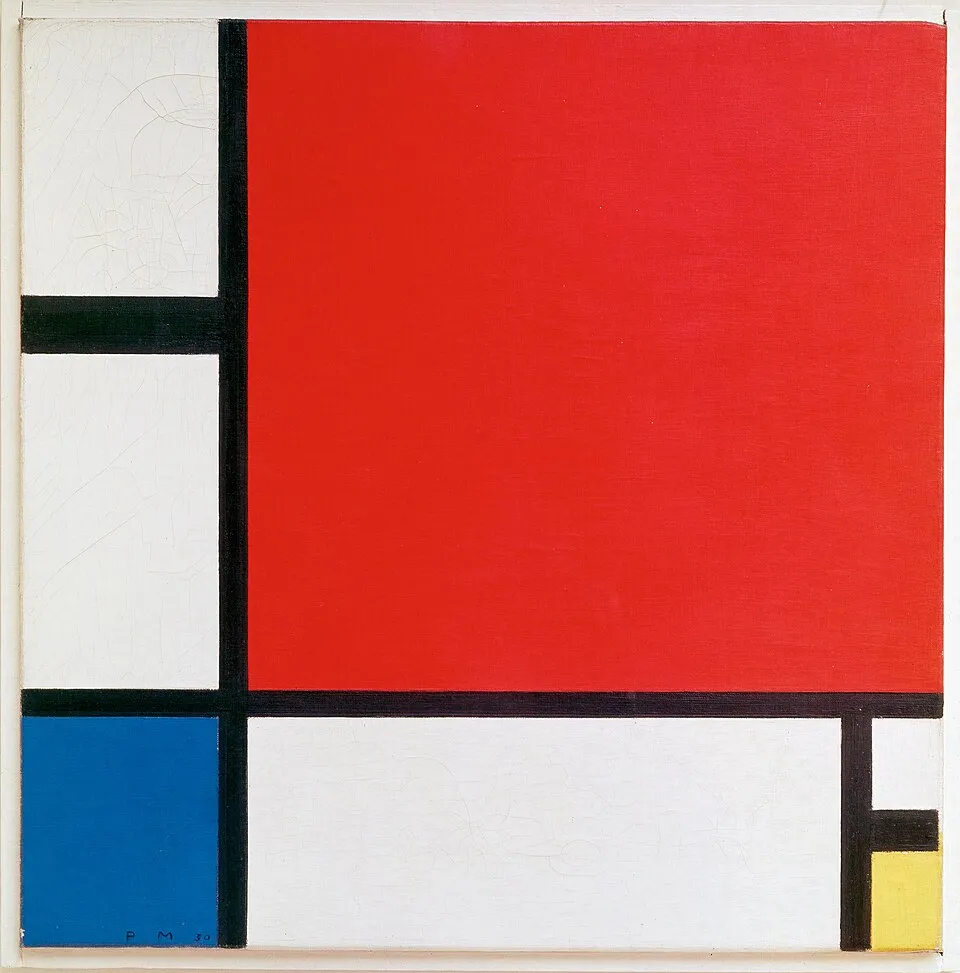
Piet Mondrian, "Composition II in Red, Blue, and Yellow" (1930), oil on canvas, 46 x 46 cm. Kunsthaus Zurich. Mondrian's De Stijl reductions to primary color and orthogonal line gave 1960s Minimalists a precedent for geometric abstraction stripped of representation. Image: Public domain, via Wikimedia Commons
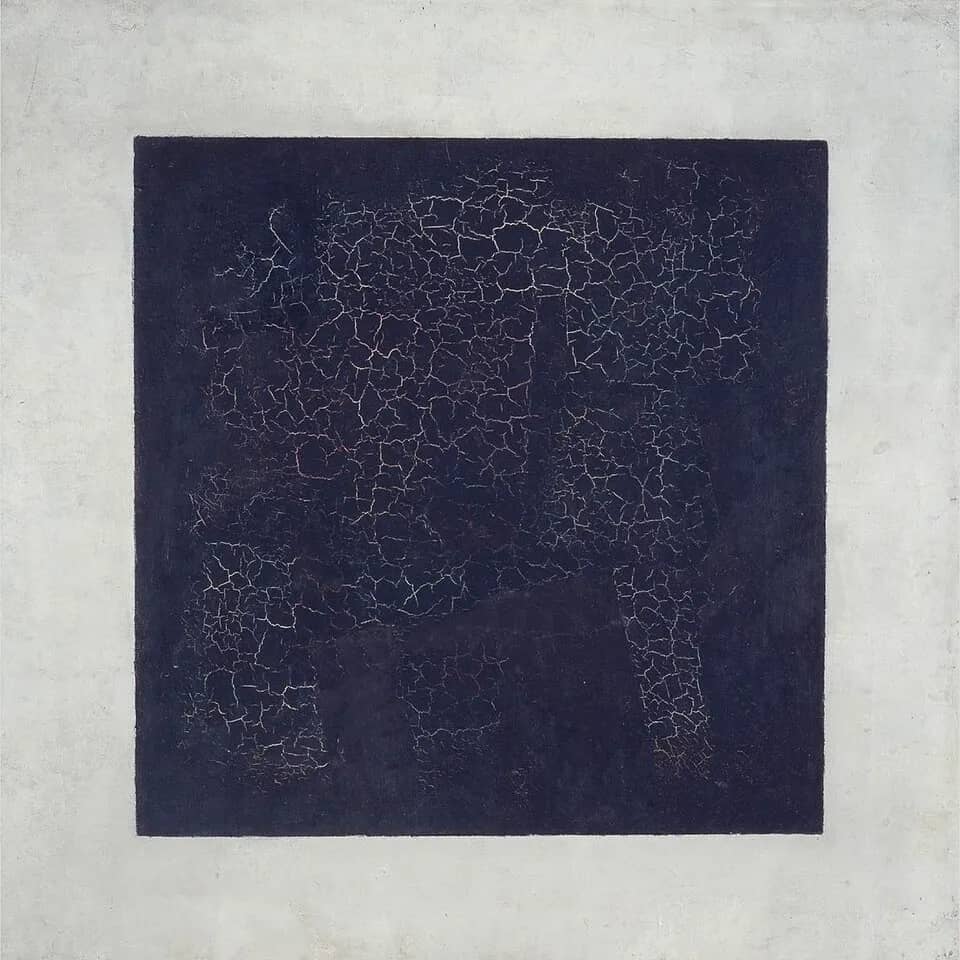
Kazimir Malevich pushed further. His "Black Square" (1915) is a black quadrilateral on a white ground, nothing more. Malevich argued he had arrived at the zero point of painting: pure sensation divorced from representation. The American Minimalists of the 1960s knew these precedents, even when they moved in different directions. The difference is that Mondrian and Malevich were mystics. They believed geometric reduction pointed toward spiritual truth. Judd and his contemporaries had no interest in spiritual truth. They wanted the object to be an object.
Reacting Against Abstract Expressionism
The immediate context for American Minimalism was Abstract Expressionism, the dominant movement of the 1940s and 1950s. Abstract Expressionism valued gesture, emotion, and the artist's psychological imprint on the canvas. The drips and slashes of Jackson Pollock, the atmospheric color of Mark Rothko, the muscular strokes of Franz Kline all communicated a self, a sensibility, a private inner world made visible.
Young artists in the early 1960s began to find this model exhausting and even dishonest. The emphasis on individual expression seemed theatrical and self-indulgent. How do you verify whether a painter actually felt what he claimed to have felt while making a painting? You cannot. Donald Judd, Frank Stella, Dan Flavin, Carl Andre, and Robert Morris proposed instead art that made no claims about inner states. An object simply was what it was: its dimensions, its material, its color, its placement in space. Nothing more needed to be read into it.
The Core Principles of Minimalism
Literalism and the Real Object
Donald Judd articulated the central Minimalist position in his 1965 essay "Specific Objects." Traditional painting and sculpture, he argued, were based on illusion: a flat canvas pretending to have depth, a figure that seemed to have mass but was actually stone. Minimalism, which Judd called "specific objects" rather than "minimalism" (a critic's label he resisted), made things that were exactly what they appeared to be. A stack of metal boxes is a stack of metal boxes. There is no hidden content, no symbolism, no narrative. The visual experience of the object in space is everything.
This insistence on literalism had radical consequences. It meant that the gallery space, the light, the viewer's position, and the viewer's body all became part of the work. A Judd stack looks different depending on where you stand, what time of day it is, and what light is in the room. The work does not have a single correct experience. It has as many experiences as there are viewers in as many different moments.
As the Tate Gallery's definition of Minimalism explains, the movement rejected the idea that a sculpture should be a self-contained object sitting on a plinth. Instead, the work and its surroundings formed an integrated situation that the viewer physically entered.
Industrial Materials and Commercial Fabrication
Minimalists deliberately rejected the handmade quality of Abstract Expressionist painting. Judd had his objects fabricated by industrial manufacturers using sheets of stainless steel, aluminum, and Plexiglas. Carl Andre used commercially available bricks, steel plates, and timber in arrangements that could be dismantled and reassembled. Dan Flavin used standard fluorescent tubes from hardware stores. The artist's hand was removed from the object itself. What the artist contributed was the idea and the decision about form, material, and placement.
This approach was connected to Conceptual Art's emerging claim that the concept behind an artwork matters more than its physical execution. But where pure Conceptualism often eliminated the object entirely, Minimalism insisted on the physical presence of the work. The object had to be there, in the room, with you. You had to walk around it, see how it caught the light, feel its weight in the space.
Frank Stella and the Shaped Canvas
Frank Stella approached Minimalism from painting rather than sculpture. His "Black Paintings" series (1958 to 1960) are large canvases covered in parallel black stripes separated by thin bare canvas lines. The stripes follow the shape of the canvas edge inward, creating a visual vibration between flatness and depth that resists easy reading.
Stella famously said: "What you see is what you see." The statement sounds simple but is actually a provocation. Stop looking for meaning behind the surface. The surface is the meaning. Color theory is exactly what Stella was working with in his later, more colorful shaped canvases: the interactions between fields of color in non-rectangular formats.
The Key Minimalist Artists
Donald Judd (1928 to 1994)
Judd's stacks and progressions of identical units are the images most people associate with Minimalism. Made from industrial materials including stainless steel, aluminum, galvanized iron, Plexiglas, and plywood, often with colored lacquer finishes, they present precise geometric forms with no hierarchy and no focal point. Each unit is the same. Your eye is denied any anchor to rest on. Judd's permanent installation at the Chinati Foundation in Marfa, Texas, where 100 milled aluminum boxes are arranged in two massive artillery sheds, remains one of the most important site-specific installations in the world. The 2025 symposium organized by Chinati and the Rice School of Architecture focused on the ongoing restoration of these sheds and the conservation challenges of maintaining Judd's work in a harsh desert environment, a problem that connects art preservation to land management and architectural adaptation.
Dan Flavin (1933 to 1996)
Flavin's medium was light. Specifically, the colored and white fluorescent tubes available from commercial manufacturers. He arranged them in corners, along walls, in corridors, and in rooms, creating immersive environments of colored light that transform their spaces completely. The tubes themselves are visible and banal. The effect they create is anything but. Flavin dedicated individual pieces to friends, artists, and historical figures, introducing a human dimension that strict Minimalist theory might seem to exclude. His installation at the Dia:Beacon museum in upstate New York fills an entire corridor with alternating green and yellow light, and walking through it feels less like looking at art and more like being inside a painting.
Carl Andre (1935 to 2024)
Andre's sculptures are often laid flat on the floor: grids of metal squares or rectangular tiles that viewers are sometimes invited to walk on. "Equivalent VIII" (1966), consisting of 120 fire bricks arranged in a flat rectangle, caused public outrage when the Tate Gallery acquired it in 1972. The tabloid response ("Is This Art?") missed the point. Andre was asking you to notice the floor, the bricks, the weight of materials, and your own body in space in a way that a conventional sculpture on a plinth does not. Andre died in 2024, and his work continues to provoke the same question it provoked sixty years ago: can an arrangement of ordinary objects be art? The answer depends on whether you think the arrangement changes how you perceive the objects and the space they occupy.
Minimalism's Lasting Influence
Minimalism's influence extends far beyond fine art galleries. In design, the "less is more" principle (borrowed from architect Ludwig Mies van der Rohe, who said it first) became a foundational doctrine. Apple's product design, Scandinavian furniture, Japanese architecture, and contemporary typography all carry the Minimalist insistence on essential form, honest materials, and the rejection of unnecessary decoration.
The movement's relationship with its predecessors and its contemporaries is rich with tension. The Bauhaus movement shared Minimalism's interest in functional form and industrial production but retained a humanist, craft-oriented dimension. Cubism gave Minimalism its geometric vocabulary while Minimalism stripped that vocabulary of the representational scaffolding Cubism still maintained.
For the Italian movement that emerged at almost exactly the same moment and offered a diametrically opposite answer to many of the same questions, see Arte Povera: Italian Art Made from Worthless Materials. Where Minimalism embraced industrial precision and commercial fabrication, Arte Povera reached for the raw, the organic, and the deliberately impermanent.
Final Thoughts
Minimalism made a claim that still provokes arguments: that an object does not need to represent anything, express anything, or symbolize anything to be worth your attention. The object's physical presence, its interaction with light and space, and your experience of moving around it are sufficient. Judd, Flavin, Andre, and Stella each tested this claim in different ways, and the work they produced continues to challenge viewers who want art to tell them what it means.
If you want to experience Minimalism in person, the Chinati Foundation in Marfa, Texas, is the most complete destination. Dia:Beacon in upstate New York has significant installations by Judd, Flavin, and Andre. And if you want to understand the broader context of how abstraction moved from Mondrian's spiritual geometry to Judd's industrial literalism, our guide to the evolution of art styles traces that trajectory. Next time you see a metal box on a gallery wall, give it ten minutes. Walk around it. Watch the light change on its surface. That is what the artist intended.