
In 1947, Yves Klein stood on a beach in the south of France and looked at the sky. He signed it. "With my signature," he later wrote, "I had taken possession of the sky." The gesture was a joke, but it was also a manifesto. For the next 15 years, Klein painted almost nothing but blue. He invented his own blue, International Klein Blue (IKB), a deep ultramarine suspended in synthetic resin, and patented it in 1960. He produced nearly 200 monochrome blue paintings, assigned numbers by his widow after his death in 1962 at age 34. Klein was not the first artist to paint in a single color. Malevich had painted a black square in 1915, and Reinhardt would spend the 1960s on all-black canvases. But Klein was the most committed. He believed that a single color, freed from form, line, and composition, could communicate directly with the viewer's emotions. "Blue has no dimensions," Klein said. "It is beyond dimensions." The monochrome painting is the most radical gesture in modern art: the reduction of painting to its absolute minimum, a surface, a color, nothing else.
Monochromatic art is a 20th-century phenomenon. Before the 20th century, painters used many colors. The monochrome was unthinkable because painting was representational, and representation requires multiple colors. The monochrome became possible only when painting was freed from representation, when abstraction allowed painters to reduce painting to color alone. The history of monochromatic art is the history of reduction: from Malevich's black square in 1915 to Klein's blue from 1947 to 1962 to Reinhardt's black in the 1960s to Ryman's white from the 1960s to the 2000s to the Vantablack controversy in 2016. This guide covers that history, the philosophical questions it raises, and what monochromatic art means in 2026.
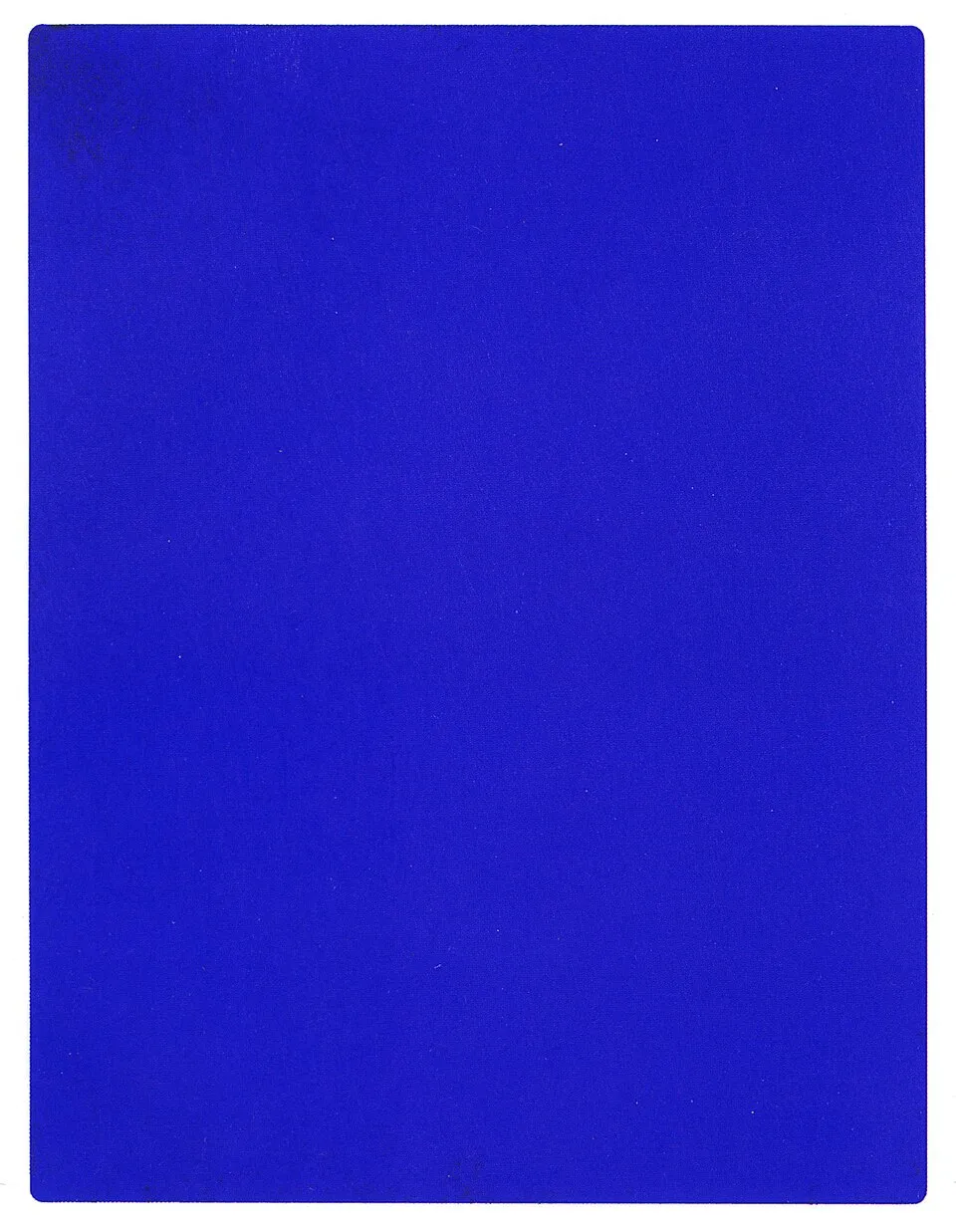
Yves Klein, "IKB 191" (1962). Pure pigment and synthetic resin on canvas. Image via Wikimedia Commons.
Malevich and the Reduction to Zero (1915)
Kazimir Malevich (1879-1935) painted "Black Square" in 1915. The work is 79.5 x 79.5 cm and now hangs in the Tretyakov Gallery in Moscow. It was first exhibited at the "Last Futurist Exhibition of Paintings 0,10" in Petrograd in December 1915, hung in the icon corner, the traditional position of the most sacred image in a Russian Orthodox home. Malevich described "Black Square" as the "zero of form," the point at which painting has been reduced to its absolute minimum. There is no subject, no representation, no composition, only a black square on a white ground. The painting is the end of painting, or the beginning. "I have transformed myself in the zero of form," Malevich wrote, "and have fished myself out of the rubbishy chasm of academic art."
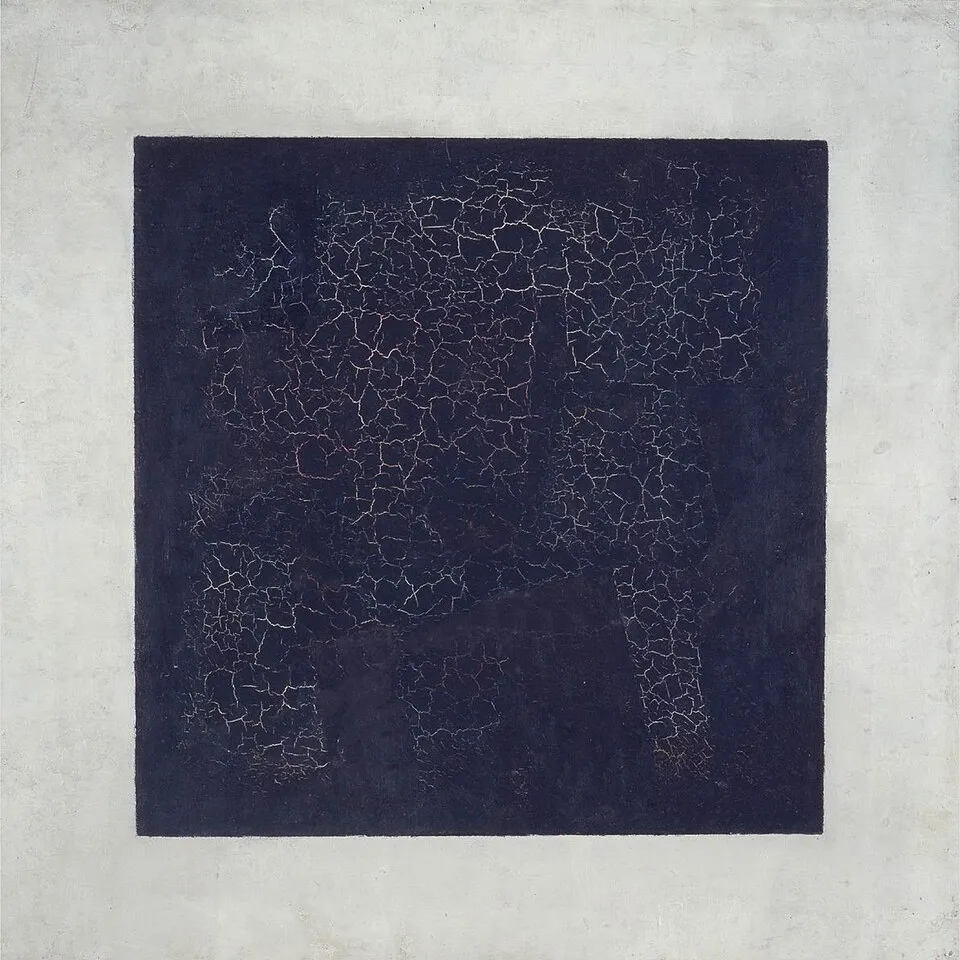
Kazimir Malevich, "Black Square" (1915). Oil on linen canvas, 79.5 x 79.5 cm. Tretyakov Gallery, Moscow. Image via Wikimedia Commons.
"Black Square" was painted the year before the October Revolution, in a Russia where the old order was collapsing. The icon corner placement was deliberate. Malevich was replacing the religious icon with the abstract one, substituting art for religion. The black square is the new icon, not an image of God but an image of nothing, which is to say, an image of art itself. Every subsequent monochrome painting is a descendant of "Black Square." Klein's blue, Reinhardt's black, Ryman's white, all are variations on Malevich's gesture. The black square is the template: a single color on a surface, nothing else. The question Malevich asked, whether painting can be reduced to color alone, has been answered by every monochrome painter since. The reduction runs parallel to the broader move toward minimalism in 20th-century art.
Yves Klein and International Klein Blue (1947-1962)
Yves Klein (1928-1962) was a French artist who began making monochrome paintings in 1947. His first exhibition of monochromes was at the Galerie Iris Clert in Paris in 1955. The exhibition consisted of identical blue paintings, same size, same color, same surface. Critics were confused. One said: "There is nothing to see, it is just blue." International Klein Blue was developed by Klein and the chemist Edouard Adam in 1956. IKB is not a pigment but a process. It is ultramarine pigment suspended in a clear synthetic resin called Rhodopas M60. The resin preserves the intensity of the pigment, which in oil or acrylic would be diminished by the binder. The result is a blue of extraordinary saturation, what one critic called "a blue that is not a color but a material." Klein registered IKB at the Institut National de la Propriété Industrielle (INPI) in May 1960 but never patented it. He produced nearly 200 IKB paintings.
Klein believed that color, freed from form, could communicate directly with the viewer's sensibility, what he called "the immaterial." "Blue has no dimensions," he said. "It is beyond dimensions." The monochrome is not a painting of something. It is the thing itself. The blue is not a representation of the sky or the sea. It is blue, pure and absolute. Klein's monochromes were not just paintings. They were performances. In 1958, he exhibited "The Void" at Galerie Iris Clert, an empty gallery with white walls and no paintings. The opening was attended by 2,500 people. In 1960, he staged "Anthropometries of the Blue Age," in which naked women covered in IKB paint pressed their bodies against canvases while an orchestra played. The monochrome was not a static object but an event, a demonstration of the power of color. Klein died of a heart attack in 1962 at age 34. His widow, Rotraut Klein-Moquay, assigned numbers to the unnamed IKB paintings after his death. The paintings are now in major museums worldwide, including MoMA, the Centre Pompidou, and the Hirshhorn. You can see one in the MoMA collection online, and read more about the pigment itself in our history of blue.
Ad Reinhardt and the Ultimate Painting (1960s)
Ad Reinhardt (1913-1967) was an American Abstract Expressionist. In the last ten years of his life, Reinhardt painted only square, black paintings, what he called his "ultimate" paintings. "Abstract Painting" (1963) is 152.4 x 152.4 cm and belongs to MoMA. Reinhardt mixed black oil paint with small amounts of red, green, or blue. He let the paint sit for weeks to separate pigment from solvent, poured off the solvent, and applied the concentrated paint in a smooth, matte surface. The result is a canvas that appears uniformly black but is in fact a three-by-three grid of subtly different blacks: reddish in the corners, bluish in the vertical bar, greenish in the horizontal bar.
Reinhardt described his paintings as "a pure, abstract, non-objective, timeless, spaceless, changeless, relationless, disinterested painting, an object that is self-conscious (no unconsciousness), ideal, transcendent, aware of no thing but art." He said: "There is a black which is old and a black which is fresh. Lustrous black and dull black, black in sunlight and black in shadow." Reinhardt's black paintings are the endpoint of modernism's reduction. If Malevich reduced painting to a single color, Reinhardt reduced it to a single color that is not even visible as a single color. It is a grid of blacks that the eye must work to distinguish. The painting demands slow looking, the opposite of the Instagram-era artwork. Reinhardt's black paintings are a protest against speed, against legibility, against the demand that art be immediately accessible. See the Reinhardt at MoMA for a high-resolution image, and our history of black for the longer story of darkness as a statement.
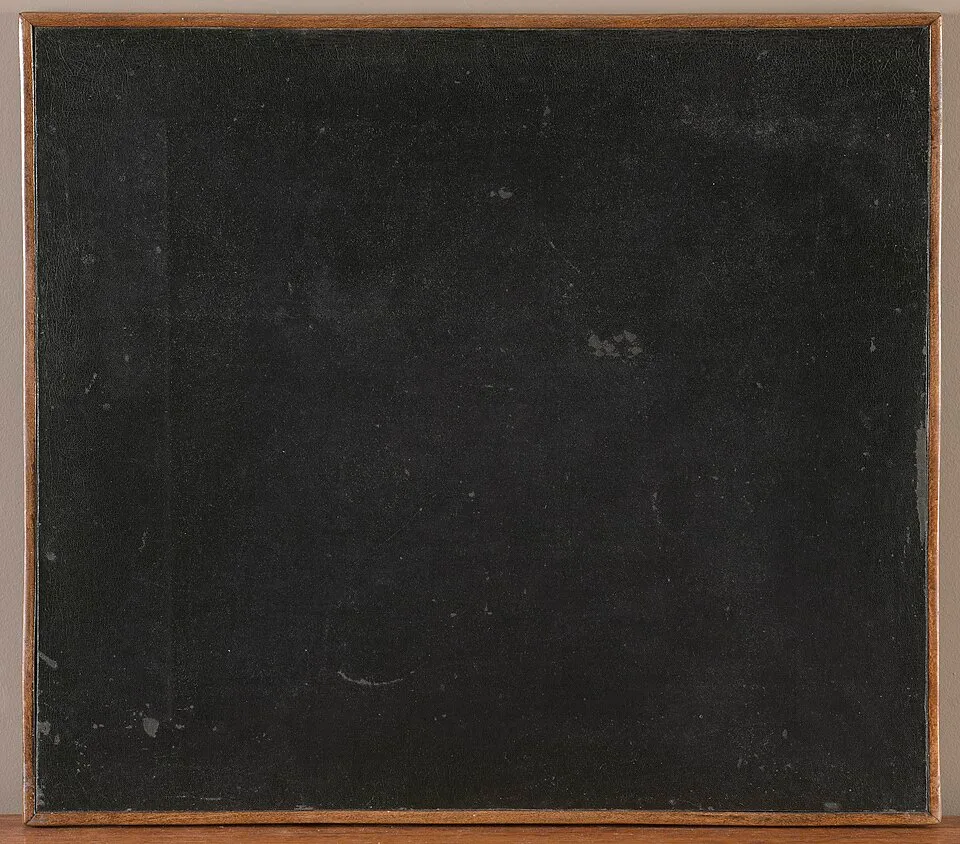
Paul Bilhaud, "Combat de nègres pendant la nuit" (1882). Oil on canvas. Often cited as the first monochrome painting, predating Malevich by 33 years. Ad Reinhardt's "Abstract Painting" (1963) is not on Commons due to copyright but is viewable at MoMA's collection online. Image via Wikimedia Commons.
Robert Ryman and the All-White Painting (1960s-2000s)
Robert Ryman (1930-2019) was an American painter who, for 50 years, painted only white. Not white as a subject, like Malevich, or as a provocation, like Rauschenberg, but as a material. "There is never a question of what to paint," Ryman said, "but only how to paint." Ryman used different whites, lead white, titanium white, zinc white, different supports, canvas, paper, aluminum, fiberglass, different application methods, brush, palette knife, roller, and different edge treatments, taped, wrapped, exposed. The paintings look "all white" but are in fact complex explorations of surface, texture, and edge.
Ryman's work shows that white is not one color but many. The white of lead paint is different from the white of titanium paint, which is different from the white of zinc paint. The white of a smooth surface is different from the white of a textured one. Ryman's paintings are a catalog of whites, a demonstration that the most "empty" color is in fact the most variable. This is the core argument of our history of white.
The Philosophical Questions
Is a monochrome a painting or an object? A traditional painting represents something, a landscape, a portrait, a scene. A monochrome represents nothing. It is a surface with color. Is it still a painting, or has it become an object, a thing in the world rather than a picture of the world? The question has been debated since Malevich. The answer depends on what you think painting is. If painting is the application of pigment to a surface, then a monochrome is a painting. If painting is the representation of the world, then a monochrome is not a painting. It is an object.
Does a monochrome require skill? Anyone can paint a canvas blue. What distinguishes Klein's blue from a house painter's blue? The question is related to the institutional theory of art: if an artist makes it and a gallery shows it, it is art. But the question is also about the material. Klein's IKB is not just any blue. It is a specific blue, made with a specific process, that produces a specific visual effect. The skill is in the material, not the gesture.
Is the monochrome the end of art? Malevich thought so. The black square was the "zero of form." But the monochrome has been painted for over 100 years, and painting has not ended. The monochrome is not the end of art but a genre, a way of making art that has its own history, its own masters, and its own questions. The monochrome is not the death of painting but one of painting's most productive traditions.
Monochromatic Art in 2026
Monochromatic art is now a tradition, a genre with a century of history. The monochrome has been absorbed into the art world's vocabulary. But the questions it raises, about the nature of painting, the role of skill, the relationship between color and form, are still live. Every monochrome painting is a restatement of Malevich's question: can painting be reduced to color alone?
The Vantablack controversy of 2016 is the latest chapter. Anish Kapoor's exclusive deal with Surrey NanoSystems for the artistic use of Vantablack, which absorbs 99.96% of light, is a monochrome gesture, the claim that a single color can be owned. Stuart Semple's Black 3.0, which absorbs 99% of light and is available to everyone except Kapoor, is the counter-gesture, the claim that color belongs to everyone. The question is whether the monochrome is still radical. After 100 years, can a single-color painting still shock? Or has the monochrome become a convention, a recognized genre that no longer challenges the viewer? The answer depends on the viewer. For someone who has never seen a monochrome, it can still be shocking. For someone who has seen 100 monochromes, it is a tradition. The radicalism of the monochrome is not in the gesture but in the looking, the willingness to spend time with a single color and see what it does. This connects to the wider shifts in contemporary art in 2026 and to the basic discipline of how to look at art.
Final Thoughts
Monochromatic art is the most radical gesture in modern painting, the reduction of painting to a single color on a surface. Malevich's "Black Square" (1915) was the "zero of form," the end of representation and the beginning of abstraction. Yves Klein's International Klein Blue (1947-1962) was a blue "beyond dimensions," a color freed from form that communicates directly with the sensibility. Reinhardt's black paintings of the 1960s were the "ultimate" paintings, a grid of blacks that demands slow looking. Ryman's all-white paintings from the 1960s to the 2000s showed that white is not one color but many. The monochrome raises philosophical questions: is it a painting or an object? Does it require skill? Is it the end of art? After 100 years, the monochrome is not the end of painting but one of its most productive traditions, a genre that continues to ask what painting is and what it can be.
Next time you see a monochrome painting in a museum, a blue, a black, a white, do not dismiss it as "just one color." Stand in front of it. Look at it for longer than you think necessary. The color will change. Your eye will adjust, the surface will reveal its texture, the edges will emerge. The monochrome is not empty. It is full of the thing that painting does best: color on a surface, seen over time. For background, see the monochrome painting overview.


