
In 1964, the philosopher Arthur Danto walked into the Stable Gallery on East 74th Street in Manhattan and saw Andy Warhol's Brillo Boxes. They were wooden boxes, silk-screened to look exactly like Brillo soap-pad cartons, stacked in neat rows. Danto had an epiphany. The boxes were visually indistinguishable from the ones in the supermarket down the street. Yet one was art and the other was not. What made the difference? Danto wrote that "it is the theory that takes it up into the world of art, and keeps it from collapsing into the real object which it is." The essay he published that year, "The Artworld" (1964), coined the term "artworld" and launched a philosophical debate that is still running. If two objects look identical and one is art and the other is not, then what makes something art is not what it looks like but the context in which it is placed.
Danto's question was not new. Marcel Duchamp had asked it in 1917 when he submitted a porcelain urinal, signed "R. Mutt," to the Society of Independent Artists exhibition. But Danto gave the question philosophical rigor. His student George Dickie took it further, formalizing the "institutional theory of art": a work of art is an artifact that has had conferred upon it the status of candidate for appreciation by some person or persons acting on behalf of the artworld. This guide covers Danto's "Artworld" (1964), Dickie's institutional definition (1974), Duchamp's readymades, the objections from Noël Carroll and David Davies, and what the institutional theory means for art in 2026.
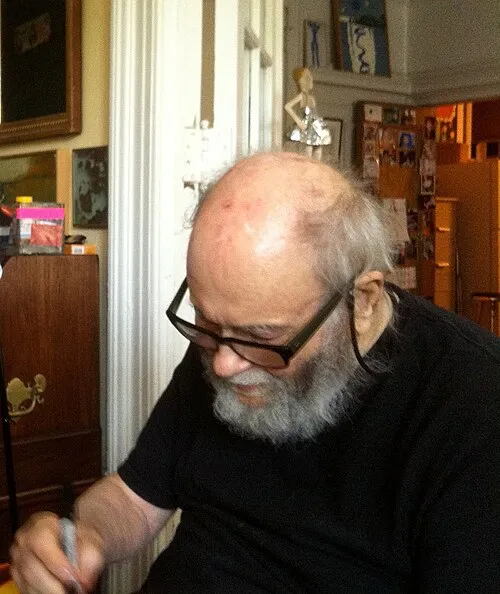
Arthur C. Danto (1924-2013). Image via Wikimedia Commons
Danto and the Brillo Box
Arthur C. Danto (1924-2013) was a professor of philosophy at Columbia University and the art critic for The Nation from 1984 to 2009. "The Artworld" was published in The Journal of Philosophy in 1964. The essay's central insight was the problem of indiscernibility: two objects can be visually identical and yet one is art and the other is not. Warhol's Brillo Boxes, each 43.2 x 43.2 x 43.2 cm, wooden and silk-screened, were visually indistinguishable from supermarket Brillo cartons. The difference was not visual but philosophical. "To see something as art," Danto wrote, "requires something the eye cannot descry: an atmosphere of artistic theory, a knowledge of the history of art: an artworld."
Danto argued that the traditional theory of art, based on imitation or mimesis, could not explain Warhol. A new theory was needed, one that acknowledged that art does not imitate reality but creates a new reality. "These days one might not be aware he was on artistic terrain without an artistic theory to tell him so." The Imitation Theory, which held that art is a copy of reality, had to give way to what Danto called the Reality Theory, in which art presents a real object that is also an artwork, and the difference lies in the theoretical framework that surrounds it.
The significance of Danto's essay is often misread. He did not say that the institution makes art. He said that art requires a theoretical context, a background of art history and art theory, to be legible as art. Without that context, Warhol's Brillo Boxes are just boxes. With it, they are art. The context is not the museum per se but the entire cultural framework of art theory and history. You can read the original text of Danto's "The Artworld" (1964) to see how carefully he framed the argument.
Duchamp and the Readymade
Marcel Duchamp (1887-1968) was the precursor. In 1917, he submitted "Fountain," a porcelain urinal signed "R. Mutt 1917," to the Society of Independent Artists exhibition. The Society, of which Duchamp was a board member, rejected it. Duchamp resigned. The strategy was to select a mass-produced object, sign it, and present it as art. He did not make the object. He did not modify it. He designated it. The "art" was the act of designation, not the object itself.
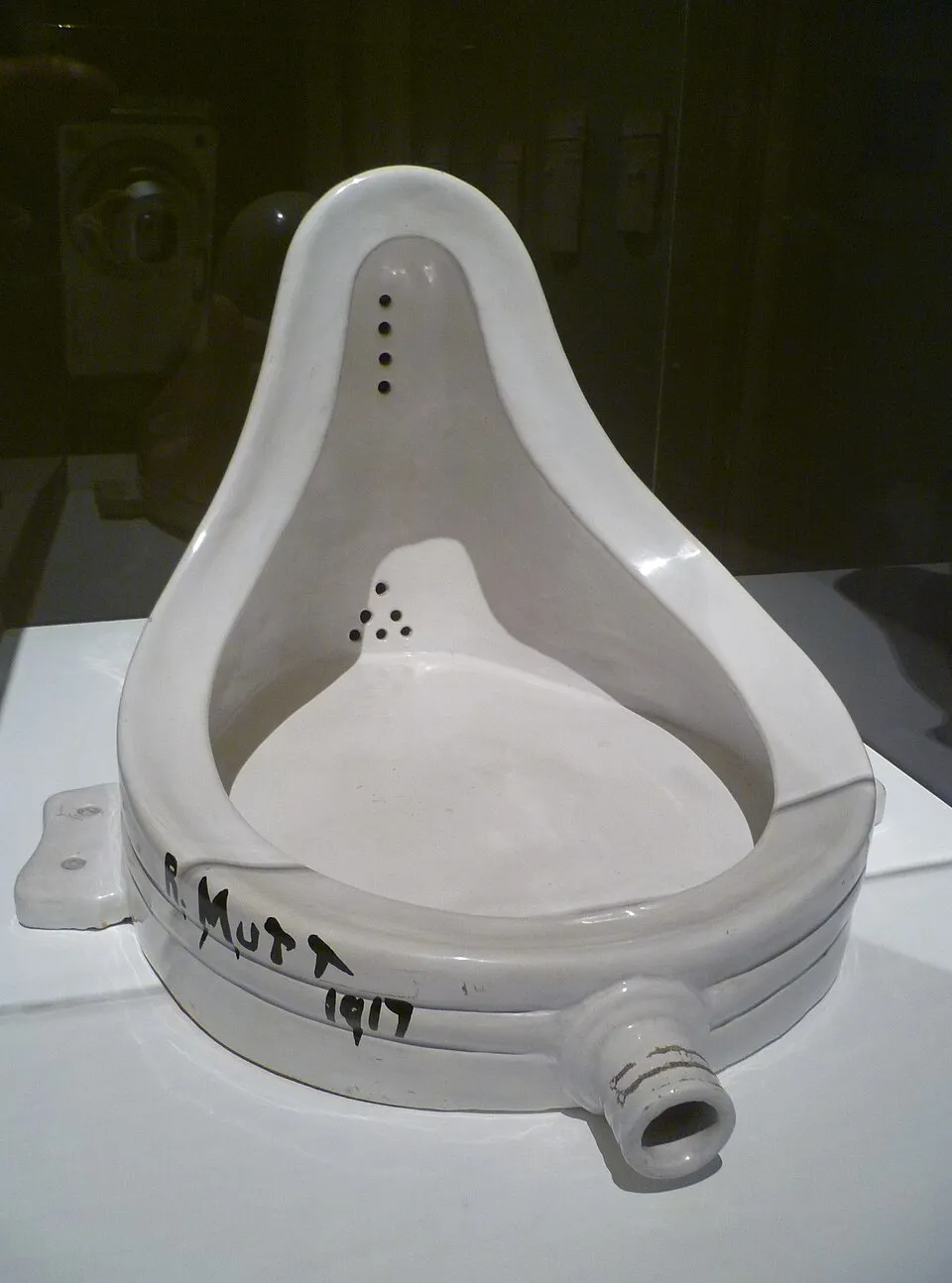
Marcel Duchamp, "Fountain" (1917, replica 1964). Porcelain, 36 x 48 x 61 cm. Tate Modern. Image via Wikimedia Commons
Duchamp's readymades were the first challenge to the idea that art must be made by the artist. They were also the first challenge to the idea that art's value lies in its visual qualities. A urinal is not visually beautiful in the traditional sense. Its status as art depends entirely on the context: the exhibition, the signature, the act of designation. Duchamp's readymades were the practical demonstration of the problem Danto theorized 47 years later. Duchamp showed that art could be made by designation. Danto explained why designation works, because the artworld provides the theoretical framework that makes the designation legible. The connection between the two runs through the whole history of postmodernism in art, where the question of what counts as art became the central question.
Dickie's Institutional Definition
George Dickie (1926-2020) was an American philosopher who took Danto's insight and formalized it into a definition. In "Defining Art" (1969) and "Art and the Aesthetic: An Institutional Analysis" (1974), Dickie proposed that "a work of art in the classificatory sense is (1) an artifact (2) a set of the aspects of which has had conferred upon it the status of candidate for appreciation by some person or persons acting on behalf of a certain social institution (the artworld)."
The definition has three key terms. "Artifact" means the object must be a made thing, or at least a designated thing. Dickie later relaxed this requirement to accommodate found objects like Duchamp's urinal. "Status of candidate for appreciation" means the object does not need to be actually appreciated. It needs to be presented as something that could be appreciated. "Acting on behalf of the artworld" means the conferral must be made by someone who has the authority to do so: a curator, a gallery owner, an artist, a critic. The artworld is the social institution, comprising museums, galleries, art schools, and art criticism, that grants this authority.
Critics argued that Dickie's definition is circular. It defines art in terms of the artworld, and the artworld in terms of art. Danto himself distanced himself from Dickie's version. "I am very grateful to those who have erected something called the Institutional Theory of Art on the analysis of 'The Artworld,'" Danto wrote, "even if the theory itself is quite alien to anything I believe." Despite the circularity, Dickie's definition captured something real. Museums, galleries, and curators do confer status. When the Tate Modern displays Duchamp's "Fountain" (a 1964 replica), it is art because the Tate says it is. When the same urinal is in a plumbing supply store, it is not art. The difference is institutional. You can read Dickie's "What is Art? An Institutional Analysis" for the full argument, and the Cambridge journal Philosophy published a useful reassessment titled "But is it Art? A new look at the institutional theory".
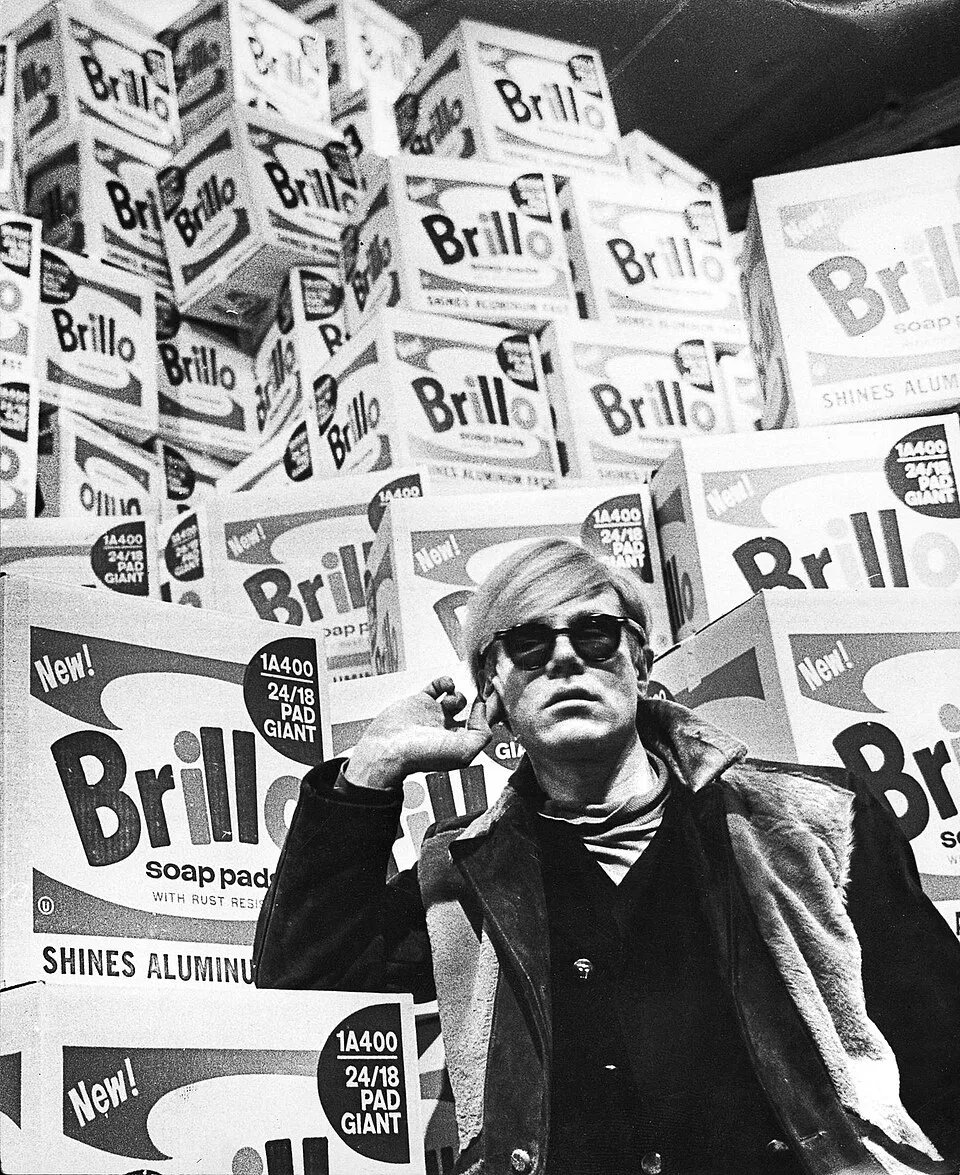
Andy Warhol, "Brillo Boxes" (1964). Silkscreen ink on wood, 43.2 x 43.2 x 43.2 cm. Image via Wikimedia Commons
Objections and Counter-Arguments
Noël Carroll argued that the institutional theory cannot explain art that is made outside the artworld. Outsider art, folk art, and art made by self-taught artists who have no connection to museums or galleries fall outside the theory's reach. If art requires institutional conferral, then Henry Darger's 15,000-page illustrated novel, made in a Chicago rooming house and never exhibited during his lifetime, is not art. But it clearly is. The institutional theory cannot account for it.
David Davies argued that the theory confuses the epistemology of art (how we know something is art) with the ontology of art (what makes something art). The fact that we need the artworld to recognize art does not mean that the artworld creates art. The artworld discovers art. It does not create it. This is the objection I find most persuasive. Darger's work was art before anyone found it. The discovery did not make it art. It made it recognized.
Then there is the value problem. The institutional theory defines art in the "classificatory sense." It tells you what is art, not what is good art. Dickie considered this a feature, not a bug. But a definition of art that cannot distinguish between a great painting and a urinal is not very useful for anyone trying to think about quality. The theory is silent on the question that matters most to viewers standing in front of a work: is this any good?
The AI art problem raises the institutional question in a new form in 2026. An AI-generated image is not made by a human artist. It is not an artifact in the traditional sense. But if a gallery exhibits it, if a curator confers status on it, is it art? The institutional theory says yes. The conferral is what matters, not the making. This is either the theory's greatest triumph or its reductio ad absurdum. I lean toward the latter. A theory that can call anything art as long as the right person says so has stopped doing the work of definition and has started doing the work of sociology. It tells you how the artworld operates. It does not tell you what art is. For more on where AI-generated work sits in the current scene, see our guide to contemporary art trends in 2026.
What the Institutional Theory Means for Museums
If the institution confers art status, then the museum has enormous power. It decides what is art and what is not. This power is not neutral. It is shaped by class, race, gender, and geography. The museum's choices determine who gets into the canon, a process examined in detail in our guide to canon formation. The institutional theory makes this power visible in a way that older theories, which treated quality as an objective property of the artwork, did not.
If the institution creates art, then the institution has a responsibility to be transparent about its choices. Why this artist and not that one? Why this object and not that one? The institutional theory makes the museum's curatorial decisions visible as decisions, not as neutral reflections of quality. A curator who hides behind "we chose the best work" is pretending to a neutrality the theory exposes as false. The choices are made by people with interests, and the theory insists we look at those interests.
The theory does have a limit that is worth stating clearly. It does not say that everything a museum shows is good art. It says that everything a museum shows is art in the classificatory sense. The question of quality is separate. A museum can show bad art. It is still art, just bad art. This distinction matters because critics of the theory often conflate the two. For help thinking through how to evaluate what you see, read our guide on how to look at art for beginners.
Final Thoughts
Danto saw Warhol's Brillo Boxes and asked why this is art. Dickie answered: because the artworld says it is. Duchamp had demonstrated the principle 47 years earlier with a urinal. The institutional theory says that art is not defined by its visual qualities but by its institutional context, the museum, the gallery, the curator, the critic, the art historian. The theory has real problems. It is circular. It cannot account for outsider art. It is silent on quality. It reduces the question "what is art?" to the question "who says it is art?"
My view is that the theory is partially right. Context matters. The museum, the label, the art historical background, all of these shape what we see when we look at a work. But the theory confuses recognition with creation. The museum does not create art. It recognizes it. Darger's drawings were art before anyone displayed them. The theory's real value is not that it legitimizes institutional power but that it makes that power visible. Once you see that the museum confers status, you can start asking who the museum is, who it serves, and who it leaves out. That is a more useful question than "is it art?" For the broader picture of how writing about art became its own practice, see our guide to art criticism, and for the long view of how we got here, the art movements timeline puts the whole story in sequence. Roland Barthes's argument about the death of the author is a useful companion piece, since both debates turn on the question of who gets to decide what a work is.
Next time you see a readymade or a conceptual artwork in a museum, ask yourself what this object would be if it were not in a museum. The answer is the difference between art and non-art, and the difference is institutional, not visual. Knowing that does not solve the problem. It just makes the problem honest.


