
Every image is a sign. A red rose in a painting is not just a red rose. It is a signifier that carries meanings: love, passion, England, socialism, secrecy (sub rosa). A skull in a Dutch still life is not just a skull. It is a memento mori, a sign of death, a reminder of transience. Semiotics is the study of signs, how they are made, how they carry meaning, and how they are interpreted. It was founded independently by two men who never met: Ferdinand de Saussure in Switzerland and Charles Sanders Peirce in the United States. Both were working at the turn of the 20th century. Both were trying to understand how meaning is produced. Neither was primarily interested in art. But semiotics turned out to be the most useful theoretical framework for understanding how images carry meaning.
Semiotics entered art criticism through Roland Barthes, who applied Saussure's linguistic theory to visual culture: advertising, photography, fashion, and painting. Barthes's "Image, Music, Text" (1977) and "Mythologies" (1957) showed that images work like languages. They have codes, conventions, and structures that determine how they are read. To understand a painting semiotically is to decode it, to identify the signs, the codes, and the cultural conventions that give it meaning. This guide covers Saussure's model (signifier and signified), Peirce's trichotomy (icon, index, symbol), Barthes's application to visual culture (denotation and connotation), and how semiotics helps you read paintings.
Saussure: The Sign is Arbitrary
Ferdinand de Saussure (1857-1913) was a Swiss linguist. His "Cours de linguistique générale" (Course in General Linguistics) was published posthumously in 1916, assembled by his students from lecture notes. Saussure defined semiology as "the study of the life of signs within society." His model of the sign is the foundation of all semiotics.
Ferdinand de Saussure (1857-1913). Image via Wikimedia Commons
Saussure argued that a linguistic sign is composed of two parts: a signifier (the sound image or written mark) and a signified (the concept). The relationship between them is arbitrary. There is no natural reason why the sound "tree" should refer to the concept of a tree. In French, the signifier is "arbre." In German, "Baum." In Japanese, "ki." The signified is the same. The signifier is different. The sign is the union of the two.
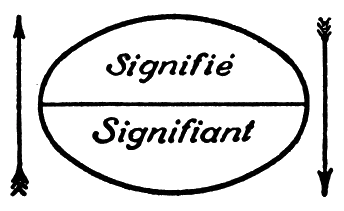
Ferdinand de Saussure, diagram of the sign (signifier/signified), from "Cours de linguistique générale" (1916). Image via Wikimedia Commons
The arbitrariness is Saussure's most radical claim. Signs do not have natural meanings. They have conventional meanings. The meaning of a sign is determined by the community of speakers who use it. Change the community, and the meaning changes. The implication for art is direct. If signs are arbitrary, then the meanings of visual images are also conventional, not natural. A red color does not naturally mean "danger" or "passion." It means those things because a culture has agreed that it does. A skull does not naturally mean "death." It means death because of a cultural convention (memento mori). To understand a painting, you need to understand the conventions that give its signs their meanings. The Britannica entry on semiotics is a good starting point for the broader field.
Peirce: Icon, Index, Symbol
Charles Sanders Peirce (1839-1914) was an American philosopher and logician who developed a theory of signs independently of Saussure. Peirce defined a sign as "something which stands to somebody for something." His classification is more detailed than Saussure's, and it is more useful for art because it distinguishes between different ways that signs relate to their objects.
Peirce classified signs into three types. An icon is a sign that resembles its object. A portrait is an icon of the person depicted. A diagram is an icon of the relationships it represents. A photograph is partly an icon of what it depicts. An index is a sign that is physically connected to its object. Smoke is an index of fire. A footprint is an index of the person who made it. A thermometer reading is an index of the temperature. In painting, a brushstroke is an index of the artist's hand. It records the physical gesture that made it. A symbol is a sign that is related to its object only by convention. A word is a symbol. A flag is a symbol. A red traffic light is a symbol. In painting, a halo is a symbol of sanctity. It does not resemble sanctity, nor is it physically caused by sanctity. It means sanctity because of a cultural convention.
Most paintings combine all three sign types. A portrait is an icon (it resembles the sitter), an index (it records the artist's brushwork), and a symbol (it uses conventional codes, clothing, pose, background, to signify the sitter's status). Understanding which sign types are at work in a painting helps you understand how it produces meaning. The indexical has been particularly important in art theory. Rosalind Krauss used Peirce's index to explain photography. A photograph is an index of the light that hit the film, a physical trace of the object in front of the camera. A painting is also indexical. It is a trace of the artist's body, the brush, the hand. The indexical is what connects the artwork to the physical world. The Stanford Encyclopedia of Philosophy's entry on Peirce's theory of signs covers the full system.
Barthes: Denotation and Connotation
Roland Barthes (1915-1980) was a French semiotician who applied Saussure's and Peirce's theories to visual culture. "Mythologies" (1957), "Elements of Semiology" (1964), and "Image, Music, Text" (1977) are the key texts. Barthes's contribution was to show that signs work on two levels: denotation and connotation.
Denotation is the literal, obvious meaning of a sign. A photograph of a rose denotes a rose, a flower with petals, a stem, thorns. Denotation is the first level of meaning, what everyone can see. Connotation is the cultural meaning of a sign, the associations, myths, and ideologies that a culture attaches to it. A rose connotes love, passion, England, socialism, secrecy. Connotation is the second level of meaning, what members of a specific culture can read. The distinction is not between "literal" and "metaphorical." It is between "what the sign is" and "what the sign means in a specific culture."
Barthes's famous analysis, in "Rhetoric of the Image" (1964), was of a Panzani pasta advertisement. The image denotes pasta, tomatoes, a tin, a string bag. It connotes "Italianicity." The red, green, and white colors, the string bag, the fresh tomatoes all signify "Italy" to a French audience. The connotation is cultural. It depends on the viewer knowing the codes (the Italian flag, Italian food, Italian market culture). The application to painting is direct. A Dutch still life denotes flowers, fruit, skulls, hourglasses. It connotes vanitas, the transience of life, the futility of pleasure, the certainty of death. The connotation depends on the viewer knowing the vanitas code. Without the code, the painting is just a picture of objects. With the code, it is a meditation on mortality.
Magritte's "The Treachery of Images" (1929) makes the semiotic point visible. "Ceci n'est pas une pipe." The image denotes a pipe. The text denies that the image is a pipe. The contradiction exposes the semiotic gap. The signifier (the image of a pipe) is not the signified (a pipe). The image is a sign, not the thing. Magritte made Saussure's point visually, 37 years before Barthes theorized it. For Barthes's broader argument about who controls meaning, read our guide on the death of the author.

René Magritte, "The Treachery of Images" (1929). Oil on canvas, 60.3 x 81.1 cm. LACMA. Image via Wikimedia Commons
Reading Paintings Semiotically
The semiotic method for reading a painting has four steps. First, identify the signs. What are the objects, figures, colors, and compositions in the painting? Each one is a sign. Second, classify the signs. Are they icons (resembling their object), indices (physically connected to their object), or symbols (conventionally related to their object)? Third, determine the denotation. What do the signs literally represent? Fourth, determine the connotation. What cultural meanings do the signs carry? What codes do you need to know to read them?
Jan van Eyck's "The Arnolfini Portrait" (1434) is a textbook case. The denotation is a man and a woman in a room, holding hands, with a dog, shoes, a mirror, candles, and fruit. The connotation: the lit candle (symbol of the eye of God), the dog (symbol of fidelity), the shoes removed (symbol of sacred ground), the mirror (showing scenes from the Passion of Christ), the hand gesture (a marriage oath). The painting is not just a portrait. It is a semiotic system, a network of signs that signifies marriage, fidelity, sanctity, and divine witness. Read the symbols without the code and you see a couple in a room. Read them with the code and you see a sacrament.
Picasso's "Guernica" (1937) is a different kind of case. The denotation is a chaotic scene of screaming humans and animals, a bombing, a dying horse, a bull, a woman with a dead child. The connotation: the bull (symbol of Spain, or brutality, or Franco), the horse (symbol of the people, or suffering), the broken sword (symbol of defeat), the light bulb (symbol of the bombing, or of divine revelation). The painting is a semiotic system, but the codes are unstable. The bull and the horse mean different things to different viewers, and Picasso refused to fix their meanings. This is the difference between a closed semiotic system (van Eyck, where the codes are stable and shared) and an open one (Picasso, where the codes are contested). For more on specific works and their meanings, see our guide on famous paintings.
The Limits of Semiotics
Semiotics has three problems that are worth stating. The first is the problem of the code. Semiotics assumes that viewers share a code. But codes are cultural, and cultures are not homogeneous. A Dutch viewer in 1650 could read a vanitas still life without instruction. A viewer in 2026 needs to learn the code. Semiotics can tell you what the code is, but it cannot guarantee that the viewer knows it.
The second is the problem of the index. Peirce's index, the physical trace, is the most useful concept for art, but it is also the most ambiguous. Is a brushstroke an index of the artist's hand, or of the artist's emotion, or of the artist's intention? The index records the physical gesture, but it does not tell you what the gesture meant. The trace is physical. The meaning of the trace is not.
The third is the problem of reduction. Semiotics can reduce a painting to a system of signs, but a painting is also an aesthetic experience: color, surface, scale, the physical presence of paint. Semiotics captures the meaning but not the experience. This is the formalist critique. Semiotics is a contextualist tool, and it can miss the formal qualities that make a painting worth looking at. The synthesis is that the best art criticism combines semiotic analysis (what do the signs mean?) with formal analysis (what do the forms feel like?) and contextual analysis (what conditions produced this work?). Semiotics is one tool among several, not the only tool. For the methodological contrast, read our guide on formalism vs contextualism.
Final Thoughts
Semiotics gives us the tools to decode images, to identify the signs, classify them (icon, index, symbol), and determine their meanings (denotation, connotation). Saussure showed that signs are arbitrary. Peirce showed that signs work in three different ways. Barthes applied both to visual culture. The result is a method for reading paintings that treats them as systems of meaning, not just aesthetic objects. The limitation is that semiotics captures meaning but not experience. It captures the code but not the color, the sign but not the surface.
My view is that semiotics is the most useful single framework for understanding how images carry meaning, but it captures the code without the color, the meaning without the experience. The best criticism uses it alongside formal analysis, not instead of it. A painting that you have decoded semiotically but not felt formally is a painting you have only half-read. For the broader practice of writing about what you see, see our guide to art criticism. For the long view, the art movements timeline puts the whole story in sequence, and the art history cheat sheet is a faster overview. For help training your eye to see both the signs and the surfaces, read our guide on how to look at art.
Next time you look at a painting, try the four-step method. Identify the signs. Classify them. Determine the denotation. Determine the connotation. You will see the painting differently, not as a picture but as a language, a system of signs that you can read.


