
In 1966, Jacques Derrida delivered a paper at Johns Hopkins University called "Structure, Sign, and Play in the Discourse of the Human Sciences." It was the opening salvo of deconstruction, a philosophical method that would dominate literary criticism, art theory, and cultural studies for the next 30 years. Derrida's argument was that meaning is never fixed. Every sign, every text, every image contains within itself the seeds of its own undoing. The meaning you think you find is always deferred, pushed to another sign, another context, another interpretation. Derrida called this deferral "différance," a neologism that combines "difference" and "deferral" and is spelled with an "a" that is visible in writing but silent in speech. The word itself is an example of the gap between writing and speech that Derrida spent his career analyzing.
Derrida was not an art critic. He was a philosopher who read texts by Plato, Rousseau, Husserl, and Heidegger, and showed how their arguments undermined themselves. But his method was applied to art by critics like Craig Owens, Hal Foster, and Rosalind Krauss, who saw in deconstruction a tool for analyzing images. Derrida himself wrote about art. "The Truth in Painting" (1978) dealt with Kant, Heidegger, and Van Gogh. "Memoirs of the Blind" (1990) dealt with drawing and vision. "The Parergon" (1979) dealt with the frame in Kant's aesthetics. This guide covers Derrida's key concepts (différance, trace, supplement, logocentrism, the parergon), his writing on art, and how deconstruction changed art criticism.
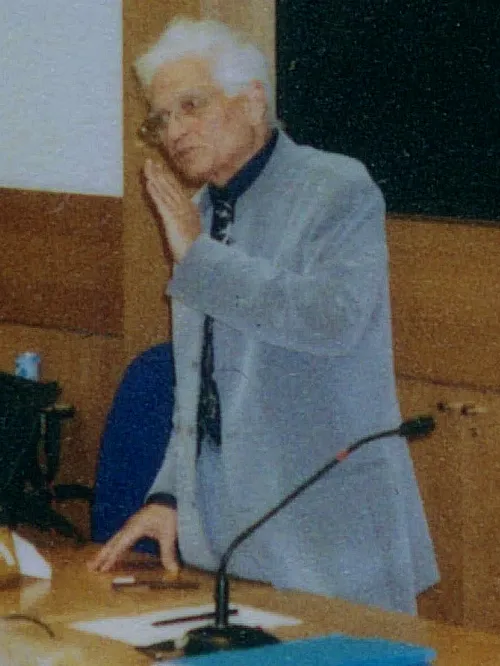
Jacques Derrida (1930-2004). Image via Wikimedia Commons
Différance and the Instability of Meaning
Différance is Derrida's most famous concept. It combines two meanings. The first is difference: signs get their meaning from their difference from other signs, an idea Derrida took from Ferdinand de Saussure. The second is deferral: meaning is never present. It is always deferred to another sign, another context. When you look up a word in the dictionary, you find more words. Those words are defined by more words. The meaning you seek is never arrived at. It is always postponed.
The "a" in différance is the whole demonstration. The word is spelled with an "a" rather than an "e," and that "a" is visible only in writing. In speech, "différance" and "différence" sound identical. The word proves Derrida's argument that writing is not secondary to speech, as Western philosophy has assumed since Plato, but can do things that speech cannot. The gap between the written word and the spoken word is where deconstruction lives.
The implication for art is direct. If meaning is always deferred, then a painting's meaning is never fixed. A painting does not have one meaning that the critic discovers. It has multiple meanings that are produced in the encounter between the painting and the viewer, and those meanings change depending on the context. There is no "correct" interpretation. There are only interpretations, each of which is partial, provisional, and subject to deconstruction. René Magritte made the point visually in "The Treachery of Images" (1929), 60.3 x 81.1 cm, now at LACMA. "Ceci n'est pas une pipe." The image is a sign. The text is a sign. The two signs contradict each other. The contradiction is not a problem to be solved but a demonstration of how signs work: by deferring meaning, by pointing to other signs, by never arriving at the thing itself. Magritte made the point in 1929. Derrida theorized it in 1966. For more on how signs carry meaning in images, see our guide to semiotics in art.
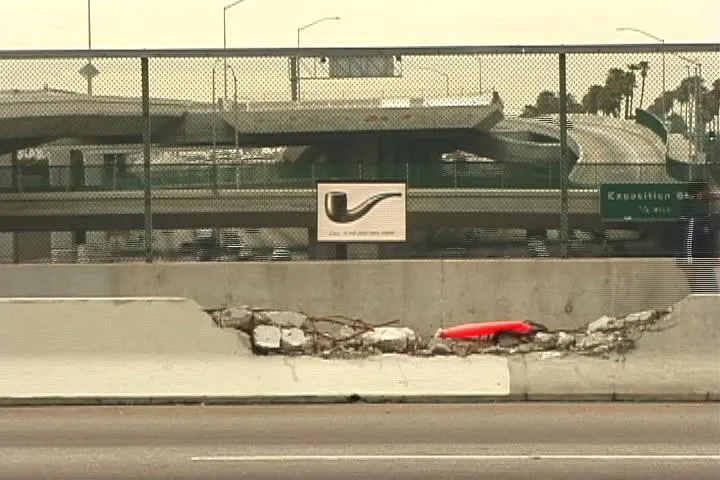
René Magritte, "The Treachery of Images" (1929). Oil on canvas, 60.3 x 81.1 cm. LACMA. Image via Wikimedia Commons
Logocentrism and Binary Oppositions
Logocentrism is Derrida's term for the Western philosophical tradition's assumption that there is a fixed center of meaning, a "transcendental signified," that grounds all other signs. This center could be God, Reason, Truth, the Self, or the Author. Derrida argued that no such center exists. Every supposed center is itself dependent on other signs, which are dependent on other signs, ad infinitum. The center does not hold. It is itself a sign that defers to other signs.
Western thought is structured around hierarchical binary oppositions: speech over writing, presence over absence, male over female, inside over outside, art over non-art. In each pair, the first term is privileged and the second is devalued. Derrida's method is to deconstruct these oppositions, to show that the privileged term depends on the devalued term for its meaning. Speech is supposed to be closer to presence than writing, but speech is itself a system of signs that defers meaning just as writing does. The privilege collapses.
Art criticism is full of binary oppositions: high art over low art, original over copy, form over content, male gaze over female gaze, art over non-art. Deconstruction shows that these oppositions are not natural but constructed, and that the privileged term is not self-sufficient but depends on its supposed opposite. The boundary between art and non-art, the boundary that Duchamp's urinal and Warhol's Brillo Boxes put under pressure, is not a natural boundary but an institutional one. Our guide to the institutional theory of art covers that boundary in detail.
The Parergon: The Frame That Is Not a Frame
"The Parergon" (1979) is Derrida's essay on Kant's "Critique of Judgment," published in October magazine. It is his most sustained engagement with visual art. The parergon is a Greek word meaning "beside the work" or "accessory." In Kant's aesthetics, the parergon is the frame, the border, the ornament, the thing that is not part of the artwork proper but that surrounds it. Kant dismissed the parergon as merely "supplementary," not essential to the work's beauty.
Derrida asked the obvious and devastating question: what is the status of the frame? It is neither inside the work nor outside it. It is the boundary that separates art from non-art. But if the frame is not part of the work, then the work's boundary is arbitrary. And if the frame is part of the work, then the work includes what is supposed to be external to it. The parergon deconstructs the distinction between inside and outside, art and non-art, work and context.
The implication extends far beyond the physical frame around a painting. The frame is the museum, the wall, the label, the art historical context, the critical discourse. Everything that surrounds the artwork and makes it legible as art is a parergon, a supplement that is supposedly external but is in fact essential. The artwork cannot exist without its frame, and the frame cannot exist without the artwork. They are co-constitutive. You can read Derrida's "The Parergon" (1979) in full online, and the University of Michigan's Biro essay on art criticism and deconstruction is a clear secondary introduction.
Derrida on Van Gogh: The Truth in Painting
"The Truth in Painting" (1978) is Derrida's most important work on visual art. The book contains four essays on the relationship between philosophy and painting, centered on Kant, Heidegger, and Van Gogh. The centerpiece is Derrida's reading of a famous dispute over Van Gogh's "A Pair of Shoes" (1886), 38.1 x 45.3 cm, Van Gogh Museum, Amsterdam.
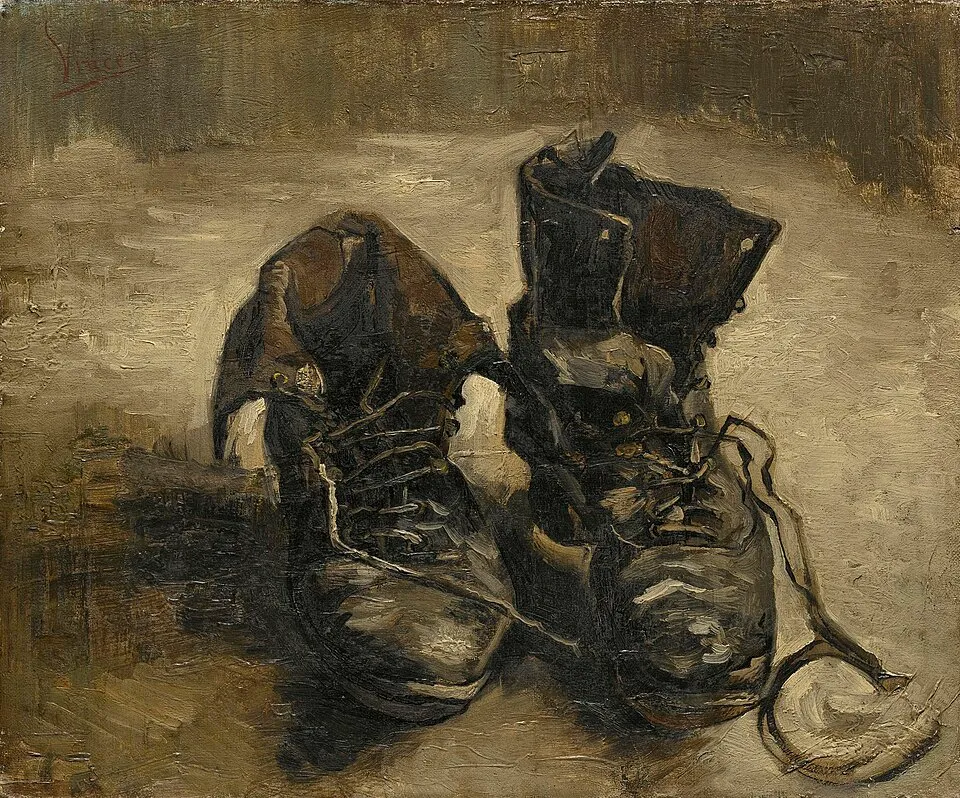
Vincent van Gogh, "A Pair of Shoes" (1886). Oil on canvas, 38.1 x 45.3 cm. Van Gogh Museum, Amsterdam. Image via Wikimedia Commons
Martin Heidegger wrote an essay, "The Origin of the Work of Art" (1935-1937), in which he analyzed the painting and claimed that the shoes revealed the "truth" of peasant life: the earth, the toil, the belonging to the soil. Meyer Schapiro countered that the shoes were Van Gogh's own, not a peasant's, and that Heidegger had projected his own rural romanticism onto the painting. Derrida deconstructed both readings. Heidegger assumed the shoes belonged to a peasant. Schapiro assumed they belonged to Van Gogh. Both assumed that the painting "belongs" to someone, that it has a fixed meaning that can be recovered by identifying the owner. Derrida argued that the painting does not have a truth to reveal. It has multiple meanings, and each reading is a projection of the reader's desires. Neither Heidegger nor Schapiro noticed that the shoes could be a woman's shoes. The assumption that they belonged to a man, peasant or artist, was itself an unexamined projection.
Derrida's reading of the Van Gogh dispute is a demonstration of deconstruction in action. He does not offer a "correct" interpretation of the painting. He shows how every interpretation is structured by assumptions that the interpreter does not acknowledge: assumptions about ownership, identity, gender, and truth. The painting is not a window onto reality. It is a surface onto which interpreters project their fantasies. For more on the artist behind the shoes, read our profile of Vincent van Gogh.
Deconstruction and Art Criticism
Craig Owens, an American art critic, argued in "The Allegorical Impulse: Toward a Theory of Postmodernism" (1980) that postmodern art was inherently deconstructive. The work of Cindy Sherman, Sherrie Levine, and Barbara Kruger exposed the constructed nature of images, the instability of meaning, the dependence of art on institutional context. Deconstruction was not just a philosophical method applied to art. It was already happening in the art itself. Hal Foster made a related argument in "The Anti-Aesthetic" (1983), positioning deconstruction as the critical method appropriate to postmodern art, a method that refused both the modernist belief in pure form and the postmodernist celebration of surfaces. Rosalind Krauss used Derrida's concepts, especially the index and the trace, to analyze photography and postmodern art in "The Originality of the Avant-Garde and Other Modernist Myths" (1985). Krauss argued that the "originality" of the avant-garde was a modernist myth. Every artwork is a citation, a trace, a copy of something else.
By the 1990s, deconstruction was under attack. Critics argued that it was nihilistic: if meaning is never fixed, then no interpretation is better than any other. They argued it was politically useless: if everything is text, then material conditions do not matter. The 1996 Sokal hoax, in which physicist Alan Sokal published a deliberately nonsensical paper in Social Text to expose what he saw as the intellectual bankruptcy of postmodern cultural studies, damaged the reputation of the whole field. Some of these criticisms were fair. Deconstruction can become an empty gesture, a way of saying "everything is complicated" without committing to any position. The debate between formalist and contextualist approaches, covered in our guide to formalism vs contextualism, is one place where this tension plays out.
Does Deconstruction Still Matter in 2026?
Deconstruction's core insight, that meaning is contextual, unstable, and never fully present, is now mainstream. Every analysis of how images construct gender, race, or power owes something to Derrida. The idea that "there is nothing outside the text" (Derrida's most misunderstood claim; he meant that there is no meaning without context, not that there is no reality) is the default assumption of cultural studies. The method won the argument even as the word fell out of fashion.
AI-generated images are the ultimate deconstructive objects. They are copies without originals, signs without referents, images made by no one for no one. They literalize Derrida's claim that meaning is produced by the play of signifiers, not by the intention of an author. The "death of the author" (Barthes) and the "deconstruction" of meaning (Derrida) converge in AI art. An image generated by a diffusion model has no author, no origin, no fixed meaning. It is pure trace. For more on the current moment, see our guide to contemporary art trends in 2026, and for the companion debate about authorship, our guide to the death of the author.
Deconstruction does have a real weakness, and it is worth naming plainly. Its inability to make normative claims is a limitation, not a feature. If every interpretation is provisional, then there is no basis for saying that one interpretation is better than another. This is a problem for art criticism, which needs to make judgments, not just about what art means but about what art is good. Deconstruction can tell you how meaning works. It cannot tell you what to value. The best art criticism uses deconstruction to expose assumptions and then makes judgments anyway, because criticism without judgment is description, not criticism. For the broader practice, see our guide to art criticism.
Final Thoughts
Derrida argued that meaning is never fixed. It is always deferred, always contextual, always dependent on what it excludes. Deconstruction exposes the assumptions that structure interpretation: the binary oppositions, the privileged centers, the frames that pretend to be neutral. Applied to art, deconstruction shows that paintings do not have fixed meanings but produce meanings in encounter with viewers, and those meanings are always partial, provisional, and projective. The method has limits. It cannot make value judgments. But its core insight, that meaning is contextual, is now inescapable.
Next time you interpret a painting, ask yourself what you are projecting onto it. What assumptions structure your reading? What are you excluding? The answers will not give you the "correct" interpretation, because there is no correct interpretation. But they will make your interpretation more honest, and honesty is the best a critic can offer.


