
In 1981, the artist Sherrie Levine photographed a reproduction of a Walker Evans photograph from a 1936 exhibition catalogue and presented it as her own work. She titled it "After Walker Evans: 4." The original photograph was of a Depression-era sharecropper's wife. Levine's version was identical, same image, different artist. She was not trying to pass it off as an original. She was asking: what does originality mean when every image is already a copy of something? This is the central question of postmodernism in art. The answer postmodernism gives is: nothing is original. Everything is a reference, a quotation, an appropriation. The artist's job is not to create from nothing but to recontextualize what already exists.
Postmodernism in art emerged in the late 1970s and 1980s as a rejection of modernism's core beliefs. Modernism, as articulated by Clement Greenberg and Michael Fried, held that art should purify its medium, that each art form should strip away everything not essential to itself, and that the history of art was a progressive narrative of formal innovation. Postmodernism rejected all of this. There was no progress, no purity, no originality, only quotation, pastiche, and appropriation. The "Pictures Generation" (Sherrie Levine, Cindy Sherman, Richard Prince, Robert Longo) made this rejection literal by photographing existing images and presenting them as art. This guide covers the key ideas of postmodernism in art, the key artists, the key theorists, and why postmodernism still matters in 2026.
From Modernism to Postmodernism
The break between modernism and postmodernism was a break over the idea of progress. Modernism held that art was a progressive narrative, each generation pushing the medium further toward purity. Postmodernism said there was no progress, only difference. There was no purity, only hybridity. There was no originality, only quotation. The break was not gradual. It was a specific intellectual event, and it happened in a specific place, New York in the late 1970s.
Fredric Jameson provided the theoretical framework. In "Postmodernism and the Consumer Society" (1979) and "The Cultural Logic of Late Capitalism" (1984), Jameson argued that postmodernism was the cultural logic of late capitalism, a culture of surfaces, images, and consumption, devoid of historical depth. He identified key features: the substitution of pastiche for parody, a predilection for nostalgia, and a fixation on the perpetual present. "The loss of historical temporality and depth associated with postmodernism was akin to the world becoming a set of photographs." The difference between parody and pastiche is the difference between criticism and celebration. Parody implies a critical distance, you parody something to mock it. Pastiche, Jameson argued, is parody without the satirical impulse. It is imitation without criticism. Postmodern art does not mock its sources. It celebrates them, quotes them, recombines them. For the movement that postmodernism was reacting against, read our guide on Abstract Expressionism.
Warhol and the End of Originality
Andy Warhol (1928-1987) was the bridge between modernism and postmodernism. His "Campbell's Soup Cans" (1962), 32 canvases each measuring 50.8 x 40.6 cm, one for each variety of soup, were not paintings in the traditional sense. Warhol used silkscreen printing, a commercial technique, to reproduce a commercial image. The "art" was not the painting but the act of selecting and presenting a mass-produced image as art. The choice was the work. The execution was mechanical.
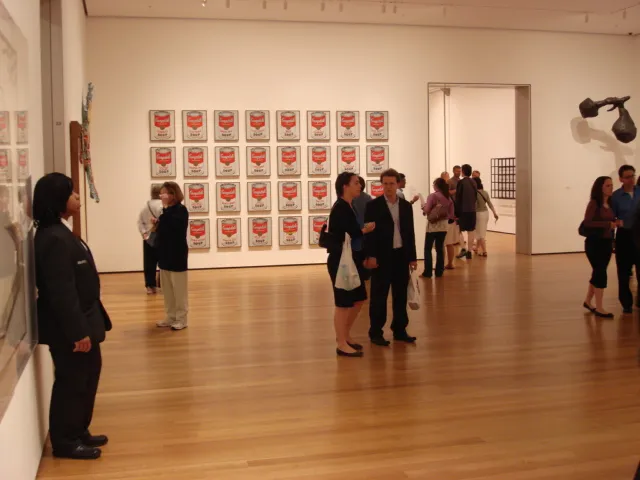
Andy Warhol, "Campbell's Soup Cans" (1962). Synthetic polymer paint on canvas, 32 canvases, each 50.8 x 40.6 cm. MoMA. Image via Wikimedia Commons
The "Brillo Boxes" (1964) pushed the logic further. These were wooden boxes silk-screened to look exactly like Brillo soap-pad cartons, each 43.2 x 43.2 x 43.2 cm. The philosopher Arthur Danto saw them at the Stable Gallery and had an epiphany. If a Brillo box in a gallery is art and a Brillo box in a supermarket is not, then the difference between art and non-art is not visual but conceptual. This insight became the basis for Danto's institutional theory of art, which you can read about in our companion piece on the institutional theory of art.
The significance of Warhol is that he collapsed the distinction between high art and commercial culture. Greenberg's modernism was built on that distinction, avant-garde versus kitsch. Warhol said the distinction was false. A soup can was as valid a subject as a landscape. A silkscreen was as valid a technique as oil paint. A commercial image was as valid a source as nature. Whether Warhol was celebrating consumer culture or critiquing it is still debated. My view is that he was doing both, and that the inability to tell the difference is the postmodern condition. For more on Warhol and the movement he launched, see our guide on Pop Art.
The Pictures Generation: Sherman, Levine, Prince
The "Pictures" exhibition in 1977, curated by Douglas Crimp at Artists Space in New York, featured Sherrie Levine, Cindy Sherman, Richard Prince, Robert Longo, and others. Crimp argued that these artists were not making images but reusing existing images. "Appropriation" became the name for the strategy. The artist does not create. The artist selects, reframes, and recontextualizes.
Cindy Sherman (born 1954) produced the "Untitled Film Stills" between 1977 and 1980, a series of 69 photographs in which Sherman posed as female characters from imaginary B-movies. She was the photographer, the model, the makeup artist, and the stylist. The images look like real film stills but are not from any film. They are simulacra, copies without originals. The series asked: what is the "female image" in cinema? It is a construction, a performance, a set of visual codes that Sherman could replicate without an actual film. You can see how this connects to the male gaze and its critique.

Cindy Sherman, "Untitled Film Still #21" (1978). Gelatin silver print, 17.8 x 24.8 cm. Image via Wikimedia Commons
Sherrie Levine (born 1947) made the argument literal. "After Walker Evans" (1981) rephotographed Evans's Depression-era photographs from a catalogue and presented them as her own. She was not claiming to have taken the original photographs. She was questioning the concept of originality itself. If Evans's photographs are art, and Levine's photographs of Evans's photographs are also art, then what distinguishes the original from the copy? The answer is: nothing, or rather, the only difference is the institutional context (gallery, museum, catalogue) that designates one as "original" and the other as "appropriation."
Richard Prince (born 1949) rephotographed Marlboro cigarette advertisements, cropping out the text. The "Marlboro Man" images, cowboys in Western landscapes originally created to sell cigarettes, became in Prince's version meditations on American mythology and masculinity. The images were identical to the advertisements except for the removed text. Prince sold them for millions. The price is part of the point. If a copy without an original sells for millions, then the art market has accepted the postmodern premise. For a broader overview, the Bruce High Quality Foundation published a useful primer on what postmodern art is.
Baudrillard and Simulacra
Jean Baudrillard (1929-2007) was a French philosopher whose "Simulacra and Simulation" (1981) gave postmodernism its theoretical backbone. Baudrillard argued that in postmodern culture, the distinction between the real and the representation has collapsed. We no longer have reality and its image. We have simulacra, copies that have no original. The image does not represent reality. It produces reality.
Baudrillard identified four stages of the image. First, the image is the reflection of a basic reality. Second, the image masks and perverts a basic reality. Third, the image masks the absence of a basic reality. Fourth, the image bears no relation to any reality whatsoever. It is its own pure simulacrum. Magritte's "The Treachery of Images" (1929), with its painted pipe and the text "Ceci n'est pas une pipe," is the prehistory of this argument. The image is not the thing. The word is not the thing. The representation is not the reality. Magritte made this point in 1929. Baudrillard theorized it in 1981. Sherman and Levine made it into art in the 1970s and 1980s.
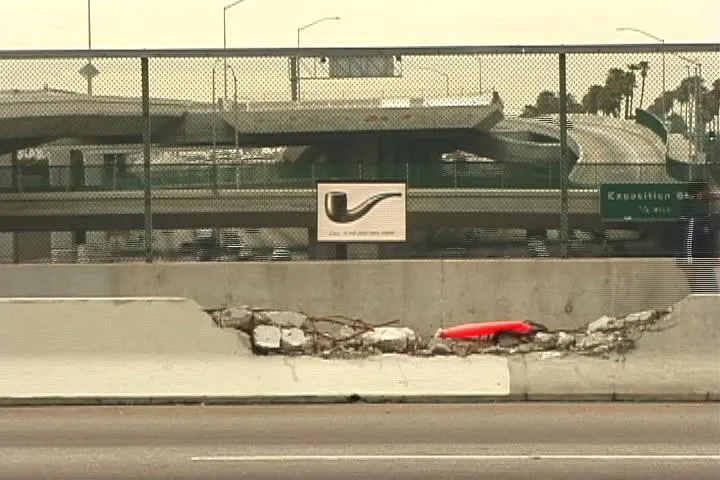
René Magritte, "The Treachery of Images" (1929). Oil on canvas, 60.3 x 81.1 cm. LACMA. Image via Wikimedia Commons
Jeff Koons (born 1955) is the purest example of Baudrillard's fourth stage. His "Balloon Dog" (1994-2000), a 307.3 cm tall stainless steel sculpture that looks exactly like a balloon animal but weighs tons and is permanent, is a copy of a copy of a copy. The balloon animal is already a simulacrum of an animal. Koons's sculpture is a simulacrum of the balloon animal. It bears no relation to any real animal. It is Baudrillard's fourth stage made into sculpture. Whether this is critique or celebration is, again, the postmodern question that has no clean answer. For where this kind of work sits in the current scene, see our guide on contemporary art in 2026.
Barbara Kruger and the Language of Power
Barbara Kruger (born 1945) worked as a graphic designer at Condé Nast before becoming an artist. Her work combines found photographs with text, short, confrontational phrases in Futura typeface on red bands. "Your body is a battleground" (1989) shows a woman's face split into positive and negative, with the text across it. Made for the 1989 Women's March on Washington, the work uses the visual language of advertising, the same language that sells products, to deliver a political message. This is postmodernism's central strategy: using the tools of mass culture against mass culture.
"I shop therefore I am" (1987) shows a hand holding a card with that text. It is a direct critique of consumer culture, using the visual language of consumer culture. The phrase parodies Descartes' "I think therefore I am." In late capitalism, Kruger says, identity is consumption, not thought. The significance of Kruger's work is that it demonstrates postmodernism is not apolitical. The claim that postmodernism is purely about surfaces and images, which is Jameson's critique, is incomplete. Kruger uses postmodern strategies, appropriation, pastiche, the visual language of mass culture, to make political arguments about gender, power, and consumption. For the feminist context of this work, read our guide on feminist art theory.
Does Postmodernism Still Matter in 2026?
The internet is the ultimate postmodern medium. It is a culture of copies without originals, of references to references, of images detached from context. Memes are postmodernism's folk art. The "deepfake" is Baudrillard's fourth stage made literal, an image that bears no relation to any reality. Every artist who uses found images, every musician who samples, every filmmaker who quotes other films is working in a postmodern framework, whether they know it or not. The strategies postmodernism invented are now standard practice. They are so standard that they are invisible.
Postmodernism has been attacked from both sides. The left attacks it for depoliticizing art, for reducing everything to text and image. The right attacks it for destroying standards, for declaring everything equal. The "metamodernism" movement, proposed by Vermeulen and van den Akker in 2010, argues that we have moved beyond postmodernism into a structure that oscillates between irony and sincerity, between knowingness and hope. Whether metamodernism is a real shift or just postmodernism with a different label is an open question. My view is that the strategies are the same. What has changed is the affect. Postmodernism was cool and detached. The current moment is warmer and more invested. But the apparatus, appropriation, pastiche, the collapsing of high and low, is unchanged. For the long view of how movements succeed each other, the art movements timeline puts it all in sequence.
Final Thoughts
Postmodernism in art said that nothing is original, that everything is a quotation, and that the distinction between high art and mass culture is false. Warhol proved it with soup cans. Sherman proved it with film stills that were not from any film. Levine proved it by photographing photographs. Baudrillard theorized it with simulacra. Whether we have moved beyond postmodernism or are still inside it, the strategies it invented are now inescapable. The question is not whether to appropriate but how to appropriate responsibly, with awareness of what is being quoted, why, and who benefits.
The unresolved question is whether appropriation is critique or style. When Sherrie Levine rephotographed Walker Evans, the gesture was critical. She was questioning originality itself. When a contemporary artist slaps a familiar image onto a canvas without that critical framework, the gesture is decorative. The difference matters, and postmodernism does not always give you the tools to tell the difference. That is its limitation. For the theoretical companion to this debate, read about the death of the author, and for the practice of evaluating what you see, our guide to art criticism covers the field.
Go to a museum and find a work that uses appropriation, a Warhol, a Sherman, a Koons, a Kruger. Ask: what is being quoted? What is the relationship between the original and the copy? Does the appropriation critique the source or celebrate it? The answer is the difference between postmodernism as critique and postmodernism as style.


