
In 1985, the Museum of Modern Art in New York opened "An International Survey of Recent Painting and Sculpture." The exhibition featured 169 artists. 13 of them were women. All 13 were white and from Europe or the United States. A group of anonymous women artists responded by forming the Guerrilla Girls, a collective that wore gorilla masks, used pseudonyms of dead women artists (Frida Kahlo, Alma Thomas, Käthe Kollwitz), and produced posters that called out the sexism and racism of the art world with statistics. Their most famous poster, from 1989, read: "Do women have to be naked to get into the Met. Museum? Less than 5% of the artists in the Modern Art sections are women, but 85% of the nudes are female." The Guerrilla Girls were funny, furious, and effective. They also represented a shift in feminist art theory, from making art about women's experience to critiquing the institutions that excluded women from art history.
Feminist art theory emerged in the 1970s as part of second-wave feminism. It had two strands. The first was the recovery of women artists excluded from the canon, Artemisia Gentileschi, Élisabeth Vigée Le Brun, Mary Cassatt. The second was the critique of the institutions, museums, galleries, art schools, art history departments, that maintained the exclusion. The first strand was about representation. The second was about power. This guide covers the feminist art movement from Judy Chicago's "Dinner Party" (1974-1979) through the Guerrilla Girls (1985-present), Barbara Kruger, Cindy Sherman, and the theory of institutional critique developed by Griselda Pollock, Lucy Lippard, and Maura Reilly.
Judy Chicago and the Dinner Party (1974-1979)
Judy Chicago (born 1939) created the first major feminist art project. "The Dinner Party" (1974-1979) is a large triangular table, 14.6 x 14.6 m, with 39 place settings, each honoring a historical woman, from the Primordial Goddess to Georgia O'Keeffe. Each setting has an embroidered runner and a ceramic plate with butterfly and vaginal imagery. The floor is inscribed with the names of 999 additional women. The work took five years and involved over 400 volunteers. It was conceived as a monument to women's history, a subject that no museum had previously considered worthy of monumental treatment.
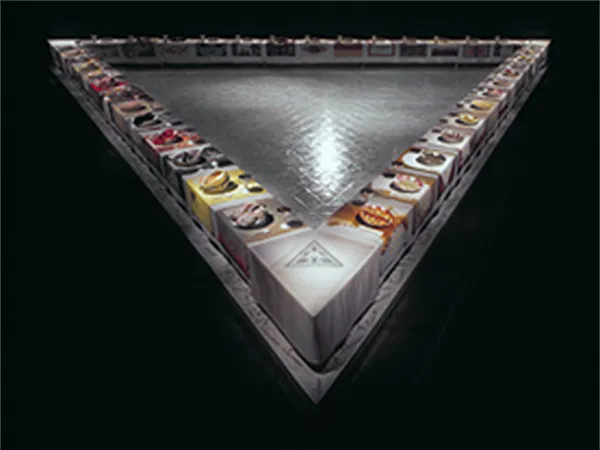
Judy Chicago, "The Dinner Party" (1974-1979). Mixed media, 14.6 x 14.6 m. Brooklyn Museum. Image via Wikimedia Commons
The work was attacked from both sides. Conservative critics called it pornographic, because the plate imagery was explicitly vaginal. Feminist critics called it essentialist, because it reduced women's identity to biology. The work was rejected by multiple museums and did not find a permanent home until 2002, when it was installed at the Brooklyn Museum's Elizabeth A. Sackler Center for Feminist Art. The significance of "The Dinner Party" was that it was the first large-scale public artwork to claim that women's history was a subject worthy of monumental art. It was also the first to use "craft" techniques, embroidery, ceramics, as fine art, challenging the hierarchy that placed painting above decorative arts.
The essentialism critique is real, and it is worth taking seriously. "The Dinner Party" assumes that women's identity is biological and that the 39 women honored share a common "feminine" experience. This assumption was challenged by Black feminists, who pointed out that the table included very few women of color. Sojourner Truth was added late, and her plate was the only one not vaginal in imagery. The exclusion was not accidental. It reflected a feminist movement that was dominated by white, middle-class women and that theorized "woman" as if she were white. For more on how art encodes social structures, read our guide on art and society.
The Guerrilla Girls (1985-Present)
The Guerrilla Girls formed in 1985 in response to MoMA's "International Survey" exhibition. Their method was posters, billboards, and public actions that used statistics and humor to expose sexism and racism in the art world. The posters were paste-on-the-wall agitprop, cheap, reproducible, designed to be seen on the street, not in galleries. The gorilla masks were a practical decision (anonymity protected their careers) and a conceptual one (the mask replaced the individual artist with the collective complaint).
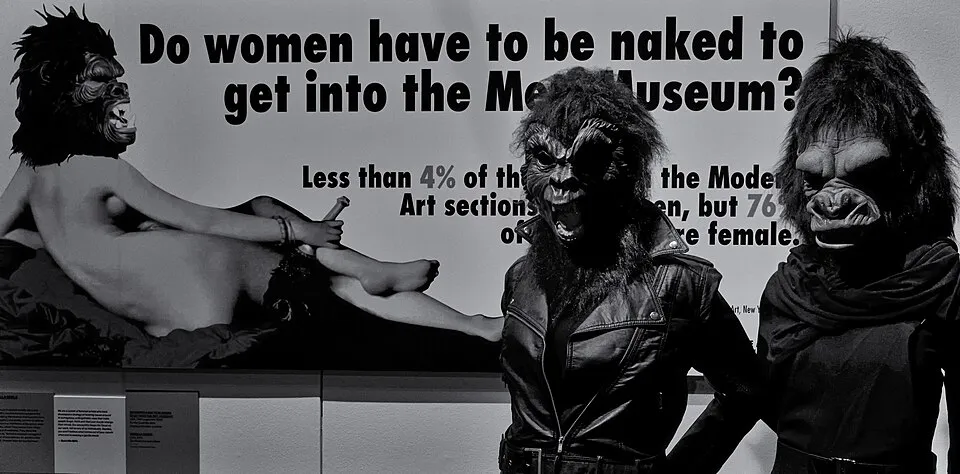
Guerrilla Girls, "Do Women Have To Be Naked To Get Into the Met. Museum?" (1989). Poster. Image via Wikimedia Commons
"Do women have to be naked to get into the Met. Museum?" (1989) is the most famous feminist art poster ever made. The statistic, 5% women artists, 85% female nudes, was based on a 1989 audit of the Metropolitan Museum's modern art galleries. The poster used Ingres' "La Grande Odalisque" with a gorilla mask superimposed. The joke was that the only way a woman gets into a museum is as a nude, and the only way a woman artist gets into a museum is if she hides her identity behind a mask. The impact was immediate. The Guerrilla Girls forced museums to confront their own statistics. By the 2000s, major museums were conducting diversity audits. The 2007 MoMA exhibition "WACK! Art and the Feminist Revolution" was the first major museum survey of feminist art.
The limitation of the Guerrilla Girls' approach is that their statistics were about representation, not quality. Some critics argued that simply adding women to the canon did not change the canon's structure. It just made it larger. This is the difference between liberal feminism (add women and stir) and radical feminism (change the structure). The Guerrilla Girls were mostly working in the liberal frame. They wanted more women in museums. They did not, for the most part, question whether the museum itself was the right frame. TheArtStory published a useful overview of the feminist art movement that traces this tension.
Barbara Kruger and Cindy Sherman: Image and Identity
Barbara Kruger (born 1945) made "Your body is a battleground" (1989) for the 1989 Women's March on Washington, in response to threats to reproductive rights. The work uses the visual language of advertising, a found photograph, Futura typeface, a red band, to deliver a political message. Kruger's work is feminist art theory in visual form. It analyzes how images construct gender identity and uses that analysis to fight back. The split face, positive on one side, negative on the other, is a visual argument about the divided position of women under patriarchy.
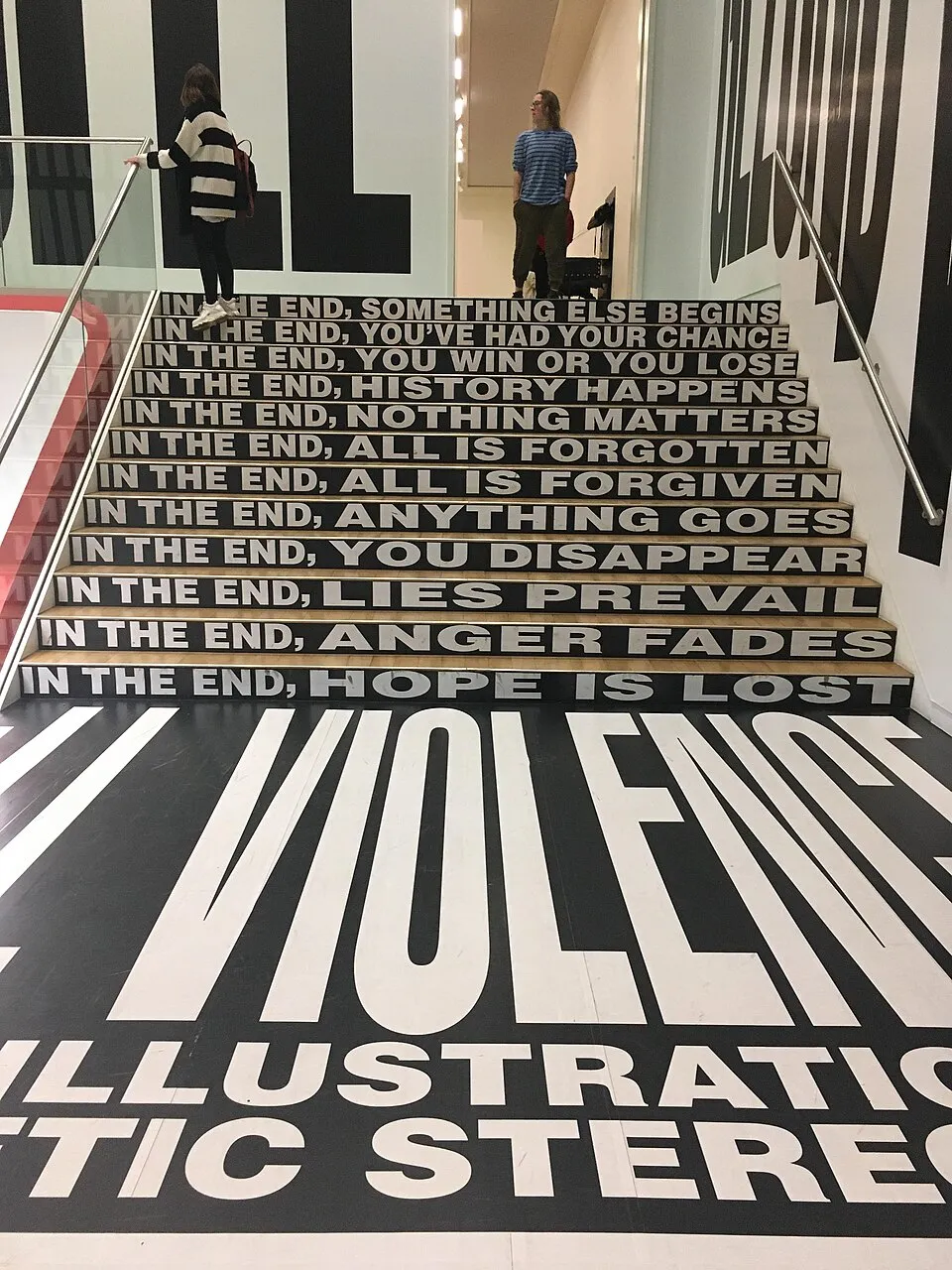
Barbara Kruger, "Your body is a battleground" (1989). Photographic silkscreen on vinyl. Image via Wikimedia Commons
Cindy Sherman (born 1954) produced the "Untitled Film Stills" between 1977 and 1980, 69 photographs in which she posed as female characters from imaginary B-movies. The series deconstructed the "female image" in cinema, the ways in which women are typed, framed, and consumed. Sherman's work is feminist art theory without text. It shows, rather than tells, how gender is a performance. The difference between Kruger and Sherman is the difference between explicit and implicit critique. Kruger's work tells you what to think. Sherman's work shows you how images work and lets you draw conclusions. Both are feminist. Both use postmodern strategies, appropriation and the visual language of mass culture. Both have been enormously influential. For the theoretical framework that connects Sherman's work to film theory, read our guide on the male gaze.
Institutional Critique: Pollock, Lippard, Reilly
Griselda Pollock (born 1949) is a feminist art historian whose "Old Mistresses: Women, Art and Ideology" (1981, written with Rozsika Parker) gave the field its theoretical foundation. The title parodies "Old Masters." If male artists are "masters," what are female artists? The book argued that art history's categories, genius, masterwork, canon, are gendered. The canon is not a neutral record of the best art. It is a construction that excludes women by defining "quality" in male terms. The "masterpiece" is a concept built around male experience, male training, and male access to patronage and education.
Lucy Lippard (born 1937) was the first critic to systematically argue that feminist art was not a subset of contemporary art but a distinct movement with its own history, theory, and aesthetics. "From the Center: Feminist Essays on Women's Art" (1976) collected her writing. She curated "Twenty Six Contemporary Women Artists" at the Aldrich Museum in 1971, the first all-women exhibition in a major American museum. The exhibition was a statement. It said that women artists were numerous enough and serious enough to fill a museum, and that the reason they had not filled museums before was not talent but exclusion.
Maura Reilly documented the statistics in "Curatorial Activism: Towards an Ethics of Curating" (2018). Between 2007 and 2013, only 27% of solo exhibitions at major US museums were women artists. At MoMA, between 2007 and 2013, only 11% of solo shows were women. The Guerrilla Girls' 1985 statistics had barely moved in 30 years. The argument of institutional critique is that the problem is not individual prejudice but structural exclusion. Museums, galleries, art schools, and art history departments are institutions with rules, practices, and assumptions that reproduce gender inequality. Adding women to the canon does not change the canon's structure. The structure itself must change. Google Arts and Culture published a useful introduction to the feminist art movement that covers this trajectory.
Intersectional Feminism and the Future
Early feminist art theory was dominated by white, middle-class women. The "woman" it theorized was implicitly white. Black feminists, bell hooks and Kimberlé Crenshaw chief among them, argued that gender cannot be separated from race and class. The experience of a Black woman in the art world is fundamentally different from that of a white woman. Crenshaw coined the term "intersectionality" in 1989 to name this insight. The art world has been slow to absorb it.
Intersectional art is the response. Artists like Kara Walker, Mickalene Thomas, and Wangechi Mutu make work that is feminist, anti-racist, and postcolonial simultaneously. Their work cannot be reduced to "feminist art." It is feminist art that is also about race, colonialism, and the body. Walker's silhouettes of antebellum violence, Thomas's rhinestone portraits of Black women, Mutu's collaged hybrid bodies, all refuse the single-category frame. They demand to be read through multiple lenses at once.
The 2020s accelerated change. The #MeToo movement, the racial reckoning of 2020, and the pandemic's disruption of museum schedules forced institutions to confront their practices. Major museums have appointed women directors. The Met, the Tate, and the Guggenheim all have women at the top. But the statistics on collection acquisitions and exhibition schedules remain starkly unequal. The Guerrilla Girls' question, "do women have to be naked to get into the Met. Museum?" is still relevant. The numbers have improved at the margins. The structure has not fundamentally changed. For what is happening in museums right now, see our guide on contemporary art in 2026.
Final Thoughts
Feminist art theory went from making art about women's experience (Chicago) to critiquing the institutions that exclude women (Guerrilla Girls, Pollock, Reilly). The movement's central insight is that art is not neutral. It is structured by power, and that power is gendered, racialized, and classed. The statistics have improved marginally since 1985, but the structure has not fundamentally changed. The question is not whether women are represented but who controls the representation.
My view is that the Guerrilla Girls' statistics have barely moved in 40 years because adding women to the canon without changing the canon's structure is not enough. But it is a start. The structure cannot change without representation, and representation cannot change without structural critique. The two strands of feminist art theory, recovery and critique, are not alternatives. They are dependencies. You cannot critique a canon that has no women in it, and you cannot change a canon by simply adding women to it. Both have to happen at once. For the broader context of how writing about art became its own practice, see our guide to art criticism, and for the long view, the art movements timeline puts the whole story in sequence. For help training your eye to see these structures in the gallery, read our guide on how to look at art, and for the specific works that stage these dynamics, see our breakdowns of famous paintings.
Go to a museum and count. How many artists are women? How many are artists of color? How many nudes are female? The Guerrilla Girls did this in 1989. The numbers will surprise you, and not in a good way.


