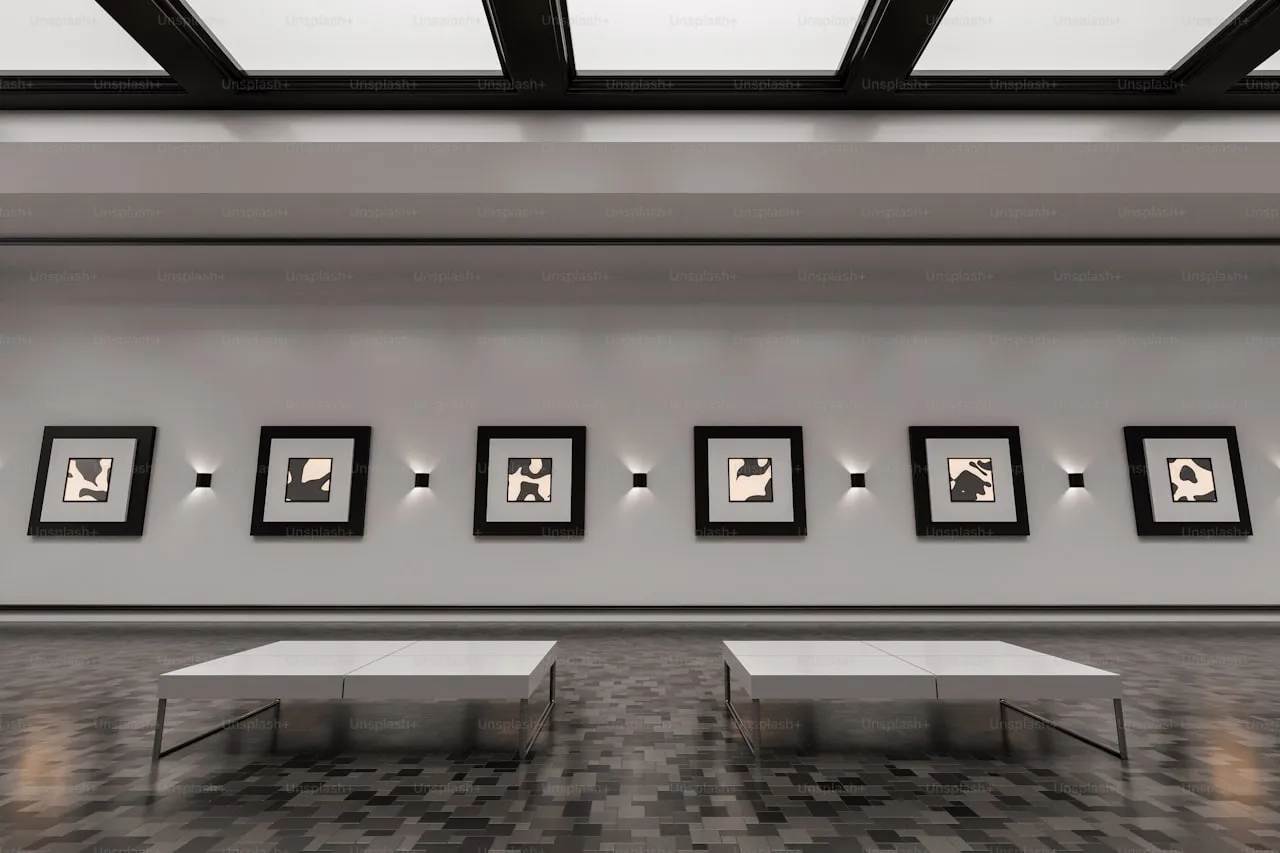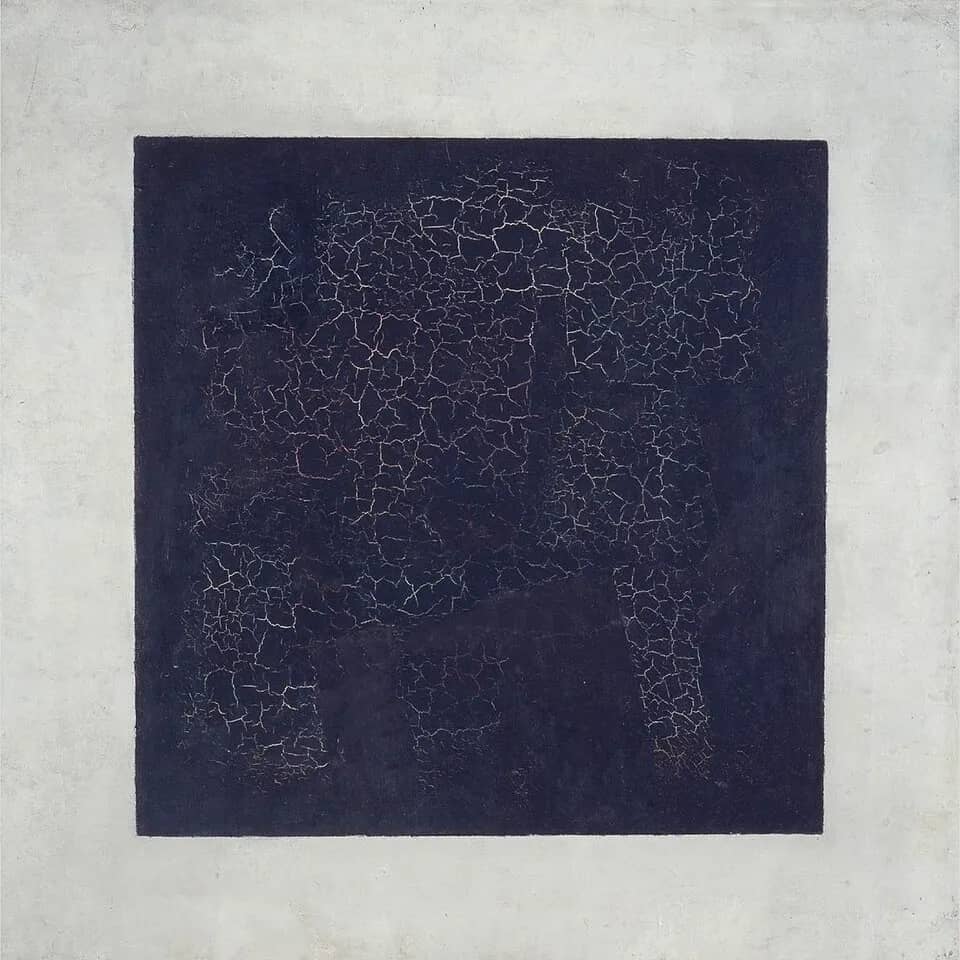
Kazimir Malevich painted a black square on a white canvas in 1915 and called it "Black Suprematic Square." He exhibited it in the uppermost corner of the room, the position traditionally reserved in Russian Orthodox homes for icons, the most sacred objects in the house. He was not being modest about the work's ambitions. He meant it as a replacement for the icon: a new kind of sacred object for a secular age, one that pointed not toward a specific deity or narrative but toward the pure, undiluted experience of form itself.
Most first-time viewers of "Black Suprematic Square" feel either baffled, irritated, or quietly fraudulent, as if they are expected to see something they cannot. This reaction is not a failure of artistic intelligence. It is a genuine and understandable psychological response to a work that has stripped away almost everything that painting conventionally provides. There is no subject. There is no narrative. There is no skill display in the conventional sense. There is only a black square, and the question it places in front of you: what do you do when there is nothing to look at except the act of looking itself?
If you have ever stood in front of an abstract painting and felt uncomfortable, you are in good company. That discomfort is not ignorance. It is your brain doing exactly what it evolved to do, and encountering a situation where its usual tools do not apply. Understanding why that happens, and why the artists who made the work wanted it to happen, changes the experience entirely. You stop feeling like you are missing something and start recognizing that the discomfort is the point.
The Pattern Recognition Problem
The human brain is, at its core, a pattern recognition machine. It evolved to extract meaning from sensory data quickly and efficiently, a capacity that was essential to survival in an environment full of predators, food sources, and other humans whose intentions needed to be read rapidly. The visual cortex has specialized regions for face recognition, for detecting motion, and for parsing three-dimensional space from two-dimensional retinal images. All of these systems are activated automatically and involuntarily when you look at an image.
Representational art feeds these systems exactly what they are designed to receive. A portrait activates the face-recognition system. A landscape painting activates the spatial processing system. A history painting with multiple figures activates the social cognition system, which tracks the relationships, intentions, and emotional states of depicted persons. The brain's pattern-recognition machinery gets to do its job, and the experience is comfortable because it is cognitively fluent.
Abstract art interrupts this process. When you look at a Rothko color field painting, the face-recognition system has nothing to work on. The spatial processing system finds no clear depth cues. The social cognition system has no figures to track. The brain searches for the familiar pattern-completion that it expects from a painted surface and does not find it. This search creates a mild but real state of cognitive discomfort, sometimes described as "not getting it" but more accurately understood as a system running without finding the data it expects.
A 2025 study published in Frontiers in Human Neuroscience examined the embodied simulation theory of abstract art, which proposes that viewers mentally replicate the artist's physical gestures when looking at brushstrokes. The study found that this embodied simulation, the sense of feeling the artist's hand movements in your own motor system, is a discrete aesthetic experience specific to action painting rather than abstract painting in general. When EEG was used to test viewers looking at abstract oriental paintings with thick black lines similar to Franz Kline's style, no mu rhythm suppression was found, meaning the mirror neuron system was not activated. This suggests that the discomfort of abstract art is not uniform. Different types of abstraction trigger different neural responses, and the body's involvement varies depending on whether the painting records visible physical gesture. You can read the full study at Frontiers in Human Neuroscience.
Even more striking is a 2025 neuroimaging study that tested the art-historical concept of the "Beholder's Share," the idea that a work of art is completed by the viewer. Using fMRI, researchers found that abstract art elicited greater interindividual variability in brain activity than representational art, particularly in the default-mode network, which is associated with internally-oriented cognition and self-referential thought. In other words, when you look at an abstract painting, your brain generates more personal, idiosyncratic responses than when you look at a representational one. Two people standing in front of the same Rothko are having genuinely different experiences, and the variability is not in the visual processing areas but in the higher-order associative areas where meaning is constructed. This is empirical evidence for what art historians have argued for a century: abstract art demands more of the viewer. The full study is available at PMC.
Malevich and the Suprematist Zero
Kazimir Malevich (1879 to 1935) understood perfectly that his Black Square would be disorienting and he considered the disorientation essential to his project. He called his movement Suprematism, and its philosophical premise was that painting should be freed from all representational content in order to express pure sensation. "The Suprematist does not observe and does not touch," he wrote, "he feels." The Black Square was meant to be experienced, not decoded.
The painting's power comes from its absolute economy. It does not invite the eye to move around a composition. It presents a confrontation: a dark void framed by white, a form that is simultaneously one of the simplest possible and one of the most philosophically loaded. Standing in front of the original in the Tretyakov Gallery in Moscow, many visitors report an experience of unease that the reproduction never conveys. The painting is large enough to occupy the visual field and there is nothing in it to hold onto.
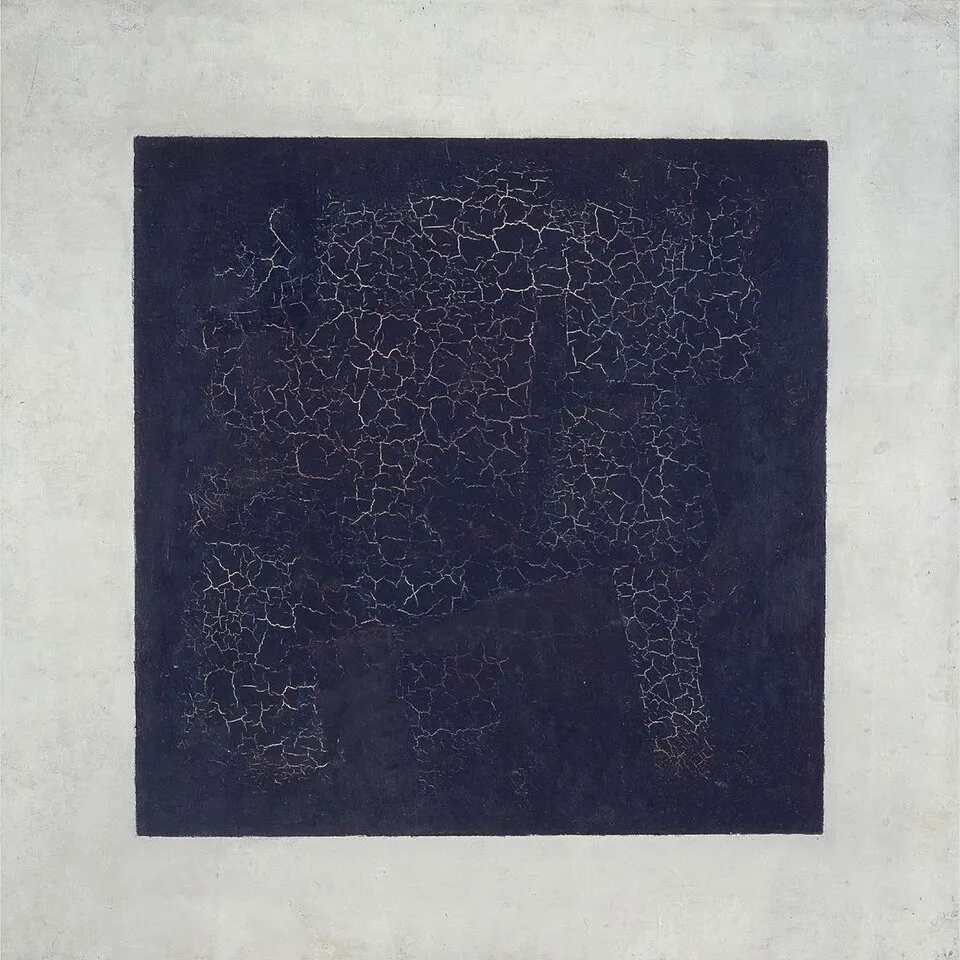
Kazimir Malevich, "Black Suprematic Square" (1915), oil on linen canvas, 79.5 x 79.5 cm. Tretyakov Gallery, Moscow. Malevich exhibited this painting in the "icon corner" of a 1915 exhibition, a deliberate positioning of it as a secular sacred object. When seen in person, the slight imperfections and brushwork in what appears in reproduction as a flat black surface become visible. Image: Public domain, via Wikimedia Commons
Rothko and the Experience of Presence
Mark Rothko (1903 to 1970) occupies a different position in the history of abstract art. Where Malevich was philosophical and systematic, Rothko was emotional and almost mystical. His mature paintings from the 1950s and 1960s consist of two or three soft-edged rectangles of color floating against a ground. They have no titles in the conventional sense, only numbers and color descriptions. They resist description and resist reproduction: the soft luminosity of the color areas, which appear to breathe and pulse in person, is reduced to flat color patches in photographs.
Rothko was explicit about what he wanted from viewers. He said his paintings were not about color or form but about "tragedy, ecstasy, doom." He wanted viewers to stand close to the work and said that if they were moved to weeping, they were having the intended experience. Many people do report strong emotional responses to Rothko's paintings in person, including physical reactions: prickled skin, quickened breathing, tears. These responses occur even in people who arrive skeptical or resistant.
A 2026 study published in Frontiers in Psychology explored whether abstract art can evoke the emotion of being moved without curatorial text or narrative cues. Conducted at the Heidi Horten Collection in Vienna, the study used three experiments to triangulate across methods. The findings showed that viewers can experience genuine, though typically moderate, emotions of being moved by abstract paintings even without explanatory text. These emotions depended primarily on viewer-centered meaning-making and interpretive engagement rather than on low-level visual features like color or composition. This is significant because it means the discomfort you feel in front of abstract art is not a barrier to emotional response. It is the precondition for it. The brain, denied its usual pattern-recognition shortcuts, starts constructing personal meaning, and that construction is what produces the emotional response. The full study is at Frontiers in Psychology.
The discomfort many people initially feel with Rothko's work is related to the gap between what they expect (subject matter, narrative, skill display) and what they are given (colored light, spatial ambiguity, emotional pressure). The paintings force the viewer into a position where all of the conventional tools for discussing art are useless, and the only option is direct, embodied response. This is uncomfortable for people who have been trained to analyze rather than feel. It is also, for many people, the most profound aesthetic experience they have had in a gallery.
Barnett Newman and the Confrontational Line
Barnett Newman (1905 to 1970) created a different kind of uncomfortable abstract art. His paintings consist of large fields of color interrupted by one or more thin vertical lines he called "zips." The paintings are enormous: "Cathedra" (1951), for example, measures 244 x 544 cm. Standing in front of it, you are surrounded by deep blue with two white and light blue zips that divide the composition with abrupt authority.
Newman wrote that his zips were not dividing the canvas but creating a sense of place within it. The zip is a horizon, a human measure against vastness, a presence. Newman wanted his paintings to produce the experience of the sublime: the overwhelming scale of something too large to comprehend fully, combined with the awareness of your own small, particular existence within it. The zip is the "I" within the infinite field.
Many viewers find this claim pretentious and the paintings empty. This is a legitimate response, but it is worth sitting with the discomfort before concluding. Newman's paintings reward extended looking in ways that are difficult to describe in advance. What initially seems like emptiness begins to develop spatial depth, internal relationships, and a quiet pressure that builds over time. The discomfort is the work's invitation to a different kind of looking.
Why the Discomfort Is the Point
The abstract artists of the 20th century were not simply trying to avoid the difficulty of representational skill. Many of them, including Rothko and Newman, were technically capable representational painters who chose abstraction deliberately. The discomfort their work produces was, for most of them, a feature rather than a bug.
The argument they were making, implicitly and sometimes explicitly, was that art which gives the viewer everything they expect in a comfortable package is not asking enough of the viewer. The comfort of conventional beautiful art allows the viewer to remain passive, to consume the artwork as visual entertainment without being changed by it. The discomfort of abstract art, when the artist has executed their vision with integrity, is a demand for active engagement: stop looking for something to recognize and start noticing what is actually happening to your perception and your emotional state.
A 2024 study in Visual Neuroscience provided support for the idea that visual discomfort is a real neurological phenomenon, not a cultural affectation. The study found that images whose statistical properties deviate from those of natural scenes are processed less efficiently by the brain and produce larger neural responses, which correlate with discomfort judgments. Artworks, by contrast, are processed more efficiently than even natural images, producing the smallest neural responses. The exception is the work of Bridget Riley, whose Op Art paintings produce large neural responses and high discomfort because their geometric patterns violate the brain's expectations for natural image statistics. This means that some abstract art is literally harder for your brain to process, and that difficulty is measurable. The full study is available at Cambridge University Press.
This is connected to a broader argument about what art is for. If art's purpose is to decorate, to entertain, or to illustrate narratives, then abstract art fails. If art's purpose is to produce specific states of consciousness and expanded modes of perception, then abstract art may be the most efficient tool available, because it has stripped away everything except the essential mechanisms that produce those states. For a deeper look at the movement that produced many of these ideas, see our guide to abstract expressionism.
How to Approach Abstract Art Without Pretending
The most common mistake people make with abstract art is pretending to understand it in the way they would understand a representational painting. You do not need to decode abstract art. You need to experience it. Several practical approaches help:
Give it time: Stand in front of an abstract painting for at least five minutes. Most people spend an average of thirty seconds in front of any museum painting. Abstract art almost never reveals itself in thirty seconds.
Notice your body: Pay attention to physical sensations, not just visual ones. Does the painting make you feel enclosed or expansive? Heavy or light? Tense or calm?
Notice the color relationships: What is happening between the color areas? Do they clash or harmonize? Is one advancing while another recedes?
Drop the question "what is it?": The question "what does this represent?" is often the wrong question for abstract work. Try replacing it with "what is happening here?" or "what does this make me feel?"
Our guides to the psychology of color and composition in art will give you more specific tools for reading what abstract paintings are doing with their visual elements. You might also find our guide to what makes art good useful for thinking about how skill and meaning operate when representation is absent.
Final Thoughts
The discomfort that abstract art produces in many viewers is a genuine psychological response to a genuine challenge. The artists who made it intended the challenge. They were asking viewers to expand their definition of what art can do, to give up the comfort of representation and subject matter and engage with form, color, and space directly. Some viewers find this liberating. Others find it alienating. Both responses are honest, and both are worth staying with rather than immediately resolving.
The abstract art that most consistently changes viewers over time is not the easiest or most immediately beautiful, but the most formally uncompromising. If you want to test this, spend an extended period with any major Rothko in person. Be patient with your own discomfort. You may find that it is not the painting that is empty. What abstract work have you found yourself unexpectedly drawn to? Share in the comments below.