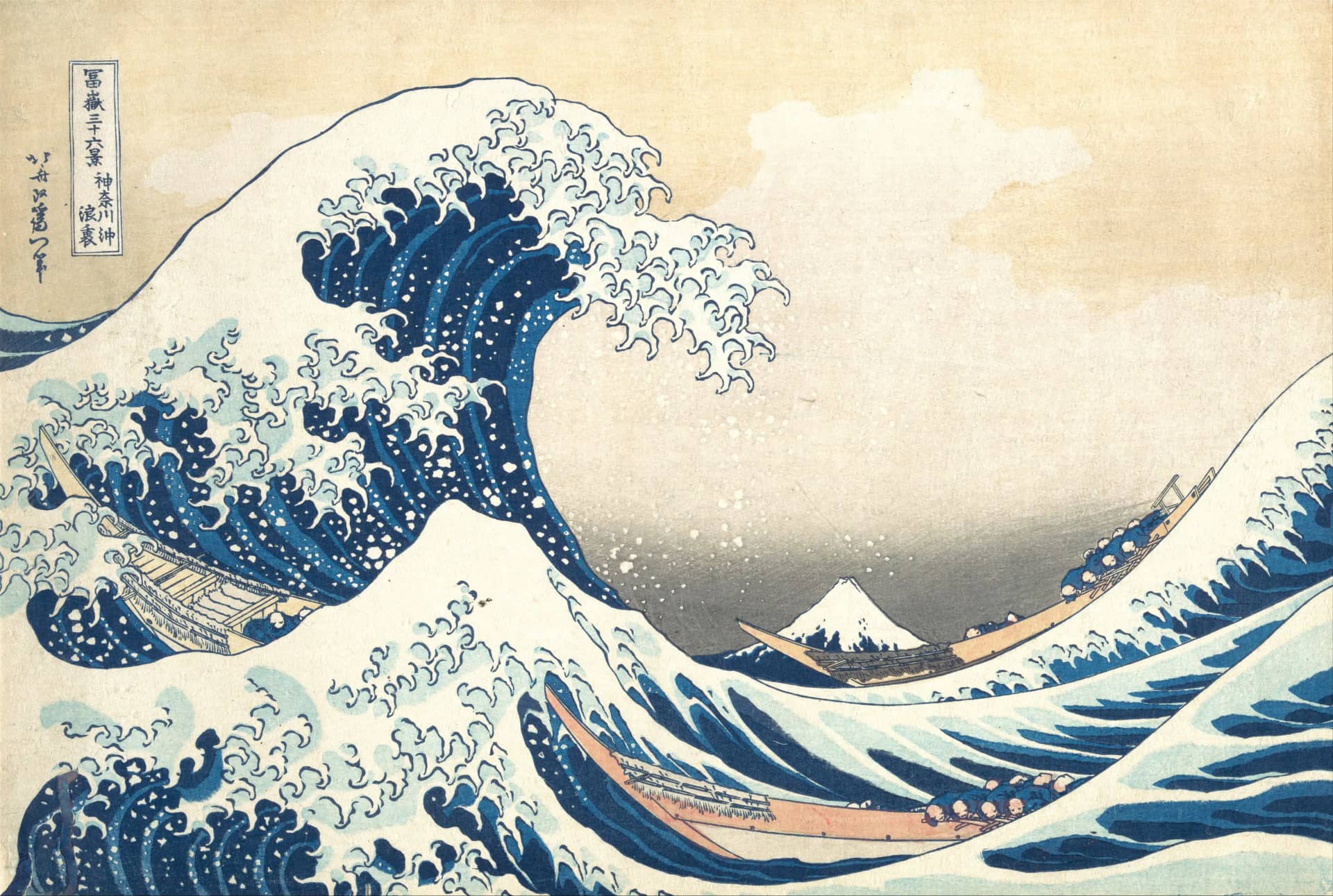
"The Great Wave off Kanagawa" (c.1831) is one of the most reproduced images in the history of visual culture. The enormous curling wave, its claw-like foam fingers reaching down toward the tiny boats below, the miniaturized cone of Mount Fuji visible in the background: the image is so familiar that it takes a conscious effort to look at it again with fresh attention. When you do, you notice how strange it actually is. The wave is not depicted naturalistically. Its form is simplified, almost decorative, organized by a sense of rhythmic pattern that owes as much to design as to observation. The color is flat and intense. The composition is so bold that it seems to anticipate the graphic sensibility of modern advertising and poster design by a century.
Katsushika Hokusai was approximately 70 years old when he designed "The Great Wave." He had been working as a professional artist for more than fifty years. He had changed his name at least thirty times over his career, each name change signaling a deliberate new beginning. He had studied and abandoned multiple artistic styles, moved house nearly a hundred times, and by his own account had not truly mastered drawing until his seventies. The work he produced in the final two decades of his life, the "Thirty-Six Views of Mount Fuji" series, the "One Hundred Views of Mount Fuji," and the hundreds of other prints and illustrated books of his late period, was the culmination of a creative life of relentless reinvention.
This profile traces Hokusai's extraordinary career, his influence on European and American art, and the specific qualities of his work that continue to make him one of the most broadly recognized artists in history.
Edo Japan and the Ukiyo-e Tradition
Katsushika Hokusai was born in 1760 in the Katsushika district of Edo (present-day Tokyo), into a family of craftsmen. His father was a mirror-maker who served the Tokugawa shogunate. From childhood, Hokusai showed an obsessive interest in drawing, and at around age twelve he worked in a library and print shop. In 1778, at age eighteen, he entered the studio of Katsukawa Shunshō, one of the leading masters of ukiyo-e, the Japanese tradition of woodblock printing.
Ukiyo-e, meaning "pictures of the floating world," had developed in the cultural centers of Edo, Osaka, and Kyoto from the 17th century onward. It catered primarily to the merchant and artisan classes, who lacked the social standing to commission painted scrolls in the classical tradition but had money and a taste for visual entertainment. Ukiyo-e prints depicted the pleasures of urban life: kabuki actors, sumo wrestlers, beautiful women, tea houses, and eventually landscapes. The prints were produced through a collaborative process: the artist made the design, a block-cutter carved it into wooden blocks (one block per color), and a printer applied ink and paper to produce editions of hundreds or thousands of impressions.
In this tradition, Hokusai became a complete master. But he was congenitally incapable of settling. He studied Kano school painting, Western perspective through Dutch books, Chinese painting, and the indigenous Yamato-e tradition, absorbing everything and integrating it into a continuously evolving visual language that had no exact parallel in the ukiyo-e world around him.
The Manga and the Education of a Visual Culture
From 1814 onward, Hokusai produced the fifteen volumes of the "Hokusai Manga," a vast collection of sketches covering virtually every subject he had ever drawn: landscapes, people, plants, animals, mythological creatures, martial arts techniques, facial expressions, architectural details, fish, birds, and hundreds of other subjects. The word "manga" in this context meant "whimsical pictures" or "random sketches," and it was used by Hokusai himself. The modern Japanese manga comic tradition, which has spread globally, does not descend directly from Hokusai's books, but the name was revived for the modern form in homage to his precedent.
The Manga volumes were used as drawing instruction books and became enormously popular both in Japan and, after Japan opened to Western trade in the 1850s, in Europe and America. They were among the first Japanese art materials to circulate widely in the West, and their influence on European artists was substantial. Edgar Degas, Claude Monet, Mary Cassatt, and Henri de Toulouse-Lautrec all collected Japanese prints and were directly influenced by their compositional strategies: unusual viewpoints, cropped figures, flat color areas, and the use of asymmetrical empty space as a compositional element. The movement known as Japonisme, the European fascination with Japanese aesthetics that ran through the 1860s to the 1890s, was fueled significantly by Hokusai's prints.
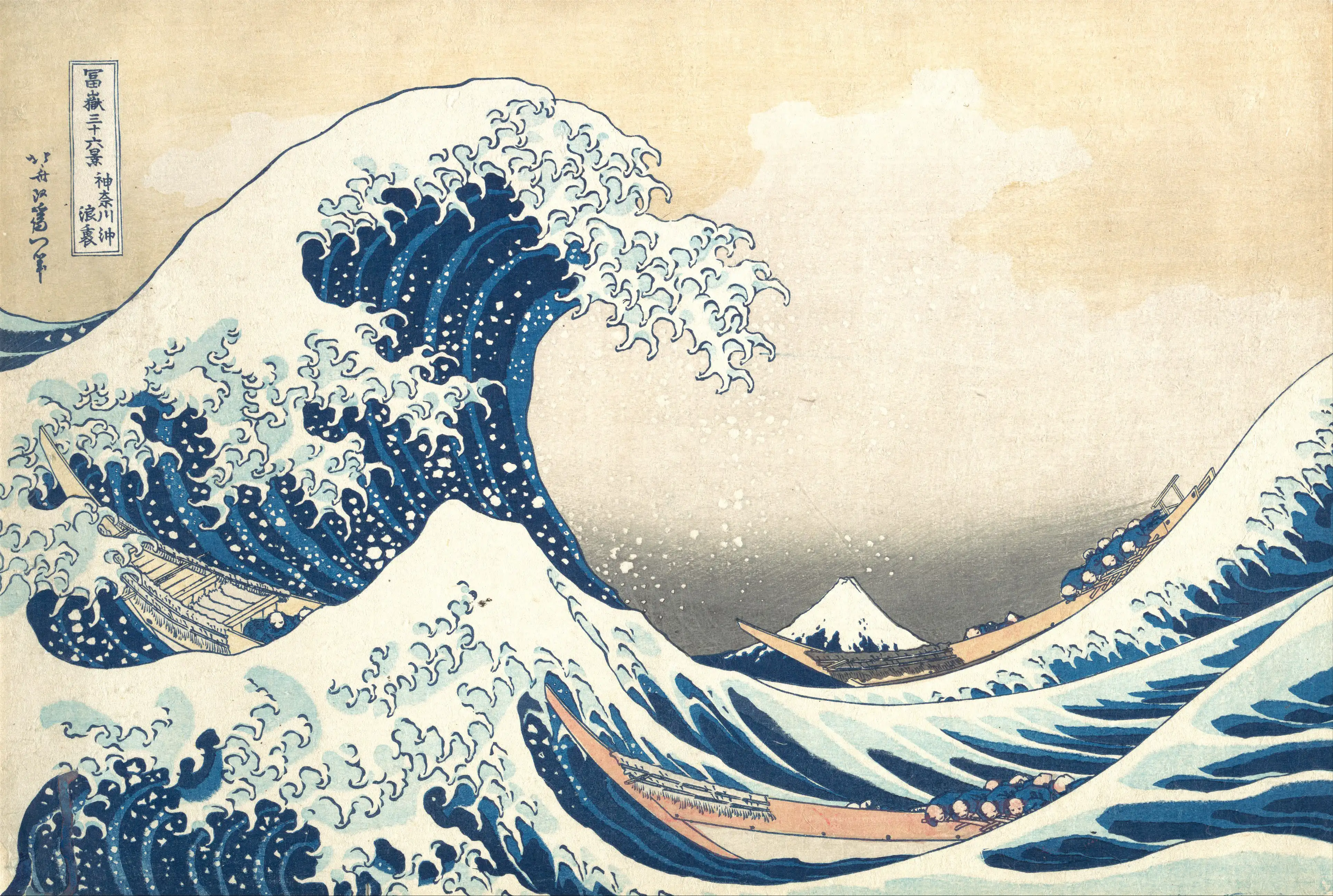
Katsushika Hokusai, "The Great Wave off Kanagawa" (c.1831), color woodblock print, 25.7 x 37.9 cm. From the series "Thirty-Six Views of Mount Fuji." Original printing at the Metropolitan Museum of Art, New York, and multiple other major museums. Image: Public domain, via Wikimedia Commons
Thirty-Six Views of Mount Fuji: A National Landscape
The series "Thirty-Six Views of Mount Fuji," produced between approximately 1826 and 1833, represents Hokusai at the peak of his powers. The series was innovative in taking landscape, rather than actors, beauties, or urban scenes, as its primary subject, and in using the distant cone of Fuji as a compositional constant that appears in different scales, different positions, and different contexts in each print. The approach was unprecedented in Japanese printmaking: a sustained investigation of a single landscape element across multiple compositions, analogous in some ways to Monet's series paintings of haystacks and cathedrals, though Hokusai preceded Monet's series work by sixty years.
"The Great Wave," officially titled "Under the Wave off Kanagawa," is the most famous print from the series but is not necessarily representative. The series also includes serene images of farmers working in rice paddies with Fuji in the background, travelers on roads, pilgrims on the mountain itself, and industrial scenes showing woodcutters and craftsmen. The range of subject, mood, and compositional approach across the thirty-six prints (forty-six including the additional ten prints published as the series sold successfully) demonstrates the breadth of Hokusai's visual intelligence.
The technique Hokusai used in the series was refined over decades of practice. His mastery of the woodblock printmaking process, particularly the use of multiple blocks to achieve complex color effects and the precise registration required to line up multiple printings accurately, was the technical foundation that made such visual ambition possible.

Katsushika Hokusai, from "One Hundred Views of Mount Fuji" (1834-35), woodblock print. The Three Views of Fuji series showed Hokusai continuing to develop new approaches to his primary subject even in his mid-seventies. Image: Public domain, via Wikimedia Commons
The Final Decade and the Declaration of Mastery
Hokusai's famous statement about his own development, recorded in the postscript to his "One Hundred Views of Mount Fuji" (1834), is one of the most extraordinary self-assessments in art history. He wrote that from the age of six he had been seized with a passion for drawing, that by seventy he had made some progress, that by ninety he would understand the true nature of things, and that at one hundred and ten, his smallest brushstroke would be alive. He was seventy-four when he wrote this.
He produced work until the last months of his life. He died on May 10, 1849, in Edo, at approximately age 88 or 89. According to one account, his last words expressed the wish for another ten years, or failing that, another five, to allow him to become a true artist. Whether or not the story is authentic, it captures something true about a man who spent nine decades in a state of genuine creative urgency, always moving forward, always dissatisfied with what he had done, always beginning again.
Final Thoughts
Hokusai's influence on Western art was enormous and largely unacknowledged at the time it was exercised. His compositional strategies, his use of flat color and bold outline, his willingness to crop figures and to use empty space as an active compositional element, and his conception of landscape as a subject of infinite visual possibility all entered European art through the Japonisme movement of the 1860s-1890s. Degas's unusual viewpoints, Monet's focus on natural phenomena, Van Gogh's simplified line and bold color, and the poster art of Toulouse-Lautrec are all partially Hokusai's legacy, though few of the artists who absorbed his influence had met any living Japanese artist.
In Japan, his reputation has never wavered. His image appeared on the 1,000-yen banknote. His work is in every major world museum. "The Great Wave" has been reproduced more widely than any other Japanese artwork and holds its own among the most recognized images in global visual culture. More than 170 years after his death, Hokusai's goal of never stopping until the last mark was alive feels less like boast and more like a precise description of what his work actually does.
For a closer look at the printmaking techniques Hokusai mastered, read the guide to Printmaking 101: Linocut, Etching, and Screen Printing. To explore how Hokusai's influence shaped European modernism, see Impressionism: Monet, Light, and Breaking Academic Rules. Have you seen a Hokusai print in person? Share your experience below.


