
The Orange County Museum of Art puts it plainly: "Art gives middle and high schoolers a space to experiment with ideas, perspectives, and ways of seeing the world. A sketchbook, a camera, a collage made from whatever's around: these aren't just creative outlets, they're ways of working through who you are and what you think." This is not how most teenagers experience art. Most teenagers experience art as a school subject, something they are tested on, something with right and wrong answers, something that happened in the past and has nothing to do with them. The Kennedy Center notes that "predicting how your teenager's interactions with the arts today will play out years from now is near impossible" but "gentle encouragement throughout the high school years to make art a part of their life" is the key. The problem is not that teenagers do not care about art. The problem is that the way art is presented to them, as history, as canon, as something you must appreciate correctly, is precisely the way to make them not care. The solution is not to dumb art down. The solution is to connect art to what teenagers already care about: identity, social media, visual culture, self-expression, and the world they live in.
Art appreciation for teenagers is not about teaching them to love Rembrandt. It is about teaching them to see, to look at the images that surround them (on screens, on walls, in museums, in advertisements) with critical eyes. Art appreciation is visual literacy, and visual literacy is a survival skill in an image-saturated world. This guide covers why traditional art education fails teens, how to connect art to their world, the identity connection, making museums actually interesting, hands-on engagement, and practical strategies for parents and teachers. For the broader context of how to teach art to younger kids, see our guide to teaching art to children.
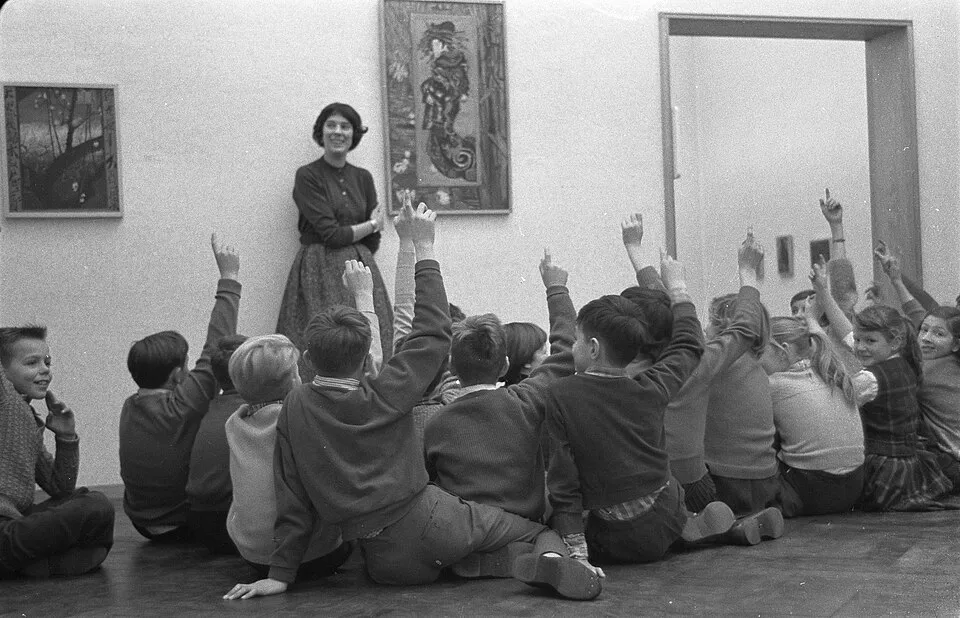
Teenagers in a museum. Research shows that "art gives middle and high schoolers a space to experiment with ideas, perspectives, and ways of seeing the world." Image via Wikimedia Commons
Why Traditional Art Education Fails Teenagers
Traditional art education presents art as history, a chronological march from cave paintings to contemporary, with dates, names, and movements to memorize. This approach works for some students but fails for most teenagers because it treats art as information rather than experience. Teenagers are not empty vessels waiting to be filled with facts. They are people in the middle of the most intense identity formation of their lives, looking for tools to understand themselves and their world.
Art education often implies that there is a "correct" way to appreciate art, that you must know the historical context, the movement, the technique, and the artist's biography before you can "understand" a painting. This is backwards. Understanding comes from engagement, and engagement comes from personal connection. The teenager who sees something of their own experience in a Frida Kahlo self-portrait understands that painting, even if they cannot name the movement or the date.
The Art of Education University offers advice that applies here: "project confidence in the interactions. Teenagers can sense hesitation and will often interpret it as insincerity." The same applies to art appreciation. If you present art as something they "should" care about, they will not. If you present art as something that might interest them, they might. The Art of Education's guide to reaching teens in the art room is worth reading for anyone teaching this age group.
Connect Art to Their World: Social Media, Street Art, Visual Culture
Teenagers see more images in a day than a Renaissance person saw in a lifetime. Instagram, TikTok, YouTube: these are visual media, and the skills of art appreciation (composition, color, framing, symbolism) apply directly to them. Teaching a teenager to analyze a TikTok video with the same tools used to analyze a painting is art appreciation, and it meets them where they are. The teenager who can identify why a particular shot in a video looks "cinematic" is doing visual analysis. They just do not know it yet.
For many teenagers, the first art they engage with is not in museums but on walls. Banksy, Shepard Fairey, JR: these are artists who work in public space, who address contemporary issues, and whose work is accessible without a museum ticket. Street art is also a gateway to art history. Banksy's "Girl with Balloon" connects to the tradition of political art from Goya to Picasso to Keith Haring. The connection is not forced. It is there in the work itself.

Street art mural. For many teenagers, the first art they engage with is not in museums but on walls: street art, graffiti, and public murals that speak to their world. Image via Wikimedia Commons
Art appreciation is not just about fine art. It is about all visual culture. Advertisements, memes, movie posters, video game design, fashion: these are all images that use the same principles as painting (composition, color, contrast, symbolism). Teaching teenagers to see these principles in the images they already encounter is art appreciation in disguise. The teenager who can explain why a movie poster uses red and black is doing color theory. For more on where art is heading, see our guide to contemporary art trends in 2026.
The Identity Connection: Art as Self-Exploration
Teenagers are in the middle of identity formation, figuring out who they are, what they believe, and where they belong. Art that speaks to identity connects directly to what teenagers are already thinking about. Frida Kahlo's self-portraits, Jean-Michel Basquiat's neo-expressionist explorations of race and culture, Cindy Sherman's identity performances: these are not historical artifacts to teenagers. They are conversations about the same questions teenagers are asking themselves.
Frida Kahlo painted her own face over and over, not out of vanity but out of necessity. "I paint self-portraits because I am so often alone, because I am the person I know best." This is a teenager's statement. Teenagers are also alone, also trying to know themselves, also looking in the mirror. Kahlo's self-portraits are not about art history. They are about identity, pain, and self-creation. That is why teenagers respond to them. For more on Kahlo, see our guide to Frida Kahlo.
Jean-Michel Basquiat started as a graffiti artist (SAMO) and became one of the most expensive artists in history. His work addresses race, power, and identity, subjects that teenagers care about. His story (young, Black, self-taught, dead at 27) is also a story that teenagers can relate to. Basquiat is not a historical figure to teenagers. He is a contemporary, a peer, someone who spoke their language. For more, see our guide to Basquiat.
Cindy Sherman photographs herself as fictional characters, proving that identity is a construction, a performance, a choice. This is a deeply teenage idea, the sense that identity is something you can try on, change, and perform. Sherman's "Untitled Film Stills" (1977-1980, 69 photographs) are about the same thing teenagers are thinking about: who am I, and am I choosing who I am?
Making Museums Actually Interesting
Museums are not designed for teenagers. They are designed for adults: quiet, reverent, slow. Teenagers are loud, restless, fast. The museum experience, walking through galleries, reading wall labels, looking at paintings, is exactly the kind of experience that teenagers find boring.
The solution is to change the experience. Instead of walking through the entire museum, pick one artwork and spend 20 minutes with it. Instead of reading the wall label, ask: what do you see? What do you think is happening? What does this remind you of? Instead of reverent silence, encourage conversation, debate, disagreement, reaction.
A museum scavenger hunt works because it gives teenagers a task, and tasks work better than instructions. Find a painting that reminds you of a song. Find a sculpture that looks like someone you know. Find a portrait whose subject you would want as a friend. The scavenger hunt turns the museum from a passive experience into an active one.
Do not ban phones in museums. Use them. Ask teenagers to photograph the artwork that interests them most, then explain why. Ask them to find an artwork and recreate it with their own body. Ask them to find an artwork and write a one-sentence story about it on social media. The phone is not the enemy of art appreciation. It is a tool for it. For more on how to look at art, see our guide to how to look at art for beginners.
Hands-On Engagement: Making, Not Just Looking
Art appreciation is not just about looking. It is about making. The teenager who tries to draw a self-portrait understands self-portraiture in a way that the teenager who only looks at Rembrandt's self-portraits does not. Making art is the deepest form of art appreciation, because it reveals the choices, the difficulties, and the decisions that looking alone cannot.
Give a teenager a sketchbook and a pen. Do not instruct them on what to draw. Let them draw what they want: their friends, their room, their feelings, their favorite characters. The sketchbook is a private space, not for display, not for grading, not for correction. The sketchbook is where art appreciation begins, because it is where the teenager discovers that they can make images, and that making images is a way of thinking.
Collage is the most accessible art form for teenagers. It requires no drawing skill, only cutting and pasting. Give them magazines, scissors, glue, and paper. Ask them to make a collage that represents who they are. The collage is a self-portrait, not drawn but assembled, not created from scratch but constructed from existing images. The collage teaches composition, color, and meaning, the fundamentals of art, without the intimidation of the blank page.
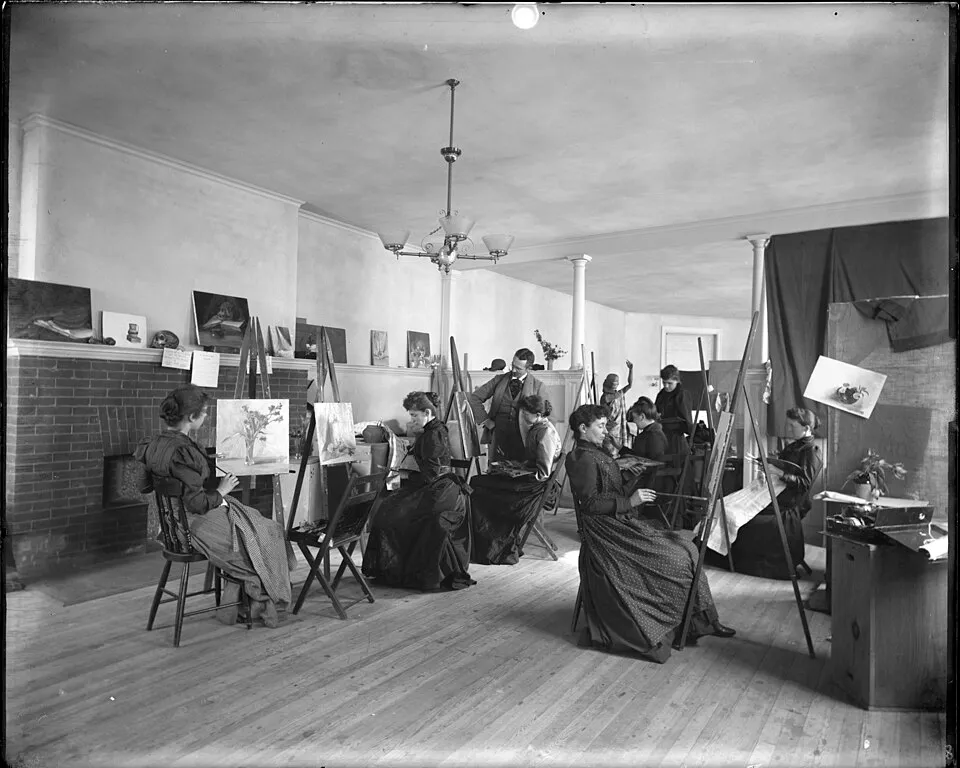
Teenagers in an art class. "A sketchbook, a camera, a collage made from whatever's around: these aren't just creative outlets, they're ways of working through who you are and what you think." Image via Wikimedia Commons
For teenagers who are more comfortable with screens than with paper, digital art tools (Procreate, Canva, even phone cameras) are legitimate art-making tools. A teenager who edits photos on their phone is making art, and understanding that is the first step toward art appreciation. For more on the therapeutic benefits of making art, see our guide to art therapy.
Practical Strategies for Parents and Teachers
Do not say "you should appreciate this." The word "should" kills interest. Instead, say "what do you think of this?" The question invites engagement. The command demands compliance. Teenagers resist compliance and respond to invitation.
Follow their interests. If a teenager likes anime, explore the history of Japanese art. If they like fashion, explore portraiture and clothing in art. If they like music, explore the relationship between music and visual art (Kandinsky and synesthesia, Whistler's "Nocturnes," Schoenberg and expressionism). The entry point is their interest, not your curriculum. The Kennedy Center's guide to making art a part of your teen's life emphasizes this approach.
Make it social. Teenagers are social creatures. Art appreciation is more effective in groups, with friends, with peers, with conversation. A museum visit with friends is more effective than a museum visit alone. A group discussion about an artwork is more effective than a lecture about an artwork.
Do not correct. If a teenager says something "wrong" about an artwork, misidentifies the subject, misattributes the artist, misinterprets the meaning, do not correct them. Let them be wrong. The engagement matters more than the accuracy. The correction can come later, after the engagement is established. The goal is not to make them right. It is to make them interested. For more resources for beginners of any age, see our guide to art for beginners.
Final Thoughts
Art appreciation for teenagers is not about teaching them to love Rembrandt. It is about teaching them to see, to look at the images that surround them with critical eyes. Traditional art education fails teenagers because it presents art as history rather than experience, as information rather than engagement, as something you "should" appreciate rather than something that might interest you. The solution is to connect art to their world: social media, street art, and visual culture. The identity connection is key. Kahlo's self-portraits, Basquiat's explorations of race and culture, and Sherman's identity performances all speak to what teenagers are already thinking about. Making museums interesting requires changing the experience: pick one artwork and spend 20 minutes with it, use scavenger hunts, and use phones as tools. Hands-on making is the deepest form of art appreciation because it reveals the choices and decisions that looking alone cannot.
If you are a parent or teacher of a teenager, do not try to make them appreciate art. Try to make them see: the images on their phone, the art on their walls, the visual culture they swim in. Give them a sketchbook. Take them to a museum and let them choose what to look at. Ask them what they think, not what they know. The goal is not to create art lovers. The goal is to create people who can see, and seeing is a skill they will use for the rest of their lives.


