
Walk into any major museum and you will pass through rooms of paintings spanning 500 years in the space of twenty minutes. The colors shift, the brushwork changes, the subjects transform from biblical scenes to soup cans to blank canvases. Most visitors sense the differences but cannot name them. They know a painting "looks old" or "looks modern" without knowing why. This is not a failure of education. It is a failure of looking closely enough.
Recognizing art styles is not about memorizing dates and artist names. It is about learning to see the specific visual clues that distinguish one way of making pictures from another. Brushwork, color choices, how depth is constructed, whether the paint is smooth or thick, whether the subject is idealized or honest: these are the signals that tell you what you are looking at. Once you can read them, every painting becomes more interesting, because you can see the decisions the artist made and the tradition they were working within or against.
This guide covers the major Western art styles from Realism to Contemporary, with specific visual clues for recognizing each one.
The Four Questions to Ask First
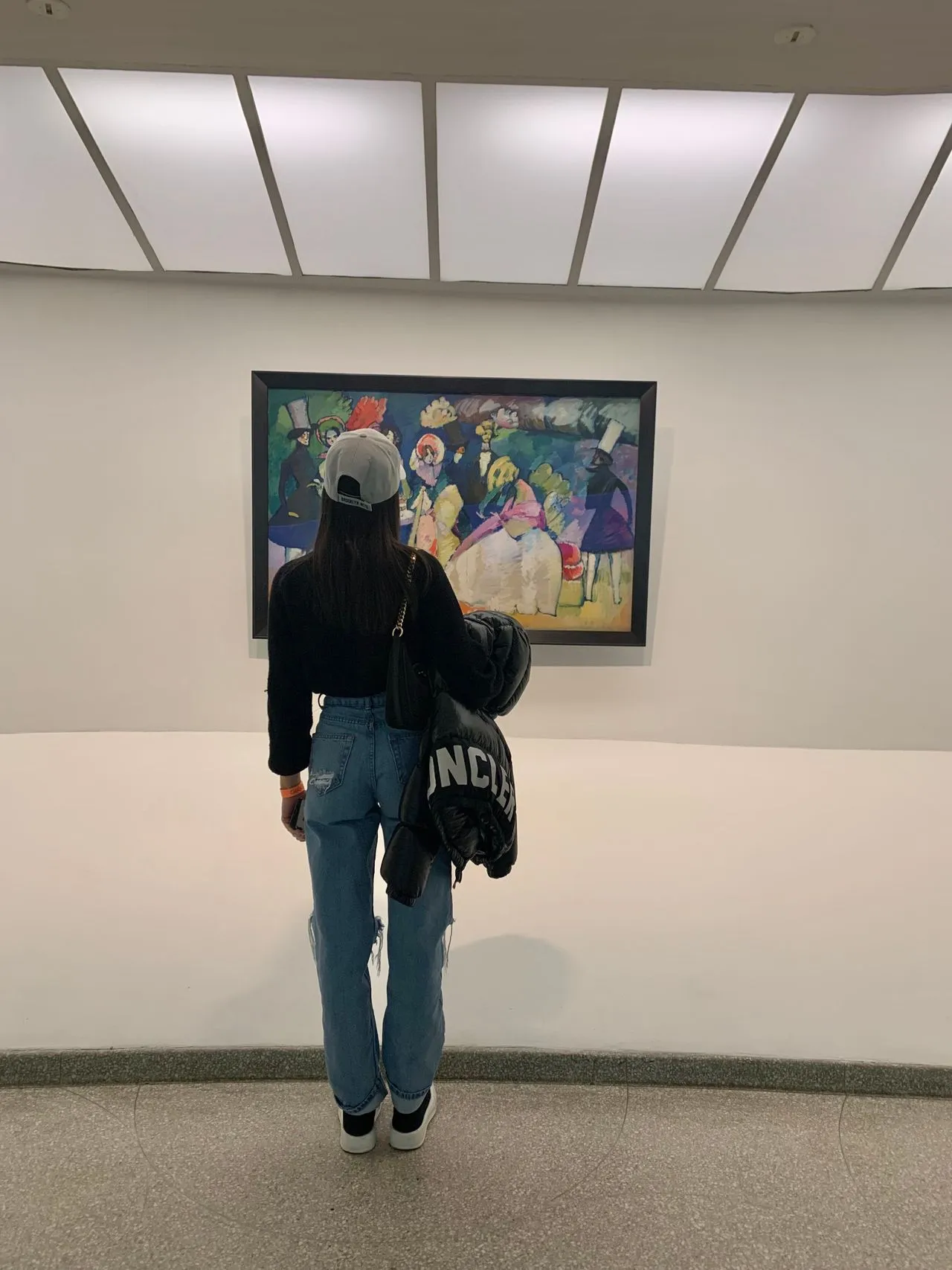
Photo by Gianna P1 on Pexels.com
Before trying to name a style, ask yourself four questions about what you see:
How does the paint look? Is it smooth and invisible, or can you see individual brushstrokes? Are the colors blended on the canvas or applied in separate marks? The surface texture tells you a lot about when and how the painting was made.
What is the subject? A biblical scene, a portrait, a landscape, a bowl of fruit, a blank canvas? Subject matter narrows the possibilities immediately. Mythological scenes with idealized figures point to academic painting. A worker in a field points to Realism or later. A soup can points to Pop Art.
How is space constructed? Does the painting use linear perspective with a clear vanishing point, or is space flattened and compressed? Do objects look three-dimensional or deliberately two-dimensional? How space is handled is one of the most reliable indicators of style.
What is the relationship to reality? Does the painting try to look like what the eye sees, or does it distort, simplify, or abandon visible reality entirely? This single question separates Realism from Expressionism from Abstraction.
Realism
Realism emerged in France in the 1840s and 1850s, led by Gustave Courbet. Before Realism, the highest-status painting was history painting: idealized scenes from the Bible, mythology, and ancient history, with smooth surfaces, perfect figures, and academic composition. Courbet rejected all of it. He painted ordinary people doing ordinary things: stonebreakers breaking rocks on a road, a funeral in a provincial town, a woman sleeping. He used thick, visible paint and direct, unflattering observation.
You can recognize Realism by its subject matter (working-class people, rural life, unidealized faces), its visible brushwork (thicker and rougher than academic painting), and its refusal to prettify. Courbet's "The Stone Breakers" (1849) shows two laborers at a roadside, their faces barely visible, their clothing patched and worn. There is no narrative, no moral lesson, no beauty ideal. It is a painting about the physical reality of labor.
Visual clues: Ordinary subjects, visible brushwork, earthy colors, no idealization.
Impressionism
Impressionism emerged in Paris in the 1870s. Claude Monet, Pierre-Auguste Renoir, and Camille Pissarro painted outdoors rather than in studios, using rapid, broken brushwork to capture the effect of light at a specific moment. The name came from a hostile critic who mocked Monet's "Impression, Sunrise" (1872) as being nothing more than an impression, not a finished painting. The artists adopted the term.
You can recognize Impressionism by its loose, visible brushwork (you can see every stroke), its bright, unmixed colors applied directly to the canvas, its avoidance of black (shadows are painted in purples and blues), and its subjects: landscapes, gardens, Parisian cafes, people enjoying leisure. The paint is always thin and rapid. There is no careful blending or smooth surface. According to the Metropolitan Museum's guide to Impressionism, the movement's core innovation was painting outdoors to capture transient effects of light rather than working from sketches in a studio.
Visual clues: Visible broken brushwork, bright colors, purple shadows, outdoor scenes, thin paint.
Post-Impressionism
Post-Impressionism is not a single style but a group of individual responses to Impressionism that emerged in the 1880s and 1890s. Vincent van Gogh, Paul Cezanne, Paul Gauguin, and Georges Seurat all started from Impressionism's color and light but pushed in different directions. Van Gogh used thick impasto paint and swirling, expressive lines to communicate emotional intensity. Cezanne structured his paintings around geometric forms, treating nature as "the cylinder, the sphere, and the cone." Seurat painted with tiny dots of pure color, a technique called Pointillism, that relied on optical mixing rather than brushwork.
You can recognize Post-Impressionism by its thicker paint than Impressionism, its more structured compositions, its use of color for emotional or symbolic effect rather than just for describing light, and its move away from the rapid, observational quality of Impressionist painting toward something more deliberate and constructed.
Visual clues: Thick paint, structured composition, symbolic color, deliberate rather than spontaneous.
Expressionism
Expressionism emerged in Germany in the early 20th century with groups like Die Brucke (The Bridge) and Der Blaue Reiter (The Blue Rider). Expressionist painters used distorted forms, jagged lines, and intense, often non-naturalistic color to communicate inner emotional states rather than external reality. Edvard Munch's "The Scream" (1893), though painted before the movement formally began, is the most recognized Expressionist image: a figure on a bridge, face distorted, sky swirling in red and orange, communicating anxiety so directly that it has become a universal symbol for existential dread.
You can recognize Expressionism by its distorted figures, its harsh, unnatural colors, its agitated brushwork, and its subjects that deal with psychological states rather than observable reality. Ernst Ludwig Kirchner's Berlin street scenes, with their elongated figures and acidic colors, are textbook Expressionism.
Visual clues: Distorted forms, harsh colors, agitated brushwork, psychological intensity.
Cubism
Cubism was invented by Pablo Picasso and Georges Braque in Paris between 1907 and 1914. It is one of the most radical departures in Western art history. Instead of showing a single viewpoint, Cubist paintings show multiple viewpoints simultaneously, breaking objects into geometric facets and reassembling them on a flat surface. Picasso's "Les Demoiselles d'Avignon" (1907) is the proto-Cubist work: five figures whose bodies are fractured into angular planes, faces influenced by African and Iberian masks, space compressed until foreground and background are indistinguishable.
You can recognize Cubism by its fragmented, geometric forms, its flattened space (no traditional perspective), its muted palette of browns, grays, and ochres in Analytic Cubism, and its incorporation of real materials like newspaper and wallpaper in Synthetic Cubism. The painting does not show what the eye sees from one position. It shows what the mind knows about an object from multiple positions, compressed into a single image.
Visual clues: Fragmented geometric forms, flattened space, multiple viewpoints, muted colors.
Surrealism
Surrealism emerged in Paris in the 1920s, influenced by Sigmund Freud's theories of the unconscious. Salvador Dali, Rene Magritte, Max Ernst, and others painted dream imagery: impossible scenes rendered with meticulous, photographic precision. Dali's "The Persistence of Memory" (1931), with its melting clocks draped over a barren landscape, is the most famous Surrealist painting. Magritte's "The Treachery of Images" (1929), showing a pipe with the words "This is not a pipe" written beneath it, questions the relationship between representation and reality.
You can recognize Surrealism by its dreamlike imagery, its meticulous technique (often resembling Renaissance painting in precision), its impossible juxtapositions, and its interest in the unconscious. The paint is usually smooth and controlled, which makes the irrational content more unsettling.
Visual clues: Dream imagery, precise technique, impossible scenes, Freudian symbolism.
Abstract Art
Abstract art abandoned recognizable subject matter entirely. Wassily Kandinsky is generally credited with the first purely abstract paintings, around 1913. By the 1940s and 1950s, Abstract Expressionism, led by Jackson Pollock, Mark Rothko, and Willem de Kooning, made abstraction the dominant mode of American art. Pollock's drip paintings, made by pouring and flicking paint onto a canvas on the floor, have no subject other than the paint itself and the gesture of its making. Rothko's large color field paintings show floating rectangles of color meant to produce a direct emotional response in the viewer.
You can recognize abstraction by the absence of recognizable subjects. Within abstraction, the sub-style depends on the paint handling: aggressive, gestural, and physical points to Abstract Expressionism; flat, hard-edged, and geometric points to Minimalism or Op Art; large areas of single color points to Color Field painting.
Visual clues: No recognizable subject, paint as subject matter, varied techniques.
Minimalism
Minimalism emerged in the 1960s as a reaction against the emotional intensity of Abstract Expressionism. Artists like Donald Judd, Agnes Martin, and Frank Stella produced work that was stripped down, geometric, and impersonal. Judd's wall-mounted boxes, made from industrial materials like aluminum and Plexiglas, have no trace of the artist's hand. Martin's grid paintings, with their faint pencil lines and pale color washes, are so quiet that many viewers walk past them without realizing what they are looking at.
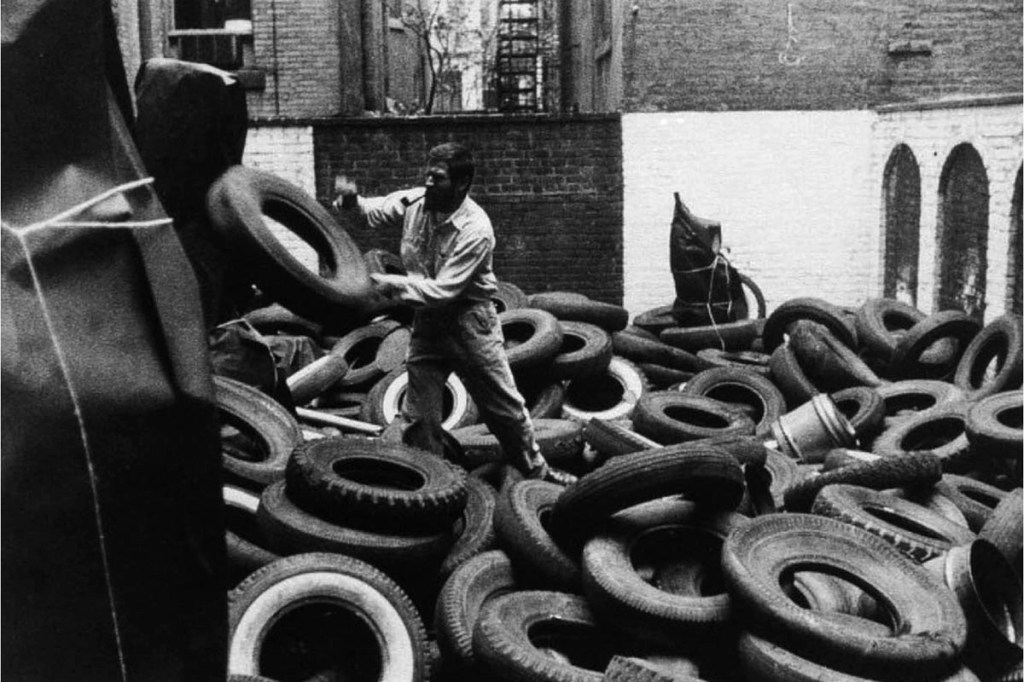
Allan Kaprow, Yard, 1961
You can recognize Minimalism by its extreme simplicity, its industrial materials, its geometric forms, and its refusal of emotional expression. If a work looks like it could have been made in a factory and seems to be doing as little as possible, it is probably Minimalist.
Visual clues: Extreme simplicity, industrial materials, geometric forms, no visible hand.
Conceptual Art
Conceptual Art, emerging in the 1960s, prioritized the idea over the physical object. Joseph Kosuth's "One and Three Chairs" (1965) presents a real chair, a photograph of that chair, and a dictionary definition of "chair." The artwork is not any of these objects. It is the concept of a chair and the questions the installation raises about representation. Sol LeWitt's wall drawings consist of written instructions that anyone can execute, meaning the artwork is the instruction, not the specific execution.
You can recognize Conceptual Art by its use of text, instructions, documentation, and ordinary objects. The visual appearance may be minimal or even absent. What matters is the idea the work communicates. If you find yourself reading a wall label to understand why a pile of candy or a stack of paper is art, you are probably looking at Conceptual Art.
Visual clues: Text, instructions, ordinary objects, idea prioritized over appearance.
Contemporary Art
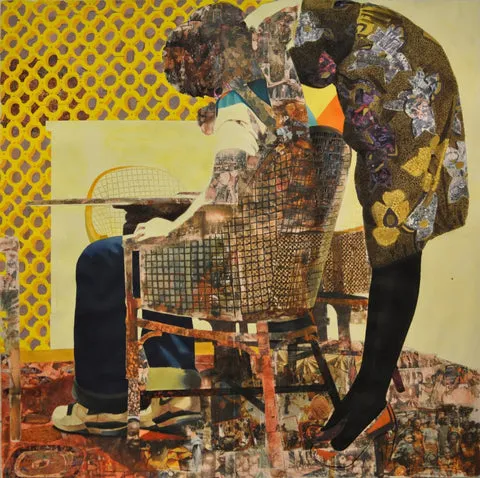
Textured Photo Collage by Nigerian-born artist, Akunyili Crosby
Contemporary art, roughly defined as art made from the 1970s to the present, is the hardest to categorize because it encompasses everything: painting, sculpture, installation, video, performance, digital art, and combinations of all of these. There is no single dominant style. Instead, contemporary art is characterized by its plurality: artists work in whatever medium and style suits their subject matter, and the subject matter is often social, political, or identity-based.
Artists like Njideka Akunyili Crosby combine painting with collage and photo transfer to create works that address cultural hybridity and the experience of living between Nigeria and America. Kehinde Wiley paints portraits of Black subjects in the poses and style of Old Master paintings, reclaiming a tradition that excluded them. Ai Weiwei uses sculpture, installation, and social media to critique the Chinese government's human rights record.
You can recognize contemporary art by its mix of media, its engagement with current social and political issues, and its refusal to fit neatly into any single category. If a work combines painting with video, or sculpture with performance, or uses materials and techniques from outside the traditional art world, it is likely contemporary.
Visual clues: Mixed media, social or political themes, no single dominant style.
When a Work Resists Categorization
Some works do not fit neatly into any style. They combine elements from multiple traditions or deliberately refuse categorization. This is normal and often intentional. Instead of forcing a label, try describing what you see: "This combines Impressionist brushwork with Cubist fragmentation" or "It uses Realist subject matter but Expressionist color." Accurate description is more useful than a correct label, and it is often more interesting.
Making mistakes is also part of the process. Calling a painting the wrong style teaches you more than getting it right, because the mistake forces you to identify exactly which visual clue misled you. The goal is not to be right. It is to look closely enough that you can describe what you see with precision.
Final Thoughts
Recognizing art styles is a skill built through looking, not through memorization. The more paintings you examine, the more readily you will notice the patterns: the broken brushwork of Impressionism, the geometric fragmentation of Cubism, the dream precision of Surrealism, the stripped-down geometry of Minimalism. Each style has its own visual signature, and once you can read those signatures, every museum visit becomes more rewarding.
The point is not to pass a test. It is to look at paintings with enough attention to see the decisions artists made and the traditions they worked within. Understanding style gives you access to the conversation that every painting is part of. For a structured approach to looking at any artwork, read our guide to how to look at art for beginners. For a deeper dive into how these styles evolved chronologically, see the evolution of art styles from Realism to Contemporary. And for the specific techniques behind these styles, our guide to drawing fundamentals covers the building blocks.


