
In 1935, the Works Progress Administration funded adult art classes at the Brooklyn Museum. The photograph from the time shows adults at easels, drawing from a model, in a life class, the same format that art schools have used for centuries. The WPA funded adult art education because it believed that art was not a luxury but a necessity, that adults, not just children, benefit from making art. The WPA was right. Today, adult art classes are offered at community colleges, art schools, museums, independent studios, and online platforms, and the range of options can be overwhelming. A typical beginner course at a community college like Las Positas College in California costs about $190 for four weeks, includes all materials for a $10 fee, and covers "line drawing, shading and blending, proportion, perspective, composition and tonal balance" followed by painting with acrylics. Foothill College offers "Oil Painting I for Older Adults" as a non-credit, no-grade, unlimited-repeat course, "targeted towards older adults" but open to anyone who wants to learn. The message is clear: it is never too late to start making art, and there is a class for every level, every schedule, and every budget.
Adult art education is different from children's art education. Adults come with specific goals: to learn a technique, to relax, to socialize, to fulfill a lifelong desire to make art. They also come with specific fears: that they have no talent, that they will be the worst in the class, that it is too late to start. This guide addresses both the goals and the fears. It covers what to expect (format, materials, instruction, critique), the types of classes available, how to find the right class, what to bring, how to overcome beginner fear, and what research shows about adult art education. For more on oil painting specifically, see our guide to oil painting techniques.

"A life class for adults at the Brooklyn Museum, under the auspice of the New York City WPA Art Project" (c. 1935). Archives of American Art, Smithsonian Institution. Image via Wikimedia Commons
What to Expect: The Studio Class Format
Most adult art classes follow a studio format: easels or tables, a still life or model, an instructor who demonstrates techniques and circulates to give individual feedback. A typical class meets once a week for 2 to 3 hours over 4 to 12 weeks. The instructor demonstrates a technique (color mixing, perspective, glazing), students practice, and the instructor circulates to give individual guidance.
A typical beginner drawing and painting course covers "line drawing, shading and blending, proportion, perspective, composition and tonal balance" (Las Positas College), followed by painting with acrylics: "color theory, color-mixing, impasto painting, glazing, scumbling." An oil painting course at Foothill College covers "value, color, and light to model the three-dimensional form," including "value or tonal under-painting, monochromatic color, warm/cool color, complementary color, local color, tints, tones, and shades." The Las Positas College beginner course is a good example of what to expect.
Most art classes include group critiques, where students present their work and the class discusses it. For adults, critiques can be intimidating, but good instructors frame critiques as constructive feedback, not judgment. The critique is not about whether the painting is "good." It is about what works, what does not, and what to try next. Many courses require or recommend a sketchbook. "Keep an active sketchbook" is listed as a course objective at Howard Community College (ARTS 120). The sketchbook is for practice, experimentation, and idea development, not for finished work.
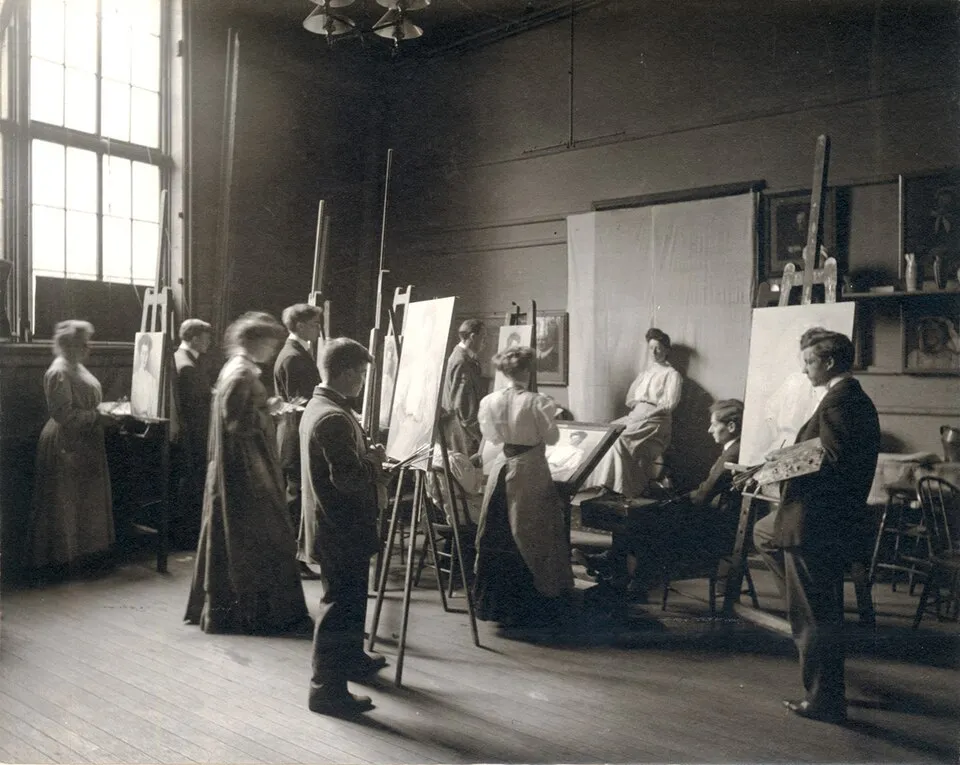
Studio painting class at the Yale School of Fine Arts (c. 1900-1920). The studio class format, easels, models, demonstrations, critiques, has remained largely unchanged for over a century. Image via Wikimedia Commons
Types of Adult Art Classes
Community colleges offer the most affordable and accessible adult art classes. Courses are typically $100 to $300 for 4 to 12 weeks, with materials fees of $10 to $35. Classes are taught by working artists or art educators, and cover drawing, painting (acrylic, oil, watercolor), sculpture, and printmaking. Many community colleges offer non-credit courses specifically for adults and older adults: no grades, no exams, no pressure. Foothill College's "Oil Painting I for Older Adults" (NCAL 406A) is a non-credit, unlimited-repeat course. You can take it as many times as you want.
Art schools (like the School of the Art Institute of Chicago, Rhode Island School of Design) offer continuing education courses for adults. These are more expensive ($300 to $800 per course) but offer higher-quality instruction, better facilities, and access to specialized equipment (printmaking presses, kilns, digital labs). Art school courses are taught by practicing artists and often culminate in a portfolio or exhibition.
Many museums offer adult art classes in their education departments. The Metropolitan Museum of Art, the Museum of Fine Arts Boston, and the Art Institute of Chicago all offer studio classes for adults. Museum classes have the advantage of direct access to the collection: you can paint in the galleries, draw from the sculptures, and study the originals.
Independent art studios offer drop-in classes, untutored sessions, and workshops. These are flexible: you can attend when you want, pay per session, and choose your medium. Independent studios are also social, "a safe and creative space for adults in an art studio" where you can "meet other like-minded people."
Online art classes (Skillshare, Domestika, Udemy, YouTube) offer the most flexibility: learn at your own pace, in your own space, for $10 to $50 per course. Online classes are best for technique instruction (how to mix colors, how to use a brush) but lack the feedback and social interaction of in-person classes. For more on getting started with art, see our guide to art for beginners.
How to Find the Right Class
Identify your goal. Why do you want to take an art class? To learn a specific technique (oil painting, watercolor, drawing)? To relax and de-stress? To socialize? To build a portfolio? Your goal determines the type of class you need. If you want to learn oil painting, a community college course is ideal. If you want to relax, an independent studio's untutored session might be better. If you want to build a portfolio, an art school continuing education course is the way to go.
Consider your schedule. How much time can you commit? A 4-week course meeting once a week for 2 hours requires 8 hours of class time plus 2 to 4 hours of practice per week. A 12-week course requires 24 to 36 hours of class time plus practice. Be realistic. A class you can attend is better than a class you cannot.
Consider your budget. Community college courses ($100 to $300) are the most affordable. Art school courses ($300 to $800) are more expensive but offer more. Independent studios ($15 to $40 per session) are flexible but add up over time. Online courses ($10 to $50) are the cheapest but offer the least feedback.
Consider your level. Are you a complete beginner or do you have some experience? Most community colleges offer "Drawing I" and "Painting I" for complete beginners, "no previous art experience necessary" (Lassen College, ART 160). If you have experience, look for "Painting II" or intermediate and advanced workshops.
Visit before you commit. Many studios and community colleges allow you to visit a class before enrolling. Sit in on a session, watch the instructor, talk to the students. The instructor's teaching style and the class atmosphere are more important than the course description. For more on self-directed learning, see our guide to teaching yourself art history.
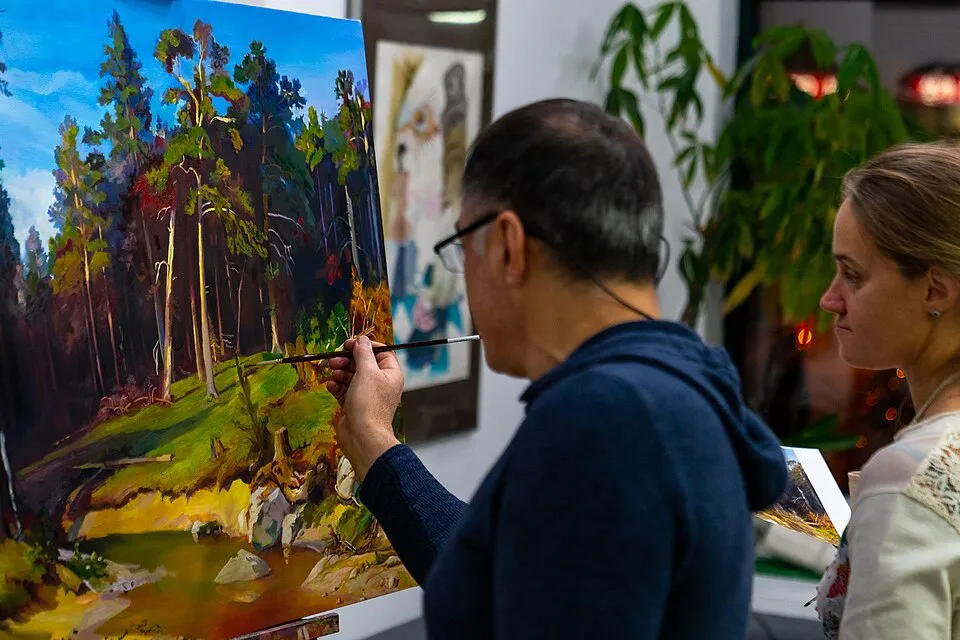
Adults in a contemporary art class. Today's options include community colleges, art schools, independent studios, museums, and online platforms, with courses designed specifically for adult beginners. Image via Wikimedia Commons
What to Bring: Materials for Beginners
For drawing, you need a sketchbook (9 x 12 inches, 60 to 80 lb paper), a set of graphite pencils (2H, HB, 2B, 4B, 6B), a kneaded eraser, a white vinyl eraser, and a pencil sharpener. Total cost: $20 to $30.
For acrylic painting, you need a set of acrylic paints (primary colors plus black and white: Cadmium Red, Ultramarine Blue, Cadmium Yellow, Ivory Black, Titanium White), a set of brushes (round, flat, filbert in sizes 2, 6, 10), a palette (disposable or reusable), a canvas pad or canvas boards (9 x 12 inches), a water container, and paper towels. Total cost: $40 to $60.
For oil painting, you need a set of oil paints (same primary colors plus black and white), a set of brushes (hog bristle and synthetic: round, flat, filbert), a palette, canvas boards or stretched canvas, odorless mineral spirits (Gamsol or Turpenoid), a medium (linseed oil or Galkyd), a palette cup, and rags. Total cost: $60 to $100. Some courses specify "traditional and/or contemporary water mixable oil paint and solvent free mediums" (Foothill College).
Many community college courses include a materials fee ($10 to $35) that covers all tools and supplies during the course. This is the most cost-effective option for beginners. You do not have to buy anything until you know you want to continue. For more on oil painting materials and techniques, see our guide to oil painting techniques.
Overcoming Beginner Fear
"I have no talent." This is the most common fear among adult beginners, the belief that art requires innate talent, and that without it, you cannot make art. This belief is wrong. Art is a skill, not a talent. Skills can be learned. "No previous art experience necessary" is not a marketing slogan. It is a statement of fact. Every artist started as a beginner.
"I will be the worst in the class." You might be. And that is fine. Adult art classes are not competitions. They are learning environments. The "worst" student in the class is the one who has the most to learn, and therefore the most to gain. The student who is "best" in the class has the least to learn, and may be in the wrong class.
"It is too late to start." It is not. Foothill College offers oil painting courses "targeted towards older adults," and the course is "unlimited repeatability," meaning you can take it for years. Lassen College's ART 160 is "a beginning (no previous art experience necessary) studio course" designed "to assist older adults in identifying and examining personal interests and aptitudes in painting and to enhance mental acuity, fine motor skills, and creativity." The research is clear: art education for older adults improves cognitive function, fine motor skills, and quality of life.
You do not need anyone's permission to make art. You do not need to be "talented." You do not need to be "good." You need to be willing to try, to fail, and to try again. That is all. For more on the therapeutic benefits of making art, see our guide to art therapy.
What Research Shows About Adult Art Education
Research shows that adult art education improves cognitive function, including memory, attention, and spatial reasoning. A study of older adults in art classes found improvements in "mental acuity, fine motor skills, and creativity" (Lassen College, ART 160 course outline). The cognitive benefits are not limited to older adults. Adults of all ages report improved focus, problem-solving, and creative thinking after taking art classes.
Adult art classes provide social connection. For adults who are retired, widowed, or socially isolated, an art class can be a lifeline: a place to meet people, to share an activity, to be part of a community. The social benefits are as significant as the cognitive benefits, and for some adults, they are more significant.
The therapeutic benefits of art-making for adults are well-documented: reduced stress, increased mindfulness, improved mood. Adult art classes combine the benefits of art-making with the benefits of social interaction and structured learning. The evidence is largely qualitative (testimonials, self-reports, practitioner observation), but it is overwhelming. Adults who take art classes report increased confidence, reduced stress, and a sense of accomplishment.
The caveat is this: the evidence is not the kind of evidence that randomized controlled trials produce. It is the kind of evidence that comes from watching adults transform over 12 weeks of a painting class, from hearing them say "I never thought I could do this," from seeing them bring their families to the end-of-term exhibition. The evidence is real, even if it is not statistical. For more on why art matters, see our guide to why art matters.
Final Thoughts
Adult art classes are more accessible than ever: community colleges ($100 to $300), art schools ($300 to $800), museums, independent studios ($15 to $40 per session), and online platforms ($10 to $50). The studio class format has remained largely unchanged since the WPA funded adult classes at the Brooklyn Museum in 1935. A typical beginner course covers "line drawing, shading and blending, proportion, perspective, composition and tonal balance" followed by painting (acrylic or oil) with color theory, color-mixing, and technique. Materials for beginners cost $20 to $100 depending on medium, or are included in a $10 to $35 materials fee.
The biggest barrier is not cost or access. It is fear. "I have no talent," "I will be the worst," "It is too late." These are the fears that keep adults from starting. The fears are wrong. Art is a skill, not a talent. Skills can be learned. "No previous art experience necessary" is a statement of fact, not a marketing slogan. Foothill College's "Oil Painting I for Older Adults" is non-credit, no-grade, and unlimited-repeat. You can take it forever. Research shows that adult art education improves cognitive function, provides social connection, and reduces stress. The WPA believed that art was not a luxury but a necessity, and it was right. It is never too late to start making art.
Find a class. A community college course, a museum studio class, an independent studio drop-in session, an online tutorial, any of these will work. The right class is the one you will actually attend. Buy the materials. Show up. Make something bad. Make something better. Make something you are proud of. The only prerequisite is the willingness to try. For more on how to look at the art you will eventually make, see our guide to how to look at art for beginners.


