
In July 1914, a magazine called BLAST appeared in London. Its cover was hot pink. Its contents included a manifesto that "blasted" everything the editors hated (England, the Victorians, humor, the weather) and "blessed" everything they liked (ships, engines, hairdressers, France). The manifesto was signed by eleven artists and writers, led by a painter named Wyndham Lewis. The poet Ezra Pound had given the movement its name: Vorticism, from the vortex, "the point of maximum energy." One month later, Britain was at war. The movement that promised to revolutionize British art lasted exactly four years and produced one issue of its journal before the war consumed it.
Vorticism emerged in London in 1914 as Britain's response to Cubism and Futurism. It was the only genuinely avant-garde movement in British art history: aggressive, abstract, and deliberately confrontational. Where Cubism analyzed form and Futurism celebrated speed, Vorticism focused on energy. The concentrated force at the center of a vortex.
This guide covers Wyndham Lewis and the founding, BLAST magazine, Epstein's Rock Drill, Bomberg's Mud Bath, Gaudier-Brzeska's sculpture, the women Vorticists, and how the war destroyed the movement before it could fully develop.
Wyndham Lewis and the Rebel Art Centre
Percy Wyndham Lewis (1882 to 1957) was Canadian-born, trained at the Slade, and spent time in Paris where he encountered Cubism. In 1914, he founded the Rebel Art Centre at 38 Great Ormond Street, London. It was intended as a space for classes, lectures, and exhibitions. It lasted only a few months.
Lewis's break with Roger Fry's Omega Workshops in 1913 was the catalyst. Lewis accused Fry of stealing his designs and left in a fury. The break galvanized him to form his own movement. Lewis's personality was brilliant, combative, and difficult. He quarreled with almost everyone. T.S. Eliot called him "the most fascinating personality of our time."
A new book by Canadian art historian James King, "Our Little Gang," published in October 2025, confirms this portrait of Lewis as a toxic leader. King documents how Lewis tried to remove a painting by David Bomberg from a 1913 exhibition in Brighton. He also painted over "Atlantic City" (c. 1915), a work by Helen Saunders, a fellow Vorticist. When Jessica Dismorr told Lewis she could not afford to buy any of his paintings, he replied: "I find you a dull person, and the fact that I have known you for so long does not release me, in your company, from a sense of oppression." Lewis was the center of the vortex, and the vortex was unstable.
BLAST and the Manifesto
BLAST No. 1 appeared in June 1914. 164 pages, hot pink cover, radical typography. Lewis was the editor; Ezra Pound was the literary advisor. The manifesto's structure was pages of "BLAST" (cursing things) and "BLESS" (praising things). BLAST: England, the Victorian era, the English climate, the English Sunday. BLESS: ships, engines, hairdressers, salt, France.
The signatories included Lewis, William Roberts, Frederick Etchells, Edward Wadsworth, Henri Gaudier-Brzeska, Helen Saunders, Lawrence Atkinson, and Ezra Pound. The list is notable for including two women, Jessica Dismorr and Helen Saunders, among the eleven signatories. This was unusual for an avant-garde manifesto in 1914.
BLAST No. 2 (July 1915) was the "War Number." Published after the war had begun. Gaudier-Brzeska, who had been killed in action in June 1915 at age 23, contributed a piece from the trenches. It would be the final issue. The magazine that was supposed to launch a revolution in British art became its obituary.
Jacob Epstein and the Rock Drill
Jacob Epstein (1880 to 1959) was American-born, moved to London in 1905. He was not officially a Vorticist (he did not sign the manifesto) but was closely associated with the movement. "Rock Drill" (1913 to 1915) was a plaster figure mounted on an actual industrial rock drill. The figure is part human, part machine. Epstein later described it as a "terrible Frankenstein's monster." The sculpture was exhibited at the Brighton City Art Gallery in December 1913.
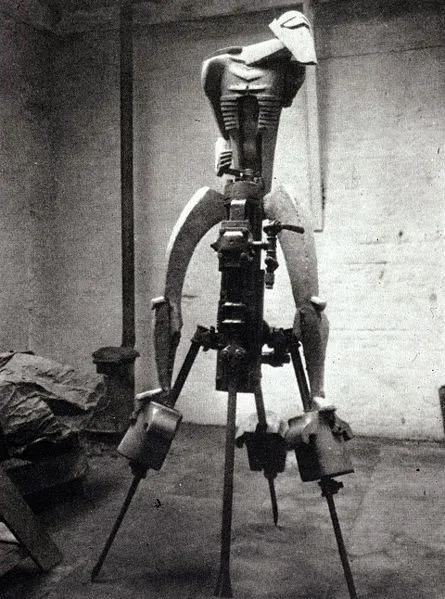
Jacob Epstein, "Rock Drill" (1913-15, original version now lost). Plaster figure on industrial rock drill. Reconstruction at Birmingham Museum and Art Gallery. Wikimedia Commons.
After the war, Epstein dismantled the sculpture. He sold the drill and truncated the figure, creating "Torso in Metal from Rock Drill" (1913 to 1916), now at Tate Britain. The truncated version is defenseless and melancholic. The opposite of the original's aggressive virility. The original Rock Drill celebrated the machine age. The truncated Torso mourns its casualties. The shift from one to the other is the story of Vorticism itself.
David Bomberg and The Mud Bath
David Bomberg (1890 to 1957) was of Polish-Jewish descent, born in Birmingham, raised in London's East End. He studied at the Slade School of Art. "The Mud Bath" (1914) measures 152.4 x 224.2 cm. It was inspired by the steam baths on Brick Lane in East London, where the local Jewish community bathed. Bomberg reduced the human figures to angular, geometric forms in red, white, and blue. He called it "Pure Form" in the exhibition foreword.
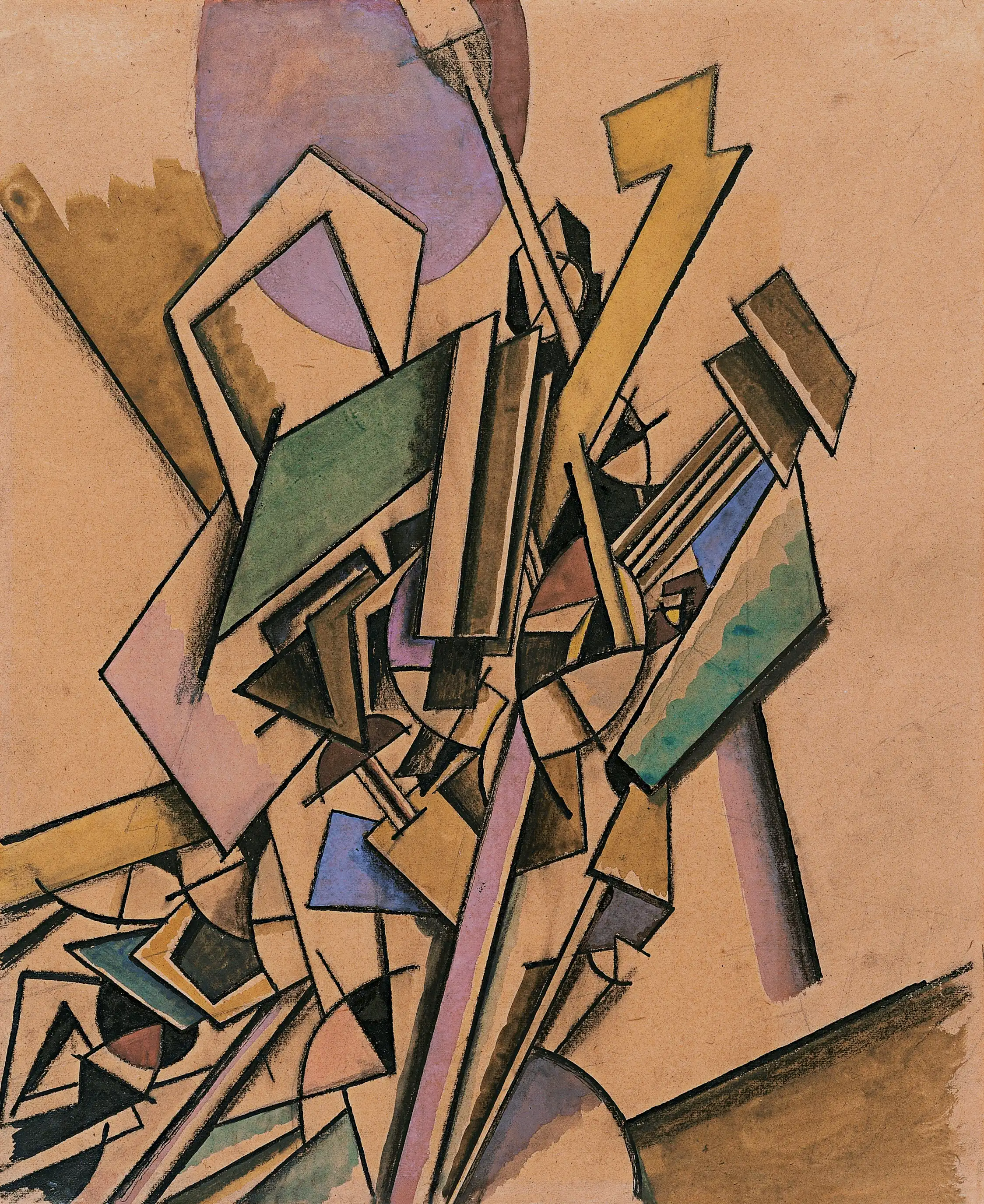
Edward Wadsworth, "Vorticist Study" (1914). Oil on canvas. Museo Nacional Thyssen-Bornemisza, Madrid. Wikimedia Commons.
Bomberg was associated with the Vorticists but not a formal member. He exhibited at the 1915 Vorticist Exhibition at the Dore Gallery, but Lewis considered him too independent. The painting was acquired by Tate in 1964 and is now considered one of the most important British paintings of the 20th century. Its angular forms connect to the broader tradition of Cubism, but Bomberg's reduction of the figure to pure geometry goes further than anything Picasso or Braque attempted.
Gaudier-Brzeska and the Cost of the War
Henri Gaudier-Brzeska (1891 to 1915) was a French sculptor who moved to London in 1911. He met Ezra Pound in 1913 and became close friends. Pound wrote a biography of him after his death. "Hieratic Head of Ezra Pound" (1914) is a carved marble head that combines Pound's features with the stylization of non-Western sculpture. The direct carving technique (no preparatory models, working directly into the stone) was radical for the period.
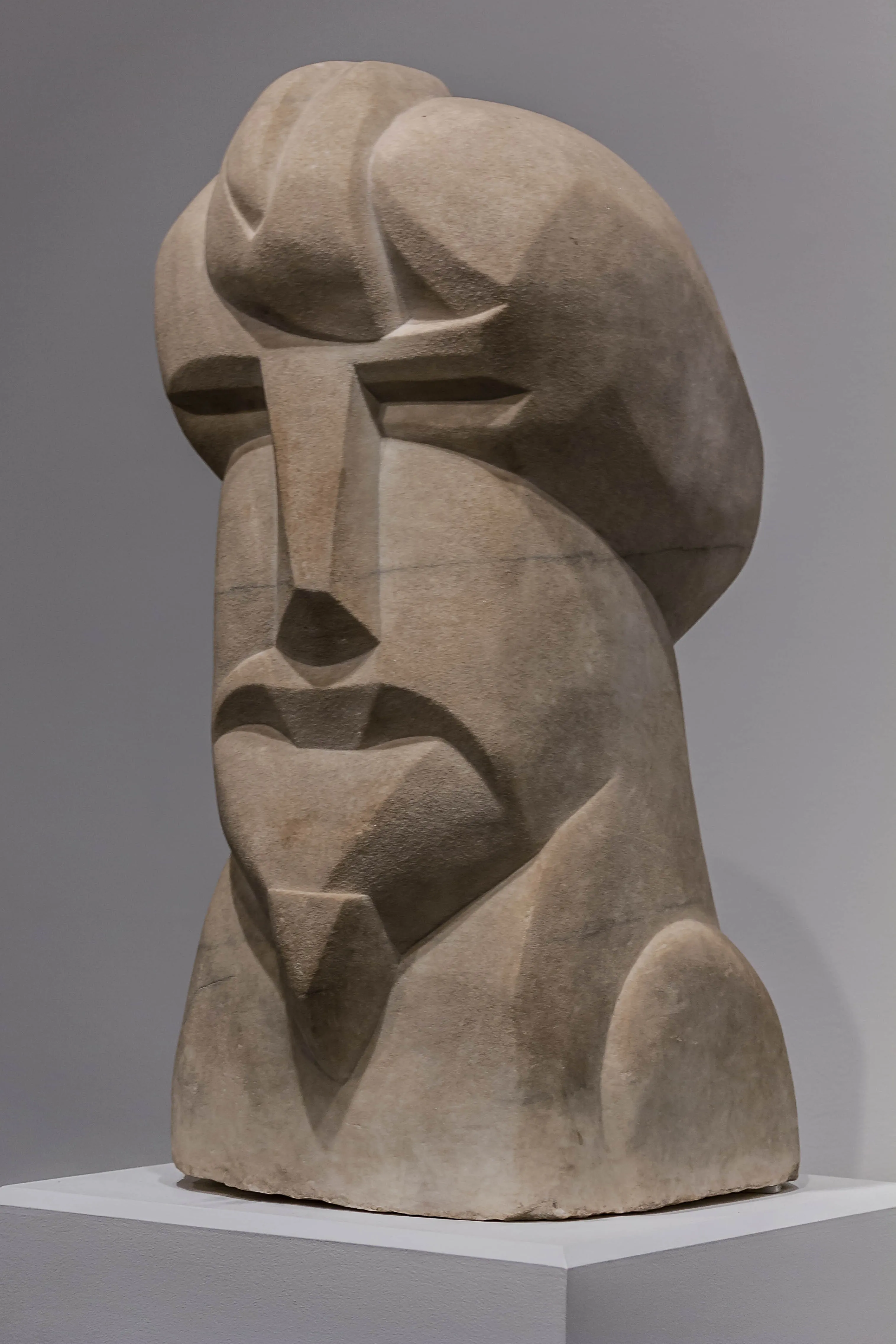
Henri Gaudier-Brzeska, "Hieratic Head of Ezra Pound" (1914). Marble. National Gallery of Art, Washington. Wikimedia Commons.
"Red Stone Dancer" (c. 1913 to 1914) compresses the human figure into a single block of energy. It is one of the most physically intense sculptures of the 20th century. Gaudier-Brzeska was killed in action in France on June 5, 1915, at age 23. He had enlisted in the French army. The loss was catastrophic for Vorticism. Gaudier-Brzeska was its most naturally gifted sculptor, and his death removed the movement's strongest three-dimensional voice.
The Women Vorticists
Jessica Dismorr (1885 to 1939) was a painter and signatory of the BLAST manifesto. Her Vorticist works are angular and abstract. She had a mental breakdown after the war and destroyed much of her own work. Helen Saunders (1885 to 1963) was also a painter and signatory of BLAST. Dorothy Shakespear (1886 to 1973) was a painter married to Ezra Pound who produced Vorticist works on paper combining abstraction with literary references.
The women Vorticists were written out of the movement's history for decades. The 2011 Tate exhibition "The Vorticists: Manifesto for a Modern World" was the first to give them serious attention. In 2019, two Courtauld students, Rebecca Chipkin and Helen Kohn, made a discovery that brought Helen Saunders back to center stage. While researching Wyndham Lewis's "Praxitella" (1921) at the Courtauld's Department of Conservation, they used X-ray analysis to reveal a lost painting hidden beneath Lewis's portrait. They identified it as Saunders's "Atlantic City" (c. 1915), a work long thought to be completely lost. All of Saunders's Vorticist paintings were believed to have been destroyed. The discovery was exhibited at the Courtauld in 2022 to 2023 and at Leeds Art Gallery in the exhibition "Things Left Unsaid."
The irony is brutal. Lewis painted over Saunders's work, literally burying her contribution under his own portrait. The 2025 book "Our Little Gang" by James King places Dismorr and Saunders at the center of the Vorticist project, arguing that Saunders was "more rigorously committed to experimentation" than her male peers. Her "Abstract Composition in Blue and Yellow" (c. 1915) shows a cluster of squares, triangles, and hexagons that look animated, as if a bizarre giant on thin legs were struggling up a steep hill. In September 2026, the HLSI will host a course titled "Modernist Mavericks: Jessica Dismorr and Helen Saunders as Vorticists," further cementing their rediscovery.
The erasure and recovery of the women Vorticists connects to broader questions about how art history decides who matters and who gets forgotten.
Why Vorticism Matters
Vorticism lasted roughly 4 years (1914 to 1918) and produced fewer than 100 surviving works. It is the shortest-lived major art movement in history. Its significance is that it proved Britain could produce an avant-garde movement equal to anything on the continent. Before Vorticism, British art was dominated by landscape tradition and academic painting. After Vorticism, British art had to be taken seriously as modern.
The war's destruction was total. Lewis served in the artillery and was effectively silenced as an artist for the duration. Gaudier-Brzeska was killed. Bomberg was traumatized. The movement that was supposed to revolutionize British art was over before it could develop. Lewis turned to writing, producing novels ("Tarr," "The Apes of God") and criticism. He returned to painting in the 1930s but never recaptured the Vorticist energy. His late portraits are powerful but conventional.
William Roberts's retrospective group portrait "The Vorticists at the Restaurant de la Tour Eiffel: Spring, 1915" (painted 1961 to 1962) is a facetious nod to Leonardo da Vinci's "The Last Supper." A monumentally proportioned Lewis appears as a flashy Jesus Christ presiding over his followers. The painting is both tribute and indictment. It captures the movement's brief, intense cohesion and the ego that fractured it.
The war did not just interrupt Vorticism. It destroyed the only genuinely avant-garde movement Britain ever produced, and British art has never fully recovered from that loss. The surviving works, Lewis's "The Crowd," Epstein's "Rock Drill" (in reconstruction), Bomberg's "The Mud Bath," Gaudier-Brzeska's carvings, are among the most powerful images of the machine age. The movement's brevity is part of its force. It has the intensity of something that existed only for a moment.
For more on the movements that surrounded Vorticism, read about Expressionism and Futurism. For the broader context, see our art movements timeline and art history cheat sheet. If you are new to analyzing modern art, our guide on how to look at art for beginners is a good starting point.
Final Thoughts
Tate Britain has a permanent Vorticism display in the Spotlight gallery. The Estorick Collection in London has mounted multiple Vorticism exhibitions and has an excellent collection of related works. The Courtauld's 2022 exhibition of Helen Saunders's drawings, the first in over 25 years, marked a turning point in the recognition of women Vorticists. With the 2025 publication of "Our Little Gang" and the upcoming 2026 course on Dismorr and Saunders, the movement's history is being rewritten to include the artists that Lewis tried to erase.
Vorticism burned out before it could burn bright. That is its tragedy and its power. The movement produced fewer works than some artists produce in a single decade, but those works carry a concentrated force that longer-lived movements rarely achieve. When you stand in front of "The Mud Bath" at Tate Britain, you are looking at a painting that was made in the last months before the war destroyed everything it stood for. That knowledge changes how the painting looks.


