
"On or about December, 1910, human character changed," wrote Virginia Woolf. The change she was describing was the Post-Impressionist exhibition organized by Roger Fry at the Grafton Galleries in London in November 1910, the first time London saw the works of Cézanne, Van Gogh, Gauguin, and Matisse in quantity. Vanessa Bell, Duncan Grant and Roger Fry were the three key artists of the Bloomsbury group, a group of artists, writers and thinkers responsible for radical innovations in twentieth-century literature, art and design. The Bloomsbury Group was not a school or a movement. It was a network of friends, artists, writers, economists, critics, who lived, worked, loved, and argued together across four decades, from roughly 1905 to 1941 (the year Virginia Woolf died). They included Virginia Woolf and Leonard Woolf (writers and publishers), Vanessa Bell and Clive Bell (painter and critic), Duncan Grant (painter and designer), Roger Fry (critic and curator), John Maynard Keynes (economist), E.M. Forster (novelist), and Lytton Strachey (biographer). Their personal lives were as unconventional as their art: multiple overlapping relationships, same-sex affairs, open marriages, and a refusal to separate art from life. The friendships formed in the Bloomsbury group were lifelong and shaped the artistic and intellectual output of its members.
Their output was enormous: Virginia Woolf's novels ("Mrs Dalloway," "To the Lighthouse," "Orlando"), Fry's Post-Impressionist exhibitions (1910, 1912), the Omega Workshops (1913-1919), the Hogarth Press (founded 1917), Keynes's economic theory, Forster's novels, Strachey's biographies. And Charleston, the farmhouse in East Sussex where Bell and Grant lived, painted, and decorated every surface from 1916 onward. Charleston is now a museum, open to the public, and the most complete surviving record of Bloomsbury's visual imagination. The Bloomsbury Group is unique in British cultural history. No other network of friends has had such an outsized impact across so many fields. They are also controversial, accused of elitism, snobbery, and hypocrisy. But their artistic contributions are undeniable. This guide covers who they were, Roger Fry's Post-Impressionist exhibitions, the Omega Workshops, Charleston Farmhouse, Vanessa Bell and Duncan Grant as painters, Virginia Woolf and the Hogarth Press, the bohemian life and its controversies, and why the Bloomsbury Group matters.
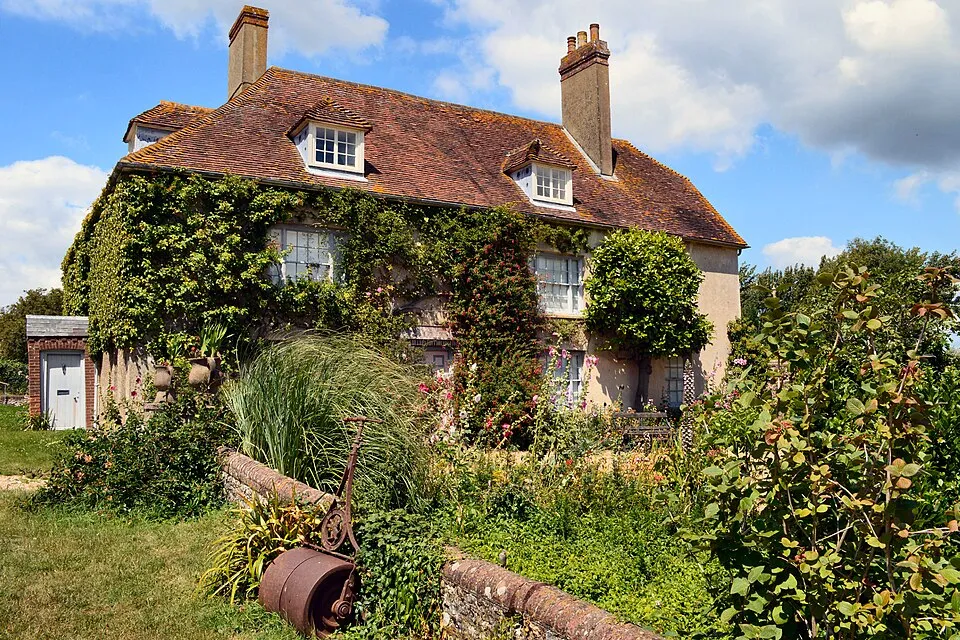
Charleston Farmhouse, East Sussex. Vanessa Bell moved to Charleston House, in East Sussex, in 1916, at the height of the Great War. During Vanessa's last years she lived at Charleston which remained a great inspiration for her painting. She died in 1961 (Tate). Image via Wikimedia Commons.
Who They Were: The Core Members
The artists were Vanessa Bell (1879-1961, painter), Duncan Grant (1885-1978, painter and designer), and Roger Fry (1866-1934, critic and curator). These three were, as Charleston's own history puts it, "the three key artists of the Bloomsbury group." The writers were Virginia Woolf (1882-1941, novelist), Leonard Woolf (1880-1969, writer and publisher), E.M. Forster (1879-1970, novelist), and Lytton Strachey (1880-1932, biographer). The economist was John Maynard Keynes (1883-1946), one of the most influential economists of the 20th century. The critic was Clive Bell (1881-1964), who coined the concept of "significant form," the idea that art's value lies in its formal properties, not its subject matter.
The friendships formed in the Bloomsbury group were lifelong and shaped the artistic and intellectual output of its members. They met at Cambridge (the Apostles society), in Bloomsbury (the London neighborhood that gave the group its name), and at Charleston (the Sussex farmhouse that became their rural headquarters). That geography matters. Bloomsbury was not a manifesto. It was a set of rooms, houses, and beds. For the wider context of where they sit in modern art, see our complete guide to art movements.
Roger Fry and the Post-Impressionist Exhibitions (1910, 1912)
The first exhibition opened in November 1910: "Manet and the Post-Impressionists" at the Grafton Galleries, organized by Roger Fry. The exhibition introduced London to Cézanne, Van Gogh, Gauguin, Seurat, and Matisse. The public reaction was hostile. The term "Post-Impressionism" was coined by Fry for this exhibition, and the press mocked the works. Virginia Woolf's famous statement, "On or about December, 1910, human character changed," refers to this exhibition and its cultural impact. She was not being hyperbolic. Before 1910, London had no significant collection of Post-Impressionist painting. The show was a shock, but it laid the groundwork for British modernism.
The second exhibition followed in 1912: the "Second Post-Impressionist Exhibition" at the Grafton Galleries. In 1912, Duncan Grant's painting "The Queen of Sheba" appeared alongside paintings by European post-impressionists at the Second Post-Impressionist Exhibition in London. The exhibition expanded to include British artists alongside the Europeans. Wyndham Lewis was a painter and writer who was associated with the Bloomsbury Group until late 1913. His work was included in the Second Post-Impressionist Exhibition organised by Roger Fry in 1912. Bell and Grant absorbed the lessons of Cézanne, Matisse, and the fauves, developing a style that was distinctively British but unmistakably modern. With paintings such as "The Tub," painted in 1913, Grant emerges as a post-impressionist artist. For more on the individual works that came out of this moment, see our guide to famous paintings explained.
The Omega Workshops (1913-1919)
The Omega Workshops were founded by Roger Fry in 1913 to apply avant-garde art to domestic design: furniture, textiles, ceramics, rugs. The idea was that Post-Impressionist art should not be confined to gallery walls but should enter everyday life. This was a radical proposition in 1913, and it prefigured the Bauhaus by several years. The workshops collapsed the distinction between fine art and decorative art. Bell and Grant designed rugs, ceramics, and textiles using the same visual language they used in their paintings. The workshops employed young artists who produced designs anonymously, and the works were sold without attribution to individual artists.
The split was public and bitter. Wyndham Lewis was associated with the Bloomsbury Group until late 1913, when he left the Omega Workshops in a dramatic falling-out, accusing Fry of mismanagement and forming the rival Vorticist movement. The split marked the beginning of the end for the Omega Workshops, which closed in 1919. They were short-lived but influential. They demonstrated that modern art could be applied to domestic objects. The works are now in museum collections, and the V&A holds a significant collection of Omega textiles and ceramics. For the social logic behind this kind of cross-disciplinary work, see our piece on art and society.
Charleston: The Rural Headquarters
Vanessa Bell moved to Charleston House, in East Sussex, in 1916, at the height of the Great War. She moved with Duncan Grant and Grant's lover David Garnett, a domestic arrangement that was unconventional even by Bloomsbury standards. Grant and Garnett were conscientious objectors, and agricultural work at Charleston provided them with exemption from military service. The war drove them to the country. The country gave them a canvas.
Bell and Grant decorated every surface of Charleston: walls, doors, furniture, fireplaces, garden pots. The decoration is a living record of Bloomsbury's visual style, bold colors, geometric patterns, post-impressionist brushwork applied to domestic surfaces. During Vanessa's last years she lived at Charleston which remained a great inspiration for her painting. She died in 1961. Grant continued to live at Charleston until his death in 1978. Charleston is now a museum, open to the public, and the most complete surviving record of Bloomsbury's visual imagination. The house, the garden, and the decorated surfaces have been restored. Inside, it was the de facto headquarters of the Bloomsbury Group. To sharpen your eye for what is on those walls, see our guide on how to look at art.
Vanessa Bell and Duncan Grant as Painters
Vanessa Bell was a prolific painter whose work absorbed the lessons of Post-Impressionism. She was influenced by the works of the fauves and Cézanne in the early 1910s. Bell's paintings, "Studland Beach" (1912), "The Tub" (1913, sometimes attributed to both Bell and Grant), her portraits and still lifes, are among the most significant British modernist works. She was also a designer: her Omega Workshops textiles, her book covers for the Hogarth Press (including Virginia Woolf's novels), and her decorated surfaces at Charleston. She worked across media because Bloomsbury refused the hierarchy that ranked painting above design.
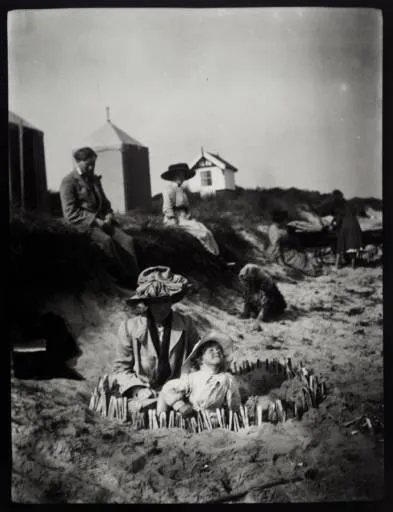
Vanessa Bell, "Studland Beach" (1912). Oil on canvas. Tate Britain. Bell was one of "the three key artists of the Bloomsbury group, a group of artists, writers and thinkers responsible for radical innovations in twentieth-century literature, art and design" (Charleston). Image via Wikimedia Commons.
Duncan Grant was a painter, designer, and decorator whose work spanned canvas, textile, ceramic, and wall. In 1912, his painting "The Queen of Sheba" appeared alongside paintings by European post-impressionists at the Second Post-Impressionist Exhibition in London. With paintings such as "The Tub," painted in 1913, Grant emerges as a post-impressionist artist. He was influenced by the works of the fauves and Cézanne. He became a member of the Camden Town Group in 1911. In 1913 he exhibited with the Grafton Group with Fry and Bell. Bell and Grant lived and worked together at Charleston for over 40 years. Their styles influenced each other. Their domestic arrangement, Bell, Grant, and Grant's various male lovers, including Angelica Garnett (Bell's daughter, who later married Grant), was complicated, but their artistic collaboration was sustained and productive. For a structured way to study this period, see our guide on how to teach yourself art history.
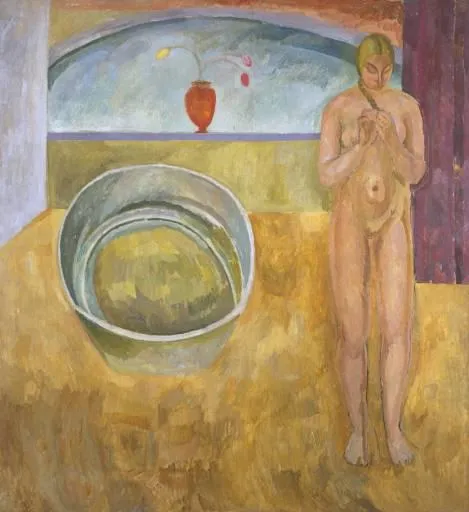
Duncan Grant, "The Tub" (1913). With paintings such as "The Tub," painted in 1913, Grant emerges as a post-impressionist artist (Tate). In 1912, Grant's "The Queen of Sheba" appeared alongside paintings by European post-impressionists at the Second Post-Impressionist Exhibition in London. Image via Wikimedia Commons.
Virginia Woolf and the Hogarth Press
Virginia Woolf (1882-1941) was the most celebrated writer of the Bloomsbury Group. Her novels, "Mrs Dalloway" (1925), "To the Lighthouse" (1927), "Orlando" (1928), "The Waves" (1931), are landmarks of modernist literature. Her essays, "A Room of One's Own" (1929) and "Three Guineas" (1938), are foundational texts of feminist criticism. Virginia and Leonard Woolf founded the Hogarth Press in 1917, initially as a hand-printing operation in their Richmond home. The press published Virginia Woolf's novels, T.S. Eliot's "Poems" (1919, including the first English publication of "The Waste Land" in book form), and works by other Bloomsbury authors. Vanessa Bell designed many of the press's book covers, connecting the visual and literary strands of Bloomsbury.
Virginia Woolf's writing and Vanessa Bell's painting were deeply intertwined. Bell's visual language, bold, abstracted, post-impressionist, influenced Woolf's literary language, fluid, layered, subjective. The two sisters were close, competitive, and mutually influential. "A Room of One's Own" argues for the material conditions of artistic production, a room, money, time, that Bell, as a woman painter, also needed and fought for. If you are just starting with this material, see our guide on art for beginners.
The Bohemian Life and Its Controversies
The Bloomsbury Group's personal lives were as unconventional as their art. Multiple overlapping relationships, same-sex affairs (Grant, Strachey, Forster, Keynes), open marriages (Vanessa and Clive Bell), and complex domestic arrangements (Bell, Grant, and Garnett at Charleston). The friendships formed in the Bloomsbury group were lifelong and shaped the artistic and intellectual output of its members. The group has been accused of elitism (they were mostly Cambridge-educated, upper-middle-class), snobbery (they looked down on non-Bloomsbury artists and writers), and hypocrisy (they preached sexual freedom while maintaining complex, sometimes cruel, personal arrangements). The most famous critique is by Wyndham Lewis, who attacked Bloomsbury in his magazine "Blast" and left the Omega Workshops in 1913.
The defense is that their unconventional lives were not just bohemian posturing. They were a deliberate rejection of Victorian conventions, the same conventions that had excluded women from art education, criminalized homosexuality, and constrained intellectual life. Their personal freedom was the condition of their artistic freedom. You cannot separate the art from the life. The Post-Impressionist exhibitions, the Omega Workshops, Charleston, the Hogarth Press were all products of a network of friends who refused to separate art from life. For more on how art reflects and reshapes its social conditions, see our piece on art and society.
Why the Bloomsbury Group Matters
The art: Fry's Post-Impressionist exhibitions introduced modern French art to Britain. Bell and Grant were among the first British artists to absorb and adapt Post-Impressionism. The Omega Workshops applied avant-garde art to domestic design. Charleston is the most complete surviving record of British modernist visual culture. The literature: Virginia Woolf's novels and essays are landmarks of modernist literature and feminist criticism. The Hogarth Press published some of the most important works of 20th-century literature. The ideas: Clive Bell's "significant form," Roger Fry's art criticism, Keynes's economic theory, Strachey's biographical method. The Bloomsbury Group reshaped not just art and literature but the intellectual framework of 20th-century Britain.
The model is the thing that lasts. The Bloomsbury Group demonstrated that art, literature, design, and ideas could be integrated in a single network of friends who lived, worked, and argued together. The model, art as a way of life, not just a profession, has influenced every subsequent artistic community, from Black Mountain College to the YBAs. For where that legacy lives now, see our guide to contemporary art trends.
Final Thoughts
Vanessa Bell, Duncan Grant and Roger Fry were the three key artists of the Bloomsbury group, a group of artists, writers and thinkers responsible for radical innovations in twentieth-century literature, art and design. "On or about December, 1910, human character changed," wrote Virginia Woolf, referring to Roger Fry's first Post-Impressionist exhibition at the Grafton Galleries. In 1912, Duncan Grant's painting "The Queen of Sheba" appeared alongside paintings by European post-impressionists at the Second Post-Impressionist Exhibition in London. With paintings such as "The Tub," painted in 1913, Grant emerges as a post-impressionist artist. The Omega Workshops (1913-1919) applied avant-garde art to domestic design. Vanessa Bell moved to Charleston House, in East Sussex, in 1916, at the height of the Great War. During Vanessa's last years she lived at Charleston which remained a great inspiration for her painting. She died in 1961. The Hogarth Press (founded 1917) published Virginia Woolf's novels and T.S. Eliot's "Poems." The Bloomsbury Group included Virginia Woolf, Leonard Woolf, E.M. Forster, Lytton Strachey, John Maynard Keynes, Clive Bell, Roger Fry, Vanessa Bell, and Duncan Grant. The friendships formed in the Bloomsbury group were lifelong and shaped the artistic and intellectual output of its members. Fry's exhibitions introduced Cézanne, Van Gogh, Gauguin, and Matisse to London. Bell and Grant were among the first British Post-Impressionists. The Omega Workshops prefigured the Bauhaus. Charleston is now a museum.
Go to Charleston. It is open to the public, and it is the most complete surviving record of Bloomsbury's visual imagination. Walk through the rooms that Bell and Grant decorated, every wall, door, fireplace, and piece of furniture. Then go to the Tate Britain, which holds works by Bell and Grant. Then read Virginia Woolf. "To the Lighthouse" (1927) is the most visual of her novels, a novel about looking, about the act of perception, about what it means to see. The Bloomsbury Group believed that art and life were inseparable. Charleston is the proof. For more, read the Charleston Trust's history of Bloomsbury Beginnings and the Tate's overview of the lifestyle, lives and legacy of the Bloomsbury Group.


