
The Prado Museum in Madrid has the world's finest collection of Spanish painting and the largest collection of Goya anywhere. Over 140 Goya paintings hang on its walls, including the Black Paintings, the Second and Third of May 1808, the Maja paintings, and the tapestry cartoons. The museum opened in 1819 in a building designed by Juan de Villanueva as a natural history museum, then became an art museum by royal decree. The core of the collection is the Spanish Royal Collection, works accumulated by the Habsburg and Bourbon monarchs over 300 years. Unlike the Louvre or the Uffizi, the Prado was never a public museum that gradually built its collection. It was a royal collection that became a public museum.
The Prado's strength is depth, not breadth. It does not try to cover all of art history. It covers Spanish painting (Velázquez, Goya, El Greco, Murillo, Zurbarán), Italian painting (Titian, Raphael, Botticelli), and Northern painting (Bosch, Rubens, Van der Weyden) with extraordinary depth. Goya alone occupies more wall space than any other artist in any major museum. In 2025, the Prado welcomed 3.5 million visitors, a record. Director Miguel Falomir responded by capping tour groups at 20 people and restricting group access to off-peak hours. "The Prado does not need a single visitor more," he said. "A museum can collapse due to success."
This guide covers Velázquez and Las Meninas, Goya and the Black Paintings, Bosch's Garden of Earthly Delights, the building and history, what most visitors miss, and practical tips for visiting in 2026.
The Building and the Royal Collection
Juan de Villanueva designed the building between 1785 and 1819 as a natural history cabinet for Charles III. Ferdinand VII converted it to an art museum in 1819. It was originally called the Royal Museum of Painting and Sculpture, and it opened to the public on November 19, 1819, with 311 paintings. Today the Prado holds over 27,000 objects, with roughly 1,300 on display at any time.
The Spanish Royal Collection is the core. The Habsburgs (Charles V, Philip II, Philip IV) were the greatest art collectors in Europe. Philip IV commissioned Velázquez as court painter and bought Italian masterpieces through his agents. The Bourbons (Philip V, Charles III, Charles IV) added French and Italian works. This is why the Prado has 49 Velázquez paintings, over 140 Goya paintings, and over 90 Rubens paintings. These were not acquired through curatorial budgets. They were royal property, inherited by the state.
The 2007 expansion by Rafael Moneo added galleries, a cloister, and a conservation center underground, without altering Villanueva's original building. The expansion connected the Prado to the adjacent Jerónimos monastery cloister, a 15th-century structure that now serves as a quiet entrance hall and café space. The museum's total floor space reached roughly 475,000 square feet. In 2026, the Prado is pursuing the Salón de Reinos project, a second expansion into a neighboring historic building that will add more gallery space and relieve the overcrowding that Falomir has made a priority. You can read more about the museum's history and architecture on the Prado Museum Wikipedia page.
Velázquez and Las Meninas
Diego Velázquez (1599-1660) was court painter to Philip IV. The Prado has 49 Velázquez paintings, the largest collection in the world. He spent most of his career in the royal household, painting the king, the royal family, and the people around them. He also made two trips to Italy, where he studied the masters and absorbed the Venetian use of color.
"Las Meninas" (1656) hangs in Room 12. It measures 318 x 276 cm. Luca Giordano called it "the theology of painting," and the description has stuck for 300 years. The painting shows the Infanta Margarita Teresa with her maids of honor (las meninas), a dwarf, a dog, and Velázquez himself at his easel. A mirror on the back wall reflects King Philip IV and Queen Mariana. The painting collapses the distinction between viewer and subject. The King and Queen stand where you stand, and you see what they see. Velázquez paints himself painting the painting you are looking at.
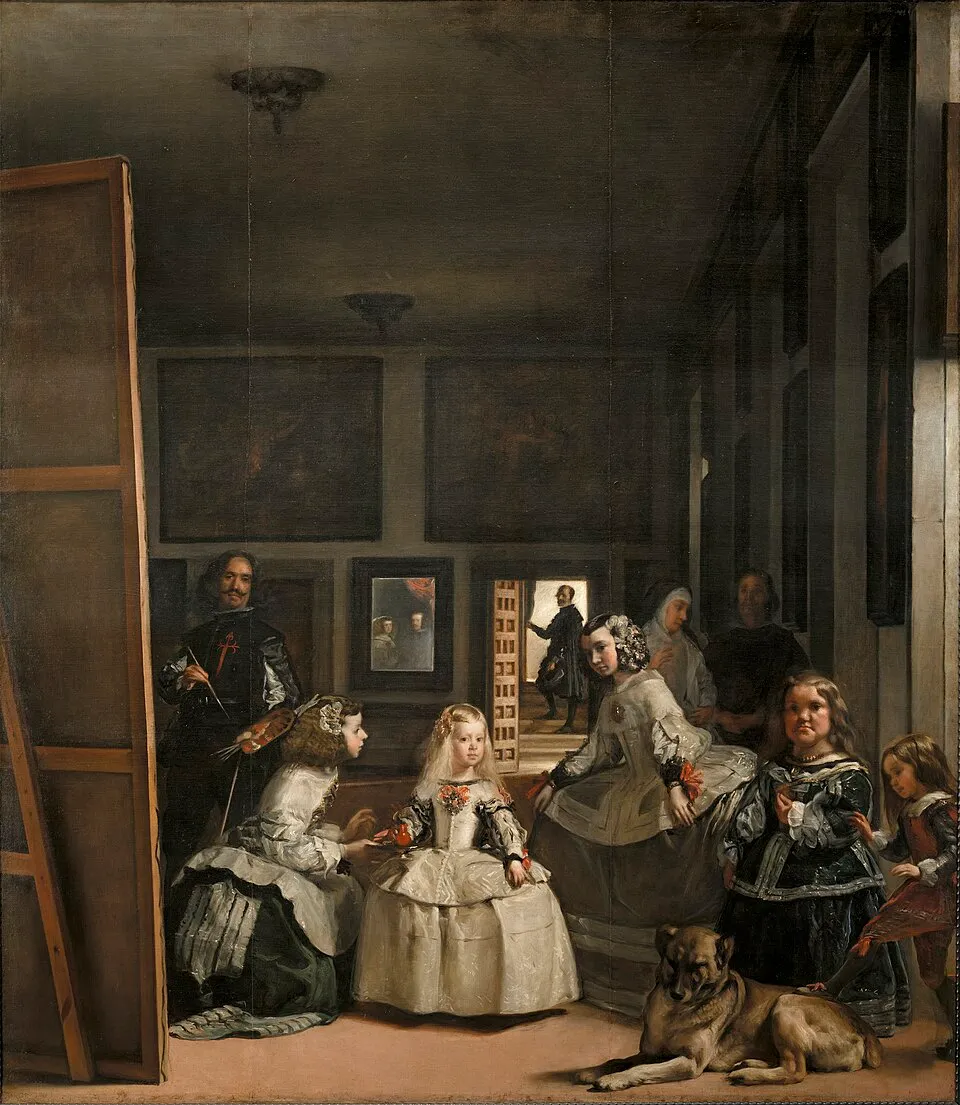
Diego Velázquez, "Las Meninas" (1656). Oil on canvas, 318 x 276 cm. Prado Museum, Room 12. Wikimedia Commons.
Las Meninas is the most discussed painting in Spanish art history. It is simultaneously a portrait, a self-portrait, a genre scene, and a philosophical statement about the nature of representation. Spend time in Room 12. Walk around the room. The painting changes as you move. The Velázquez galleries (Rooms 10-14) require at least 45 minutes. If you want to understand why this painting has generated centuries of debate, read our guide to famous paintings explained, which covers Las Meninas in detail alongside other works that changed how people think about representation.
Goya and the Black Paintings
Francisco Goya (1746-1828) is the artist the Prado is built around. Over 140 Goya paintings are here. No other museum has this depth of a single major artist. You can trace his entire career in one building: tapestry cartoons (youthful, colorful, scenes of everyday life), court portraits (formal but psychologically penetrating), the Second of May 1808 and the Third of May 1808 (war, violence), and the Black Paintings (madness, fear, isolation).
"The Third of May 1808" (1814) measures 268 x 347 cm. It shows French soldiers executing Spanish civilians during the Peninsular War. The central figure in the white shirt, arms spread, is one of the most powerful images of innocent suffering in Western art. Manet quoted it, Picasso quoted it, Bacon quoted it. The painting is not in the Black Paintings section. It hangs in a separate gallery on Floor 0, and it is the painting that most visitors remember longest.
The Black Paintings (c. 1819-1823) are 14 works Goya painted directly on the walls of his house, the Quinta del Sordo (House of the Deaf Man). He was 73, deaf, ill, and isolated. "Saturn Devouring His Son" (143 x 81 cm), "The Witches' Sabbath," "Fight with Candles." The paintings were never meant to be seen by anyone. They were transferred to canvas after his death and donated to the Prado in 1881.
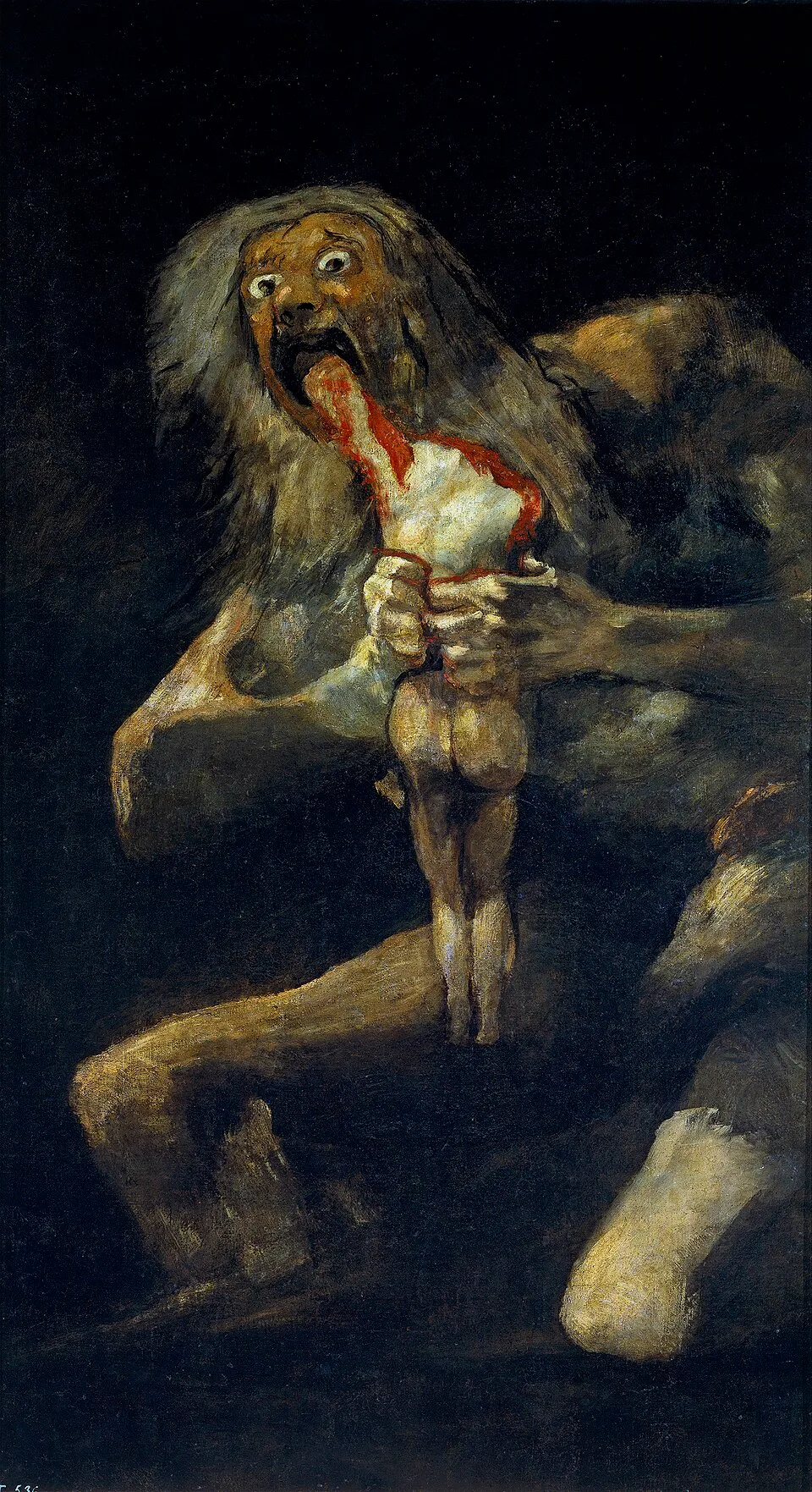
Francisco Goya, "Saturn Devouring His Son" (c. 1819-1823). Oil on plaster, transferred to canvas, 143 x 81 cm. Prado Museum, Rooms 66-67. Wikimedia Commons.
The Black Paintings hang in Rooms 66-67 on Floor 0, in a dim, low-ceilinged space that approximates the rooms of Goya's house. Most visitors rush past them on the way to the exit. Stop here. These are the most disturbing works in any major museum. Seeing them feels like reading someone's private diary that was never intended for your eyes. Goya's trajectory from court painter to this is the most dramatic psychological descent in art history. For more on the movement that Goya helped define, read our guide to Romanticism and the rebellion against reason.
Bosch and the Garden of Earthly Delights
Hieronymous Bosch (c. 1450-1516) is the most enigmatic painter in Western art. The Prado has "The Garden of Earthly Delights," the most famous and most puzzling painting of the Northern Renaissance. It measures 220 x 389 cm and is a triptych. The left panel shows Eden, with Adam and Eve among exotic animals. The center panel shows a surreal earthly paradise filled with nude figures, giant fruit, impossible architecture, and bizarre creatures. The right panel shows hell, with burning buildings, monstrous punishments, and a knife-eared pig in a nun's habit.
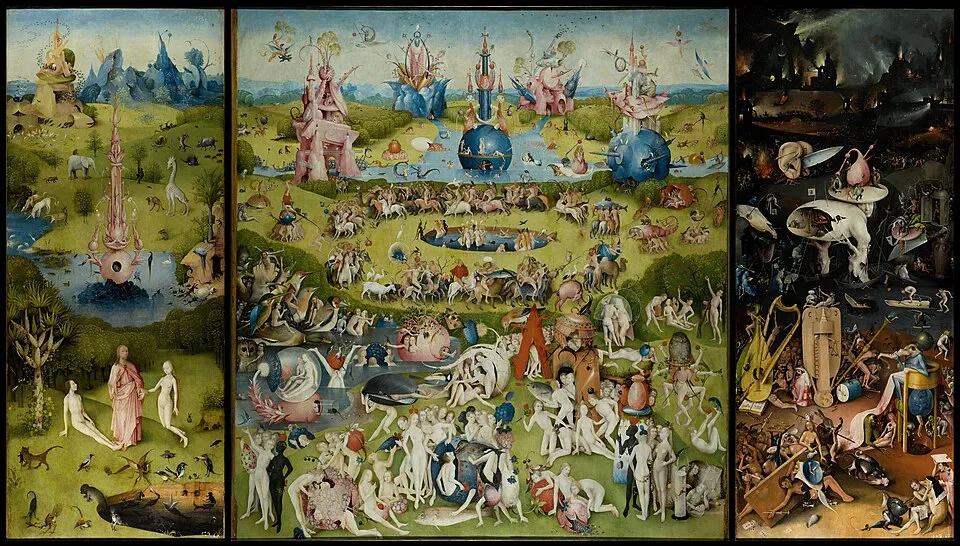
Hieronymous Bosch, "The Garden of Earthly Delights" (c. 1490-1510). Oil on wood, 220 x 389 cm. Prado Museum. Wikimedia Commons.
The painting has been interpreted as a warning against lust, as an alchemical allegory, as a hallucination, and as a genuine vision of another world. Philip II acquired it and hung it in his bedroom at El Escorial. It was transferred to the Prado in 1939. Bosch's other works in the Prado include "The Haywain" (c. 1516) and "The Adoration of the Magi" (c. 1494). The Prado has the largest Bosch collection in the world. The American Friends of the Prado Museum maintains a detailed analysis of the painting's iconography.
What Most Visitors Miss
The El Greco galleries (Rooms 8-9) are often skipped by visitors heading straight for Velázquez. "The Nobleman with his Hand on his Chest" (c. 1580) is the most famous El Greco in the Prado. The elongated figure, the intense gaze, the hand on the chest. It is Mannerism at its most spiritual. El Greco painted in Toledo, about 70 km from Madrid, and his work has a quality of religious intensity that no other Spanish painter matches.
The Rubens galleries are equally overlooked. The Prado has the largest Rubens collection in the world (over 90 paintings). Rubens visited Madrid twice and painted copies of Titian works in the Royal Collection. His "The Duke of Lerma" (1603) is in the Prado, and it is one of the great equestrian portraits.
The Dauphin's Treasure is a collection of 169 Renaissance vessels and decorative objects in the basement. Almost no one visits it. The collection was inherited by Philip V from his father, the Grand Dauphin of France, and includes rock crystal vessels, hardstone cameos, and gold-mounted pieces by European goldsmiths.
The Jerónimos cloister, the 15th-century monastery cloister incorporated into the 2007 Moneo expansion, is the best place to rest during a visit. It is quiet, cool, and architecturally beautiful. The café is adjacent. The Prado visitor guide has more details on these lesser-known areas.
Practical Tips
Tickets cost €15 for general admission, €7.50 for reduced admission. Audio guides add €5. The last two hours before closing are free for the permanent collection, with a 50% discount on temporary exhibitions. Free hours are 18:00-20:00 Monday through Saturday and 17:00-19:00 Sunday. Arrive early for the free hours because queues form.
Hours are Monday through Saturday 10:00-20:00 and Sunday 10:00-19:00. The museum is closed January 1, May 1, and December 25. The best time to visit is the 10:00 AM opening. Go to Room 12 (Las Meninas) first, then the Goya galleries on Floor 0. Plan 2 to 3 hours for highlights and 4 to 5 hours for a thorough visit.
The Prado does not allow photography in most galleries. This is unusual among major museums and it actually improves the experience. You look at the paintings instead of your phone. The museum has also introduced new crowd control measures in 2026: tour groups are capped at 20 people (down from 30), and group access is restricted to off-peak hours between 4:00 PM and 6:00 PM. Thematic routes like "The Female Perspective" and "A Botanical Stroll" are designed to spread visitors into less crowded galleries.
For 2026, the Prado's exhibition program includes "In the Italian Manner: Spain and the Mediterranean Gothic, 1320-1420" (May 26 to September 20), which examines how Italian Trecento models were absorbed by Spanish artists. "Prado. 21st Century" (June 9 to September 27) surveys 98 works acquired since 2000, showing how the museum has evolved. Later in the year, exhibitions on Rilke and Spanish art, Hans Baldung Grien, and Mariana of Austria are scheduled.
If you want a broader framework for understanding what you are seeing, our guide to visiting art museums without getting overwhelmed covers strategies for pacing yourself, and our art history cheat sheet gives you a quick timeline of the periods represented in the Prado's collection.
Final Thoughts
The Prado is the best museum in the world for understanding Spanish painting. Its depth in Velázquez, Goya, and El Greco is unmatched. The Black Paintings alone, 14 works painted by a deaf, isolated old man on the walls of his house, never meant to be seen, are worth the trip to Madrid. The Bosch triptych is the most mysterious painting in the collection, and the Rubens galleries hold more work than most museums dedicated to a single artist.
The Prado in 2026 is a museum actively managing its own success. With 3.5 million visitors and a director who says he does not want a single visitor more, the experience is shaped by crowd control. Go at 10 AM. Las Meninas first, then Goya's Black Paintings on Floor 0. End with Bosch. Use the free evening hours if you want a second visit. Book at museodelprado.es.
For more context on the periods and movements represented in the Prado, read our complete guide to art movements and our introduction to Renaissance art. If you are new to looking at paintings, our guide on how to look at art for beginners will help you get more out of the visit.


