
Diego Velázquez painted "Las Meninas" in 1656, and art history has been arguing about it ever since. The philosopher Michel Foucault opened his major work "The Order of Things" (1966) with a twelve-page analysis of the painting. Picasso produced 58 variations of it in 1957 alone, over about four months. Every art history student encounters it. And still, after nearly four centuries, the painting raises questions that resist settled answers: who is really in the room, what the mirror reflects, where the viewer is positioned, and what Velázquez himself is doing in the scene he is painting. These are not puzzles sitting alongside the painting. They are the painting's actual subject.
"Las Meninas" is Baroque art at its most self-aware. It is not content to depict a scene; it depicts the act of depiction, and it implicates the viewer in that act in ways that most paintings carefully avoid. Standing in front of it in Room 12 of the Prado Museum in Madrid, you gradually realize that the painting is organized around the spot where you are standing, and that Velázquez is watching you from inside the canvas.
Who Is in the Room
The painting shows a large studio space in the Royal Alcázar of Madrid. In the center stands the five-year-old Infanta Margarita, daughter of King Philip IV of Spain and Queen Mariana of Austria. She is attended by two ladies-in-waiting, two court dwarfs, a large mastiff dog, a bodyguard, and a duenna partially visible in shadow. In a doorway at the back, brightly lit against the dark room, stands a figure who appears to be entering or leaving: José Nieto, the royal marshal of the palace.
On the far left, behind a large canvas whose back faces the viewer, stands Velázquez himself, palette in his left hand, brush raised, looking out toward the viewer with an expression that is calm, attentive, and slightly challenging. On the back wall, in a small mirror, are reflected two figures who must be standing where the viewer stands: King Philip IV and Queen Mariana. Or, as several art historians have argued, the mirror may reflect the canvas Velázquez is painting rather than figures actually present in the room.
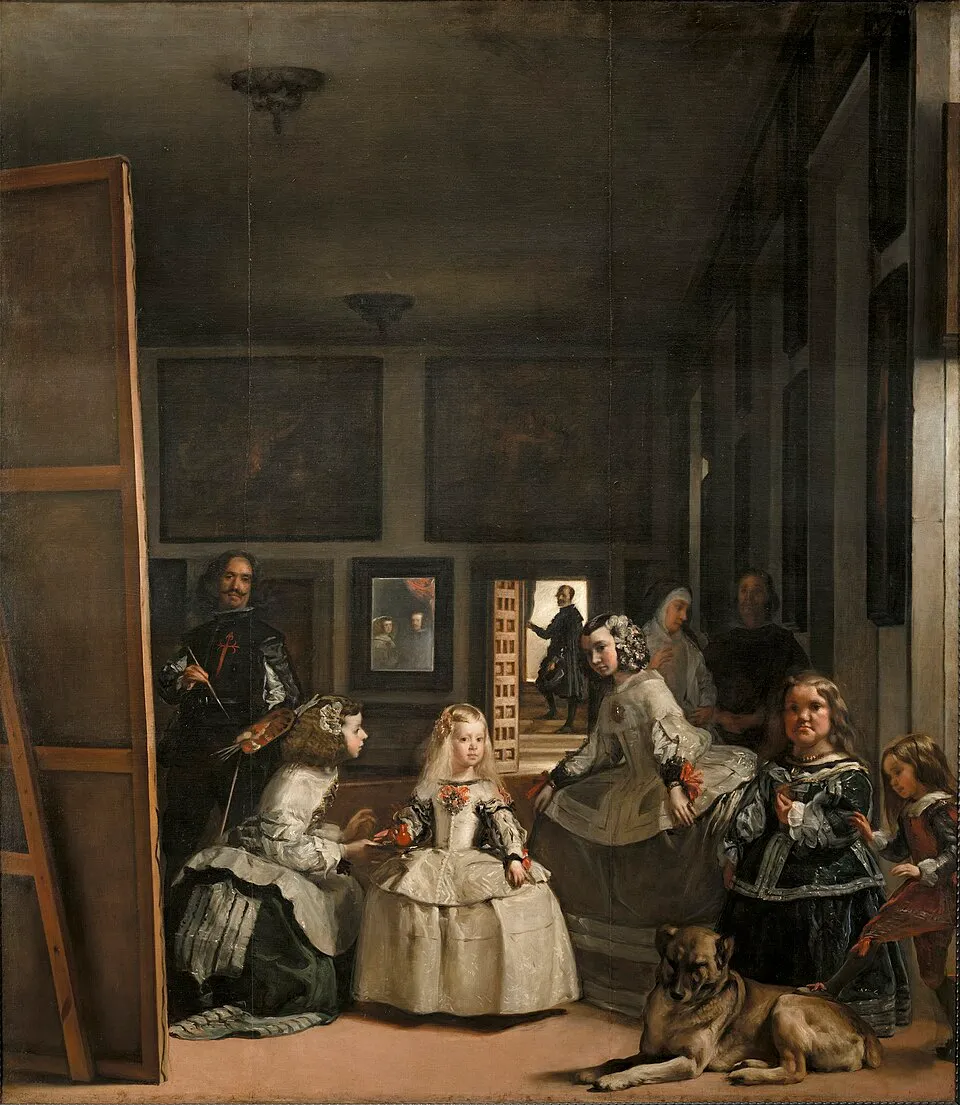
Diego Velázquez, "Las Meninas" (1656), oil on canvas, 318 x 276 cm. Museo del Prado, Madrid. Velázquez's most discussed painting has occupied philosophers, artists, and art historians for nearly 370 years. Image: Public domain, via Wikimedia Commons
The Mirror Problem
The small mirror on the back wall is the painting's most contested detail. If it reflects the actual king and queen standing at the viewer's position, then we occupy the royal point of view. The painter, the princess, and the court are all oriented toward the royal presence that we momentarily inhabit. This reading makes the painting an elaborate act of flattery toward Philip IV, organized around the experience of being the king looking in at his own household.
The alternative reading, developed by the art historian Joel Snyder and others, argues that the mirror does not reflect figures at the viewer's position but reflects the canvas that Velázquez is actively painting. On this account, the canvas shows a completed portrait of the king and queen, and the mirror gives the viewer a glimpse of that otherwise invisible image. The painting then becomes a painting of a painter painting a portrait, with the mirror as the only window into the work-within-the-work.
The physics of the mirror do not fully support either reading. Its position on the wall, its size, and the angle at which a genuine reflection would fall do not align precisely with either the viewers in the room or the canvas in front of Velázquez. This is almost certainly deliberate. Velázquez was technically capable of painting an optically accurate reflection if he had wanted to. He chose ambiguity instead. That choice is the painting's most important decision.
Velázquez's Self-Portrait and the Status of Painting
The figure of Velázquez himself is among the most significant self-portraits in Western art history. He stands at full height in good clothing, with a calm authority that has nothing of the craftsman's deference about it. He wears the red cross of the Order of Santiago on his chest, a mark of noble status. Historical records confirm that Velázquez was admitted to the Order in 1659, three years after the painting was finished. The cross was probably added to the canvas after his admission, possibly by Velázquez, possibly by Philip IV, though this remains unconfirmed.
What is clear is the claim the image makes. In 17th-century Spain, painting was not universally accepted as a liberal art. Painters were classified as artisans, subject to taxes that applied to tradespeople but not to artists or intellectuals. Velázquez spent much of his adult life petitioning for the social recognition that the Order of Santiago represented. His self-portrait in "Las Meninas," standing in the royal studio at eye level with the king's daughter, is an argument that painting is an intellectual activity practiced by a man of standing, not a craft performed by a servant. The broader context of the Baroque Spanish court is covered in the guide to Baroque Art: Drama, Light, and the Power of the Catholic Church.
Foucault's Reading and Why It Matters
Michel Foucault's analysis of "Las Meninas" in "The Order of Things" argued that the painting represents the Classical episteme: the structure of knowledge and representation that dominated European thought from the mid-17th to the late 18th century. For Foucault, the painting stages the moment when representation became conscious of itself, when art began to examine the conditions of its own possibility rather than simply depicting the world.
The elements Foucault focused on are exactly the ones that resist resolution: the painter visible in the work he is making, the viewer implied by the mirror but absent from the image, the canvas whose face we cannot see, the mirror whose reflection we cannot verify. These form a diagram of representation's structure: subject, object, viewer, and the act of looking, all made simultaneously present and uncertain. The painting does not show a scene. It shows the conditions under which scenes can be shown at all.
Whether or not Foucault's reading is historically accurate as a description of what Velázquez intended, it names something the painting genuinely does. It invites this kind of analysis in a way that most paintings do not, because it is constructed to generate questions about looking and to resist easy closure. That is why the framework for reading paintings benefits from extended time with this particular canvas.
Picasso's Variations
In 1957, Picasso retreated to his studio at La Californie in Cannes and spent roughly four months producing 58 paintings based on "Las Meninas." This is his most sustained engagement with any single historical work, and the series reveals what happens when a painter treats an old master not as a monument to be admired but as a problem to be solved.
Picasso enlarged certain figures, reduced others, fragmented the spatial logic of the room, and rearranged the relationships between the characters. He worked in grisaille for some paintings and in high-keyed color for others. He zoomed in on the Infanta's face until it filled the canvas. He reduced Velázquez to a rough shape in the corner. In some versions, the dog occupies most of the composition. The series is now housed in the Museu Picasso in Barcelona, where it occupies several rooms and can be seen alongside reproductions of the Velázquez.
Looking at Picasso's variations makes the original stranger and more complex. You see how much the spatial ambiguity in Velázquez's painting depends on specific compositional decisions that Picasso isolates by changing them. The way the doorway at the back creates depth. The way the mirror draws your eye to the exact center of the far wall. The way the large canvas on the left acts as a counterweight to the bright doorway on the right. All of these choices become visible when Picasso removes or disrupts them. The guide on Pablo Picasso: Cubism, Controversy, and a Century of Influence covers his broader practice and the context within which the Las Meninas series sits.
"Las Meninas" hangs in Room 12 of the Museo del Prado in Madrid. It measures 318 by 276 cm and requires some distance to take in as a whole. Standing in front of it, you gradually become aware that the painting is organized around your position, that the figures within it are looking at you, and that the questions it raises are not going to be settled by looking more carefully. It is one of the few paintings that genuinely looks back. What do you make of the mirror's reflection? Let us know in the comments.


