
Most paintings ask you to look. Las Meninas looks back. Stand in front of it in Room 12 of the Prado Museum in Madrid and the first thing you notice is Velázquez himself, on the left side of the canvas, paint brush in hand, staring directly at you with an expression that is calm and slightly challenging. The second thing you notice is a small mirror on the back wall of the room, reflecting the blurred shapes of a man and woman who are standing where you are standing. You are where the king is. The painter is watching you both. After nearly four centuries, that double awareness, of being observed while you observe, still stops people cold in the middle of the gallery.
Las Meninas is 318 by 276 centimeters. It takes up most of a wall and requires some distance to take in as a whole. Velázquez completed it in 1656, when he was in his mid-fifties and had spent nearly thirty years as Philip IV's court painter. It is unlike anything else he ever made, and unlike anything that existed in Western painting before it. The philosopher Michel Foucault opened his landmark work "The Order of Things" (1966) with twelve pages of analysis of this canvas, arguing that it represents the moment in Western intellectual history when representation became conscious of itself. Whether or not you follow Foucault's argument, the painting has been generating that kind of attention for over 350 years.
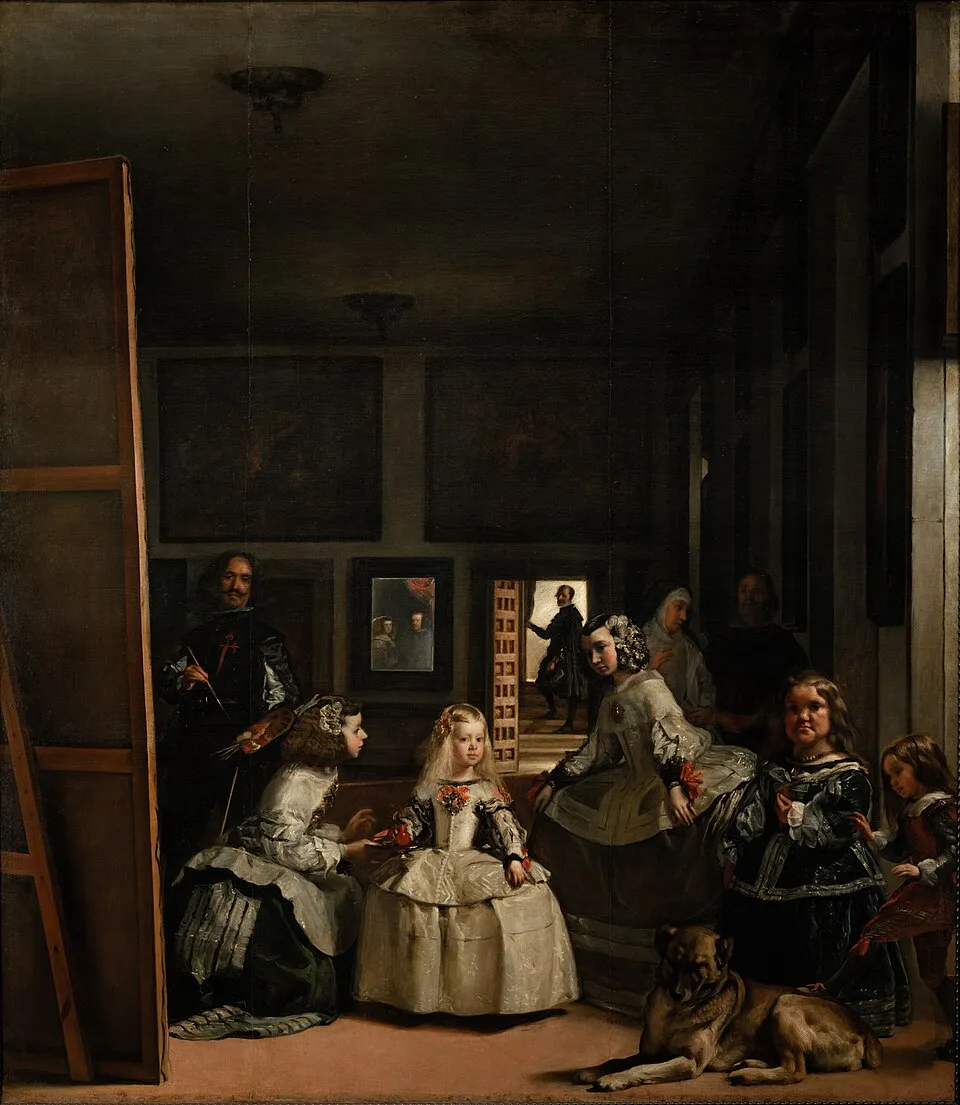
Las Meninas, Diego Velázquez, 1656. Oil on canvas, 318 x 276 cm. Museo del Prado, Madrid. Wikimedia Commons.
Who Is in the Room: The Cast of Characters
The scene takes place in a large room in the Alcázar palace in Madrid, the room Velázquez used as his studio. At the center foreground stands the Infanta Margarita, the five-year-old daughter of King Philip IV and Queen Mariana of Austria. She is dressed in a white and silver gown that spreads wide, a formal costume for a formal occasion. Two ladies-in-waiting flank her. On her left, one of them offers a small red ceramic vessel. On her right, another bends toward her. The "meninas" of the title is the Portuguese term for these young noble attendants.
To the right of the Infanta stands Maribarbola, one of the court dwarfs, next to a large dog lying on the floor. Another dwarf, Nicolasito Pertusato, prods the dog with his foot. At the back of the room, partially in shadow, stand a nun and a male guardian. In the doorway at the far back, brightly lit against the dark room, stands a man on a staircase who is either entering or leaving: this is José Nieto, the marshal of the queen's household.
And on the far left, behind a large canvas whose back faces us, stands Velázquez himself, palette in his left hand, brush in his right, looking directly out of the painting. He is not looking at the Infanta. He is looking at whatever is in front of the canvas, which is where you are standing. The small mirror on the back wall reflects a man and a woman. According to the early biographer Antonio Palomino, writing in 1724, those two figures are King Philip IV and Queen Mariana.
The Mirror and What It Actually Shows
The mirror is the painting's most contested element, and it has generated a significant body of art historical scholarship. The simplest reading: the king and queen are standing at the viewer's position, outside the painting's picture plane, posing for a portrait. Velázquez is painting them. The Infanta and her attendants have come in to watch. The mirror reflects the royal couple's presence in the real space of the studio. On this reading, you, the viewer, are standing where they stand, and the painting gives you the experience of occupying the royal gaze.
An alternative reading, developed by the art historian Joel Snyder and others, argues that the mirror does not reflect figures in the room at all. Instead, it reflects the image on the canvas that Velázquez is painting: a completed portrait of the king and queen that hangs facing us, visible in the mirror. This reading makes the painting even more layered. We are not watching a portrait sitting. We are watching a painter finish a portrait, and the mirror gives us a glimpse of the finished work, which we otherwise cannot see because the canvas faces away from us.
Neither reading can be definitively settled by looking at the painting, because the physics of the mirror, its size, its position on the wall, and the angle from which it would need to reflect either the room or the canvas, do not fully cooperate with either interpretation. This ambiguity is not an accident or a technical failure. It is the painting's central mechanism. Velázquez built a picture that you cannot fully resolve, and that irresolution is what keeps you looking.
Velázquez and the Status of the Painter
Why did Velázquez include himself so prominently? He stands at full height, in good clothing, with a calm authority that has nothing of the craftsman's deference about it. On his chest is the red cross of the Order of Santiago, one of Spain's most prestigious chivalric orders. Historical records show that Velázquez was admitted to the Order in 1659, three years after the painting was completed. The cross was probably added to the canvas after his admission, either by Velázquez himself or, according to one persistent account, by Philip IV. Whether or not the king painted it in, the symbolic claim is consistent with the painting's broader argument.
In 17th-century Spain, the question of whether painting was a mechanical trade or a liberal art was unresolved, and it had real economic consequences. Tradesmen paid certain taxes and held certain social positions. Liberal artists did not. Painters spent decades petitioning the courts for exemption from taxes on the grounds that painting was an intellectual activity, not a craft. Velázquez's self-portrait in Las Meninas stakes out a position in this debate by showing the painter as a figure of social distinction standing in the royal studio alongside the king's family. As the Prado Museum's curatorial notes on the work describe, the painting is as much about the dignity of artistic practice as it is about any specific narrative moment.
The Painting's Influence and the Artists Who Responded to It
Las Meninas spent its first century inside the Spanish royal collections and was not widely known outside Spain. Francisco Goya made an etched copy in 1778, one of his earliest engagements with the Spanish Old Masters whose company he aspired to join. The painting entered the Prado when the museum opened in 1819 and gradually became one of the most reproduced and studied works in the Western canon.
Pablo Picasso's engagement with it is the most sustained and revealing. In the summer and autumn of 1957, Picasso retreated to his studio at La Californie in Cannes and produced 58 paintings based on Las Meninas, spending approximately four months working through the composition from multiple angles. He enlarged the Infanta until she filled the canvas. He reduced Velázquez to a sketch. He rearranged the spatial logic of the room. He made some versions in gray and others in saturated color. The series is now in the Museu Picasso in Barcelona, and seeing it alongside reproductions of the Velázquez demonstrates how much interpretive latitude the original contains. Picasso was not copying. He was arguing with the picture, testing which elements were structural and which were optional.
Francis Bacon made distorted versions in the 1950s. Salvador Dalí engaged with it. Contemporary photographers and digital artists return to it regularly. The reason is the same every time: the painting poses questions that are still alive. Who is looking? Who is being looked at? Where does the painting's space end and the viewer's space begin? These are not puzzles to be solved. They are the painting's actual subject.
Visiting the Prado and Seeing It in Person
The Prado hangs Las Meninas in Room 12, and the museum provides a good amount of space in front of it. You need distance. At fifteen feet, the composition reads as a whole and the depth of the room becomes legible. Up close, the paint handling is extraordinary: the Infanta's dress is built from loose, confident strokes that suggest rather than describe the fabric's texture, and the figures in the background dissolve into soft passages that are more atmospheric than descriptive.
The cross of Santiago on Velázquez's chest is painted with the same loose assurance as everything else. Whatever its history, it reads as part of the work. The mirror on the back wall is genuinely small, maybe four inches square in the actual painting, and the reflections in it are more suggested than rendered. The light that falls through the doorway where José Nieto stands illuminates a large section of the back wall and creates the spatial recession that makes the room feel real. Spending an hour in that room teaches you more about Baroque painting than most textbooks.
For the Baroque tradition that produced this painting, the guide to Baroque art and its techniques of light and drama provides essential context. For how to approach any complex painting systematically, the step-by-step framework for reading paintings is a useful companion to any extended time with Las Meninas. And if Velázquez's self-portrait raises questions about how artists have historically positioned themselves within their work, the guide to reading portraits covers what those choices communicate.


