
The Louvre gets 8.7 million visitors a year. The Mona Lisa room has 500 people in it at any given time, held back by a rope line, photographing the painting through their phones. But the Mauritshuis in The Hague, which has Vermeer's "Girl with a Pearl Earring," one of the most famous paintings in the world, gets 400,000 visitors a year. You can stand in front of it alone. The Frick Collection in New York has Vermeer, Rembrandt, Bellini, and Turner in a mansion you can walk through in 90 minutes. The Gemäldegalerie in Berlin has the deepest collection of European Old Master paintings in any single museum, and it is almost always empty. Small museums offer something the mega-museums cannot: intimacy, focus, and the ability to see the entire collection in one visit.
"Small" is relative. The Mauritshuis has 841 objects. The Frick has 1,700. The Gemäldegalerie has 3,600 paintings. By comparison, the Louvre has 35,000 works on display and the Met has 2 million. The point is not that small museums are better. It is that they offer a different experience. You can see everything. You can return to a painting three times in one visit. You can sit on a bench and look. This guide covers 10 small museums worth traveling for: the Mauritshuis (The Hague), the Frick Collection (New York), the Gemäldegalerie (Berlin), the Calouste Gulbenkian (Lisbon), the Museu Nacional d'Art de Catalunya (Barcelona), the Musée de l'Orangerie (Paris), the Isabella Stewart Gardner Museum (Boston), the Dulwich Picture Gallery (London), the Museo Sorolla (Madrid), and the Kröller-Müller Museum (Netherlands).
The Mauritshuis (The Hague, Netherlands)
The Mauritshuis has 841 objects in a 17th-century city palace. The collection was built around the Dutch Royal Cabinet of Paintings, and the building itself is a masterpiece: a Classical palace designed by Jacob van Campen for Count Johan Maurits of Nassau-Siegen, built between 1633 and 1644. The museum was renovated from 2012 to 2014, and the underground entrance hall connects to the Royal Palace complex next door. The renovation added climate control, a new café, and an education space, but the galleries upstairs remain as they were: small rooms with silk wallpaper and paintings hung in the 19th-century manner.
Vermeer's "Girl with a Pearl Earring" (c. 1665) is the painting most visitors come for. At 44.5 x 39 cm, it is smaller than you expect. The painting was purchased at auction in 1881 for 2 guilders plus 30 cents buyer's premium, roughly equivalent to 24 euros in 2015 values. It was in poor condition at the time. The collector Arnoldus des Tombe bought it for almost nothing and bequeathed it to the Mauritshuis in 1902. The pearl itself is not a pearl. It is a paint stroke: two brushmarks of white lead with a tiny highlight. Vermeer did not paint a pearl. He painted the idea of a pearl, and the viewer's eye fills in the rest.

Johannes Vermeer, "Girl with a Pearl Earring" (c. 1665). Oil on canvas, 44.5 x 39 cm. Mauritshuis, The Hague. Image: Public domain, via Wikimedia Commons
Rembrandt's "The Anatomy Lesson of Dr. Nicolaes Tulp" (1632) is the other major work. At 169.5 x 216.5 cm, it was Rembrandt's first major group portrait, painted when he was 26. The painting shows Dr. Tulp dissecting a forearm while seven surgeons watch. The faces are individual portraits, each paid for separately. The arm is anatomically incorrect: the flexor muscles are painted as if they belong to a right arm, but the arm being dissected is a left arm. Rembrandt either did not know the anatomy or chose to sacrifice accuracy for compositional clarity.
Vermeer's "View of Delft" (c. 1660-1661) is the third painting worth seeking out. At 96.5 x 115.7 cm, it is Vermeer's largest surviving work. Proust said it was "the most beautiful painting in the world," and in "In Search of Lost Time," the character Bergotte dies in front of it. The painting is a view of Delft from across the river, with the city's rooftops and church towers under a sky of building clouds. The foreground water is painted in short horizontal strokes of blue and gray. The city is painted in precise detail. The sky is where Vermeer's genius is most visible: the clouds are built up in layers of gray, white, and pale yellow, and they have a weight and density that no photograph captures.
The Mauritshuis is running two major exhibitions in 2026. "BIRDS: Curated by The Goldfinch and Simon Schama" ran from February to June 2026, exploring humanity's relationship with birds through works by Leonardo da Vinci, Rembrandt, Picasso, Matisse, and Tracey Emin. In October 2026, the Mauritshuis will open "Thyssen-Bornemisza Loves Mauritshuis," an unprecedented exchange where 25 masterpieces from the Thyssen-Bornemisza Museum in Madrid will come to The Hague, including works by Jan van Eyck, Dürer, El Greco, and Piero della Francesca. Entry is 15 euros. You can see the permanent collection in 90 minutes. For more on Rembrandt, see our guide to Rembrandt: Light, Shadow, and the Human Face.
The Frick Collection (New York)
The Frick Collection has 1,700 objects in the Gilded Age mansion of Henry Clay Frick (1849-1919), steel magnate and one of the most ruthless industrialists of his era. The mansion at 1 East 70th Street was designed by Thomas Hastings of Carrère and Hastings in 1913-1914. Frick intended the house as a permanent home for his collection, and after his death, his daughter Helen oversaw the conversion into a museum that opened in 1935.
The collection includes Vermeer's "Mistress and Maid" (c. 1666-1667) and "Officer and Laughing Girl" (c. 1657), Rembrandt's "Self-Portrait" (1658) and "The Polish Rider" (c. 1655), Bellini's "St. Francis in the Desert" (c. 1476-1478), Turner's "The Harbor of Dieppe" (c. 1826-1830), and Holbein's "Sir Thomas More" (1527). These are not second-tier works. "St. Francis in the Desert" is one of the most important Renaissance paintings in America. The Rembrandt self-portrait is one of the greatest self-portraits in any collection.
The Frick is a house museum. You walk through Frick's living rooms, dining room, and garden court. The paintings hang above fireplaces and between windows, as they did when Frick lived here. There are no labels on the walls. You carry a guide or use the app. The experience is closer to visiting someone's home than visiting a museum, and that is the point. The Frick is what it feels like to live with great paintings.
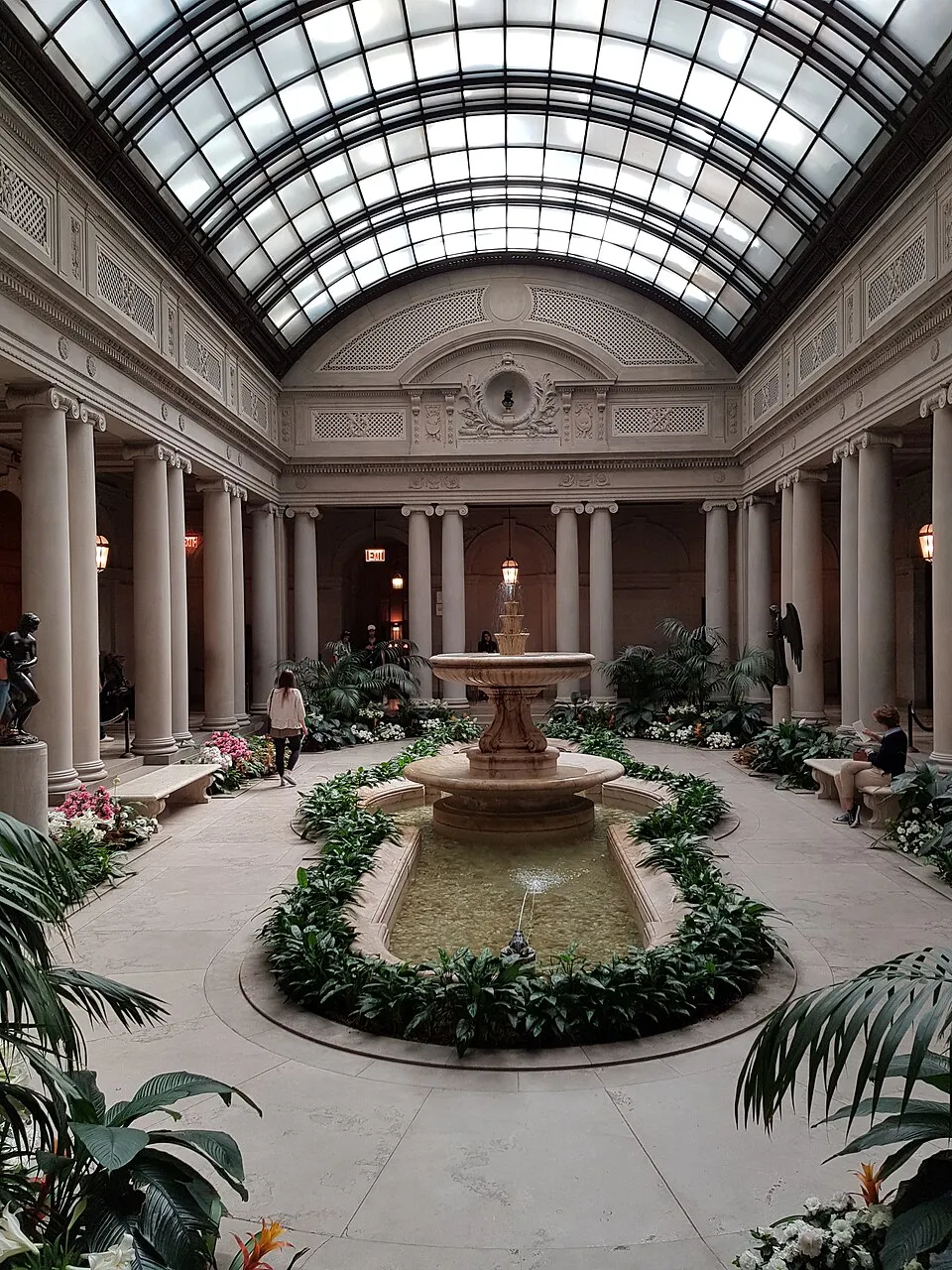
The Frick Collection, New York. Henry Clay Frick's former residence, 1913-1914. Image: Public domain, via Wikimedia Commons
The Frick reopened on April 17, 2025 after a five-year, $220 million renovation designed by Selldorf Architects with executive architect Beyer Blinder Belle. The renovation restored the historic first-floor galleries and opened the second floor to the public for the first time in the museum's 90-year history. The second floor, formerly the Frick family's private living quarters and later staff offices, now contains 10 rooms and five passages displaying smaller-scale paintings, sculptures, and decorative objects. The renovation also added a new 220-seat auditorium, the museum's first dedicated education rooms, a café, and a new reception hall. The total project cost was $330 million, including the temporary relocation to the Breuer building on Madison Avenue from 2021 to 2024.
The renovation was controversial. Some critics felt it overmodernized a beloved space. The New York Times called it "poetic." ArtNews called it "a little disappointing." The most noticeable additions are a new staircase made from Breccia Aurora Blue marble and the below-ground auditorium, both of which are louder than the rest of the building. But the restored first-floor galleries are as good as they have ever been, and the second-floor rooms are a genuine addition. Ingres's "Portrait of the Comtesse d'Haussonville" (1845), one of the collection's most famous works, looks better in its new second-floor setting than it did in the old gallery. The Frick's inaugural exhibition in the new first-floor special exhibition galleries, "Vermeer's Love Letters," opened in June 2025. The museum is now open five days a week (expanding to six), and admission is $22, with free admission on Wednesdays from 2 to 6 PM. For more on famous paintings, see our guide to famous paintings explained.
The Gemäldegalerie (Berlin)
The Gemäldegalerie has 3,600 European Old Master paintings from the 13th to the 18th century, housed in the Kulturforum complex near Potsdamer Platz. The building was designed by Hilmer and Sattler and opened in 1998. The galleries are long, skylit, and arranged chronologically. The collection is the deepest collection of European Old Master paintings in any single museum: 16 Rembrandts (more than any museum outside Amsterdam), 2 Vermeers, 3 Caravaggios, plus Botticelli, Raphael, Titian, and Bruegel.
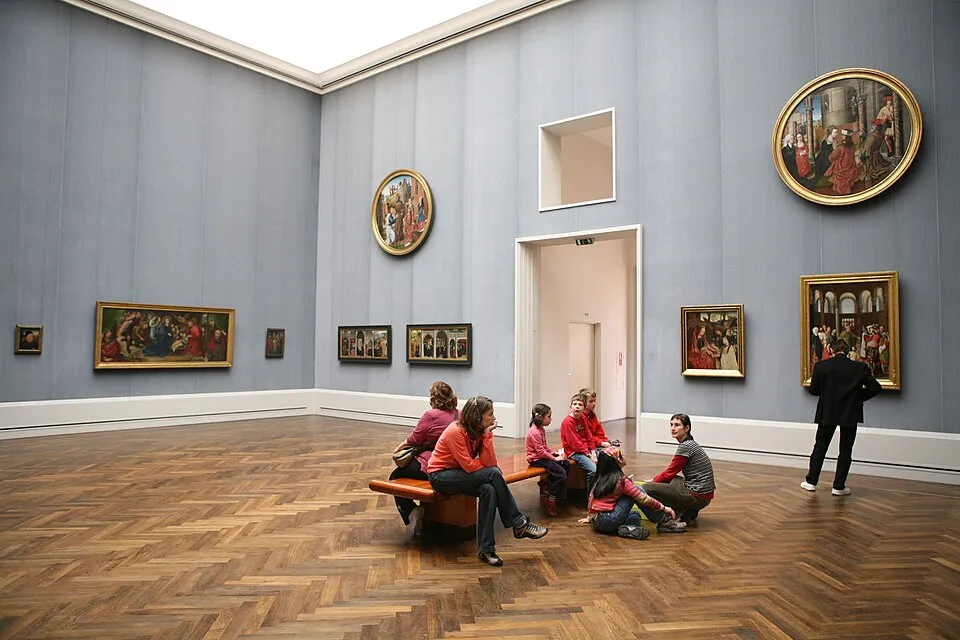
The Gemäldegalerie, Berlin. Kulturforum, designed by Hilmer and Sattler, opened 1998. Image: Public domain, via Wikimedia Commons
Vermeer's "The Wine Glass" (c. 1658-1660) and "Woman with a Pearl Necklace" (c. 1662-1665) are both here. Caravaggio's "Amor Vincit Omnia" (1602) is one of the most provocative paintings in the collection: a naked Cupid standing on a pile of armor, books, and musical instruments, grinning at the viewer. Bruegel's "The Dutch Proverbs" (1559) is a painting you can spend an hour with: it depicts over 100 Netherlandish proverbs being acted out by peasants in a village square. A man banges his head against a brick wall. A woman hangs a blue cloak on her husband (meaning she is cheating on him). A pig is taught to play a bagpipe. Each figure is a proverb, and the painting is a visual encyclopedia of 16th-century folk wisdom.
The gallery is almost always empty. Berlin visitors go to Museum Island for the Pergamon Altar and the Nefertiti bust, and they skip the Kulturforum entirely. This is both wonderful and wrong. The Gemäldegalerie is the best Old Master collection in Germany, and it has more Rembrandts than the National Gallery in London. You can sit on a bench in front of a Caravaggio with no one else in the room. Entry is 14 euros. Plan 2 to 3 hours for highlights and 4 to 5 hours for the full collection. In 2026, the Gemäldegalerie is running "Gallery Looks: Fashion Staging at the Gemäldegalerie" (January to May 2026), exploring the interface between Old Master paintings and contemporary fashion, and "Portraits! Surprising Encounters from Botticelli to Lempicka" (October 2026 to March 2027), bringing together 80 masterworks of portraiture spanning five centuries. For more on Renaissance art, see our guide to Renaissance Art: Perspective, Humanism, and the Birth of Modern Art.
The Calouste Gulbenkian Museum (Lisbon)
The Calouste Gulbenkian Museum has 6,000 objects collected by Calouste Gulbenkian (1869-1955), an Armenian-British oil magnate who settled in Lisbon during World War II. The museum opened in 1969, 14 years after Gulbenkian's death. The building is a modernist structure set in a park designed by landscape architect Gonçalo Ribeiro Telles, and the garden alone is worth the visit. It is one of the most beautiful urban parks in Lisbon, with a lake, winding paths, and a collection of sculptures.
The collection spans Egyptian, Greco-Roman, Islamic, and European art. The highlights are the Lalique jewelry collection: 170 pieces by René Lalique, the largest in the world. Gulbenkian was Lalique's primary patron, and the collection includes brooches, combs, pendants, and vases in gold, enamel, glass, and semi-precious stones. The pieces are displayed in a dedicated gallery with special lighting that shows the translucency of the glass and enamel. Also notable are Rembrandt's "Portrait of an Old Man" (c. 1655), Turner's "The Wreck of the Transport Ship" (c. 1805-1810), and Monet's "Portrait of the Artist's Wife" (1876). The Rembrandt is a small portrait, but it has the same quality of psychological penetration as the larger works in the Hermitage or the National Gallery. Entry is 10 euros, and the museum is free on Sundays from 10 AM to 2 PM. Plan 2 hours for the full collection.
Five More Hidden Gems
Musée de l'Orangerie (Paris): Monet's "Water Lilies" in two oval rooms designed by Monet himself. The rooms are the most immersive Monet experience in the world. The eight panels, installed in 1927 after Monet's death, wrap around the curved walls of the two rooms. The lighting changes with the time of day through the skylights above. The museum also has the Jean Walter and Paul Guillaume collection of Impressionist and Post-Impressionist works: Renoir, Cézanne, Matisse, Picasso, Rousseau, Modigliani. Entry is 12.50 euros. Plan 90 minutes.
Isabella Stewart Gardner Museum (Boston): a 15th-century Venetian palace reconstructed in Boston, filled with Gardner's personal collection of paintings, sculpture, furniture, and textiles. The building is organized around a central courtyard garden that blooms year-round. The museum was the site of the biggest art heist in history: on March 18, 1990, two men dressed as police officers stole 13 works, including Vermeer's "The Concert" (c. 1664) and Rembrandt's "Storm on the Sea of Galilee" (1633). The works have never been recovered. Empty frames still hang on the walls where the paintings were. Admission is $22.
Dulwich Picture Gallery (London): England's first purpose-built public art gallery, designed by Sir John Soane in 1811. The building is a masterpiece of museum architecture: skylit galleries, brick walls, a mausoleum at the center. The collection has 600 Old Master paintings, including Rembrandt, Rubens, Poussin, and Watteau. The gallery is in south London, away from the museum crowds of South Kensington, and it is almost always quiet. Admission is 18 pounds. Plan 60 to 90 minutes.
Museo Sorolla (Madrid): the house and garden of Joaquín Sorolla (1863-1923), Spain's greatest Impressionist. Sorolla painted sunlight better than almost anyone. The garden is the most beautiful museum garden in Madrid, with fountains, tiles, and flowers arranged in Andalusian style. The house contains Sorolla's studio, preserved as it was when he worked there, with his brushes, palettes, and unfinished canvases. The museum was closed for renovation in 2025 and early 2026. Check the current status before visiting. Entry is 3 euros, making it one of the best value museum visits in Europe.
Kröller-Müller Museum (Netherlands): located in the Hoge Veluwe National Park, 90 minutes from Amsterdam. The museum has 90 Van Gogh paintings, the second-largest collection after the Van Gogh Museum in Amsterdam. It also has a 25-hectare sculpture garden with works by Rodin, Henry Moore, Barbara Hepworth, and Marta Pan. The park itself is remarkable: 5,400 hectares of forest, heath, and sand dunes, with free white bicycles available at the entrance for visitors to ride to the museum. The combination of art, nature, and cycling makes this one of the most distinctive museum experiences in Europe. Entry is 20 euros, which includes park entry. For more on how to make the most of museum visits, see our guide on how to visit an art museum without getting overwhelmed.
Final Thoughts
Small museums offer what mega-museums cannot: the ability to see everything, to return to a painting, to sit and look. The Mauritshuis has Vermeer's most beloved painting in a building you can walk through in 90 minutes. The Frick has Rembrandt and Vermeer in a Gilded Age mansion that reopened in 2025 with new second-floor galleries. The Gemäldegalerie has the best Old Master collection in Germany and almost no visitors. These museums are not consolation prizes. They are the best museum experiences in the world.
The mega-museums have their place. The Louvre, the Met, the British Museum, the Prado: these are encyclopedic collections that no small museum can match. But the experience of visiting them is often exhausting, crowded, and rushed. You stand in line, you fight through tour groups, you take a photo and move on. At a small museum, you sit down. You look. You come back to the same painting. You leave feeling like you have seen something, not like you have been processed through a building.
Next time you are in a major city, skip the mega-museum for a day and visit the small museum instead. Book the Mauritshuis if you are in Amsterdam (40 minutes by train from Centraal). Book the Frick if you are in New York. Book the Gemäldegalerie if you are in Berlin. For the broader context of art history, see our Complete Guide to Art Movements and our Art History in 10 Minutes. For more on how to look at art, see our guide on how to look at art for beginners.


