
Albrecht Dürer's "Praying Hands" (c. 1508) is the most reproduced religious image in art history. The drawing, two hands pressed together in prayer, palms open, fingers pointing up, was originally a study for an altarpiece, the "Heller Altarpiece," which was destroyed by fire in 1729. The drawing survived. The altarpiece did not. The hands are not praying in any specific religious tradition. They are a universal gesture of supplication, of openness, of reaching toward something beyond the self. The drawing is small (29.1 x 19.7 cm) and executed in brush on blue paper, but it has been reproduced on greeting cards, tattoos, keychains, and church windows for over 500 years. The hands are not just hands. They are a symbol. And they are not the only hands in art that carry meaning. Michelangelo's "Creation of Adam" (c. 1512), God's finger reaching toward Adam's finger, the gap between them the space of life itself, is the most famous hand gesture in art history. Buddhist mudras encode the entire path of enlightenment in hand positions. Christian iconography uses specific hand gestures for blessing, teaching, and judgment. The hand in art is never just a hand. It is a gesture, a symbol, a message.
The human hand is the most expressive part of the body after the face. It can bless, curse, teach, pray, reach, reject, hold, release. In art, the hand carries meaning that the face cannot. The face is individual. The hand is universal. A praying hand in a 15th-century painting and a praying hand in a 21st-century photograph are the same gesture. This guide covers the hand in art: Dürer's Praying Hands, Michelangelo's Creation of Adam, Christian hand iconography, Buddhist mudras, the hand in secular art, the hand as artistic self-portrait, and what hands communicate that faces cannot.
Dürer's Praying Hands: The Universal Gesture (c. 1508)
"Praying Hands" (c. 1508, brush on blue paper, 29.1 x 19.7 cm, Albertina, Vienna) was a study for the apostle hands in the "Heller Altarpiece" (1509, destroyed by fire in 1729). The altarpiece was commissioned by Jakob Heller for the Dominican church in Frankfurt. Dürer's study shows two male hands, rough, veined, working-class hands, pressed together in prayer. A popular 19th-century legend claims the hands belong to Dürer's brother, who sacrificed his own art education to support Albrecht's. The story is apocryphal. There is no evidence for it. The hands are not anyone's hands in particular. They are a study, a preparatory drawing for a larger work.
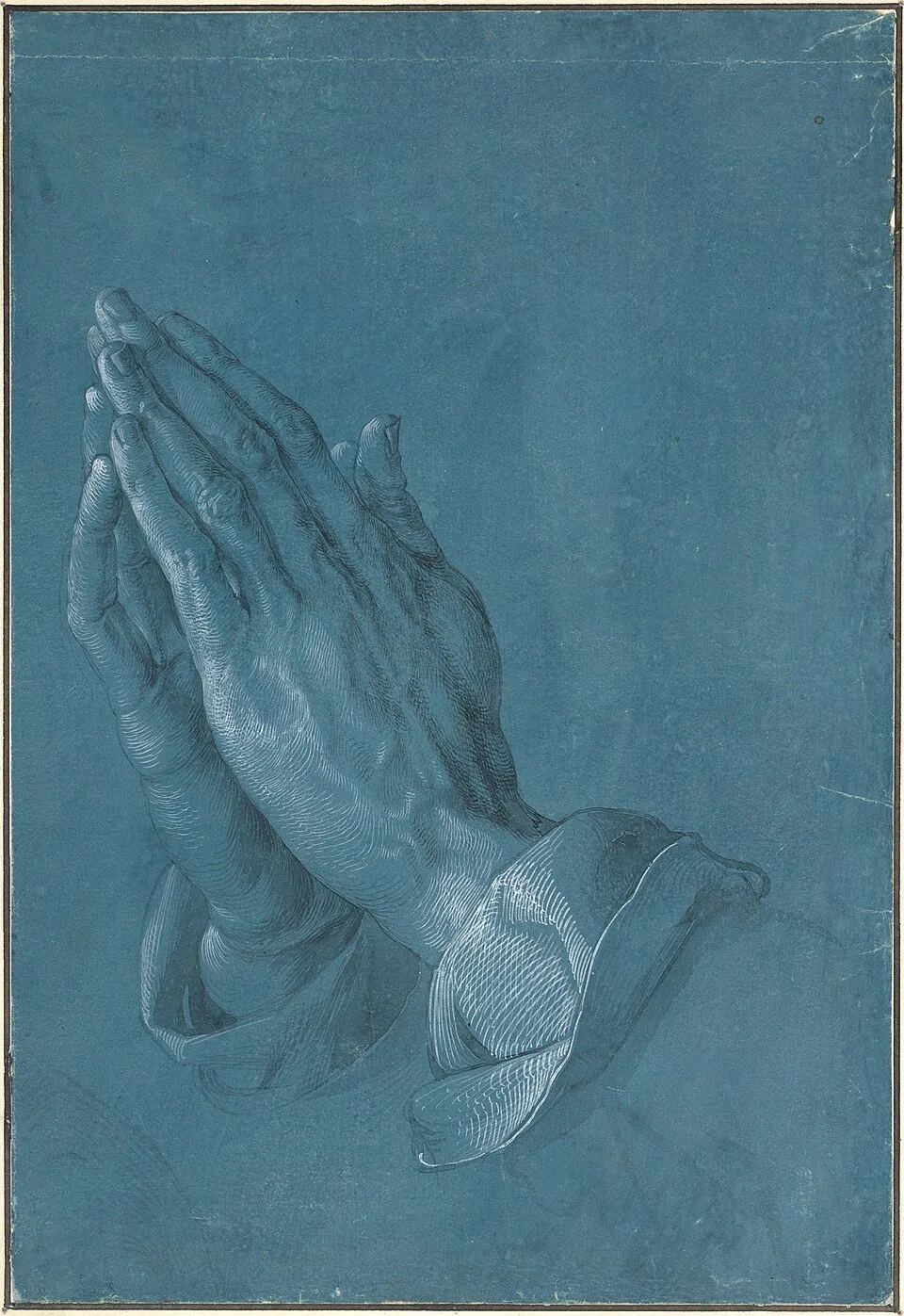
Albrecht Dürer, "Praying Hands" (c. 1508). Brush drawing on blue paper, 29.1 x 19.7 cm. Albertina, Vienna. Image via Wikimedia Commons
The drawing's power comes from its specificity. Dürer did not draw generic hands. He drew particular hands, with particular veins, particular wrinkles, particular knuckles. The specificity makes the hands real, and the reality makes the gesture universal. The hands are not idealized. They are working hands, rough and veined. The prayer is not abstract. It is embodied, physical, muscular. The drawing says: prayer is not a feeling. It is an act of the body. For more on the works that define this period, see our guide to famous paintings explained, and the Wikipedia entry on Praying Hands covers the drawing's history.
Michelangelo's Adam: The Gap That Gives Life (c. 1512)
"The Creation of Adam" (c. 1512, fresco, 280 x 570 cm, Sistine Chapel, Vatican) is one panel of the Sistine Chapel ceiling, commissioned by Pope Julius II and painted between 1508 and 1512. The composition shows God the Father, surrounded by angels, reaching from the right toward Adam, who reclines on the left. Their hands are nearly touching. God's index finger extends with purpose. Adam's finger is limp. They do not meet. The gap between the fingers is the space of life, the moment before the spark, the instant before animation.
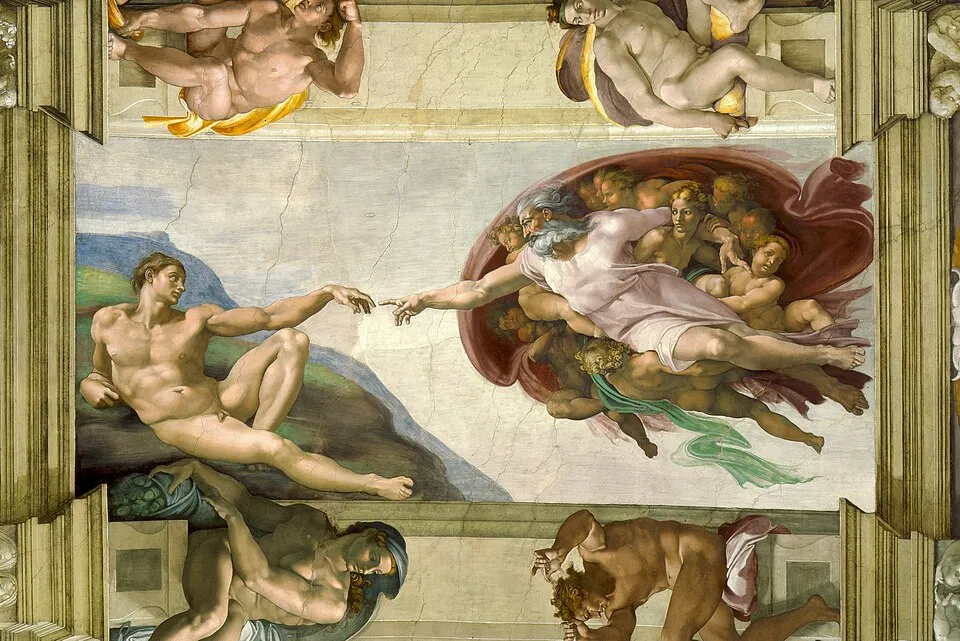
Michelangelo, "The Creation of Adam" (c. 1512). Fresco, 280 x 570 cm. Sistine Chapel, Vatican. Image via Wikimedia Commons
God's hand is active. The index finger extends with purpose, the arm is muscular, the hand is taut. Adam's hand is passive. The arm is limp, the finger barely lifts, the body is still half-asleep. The contrast is the meaning: God reaches, Adam receives. The gesture is not just a gesture. It is a theology. The gap between the fingers is the space of divine grace, the space where the divine meets the human, where the creator gives life to the created. The nearly-touching fingers are the most famous hand gesture in art history. The image has been reproduced, parodied, and referenced thousands of times, from E.T. to The Simpsons to NASA mission patches. The gesture's power comes from its incompletion. The fingers do not touch. The meaning is in the gap: the almost, the not-yet, the about-to-be. For more on the sculptor and painter behind this work, see our profile of Michelangelo.
Christian Hand Iconography: Blessing, Teaching, Judgment
In Christian art, Christ blesses with the right hand raised, two fingers extended (index and middle), the other fingers curled. The two fingers symbolize Christ's dual nature, human and divine. The gesture is called the "Manus Dei" (Hand of God) and appears in Byzantine icons, Renaissance paintings, and Orthodox frescoes. In Eastern Orthodox iconography, the blessing hand forms the letters IC XC, the first and last letters of "Jesus Christ" in Greek. The fingers literally spell the name of Christ.
Christ as teacher raises the right hand with the index finger extended, the gesture of authority, of speech, of instruction. In "The Transfiguration" (1516-1520, 159 x 159 cm, Vatican Pinacoteca), Raphael's Christ raises both hands, the right in blessing, the left in teaching. The gesture is not just a hand position. It is a claim: I have authority to teach. In "The Last Judgment" (1536-1541, 1370 x 1220 cm, Sistine Chapel), Michelangelo's Christ raises his right hand in a gesture of judgment: the hand raised, the arm cocked, the fingers spread. The gesture is not a blessing. It is a threat. The same hand that creates in "The Creation of Adam" destroys in "The Last Judgment." The hand in Christian art carries the full range of divine power: creation, teaching, blessing, and destruction. For more on the religious context, see our guide to art and religion. ResearchGate has a useful paper on secret hand gestures in paintings, and CyPaint explains what a raised hand means in religious art.
Buddhist Mudras: The Hand as Spiritual Path
In Buddhist art, hand gestures (mudras) are a codified system of symbolic positions that encode specific spiritual meanings. There are six principal mudras, each representing a specific event in the life of the Buddha. The dharmachakra mudra (turning the wheel of dharma) represents teaching. The bhumisparsha mudra (touching the earth) represents calling the earth to witness enlightenment. The dhyana mudra (meditation) places both hands in the lap, palms up. The abhaya mudra (fearlessness) raises the right hand, palm outward. The varada mudra (gift-giving) lowers the right hand, palm outward. The namaskara mudra (greeting) presses both hands together at the chest.
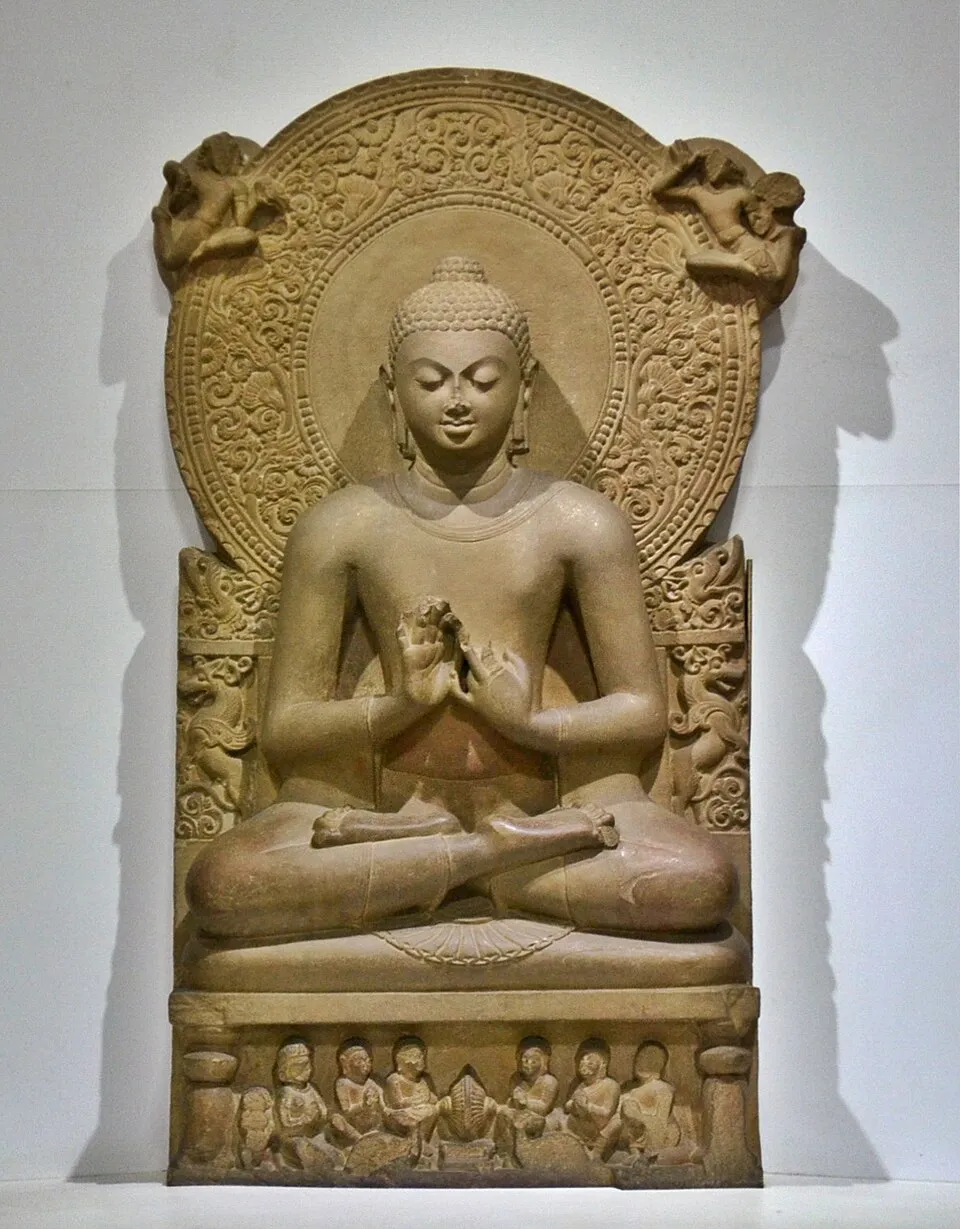
Buddha statue with dharmachakra mudra (gesture of teaching). Buddhist hand gestures (mudras) encode specific spiritual meanings. Image via Wikimedia Commons
Each mudra tells a story. The bhumisparsha mudra, the right hand touching the earth, represents the moment the Buddha called the earth to witness his enlightenment, defeating the demon Mara. The abhaya mudra, the raised open hand, means "do not fear" and was the Buddha's gesture to a charging elephant in the story of Nalagiri. The mudras are not arbitrary. They are a visual language that communicates the Buddha's teachings through the body. Buddhist mudras are the most sophisticated hand symbolism in art. They demonstrate that the hand can carry meaning as precisely as language. Each mudra is a word, a sentence, a story. The mudras also demonstrate that the body is a medium for spiritual truth. The hand is not just a hand. It is a vehicle for teaching, for blessing, for enlightenment. The hand in Buddhist art is not decorative. It is doctrinal. For more on how different cultures encode meaning in visual form, see our guide to color and culture.
The Hand in Secular Art: Gesture, Labor, Touch
In secular portraiture, the hand conveys social status and personality. The hand on the hip (akimbo) signals confidence. See Rembrandt's "The Night Watch" (1642, 363 x 437 cm, Rijksmuseum), where Captain Banninck Cocq's hand on his hip commands the scene. The hand on the chest signals sincerity. See Holbein's "Portrait of Erasmus" (1523, 42 x 32 cm, National Gallery, London). The hand resting on a book signals learning. See Vermeer's "The Astronomer" (1668, 51 x 45 cm, Louvre).
In Realist art, the hand is a tool of work. Jean-François Millet's "The Gleaners" (1857, 83.5 x 110 cm, Musée d'Orsay) shows three women bending to gather grain. Their hands are rough, reddened, and calloused. Gustave Courbet's "The Stone Breakers" (1849, 165 x 257 cm, destroyed in WWII) shows two men breaking stones. Their hands grip hammers. The hand in Realist art is not a symbol. It is an instrument, and the painting honors the labor it performs.
The hand in art can also represent touch itself, the most intimate of the senses. In "The Creation of Adam," the nearly-touching fingers represent the moment before contact, the anticipation of touch. In Antony van Dyck's "The Lomellini Family" (c. 1632, 264 x 246 cm, National Gallery of Scotland), a child's hand rests on a dog's head, a gesture of affection and possession. In Mary Cassatt's "The Child's Bath" (1893, 100 x 66 cm, Art Institute of Chicago), a mother's hand supports the child's foot, a gesture of care and tenderness. For more on how art reflects social structures, see our guide to art and society.
The Hand as Artistic Self-Portrait
The hand that paints is also the hand that is painted. In self-portraits, artists often show their painting hand, the hand that makes the art. In "Self-Portrait as the Allegory of Painting" (c. 1638-1639), Artemisia Gentileschi shows her right hand holding a brush, poised over the canvas. In "Self-Portrait" (c. 1665, 114 x 94 cm, Kenwood House), Rembrandt shows himself with palette and brushes in his hands, the tools of his trade. The artist's hand in a self-portrait is a declaration: I made this. My hand made this. The hand is both the subject and the instrument. It paints and is painted. This circularity, the hand that makes the image is also in the image, is unique to self-portraiture. No other genre shows the tool and the product simultaneously. For more on the genre, see our guide to the self-portrait as genre.
What Hands Communicate That Faces Cannot
The face is individual. It shows a specific person. The hand is universal. It shows a gesture that anyone can recognize. A praying hand, a blessing hand, a reaching hand: these gestures cross cultures and centuries. The face changes with fashion, culture, and era. The hand does not. A praying hand in a 15th-century painting and a praying hand in a 21st-century photograph are the same gesture.
The face can lie. It can smile when it is sad, frown when it is happy. The hand is harder to control. It trembles when afraid, clenches when angry, opens when trusting. The hand is the body's tell, the unconscious signal that reveals what the face conceals. In portraiture, the hand often reveals more about the sitter than the face: the tension in the fingers, the relaxation of the palm, the position relative to the body. The hand in art is the body's language, a language that is older than speech, more universal than words, and more honest than the face. The hand blesses, teaches, prays, reaches, works, touches, and creates. In art, the hand carries meaning that the face cannot, because the face is personal and the hand is universal. For help thinking about what you see, see our guide on how to look at art for beginners.
Final Thoughts
The hand in art is never just a hand. It is a gesture, a symbol, a message. Dürer's "Praying Hands" (c. 1508, 29.1 x 19.7 cm) is the most reproduced religious image in art history, a universal gesture of supplication drawn from specific, rough, working-class hands. Michelangelo's "Creation of Adam" (c. 1512, 280 x 570 cm), God's finger reaching toward Adam's, is the most famous hand gesture in art, with the gap between the fingers carrying the meaning of life itself. Christian iconography uses specific hand gestures for blessing (two fingers, dual nature), teaching (index finger, authority), and judgment (raised hand, spread fingers). Buddhist mudras encode the entire spiritual path in six hand positions, from bhumisparsha (enlightenment) to abhaya (fearlessness). In secular art, the hand conveys status (akimbo), labor (Millet's gleaners), and touch (Cassatt's mother and child). In self-portraits, the artist's hand is both subject and instrument, the tool that makes the image is also in the image.
My position is straightforward. The hand is the body's language: older than speech, more universal than words, more honest than the face. The face is personal. The hand is universal. The hand in art is never just a hand. It is always a gesture, a symbol, a message. Next time you look at a painting, any painting, look at the hands, not just the faces. The hands are blessing, teaching, praying, reaching, working, touching. The hands are telling you something the faces are not. And the something they are telling you is older than language, more universal than words, and more honest than any face can be.


