
In the West, a bride wears white. In China, a bride wears red. In the West, mourners wear black. In China, mourners wear white. In Mexico, the dead are honored with orange marigolds, pink sugar skulls, and yellow pan de muerto. In Ghana, the dead are buried in brightly painted coffins shaped like fish, cars, and shoes. The same color means different things in different cultures, and the differences are not trivial. They are structural. White is not universally pure. Red is not universally dangerous. Black is not universally the color of death. The meanings of color are constructed by culture, not by biology, and the construction is so deep that most people are unaware of it. They think their culture's color meanings are natural, universal, and obvious. They are not. The same red that communicates celebration and luck in China communicates danger and warning in the West. The same white that signifies purity in a Western wedding signals mourning in a Chinese funeral. Getting these associations wrong, in design, in marketing, in art, can undermine a campaign, offend an audience, or produce a visual communication that fails to land.
The study of color symbolism across cultures reveals that color meanings are constructed through repeated association within a specific cultural context. While certain physiological responses to color may be universal, red increases heart rate and blue is calming, the symbolic weight assigned to a hue is overwhelmingly cultural. John Gage, in "Color and Meaning" (1999), argued that "meanings are constructed through repeated association within a specific cultural context." The same color can mean opposite things in different cultures, and both meanings are equally valid. This guide covers how different cultures read the same colors differently: white, red, black, yellow, blue, and green. It covers the Chinese five-element color system (wuxing), the Mexican Día de los Muertos, Ghanaian fantasy coffins, and what cross-cultural color means for art and design in 2026.
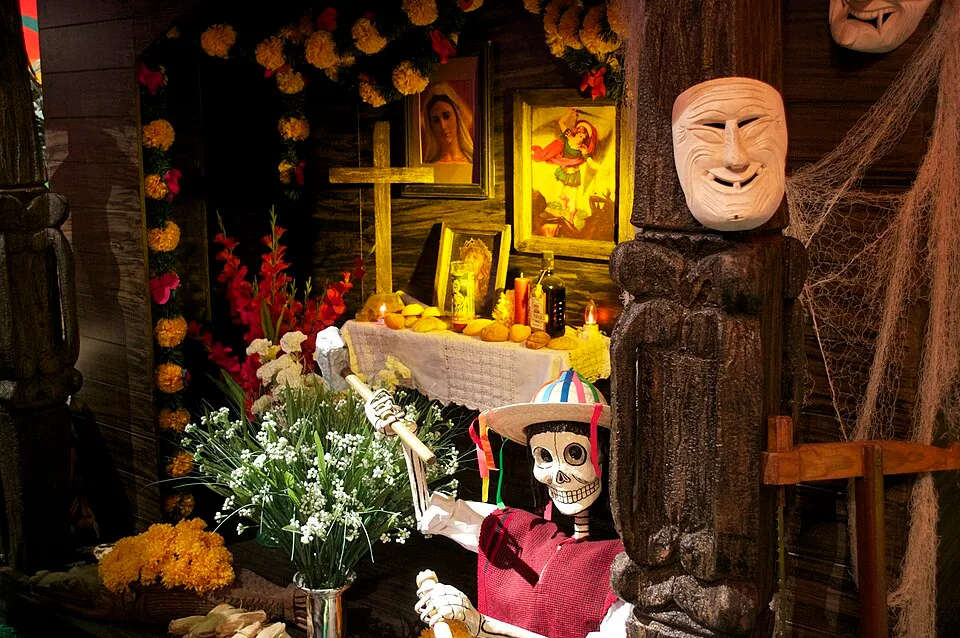
Día de los Muertos altar, Mexico. The celebration uses color, orange marigolds, pink sugar skulls, yellow pan de muerto, to honor the dead. Photo by Tomascastelazo, via Wikimedia Commons, CC BY-SA 4.0.
White: Purity in the West, Death in the East
In Christian traditions, white is the color of purity, innocence, and new beginnings. Brides wear white, a tradition popularized by Queen Victoria in 1840. Priests wear white for celebratory masses. Babies are christened in white. White interiors signal cleanliness and modernity. Apple's commitment to white product design positioned whiteness as a premium aesthetic signal.
In China, Korea, Japan, and Vietnam, white is the traditional color of mourning and funerals. Death rituals are "white affairs" (Baishi, 白事). Mourners wear white robes, white headbands, and white flowers. The practice is rooted in Confucianism. White is the color of purity and asceticism, associated with the concept of wu (無), meaning "non-being" or "void." To wear undyed, plain white garments during mourning is a sign of deference to the deceased, stripping oneself of social vanity. Buddhism further cemented the connection. Death is a transition, and white symbolizes the liberation of the spirit from earthly confines.
The same color that means weddings in the West means funerals in the East. The difference is not biological. It is cultural. A Western designer who uses white for a wedding invitation in China will confuse the audience. A Chinese designer who uses white for a funeral in the West will seem inappropriately cheerful. The meaning of white is not in the color but in the culture. Read our history of white for the longer story.
Red: Danger in the West, Luck in China
In the US and Europe, red's primary associations are danger, urgency, and warning, a legacy of traffic systems, emergency services, and hazard signage. Red is also associated with love on Valentine's Day and with passion, but the danger association is the most immediately activated in utilitarian contexts. Red is the color of stop signs, fire engines, and error messages.
In Chinese culture, red (紅, hóng) is the color of luck, prosperity, fertility, celebration, happiness, and masculine yang energy. Chinese New Year decorations are overwhelmingly red: red lanterns, red envelopes (hongbao) filled with money, red characters on doors. Brides wear red at traditional weddings. Red is the color of the Chinese flag (#DE2910). The specific reds used in Chinese festive contexts tend toward deeper, warmer values, #C41E3A (China red) and #DE2910 (Chinese flag red), rather than the aggressive pure red of Western warning systems.

Traditional Chinese wedding couple in red. Red symbolizes luck, prosperity, and happiness in Chinese culture. Image via Wikimedia Commons.
In Hindu tradition, red is associated with purity, fertility, love, beauty, and auspiciousness. The sindoor, red vermillion applied to the parting of a married woman's hair, is one of the most recognizable cultural markers in South Asian societies. Red is the primary color of bridal dress in many Indian communities. In ancient Egypt, red was associated with death. Mummies were wrapped in cloth dyed with hematite. Osiris, god of the afterlife, was known as the "lord of the red cloth." In ancient China, red and black frequently appeared in tombs, and red was associated with death at the time. Red is "the most culturally variable of all colors. No color shows greater divergence across cultures." The same red that means stop in New York means celebrate in Beijing. The same red that means love in Paris means death in ancient Thebes. Red is not one color but many, and its meaning is determined by the culture that uses it. Our history of red goes deeper into the pigment politics.
The Chinese Five-Element Color System (Wuxing)
Traditional Chinese culture recognizes five "cardinal colors": cyan (青, qīng), red (紅, hóng), yellow (黃, huáng), white (白, bái), and black (黑, hēi). These correspond to the five elements (wuxing) of traditional Chinese metaphysics: wood, fire, earth, metal, and water. The correspondences are precise. Cyan and green equal wood, spring, growth, and east. Red equals fire, summer, passion, and south. Yellow equals earth, the center, neutrality, and the emperor. White equals metal, autumn, purity, and west. Black equals water, winter, heaven, and north. The system is not arbitrary. It is a cosmology. Colors are linked to seasons, directions, elements, and virtues. The emperor wore yellow because yellow is the center, the earth, the axis of the world.
Yellow is "the most beautiful and prestigious color" in Chinese culture. "The Chinese saying 'Yellow generates yin and yang' implies that yellow is the center of everything." Yellow was the color of the emperor. Only the emperor and his immediate family were permitted to wear yellow. Yellow also represents freedom from worldly cares in Buddhism. Monks' garments are yellow, as are elements of Buddhist temples. The contrast with the West is sharp. In the West, yellow is associated with cowardice ("yellow-bellied"), caution (yellow traffic lights), and illness (jaundice). In China, yellow is associated with heroism, the emperor, and the center of the cosmos. The same color that means cowardice in the West means royalty in the East. This is the kind of structural difference we examine in art and society.
Black: Mourning in the West, Heaven in China
In Western culture, black symbolizes death, grief, evil, and mourning. People wear black at funerals. Black is the color of the void, of absence, of the end. It is also the color of elegance and sophistication, the "little black dress," the black-tie event. In Chinese culture, black (黑, hēi) corresponds to water and is "generally understood as a neutral color." The I Ching regards black as Heaven's color. "The saying 'heaven and earth are black' was rooted in the observation that the northern sky was black." Ancient Chinese people "regarded black as the king of colors and honored black more consistently than any other color." Laozi said: "know the white, keep the black." Taoists believe black is the color of the Tao.
The same color that means death in the West means heaven in China. The Western association of black with mourning is not universal. It is a cultural construction, rooted in Christian traditions of darkness and sin. The Chinese association of black with heaven is rooted in observation: the night sky is black, and the divine resides in the sky. The meaning of black is not in the color but in the cosmology. See our history of black for more.
Death and Color: Mexico, Ghana, and the Colors of Mourning
On November 1 and 2, Mexican families honor the dead with elaborate altars (ofrendas) adorned with photographs, favorite foods, and belongings of the departed. The altars are a riot of color: orange marigolds (cempasúchil), pink sugar skulls (calaveras), yellow pan de muerto, red and green candles. Death is not met with black but with every color available. The Mexican perspective on death emphasizes remembrance, celebration, and the continuation of familial bonds.
In Ghana, the dead are buried in brightly painted coffins shaped like objects representing the deceased's profession or passions: fish-shaped coffins for fishermen, car-shaped coffins for drivers, shoe-shaped coffins for cobblers. The coffins are meticulously crafted and painted in vivid colors. The Ghanaian tradition treats the burial as a celebration of life, not a mourning of death. The colors are not somber but jubilant, a final, colorful statement of the deceased's identity.

Ghanaian fantasy coffin. These brightly painted coffins celebrate the deceased's profession and personality. Image via Wikimedia Commons.
The contrast is the point. In the West, death is black. In Mexico, death is every color. In Ghana, death is the deceased's favorite color. In China, death is white. The color of mourning is not universal. It is cultural. The way a society colors death reveals its relationship to mortality: fear (black), acceptance (white), celebration (color), identity (personalized color). There is no "correct" color for death, only the color that a given culture has chosen.
What Cross-Cultural Color Means for Art and Design in 2026
In a globalized world, color is cross-cultural. A design created in New York is seen in Beijing, Mumbai, and Lagos. A color that communicates purity in New York may communicate death in Beijing. A color that communicates danger in London may communicate celebration in Mumbai. The global designer must know the color symbolism of every market they serve, or risk producing a design that is misunderstood, offensive, or simply ineffective. Western companies have made color mistakes in international markets. A Western brand using white for a wedding product in China will confuse the audience. A Western brand using red for a warning label in China will seem inauspicious. The specific reds used in Chinese festive contexts (#C41E3A, #DE2910) are different from the reds used in Western warning systems, and "a too-bright or too-cool red can read as foreign and contextually mismatched" in the Chinese market.
The history of art is a history of color symbolism, and the symbolism is not universal. The red of Christ's Passion in a Renaissance painting means sacrifice and blood. The red of a Chinese New Year decoration means luck and prosperity. The red of a Hindu bridal dress means purity and auspiciousness. The same pigment, whether vermilion, cochineal, or cadmium red, carries different meanings in different cultural contexts. The art historian who ignores cultural context will misread the color. Color is not a universal language. It is a set of dialects, related but not identical, mutually intelligible but not interchangeable. The same color can mean opposite things in different cultures, and both meanings are equally valid. The task of the artist, the designer, and the art historian is to learn the dialects, to understand that white is not always pure, red is not always dangerous, and black is not always the end. This is the working assumption behind contemporary art trends in 2026 and our color theory guide. For the Western side of yellow, see our history of yellow.
Final Thoughts
Color meanings are cultural, not universal. White means purity in Western weddings and death in Chinese funerals. Red means danger in the West and luck in China. Black means mourning in the West and heaven in Chinese cosmology. Yellow means cowardice in the West and royalty in China. The Chinese five-element system (wuxing) links colors to elements, seasons, and directions, a cosmology that has no Western equivalent. The Mexican Día de los Muertos and Ghanaian fantasy coffins show that death can be colored with celebration, not just mourning. In a globalized world, the cross-cultural meaning of color is a practical problem for designers and a theoretical problem for art historians. Color is not a universal language but a set of dialects, related but not identical, mutually intelligible but not interchangeable.
Next time you see a color in a painting, a product, or a design, ask yourself: what does this color mean in this culture? Not what does it mean to you. What does it mean to the person who made it and the audience it was made for. The meaning of color is not in the pigment but in the people who use it. Learn the dialects. The same color can mean opposite things, and both meanings are equally real. For reference, see the color symbolism overview, the color in Chinese culture guide, and ColorFYI's color meanings across cultures.


