
In 1956, the art historian Kenneth Clark published "The Nude: A Study in Ideal Form," still the most influential book on the subject. Clark opened with a distinction: "The English language, with its elaborate generosity, distinguishes between the naked and the nude. To be naked is to be deprived of our clothes, and the word implies some embarrassment or objectification. To be nude is to be seen as a work of art." The distinction is elegant, and it is a dodge. It says the nude is not a body but an idea. The nude is not about sex but about form. The nude is not about power but about beauty. But the nude is about all of these things. The nude is a body, a specific body, usually female, usually young, usually white, usually passive, usually displayed for a viewer who is assumed to be male. The nude is not just a "work of art." It is a representation of a body that carries the weight of gender, class, race, and power. The controversy is not new. When Manet exhibited "Olympia" at the Paris Salon of 1865, the painting was greeted with riots. Critics called it "a female gorilla" and "a corpse." The public was scandalized, not by the nudity, since nudes were standard in the Salon, but by the fact that the nude woman looked back at the viewer with what one critic called "the shamelessness of a courtesan."
The nude has been a central subject of Western art since Greek antiquity. The Greeks invented the nude as an ideal, the body as a manifestation of divine proportion and human perfection. The Renaissance revived the Greek ideal in Botticelli's Venus, Michelangelo's David, and Titian's reclining nudes. The modern period challenged the ideal in Manet's Olympia, Picasso's Demoiselles d'Avignon, and Lucian Freud's unflattering nudes. The feminist critique of the 1970s exposed the power dynamics of the nude: the male gaze, the objectification, the exclusion of the female experience. This guide covers the history of the nude in art, from Greek idealism to the contemporary nude, and why the subject remains controversial in 2026.
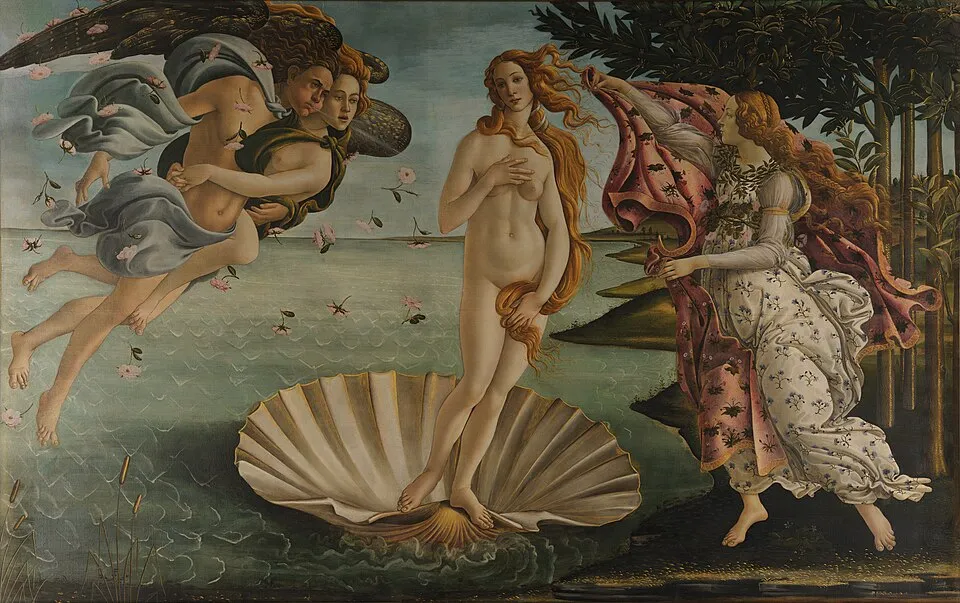
Sandro Botticelli, "The Birth of Venus" (c. 1485). Tempera on canvas, 172.5 x 278.9 cm. Uffizi Gallery, Florence. Image via Wikimedia Commons.
Kenneth Clark and the Naked/Nude Distinction
Kenneth Clark (1903-1983) was a British art historian, director of the National Gallery, and author of "The Nude: A Study in Ideal Form" (1956). The book is based on his Mellon Lectures at the National Gallery of Art in Washington, delivered in 1953. The distinction is the book's foundation: "To be naked is to be deprived of our clothes, and the word implies some embarrassment or objectification. To be nude is to be seen as a work of art." The nude is not a body but a transformation of the body into form. The nude is the body idealized, stripped of its individuality, its imperfections, its sexuality, and its power.
Clark's distinction is an evasion. It separates the body from the representation, as if the representation does not involve a body, a viewer, and a power dynamic. The "nude" is not a pure form. It is a body seen by a specific viewer, usually male, through a specific convention, the male gaze. The "nude" is not free of sexuality. It is sexuality sublimated into form, which is to say, sexuality made acceptable by being called "art." Clark's book is still the starting point for any discussion of the nude, not because it is right but because it states the conventional position most clearly. The feminist critique of the nude by Berger, Mulvey, and Nochlin is a critique of Clark, a rejection of the distinction between "naked" and "nude" and an exposure of the power dynamics that the distinction conceals. We take up those dynamics in our piece on the male gaze.
The Greek Ideal and the Invention of the Nude
The Greeks invented the nude as an art form. The kouros, around 600 BCE, the standing male nude, was the first monumental nude in Western art. The Greeks saw the nude body as a manifestation of divine proportion, the body as a mathematical ideal, a demonstration of harmony, symmetry, and balance. Polykleitos, the Greek sculptor of the 5th century BCE, wrote "The Canon," a treatise on the proportions of the ideal male body. The Doryphoros (Spear-Bearer) was the embodiment of the Canon, a body whose proportions were mathematically determined. The Greek nude was not a representation of any individual. It was a representation of an idea: the ideal human form.
The Greek nude was overwhelmingly male. Female bodies were clothed until the 4th century BCE, when Praxiteles' "Aphrodite of Knidos" (c. 350 BCE) became the first monumental female nude in Greek art. The female nude was immediately sexualized. The Aphrodite of Knidos was "attacked" by a young man who was overwhelmed by desire, according to ancient sources. The Greek nude established the convention that the nude is an ideal, not a body but a form. The convention persisted for 2,000 years. The Renaissance revived it. The academy taught it. The museum displays it. The convention is so deep that it is invisible. Most viewers see a nude as "a work of art" without questioning why the body is idealized, why it is usually female, and why it is displayed for a viewer who is assumed to be male. Trace the full sweep in our art movements timeline.
The Renaissance: Botticelli, Michelangelo, and the Revival of the Nude
Botticelli's "The Birth of Venus" (c. 1485), 172.5 x 278.9 cm, in the Uffizi, was the first large-scale female nude in Renaissance art since antiquity. Venus stands on a shell, born from the sea, covering her genitals and breasts in the "modest Venus" pose (Venus pudica) derived from the Aphrodite of Knidos. The painting is not erotic. It is mythological. Venus is a goddess, not a woman. The nudity is justified by the myth. It is "art," not "nakedness." Michelangelo's "David" (1501-1504), 5.17 m, in the Galleria dell'Accademia in Florence, is the most famous male nude in art history. David is not a warrior or a king. He is an ideal body, a demonstration of human perfection. The nudity is justified by the biblical story of David and Goliath, but the body is Greek, idealized, mathematical, divine.
The Renaissance revived the Greek ideal but added a Christian justification. The nude was acceptable if it was biblical (David, Adam and Eve) or mythological (Venus, Diana). The nude was not acceptable if it was contemporary, a real woman, undressed, looking at the viewer. The distinction between "art" and "pornography" was established here: the mythological or biblical nude is art; the contemporary nude is pornography. The distinction is still with us, and it is still contested. See more examples in our guide to famous paintings explained.
The Reclining Venus: Titian, Giorgione, and the Domestic Nude
Giorgione's "Sleeping Venus" (c. 1510), 108 x 175 cm, in the Gemäldegalerie Alte Meister in Dresden, was the first reclining female nude in Western art. Venus is asleep, in a landscape, her body arranged for the viewer's gaze. She does not look at us. She is unaware of our presence. The painting establishes the convention of the reclining nude: a passive, available body, displayed for a viewer who is assumed to be male. Titian's "Venus of Urbino" (1538), 119 x 165 cm, in the Uffizi, is the most famous reclining nude. Venus is awake. She looks directly at the viewer. She is in a domestic interior, not a mythological landscape. She holds a flower. A dog sleeps at her feet. Servants work in the background. The painting is not mythological. It is domestic. Venus is not a goddess but a woman, a woman who is nude, in her bedroom, looking at the viewer. Mark Twain called it "the foulest, vilest, the obscenest picture the world possesses."
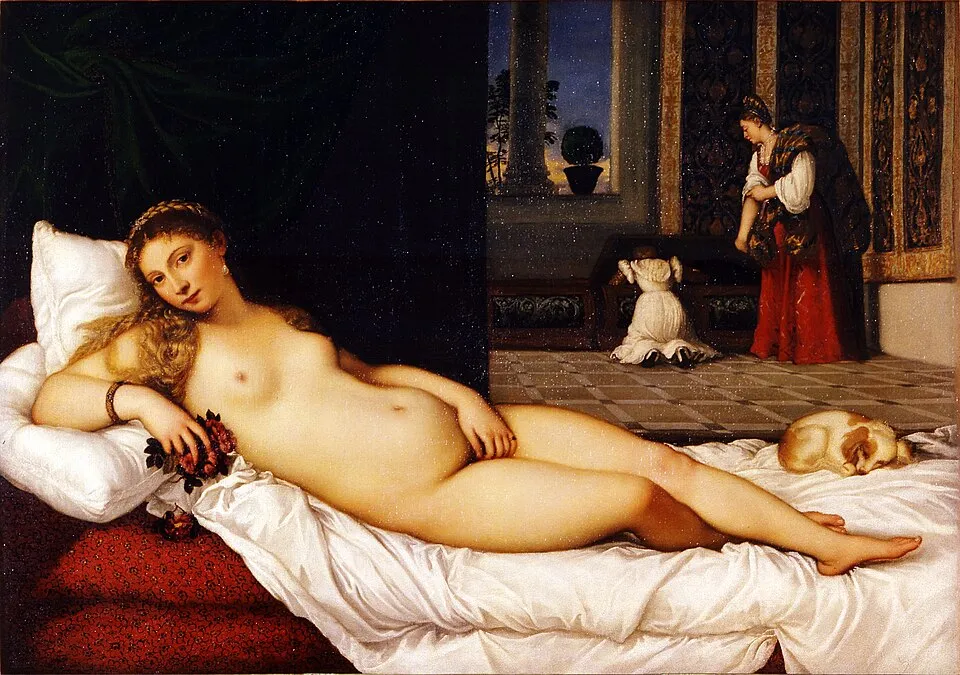
Titian, "Venus of Urbino" (1538). Oil on canvas, 119 x 165 cm. Uffizi Gallery, Florence. Image via Wikimedia Commons.
The reclining Venus became a convention, repeated by Rubens, Velázquez ("Rokeby Venus," 1647-1651, 122 x 177 cm, National Gallery, London), Goya ("La Maja Desnuda," 1797-1800, 97 x 190 cm, Prado), and Ingres ("La Grande Odalisque," 1814, 91 x 162 cm, Louvre). Each variation adjusted the convention. Rubens made the body fuller. Velázquez made it more reflective. Goya made it more confrontational. Ingres made it more exotic, an odalisque, a harem woman. But the convention persisted: a female body, reclining, available, displayed for a male viewer. The reclining Venus is the archetype of the female nude in Western art. It is the image that John Berger analyzed in "Ways of Seeing" (1972): "Men act and women appear. Men look at women. Women watch themselves being looked at." The reclining nude is not just a painting of a body. It is a painting of a body arranged for a gaze. The body is not active. It is displayed. The viewer is not invited. The viewer is assumed.
Manet's Olympia: The Shock of Realism (1865)
Édouard Manet's "Olympia" (1863), 130.5 x 190 cm, now in the Musée d'Orsay, was exhibited at the Paris Salon of 1865. The painting is based on Titian's "Venus of Urbino." The pose is the same. The composition is the same. But the differences are everything. Olympia is not a goddess. She is a prostitute. The name "Olympia" was associated with prostitutes in 19th-century Paris. The model is Victorine Meurent, a real woman, not an idealized Venus. Her body is not idealized. It is thin, pale, and confrontational. She looks at the viewer with what critics called "the shamelessness of a courtesan."
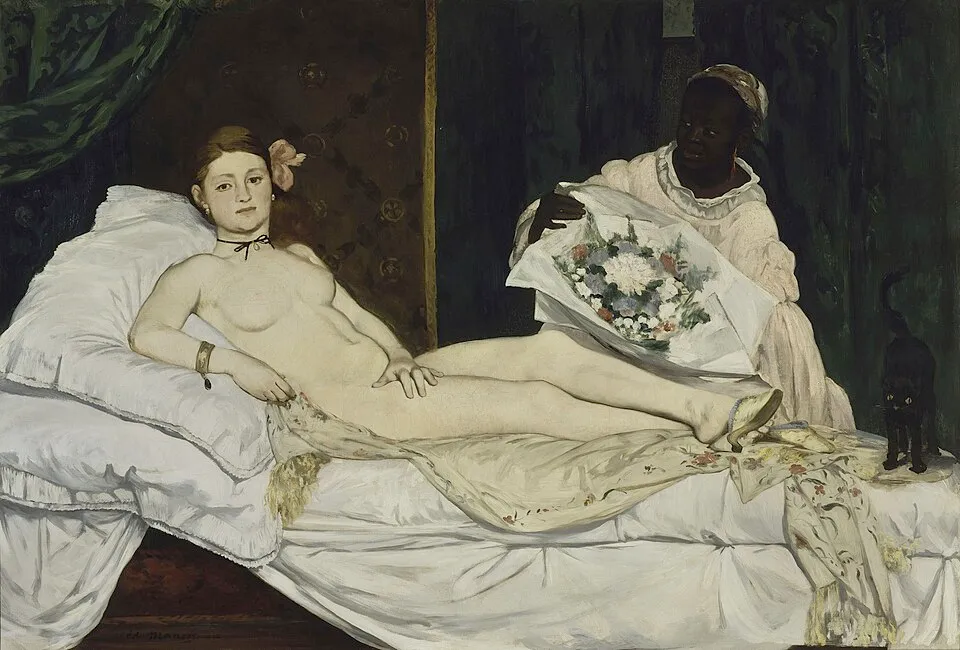
Édouard Manet, "Olympia" (1863). Oil on canvas, 130.5 x 190 cm. Musée d'Orsay, Paris. Image via Wikimedia Commons.
The Black maid, named Laure, presents flowers from a client. The inclusion of a Black maid highlights the racial dynamics of the scene: the white prostitute served by the Black servant, both commodified, both displayed. The painting caused riots at the Salon. Critics called Olympia "a female gorilla," "a corpse," "a yellow-bellied odalisque." The public was scandalized not by the nudity, since nudes were standard at the Salon, but by the realism. Olympia was not a goddess, not a myth, not an ideal. She was a contemporary woman, a prostitute, looking at the viewer with the directness of a business transaction. The distinction between "nude" and "naked" that Kenneth Clark would later articulate was exactly what Manet destroyed. Olympia was not a nude. She was naked, and she knew it. "Olympia" is the turning point in the history of the nude. Before Manet, the nude was idealized, a goddess, a myth, a form. After Manet, the nude could be real, a body, a person, a transaction. Manet did not destroy the nude. He exposed it. He showed that the "nude" was not a pure form but a convention, a convention that could be broken by painting a real body in a real room with a real gaze.
The Feminist Critique: Berger, Mulvey, and Nochlin
John Berger's "Ways of Seeing" (1972) is the most influential critique of the nude. Berger argued that the European nude tradition is based on the male gaze: "Men act and women appear. Men look at women. Women watch themselves being looked at." The nude is not a representation of a woman. It is a representation of a woman as seen by a man. The woman in the painting is not the subject. She is the object. The viewer is the subject, and the viewer is assumed to be male. Laura Mulvey's "Visual Pleasure and Narrative Cinema" (1975) coined the term "the male gaze" in the context of film, but the concept applies to painting. The male gaze is the convention of representing women as objects of male visual pleasure. The woman is displayed; the man looks. The woman is passive; the man is active. The convention is so deep that it is invisible. It is the default mode of representation in Western art.
Linda Nochlin's "Why Have There Been No Great Women Artists?" (1971) did not write about the nude directly, but her argument applies. The "great artist" is a male construct. The artist who paints the female nude is exercising a male privilege. The female artist who paints the male nude is transgressing a convention. The asymmetry is structural: the nude is a genre defined by male viewers and female objects. The feminist critique did not destroy the nude. It exposed its power dynamics. After Berger, Mulvey, and Nochlin, the nude cannot be seen as "a pure form" or "a work of art." It is a representation of a body, and the representation carries the weight of gender, class, race, and power. The nude is not innocent. It is political. Read more in our guide to feminist art theory.
The Contemporary Nude: Who Paints Whom?
In the late 20th and early 21st centuries, the nude has been reclaimed by artists who challenge the male gaze. Jenny Saville paints large, fleshy female nudes from a female perspective. "Propped" (1992) sold for £9.5 million in 2018. Lucian Freud painted nudes of all bodies, male, female, old, young, thin, heavy, with unflinching realism. Alice Neel painted male nudes from a female perspective, reversing the gaze.
Is the nude still controversial? In the museum, no. The nude is a tradition, a genre, a subject. On social media, yes. Instagram and Facebook ban female nipples but not male nipples, perpetuating the double standard that the nude has always embodied. The controversy has moved from the museum to the platform, from the Salon to the algorithm. The nude will remain controversial as long as it involves a body, a viewer, and a power dynamic. The nude is not just a painting of a body. It is a representation of who looks and who is looked at. As long as that relationship is unequal, as long as the viewer is assumed to be male and the body is assumed to be female, the nude will be political. The task of contemporary art is not to abandon the nude but to reinvent it, to paint bodies that are not objects, to create gazes that are not male, to represent the body as a subject, not an object. This is the live debate in contemporary art in 2026, and it starts with the basics of how to look at art and the wider frame of art and society.
Final Thoughts
The nude is the oldest and most controversial subject in Western art. The Greeks invented it as an ideal, the body as divine proportion. The Renaissance revived it in Botticelli's Venus, Michelangelo's David, and Titian's reclining nudes. Manet's "Olympia" (1865) destroyed the ideal: the nude was not a goddess but a prostitute, not a form but a body, not art but life. The feminist critique by Berger, Mulvey, and Nochlin exposed the power dynamics, the male gaze, the objectification, the asymmetry of who looks and who is looked at. Kenneth Clark's distinction between "naked" and "nude," between deprivation and art, is an evasion. The nude is not a pure form. It is a body, represented by a specific person, for a specific viewer, in a specific culture. The nude is political, and it will remain political as long as it involves a body and a gaze.
Next time you see a nude in a museum, a Venus, an Olympia, a David, ask yourself: who is looking and who is being looked at? Who is the subject and who is the object? Who is the artist and who is the model? The nude is not just a body. It is a relationship. And the relationship is not equal. For reference, see Sotheby's history of the nude in 10 works, the Venus of Urbino entry, and the Olympia by Manet entry.


