
In 1991, the Basque government in Bilbao, Spain, made a bet. The city was dying. Shipyards closed, steel mills shuttered, unemployment at 25%. They offered the Solomon R. Guggenheim Foundation a deal: build a museum here, and we will pay for the building, the infrastructure, and the operating costs. The Guggenheim Foundation said yes, and hired Frank Gehry. The building opened on October 19, 1997. Within three years, Bilbao had 1.3 million visitors a year, the city was on every must-visit list in Europe, and the term "the Bilbao Effect" was coined to describe the idea that a single museum building could transform a city's economy and identity. The building is covered in 33,000 titanium panels, each individually cut and curved. It has no right angles.
The Guggenheim Bilbao is not a museum with a famous building. It is a famous building that happens to contain a museum. The collection is secondary to the architecture. This is not a criticism. It is the point. Gehry's building is the artwork, and everything inside it is a bonus. In 2025, the museum welcomed 1,305,003 visitors, confirming that nearly three decades after opening, the building still draws people who would not otherwise visit Bilbao.
This guide covers Gehry's architecture, the Bilbao Effect, the outdoor sculptures (Puppy, Maman, the fog sculpture), Richard Serra's permanent installation, the collection inside, and practical tips.
Frank Gehry and the Architecture
Frank Gehry (born 1929) is a Canadian-American architect. The Guggenheim Bilbao was his breakthrough project, the building that made him the most famous architect in the world. The materials are 33,000 titanium panels (0.38 mm thick), 6,000 limestone panels, and 3,000 glass panels. The titanium was chosen because it reflects light differently at different times of day: silver in the morning, gold in the afternoon, blue at dusk.
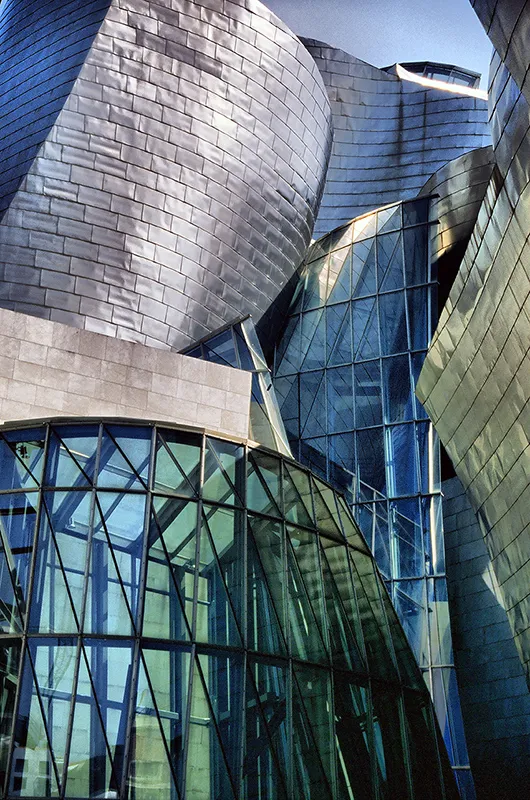
Titanium panel detail, Guggenheim Bilbao. 33,000 titanium panels, each individually cut. Wikimedia Commons.
The form has no right angles and no orthogonal geometry. Gehry used CATIA, aerospace design software, to calculate the curves. The building is described as a ship, a flower, an explosion. Gehry says it was inspired by the industrial shipyards that used to line the Nervión River. The museum sits on the river, next to the Puente de La Salve bridge. Gehry designed the building to integrate with the bridge: one of the museum's volumes passes under the bridge, connecting the building to the city's infrastructure.
The titanium panels accumulate pollution buildup over time. The museum commissioned the Inasmet Foundation, a Basque technology center, to develop an in-situ cleaning process that could be applied without scaffolding or removing the panels. The process uses a four-phase application sequence to restore the titanium to its original condition. The building is now closer to its original silver color than it has been in years.
The Bilbao Effect
Before the museum, Bilbao was an industrial city in decline. The shipyards had closed, the steel mills were shutting down, and the river was polluted. The Basque government needed a catalyst for urban renewal. The deal was straightforward: the Basque government paid $100 million for construction, $50 million for acquisitions, and agreed to cover operating costs. The Guggenheim Foundation provided the collection, the brand, and the curatorial expertise.
The result was 1.3 million visitors in the first year, far exceeding the expected 400,000. The museum generated €500 million in economic activity in its first three years. The city invested in infrastructure: a new metro by Norman Foster, a new airport by Santiago Calatrava, a new footbridge. The Bilbao Effect became the template for every city that wanted to use architecture as urban regeneration. Some succeeded (Tate Modern in London, 2000). Many failed (the Guggenheim Las Vegas was never built; the Guggenheim Abu Dhabi has been stalled since 2011). The lesson is that the Bilbao Effect requires three things: a great architect, a strong institution, and a city willing to invest in infrastructure around the museum. For more on how contemporary art institutions shape cultural conversations, read our guide to contemporary art trends in 2026.
The Outdoor Sculptures
Jeff Koons's "Puppy" (1992) stands at the museum entrance. It is 12 meters tall and covered in 60,000 flowering plants (begonias, marigolds, petunias). Created for Documenta 9 in Kassel, Germany, it was installed permanently at the Guggenheim Bilbao in 1997. The flowers are changed seasonally. It is the most photographed artwork in Spain.
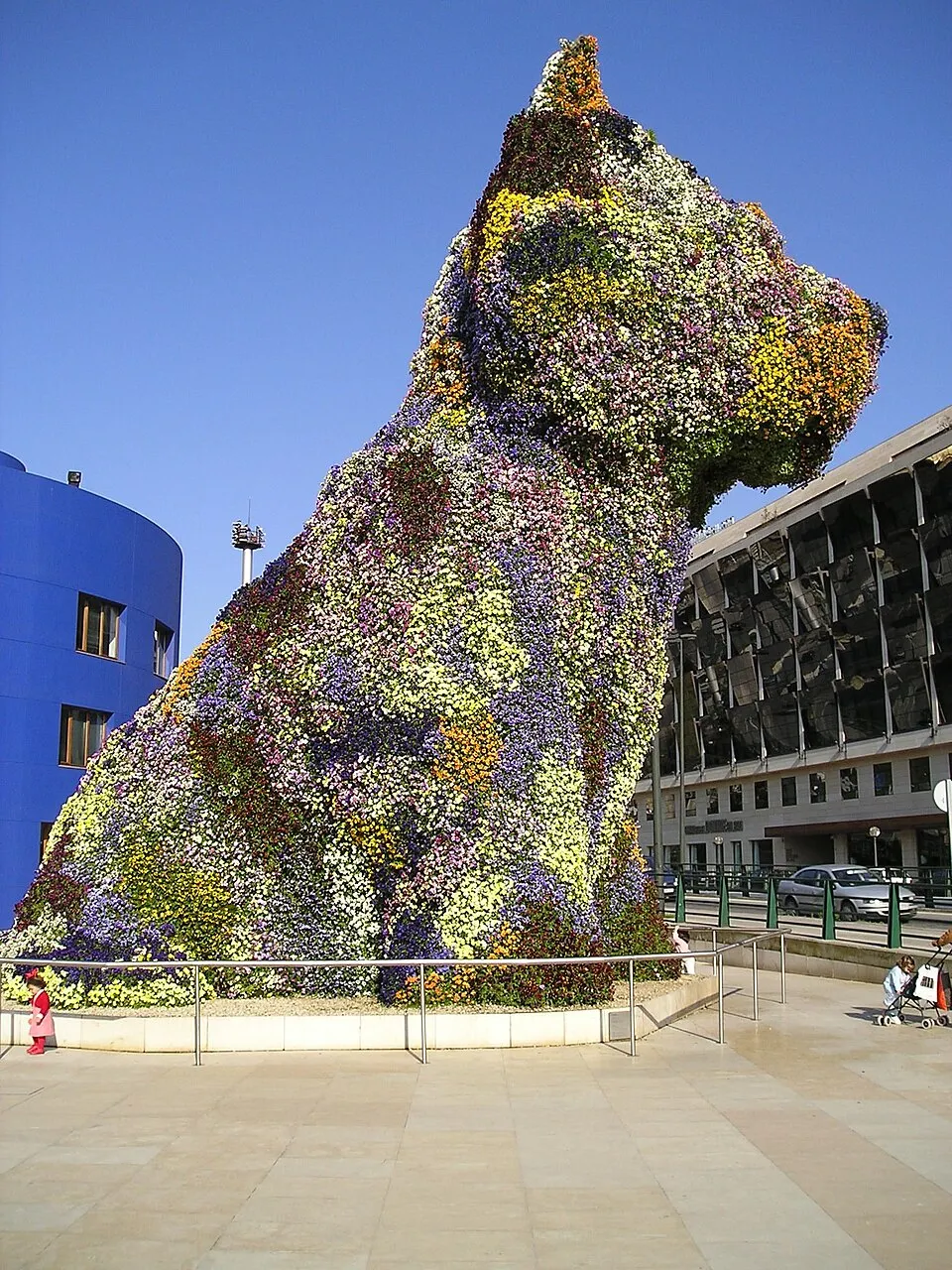
Jeff Koons, "Puppy" (1992). 12 meters tall, covered in 60,000 flowering plants. Installed permanently at the Guggenheim Bilbao entrance. Wikimedia Commons.
Louise Bourgeois's "Maman" (1999) stands nearby. It is 9 meters tall, a bronze spider with a marble egg sac. One of six casts. Bourgeois said the spider was an ode to her mother, who was a weaver. The sculpture is simultaneously threatening and tender.
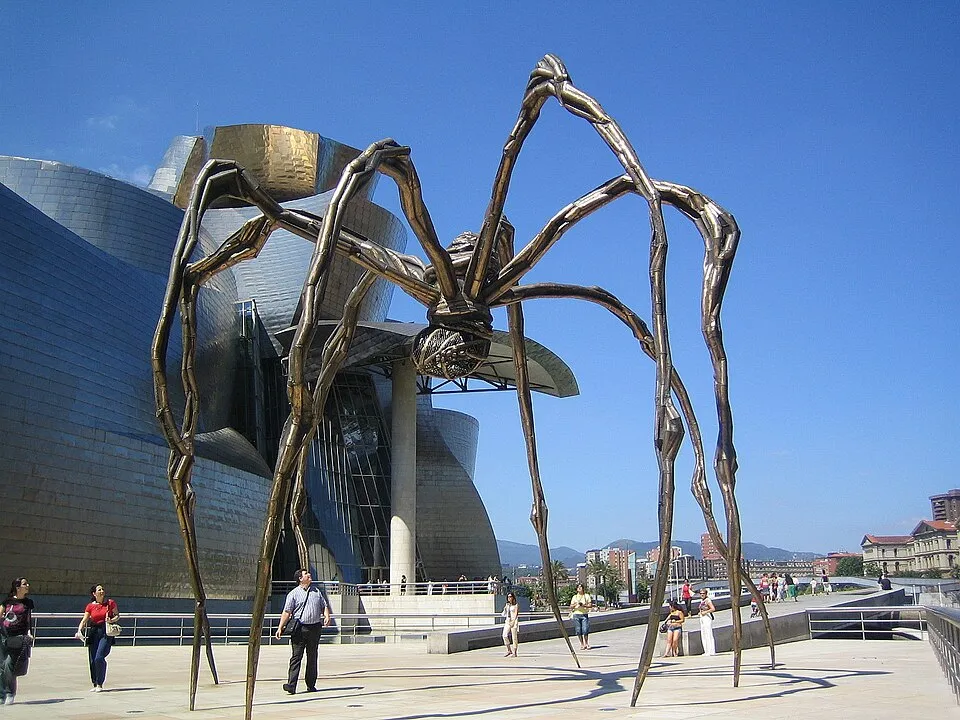
Louise Bourgeois, "Maman" (1999). Bronze, stainless steel, and marble. 9 x 8.7 x 8.7 meters. Guggenheim Bilbao. Wikimedia Commons.
Fujiko Nakaya's fog sculpture activates every hour for eight minutes, enveloping the museum's pond in mist. The fog is made from filtered river water, pressurized and atomized. It is the most atmospheric outdoor artwork in any museum. The outdoor works are accessible without a museum ticket. You can walk around the building, see Puppy, Maman, and the fog sculpture, and experience the architecture without paying admission.
Richard Serra's "The Matter of Time"
Richard Serra's "The Matter of Time" (2005) is a permanent installation in the museum's largest gallery (Floor 1, Gallery 104). Eight torqued steel sculptures, the largest weighing 276 tons. The gallery is 130 meters long and 9 meters wide. Serra designed the sculptures for this specific space.
Walking through the sculptures is disorienting. The walls curve, tilt, and spiral. Your sense of balance shifts. Serra has said the work is about "the experience of time in space." You walk through it, and the walking is the artwork. The sculptures were fabricated in Germany and shipped to Bilbao in pieces. The assembly took six months. The gallery floor was reinforced to support 1,000 tons of steel.
"The Matter of Time" is the largest permanent installation by any living artist in any museum. It is the one work inside the Guggenheim Bilbao that matches the building's scale. Everything else inside feels smaller by comparison. For more on the movement that Serra's work grows out of, read our guide to Minimalism.
The Collection Inside
The Guggenheim Bilbao's collection is thinner than its reputation suggests. The museum has roughly 250 works, a fraction of the Guggenheim Foundation's total collection. The building is the main attraction. The collection rotates. Floor 2 hosts major temporary exhibitions. Floor 1 holds Richard Serra (permanent) plus rotating contemporary installations. Floor 3 displays selections from the Guggenheim Foundation collection: Abstract Expressionism, Minimalism, Pop Art. Works by Rothko, Warhol, Kandinsky, Picasso.
The Jenny Holzer installation "For Bilbao" (1997) consists of LED columns in the north gallery, displaying texts in English, Spanish, and Basque. The columns rise 9 meters and create an immersive environment of language and light.
In November 2025, the museum reopened "Works from the Guggenheim Museum Bilbao Collection" with new acquisitions and long-term loans. The exhibition includes pieces from the D.Daskalopoulos Collection and the Al Held Foundation, along with around fifty works on long-term loan from the Inge Rodenstock Collection. These additions strengthen the museum's holdings in postwar art, with works by Jean-Michel Basquiat, Yves Klein, Jeff Koons, Antoni Tàpies, Cy Twombly, and Andy Warhol. The exhibition is on Floors 3, galleries 301-307.
The 2026 exhibition program is ambitious. Ruth Asawa's retrospective (March 19 to September 13, 2026) is the first major European survey of the Japanese-American sculptor, organized with SFMOMA and MoMA. It features 300 works across six decades, including her signature suspended looped-wire sculptures. A Jasper Johns retrospective follows in the first half of the year. Autumn brings installations by Pipilotti Rist (October 1), Steve McQueen (October 9), and a Dan Flavin exhibition drawn from the Solomon R. Guggenheim Museum's collection (November 12). For more on the movement that Asawa, Johns, and Flavin connect to, read our guide to Abstract Expressionism and American painting.
Practical Tips
Tickets cost €18 for adults during the summer rate (June 15 to September 13) and €15 the rest of the year. Reduced admission is €9 in summer and €7.50 otherwise, for students aged 18 to 25 and seniors over 65. Children under 18 enter free. All tickets include an audio guide. There is no free entry day, despite what many travel sites claim. The museum's own booking engine confirms that Tuesday evening slots charge the full rate.
Hours are Tuesday through Sunday 10:00 AM to 7:00 PM, with extended hours until 8:00 PM during Easter week and summer (June 15 to September 13). The museum is closed most Mondays, with exceptions during Easter, summer, and certain holidays. It is closed December 25 and January 1.
Plan 1.5 to 2 hours for the building and highlights. 3 to 4 hours for a thorough visit. The outdoor sculptures (Puppy, Maman, fog) are free to see. Walk around the building before or after your visit. Bilbao is a 1-hour flight from Madrid or Barcelona. The museum is a 15-minute walk from the city center. The museum café on Floor 1 has river views.
For more on navigating museums efficiently, read our guide on how to visit an art museum without getting overwhelmed. For a broader timeline of the art movements represented in the collection, see our complete guide to art movements.
Final Thoughts
The Guggenheim Bilbao is the most successful example of architecture as urban regeneration in history. Gehry's building is the artwork. The titanium curves, the ship-like forms, the integration with the river and the bridge. The collection inside is secondary, and that is fine. The building alone justifies the trip.
Fly to Bilbao. Walk around the building first (Puppy, Maman, the fog). Then go inside and walk through Serra's "The Matter of Time." Then explore the old town, which is 10 minutes away. If you are visiting in 2026, the Ruth Asawa retrospective is worth the ticket price on its own. It is the first time her work has been shown at this scale in Europe.
For more context, read our art history cheat sheet and our guide on how to look at art for beginners.


