
In the spring of 2025, Tate Modern returned Louise Bourgeois's giant spider sculpture to the Turbine Hall to mark the gallery's 25th anniversary. Maman had been the first work visitors saw when Tate Modern opened in May 2000, and bringing it back for the anniversary was a statement about which artists had shaped the gallery's identity. Standing beneath it in the Turbine Hall, which is 35 meters tall and large enough to feel like the inside of a cathedral, you understand why it was chosen. The spider stands 10 meters high. Its eight legs are made from steel rods that look almost too slender to support the cast bronze body. Beneath the abdomen, a mesh cage holds seventeen white marble eggs. You feel the scale in your body before you think about what it means.
Louise Bourgeois made Maman in 1999, when she was eighty-seven years old. She had been making art since the 1940s and had not received significant international recognition until the Museum of Modern Art in New York gave her a retrospective in 1982, when she was seventy-one. She then continued producing major work for the remaining twenty-eight years of her life, dying in May 2010 at ninety-eight. The late recognition and the late flowering are both consistent with an artist who spent her career refusing to adapt her work to what the market or the critical mainstream wanted from it.
The Early Life: Paris, the Tapestry Workshop, and the Governess
Louise Bourgeois was born in Paris in 1911. Her family ran a tapestry restoration workshop, and she grew up surrounded by the labor of weaving, repairing, and restoring fabric works, an experience she returned to repeatedly in her art. Her mother Josephine was patient and reliable. Her father Louis was intellectually stimulating and chronically unfaithful. For roughly a decade, he conducted an open affair with Sadie Gordon, the English governess hired to teach the children English, while the family lived together under the same roof.
Bourgeois knew exactly what was happening. She watched it as a child, processed it as an adult in decades of psychoanalysis beginning in the 1950s, and converted it into art for the rest of her life. The rage at her father's betrayal, the complicated love for a mother she idealized and grieved, the experience of the family as both the source of safety and the location of damage: these are the materials every major work she made is built from. Calling her art autobiographical understates the case. Her biography is her art's subject matter, not just its context.
New York and the Development of a Visual Language
Bourgeois moved to New York in 1938 after marrying the American art historian Robert Goldwater, and the city became her permanent home. In the 1940s she made a series of painted wooden sculptures called "Personnages," vertical forms assembled from found and fabricated elements that represent figures from her French life: her father, his circle, the social world she had left. These were not illustrations. They were objects that occupied space in ways that suggested psychological relationships, and they were often displayed in groups that emphasized the social dynamics between them.
Through the 1950s and 1960s she developed increasingly complex forms in plaster, latex, bronze, and marble. Many of these are biomorphic, suggesting body parts or internal organs, and they anticipate the hybrid human-architectural forms that would become central to her "Cells" series. She was briefly associated with the Surrealists but maintained independence from any movement throughout her career. The dominant critical framework of the 1950s and 1960s privileged impersonal abstraction, and her insistence on intensely personal content put her outside the mainstream institutional conversation for decades. She was working in exactly the right direction at exactly the wrong moment for easy recognition.
Maman: The Giant Spider
Maman (1999) is one of the most immediately recognizable objects in contemporary sculpture. The bronze spider stands approximately nine to ten meters tall depending on the installation space, weighs over nine thousand kilograms, and carries a suspended cage beneath its body containing seventeen white marble eggs. Multiple cast versions have been installed at major institutions worldwide, including the Tate Modern in London, the Guggenheim Museum Bilbao, the National Gallery of Canada in Ottawa, and the Mori Art Museum in Tokyo.
Bourgeois described the spider explicitly as a tribute to her mother. "My best friend was my mother and she was deliberate, clever, patient, soothing, reasonable, dainty, subtle, indispensable, neat and as useful as a spider. She could defend herself and me by refusing to answer stupid inane questions." The eggs beneath the body reinforce the maternal interpretation: this spider is not predatory but generative, protective of what it carries.
But the work does not reduce to a single meaning. Standing beneath Maman, you are reduced in scale to something much smaller than human. The legs are thin enough to look fragile but extend above you into the air like the structure of a building. The protective enclosure can tip into threatening entrapment depending on where you stand and what you bring to the encounter. Bourgeois understood that her best work would hold contradictory meanings simultaneously, and Maman holds protective and predatory, loving and suffocating, all at once.
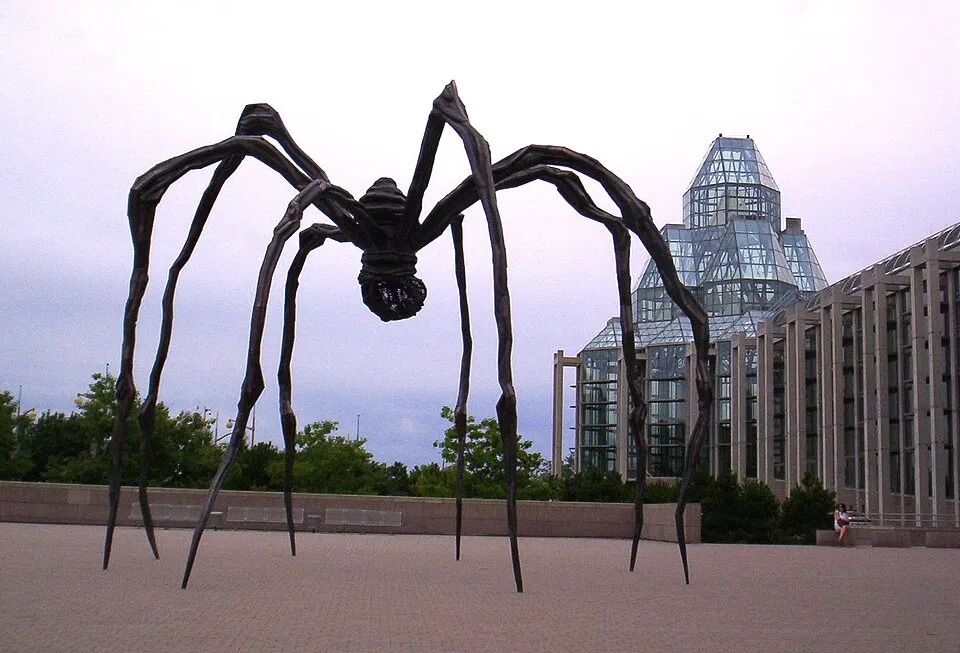
Louise Bourgeois, "Maman" (1999). Bronze, stainless steel, and marble. 927.1 x 891.5 x 1023.6 cm. National Gallery of Canada, Ottawa. One of multiple cast versions installed at major institutions worldwide. In 2025, Maman returned to Tate Modern's Turbine Hall for the gallery's 25th anniversary, marking its significance to the institution's history. Image: Wikimedia Commons.
The Cells
The "Cells" series, which Bourgeois began making in the late 1980s and continued into the 2000s, are room-sized enclosed environments constructed from found architectural elements: wire mesh, old doors, windows, and metal frames, filled with objects, sculptures, and handwritten texts. Each Cell contains a specific emotional territory. "Cell (Eyes and Mirrors)" (1989-93) holds pairs of glass eyes suspended at the center of a circular wire mesh enclosure alongside mirrored surfaces that reflect them endlessly. "Cell (Hands and Mirror)" (1995) confronts the viewer with marble hands and mirrors in a space that can be seen into but not entered. "Cell (Arch of Hysteria)" (1992-93) presents a suspended bronze figure in a backward arch.
The Cells work through a specific formal mechanism. You look in from outside at an arrangement of objects whose meaning is partially legible and partially opaque, as if you were watching through a window into a psychological space that belongs to someone else and that you recognize anyway. The wire mesh and old doors both invite looking and prevent entry. The objects inside are specific enough to evoke particular experiences but ambiguous enough that different viewers bring different memories to them. As Tate's documentation of Bourgeois's practice describes, the Cells insist that psychological states have spatial and physical dimensions, that emotions are something the body lives inside rather than simply experiences.
The Feminist Reading and Why Bourgeois Resisted It
Bourgeois's 1982 retrospective at MoMA coincided with a period when feminist art criticism was establishing itself as a serious intellectual force. Her work was immediately absorbed into that conversation, with good reason. Her investigation of the female body's experience of pain, her engagement with the domestic sphere as a site of psychological complexity, and her insistence on autobiographical content at a moment when the dominant critical framework preferred impersonal abstraction: all of these made her work legible as feminist practice before the term had been applied to it.
Bourgeois acknowledged these readings and engaged seriously with feminist ideas in interviews. But she consistently refused to be defined by them. Her primary concern, she said, was with the specific psychological content of her own experience, not with making generalizable claims about gender or women's experience as a class. This resistance is not a disavowal of feminism. It is a statement about what her work is actually doing: addressing the particular rather than the general, the biographical rather than the theoretical. The feminist readings are valid because they illuminate real dimensions of the work. They are incomplete because they cannot account for its full specificity.
Final Thoughts
Louise Bourgeois spent nine decades making art out of the materials of her own psychological life. The spiders, the Cells, the fabric works, the drawings and prints, the late confessional pieces made in her eighties and nineties: each one engages with a specific aspect of being a body in a family, and together they constitute one of the most sustained investigations of psychological experience that art has produced. The late recognition was genuinely unjust. The late flowering was remarkable. Both are consistent with an artist who refused to make her work more accessible than the psychological territory it was exploring.
For the sculpture tradition she worked within and transformed, the guide to modern sculpture from Rodin onward provides useful historical context. For how installation art creates environments that surround and implicate the viewer, the installation art guide covers the broader field the Cells belong to. What is your experience of Maman? Have you stood beneath one of the installed versions? Share in the comments.


