
Tate Modern is the world's most-visited modern art museum. In 2024-25, it received 4.4 million visitors, according to Tate's annual report. It is housed in a former oil-fired power station on the south bank of the Thames, opposite St Paul's Cathedral. The power station was designed by Sir Giles Gilbert Scott, the architect of Battersea Power Station and the red telephone kiosk, and built in two phases between 1947 and 1963. It closed in 1981 and stood empty for 13 years. The Tate Trustees bought it in 1994. The Swiss architects Herzog and de Meuron won the competition in 1995 with a radical proposal: keep the brick shell, preserve the 99-meter chimney, and convert the 35-meter-high turbine hall into one continuous internal space. The museum opened in May 2000. Over 60 million visitors have experienced the Turbine Hall since.
The permanent collection is free to all, a structural fact shared with the British Museum and the National Gallery. Special exhibitions are ticketed, roughly GBP 18 to 22 for adults. Under-11s are free. Visitors aged 16 to 25 pay GBP 5 through the Tate Collective scheme. Visitor numbers have been declining in recent years: 4.5 million in 2025, down a quarter from 2019, and the lowest non-Covid-impacted year since 2004. Tate has attributed the decline to fewer young Europeans visiting London after Brexit. The 2026 exhibition program, with major shows by Tracey Emin, Frida Kahlo, Ana Mendieta, and Julio Le Parc, is designed to reverse that trend.
This guide covers the building's architecture, the Turbine Hall commissions, the Natalie Bell Building collection route (Rothko, Picasso, Warhol), the Blavatnik Building, 2026 exhibitions, and practical tips.
The Building: From Power Station to Cathedral
Bankside Power Station is 155 m long, 73 m wide, steel-framed, and brick-clad, with a central chimney 99 m high. The chimney was deliberately designed to be shorter than St Paul's dome and set back from the river so it would not dominate the view. Scott's building is a masterpiece of industrial architecture, but by the 1990s it was a derelict shell. The Tate Trustees bought it for a fraction of what a new building would have cost.
Herzog and de Meuron's winning move was to refuse to disguise the source. They kept Scott's brick shell, preserved the chimney, kept the turbine hall volume as one continuous 35-meter-high, 152-meter-long internal space, and dropped horizontal galleries into the boiler house alongside it. The result is a museum that feels like what it was: a power station converted into a cathedral for art. The brick walls, the steel framework, the industrial scale: all of it is visible and all of it is part of the experience.
The Blavatnik Building, opened in 2016, is the extension, also by Herzog and de Meuron. It added six floors of galleries and a 10th-floor viewing terrace. The twisted pyramid form is a London landmark, visible from across the river. The processional west ramp descending into the Turbine Hall is the single most-quoted architectural decision in any UK museum of the past 30 years. You enter at street level and descend a long concrete ramp into the vast volume of the hall, which opens up before you like the nave of a cathedral. You can read more about the architecture on the Tate's architecture page.
The Turbine Hall Commissions
The Turbine Hall has hosted some of the most memorable contemporary art installations of the 21st century. The annual commission, sponsored by Hyundai since 2015 and previously by Unilever, invites one artist to create a site-specific work for the 35-meter-high, 152-meter-long space. Over the past decade, the Hyundai Commission has welcomed over 19 million visitors.
Landmark commissions include Olafur Eliasson's "The Weather Project" (2003), a giant artificial sun made of hundreds of mono-frequency lamps that turned the hall into a sunset. Visitors lay on the floor and stared at the light, creating an impromptu communal experience that nobody planned. Doris Salcedo's "Shibboleth" (2007) was a crack running the length of the hall floor, 167 meters long, symbolizing the division and exclusion experienced by migrants. Ai Weiwei's "Sunflower Seeds" (2010) was 100 million hand-painted porcelain seeds spread across the floor, though visitors were initially allowed to walk on them and then barred when the dust became a health concern. Kara Walker's "Fons Americanus" (2019) was a 13-meter-tall fountain exploring the transatlantic slave trade, modeled on the Victoria Memorial outside Buckingham Palace but subverted into a critique of empire.
The 2026 Hyundai Commission is by Tarek Atoui, an artist and composer known for installations that explore sound as a medium. It opens October 13, 2026, and runs to April 11, 2027. It will be the 11th in the Hyundai series. You can read more on the Tate Modern Turbine Hall page.
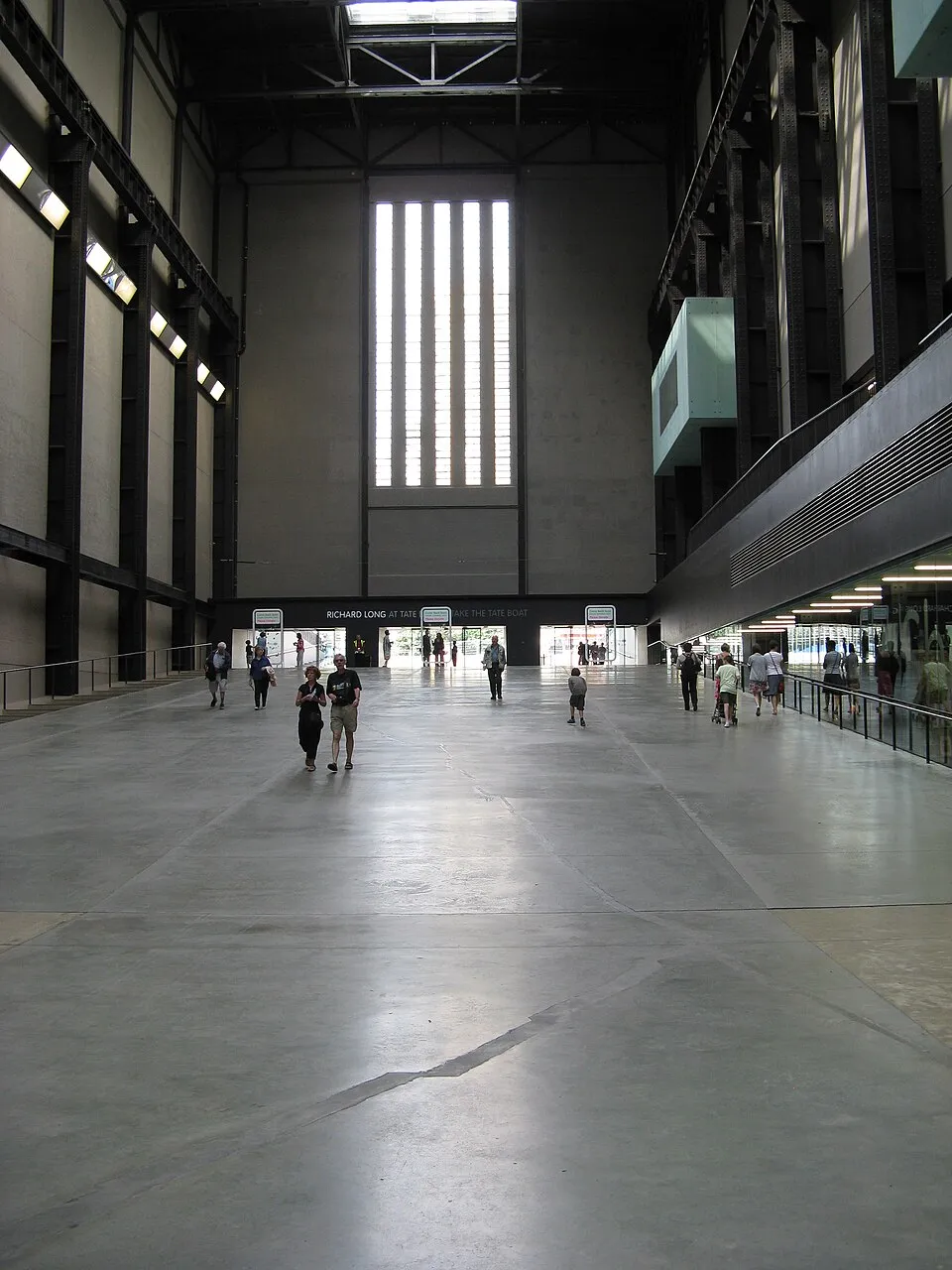
The Turbine Hall at Tate Modern. 35 meters high, 152 meters long. The former turbine hall of Bankside Power Station. Wikimedia Commons.
The Natalie Bell Building: The Collection Route
The permanent collection is in the Natalie Bell Building, the original boiler house, on Levels 2 through 4. Start on Level 4 and work down. The collection is organized thematically rather than chronologically, which is different from MoMA or the Uffizi. Each room pairs works from different periods to create conversations across time.
Level 4 is the center of gravity. The Rothko Seagram Murals room is the most powerful single room in any museum in London. Rothko donated nine murals to Tate in 1968-69. They were originally commissioned in 1958 for the Four Seasons restaurant in the Seagram Building in New York. Rothko visited the restaurant and decided it was too fancy for his paintings. He withdrew from the commission and returned his advance, saying the restaurant was a place "where the richest bastards in New York will come to feed and display themselves." The paintings are dark reds, maroons, and blacks, hung in dim light as Rothko insisted. Spend 25 minutes in this room. It will change how you think about what painting can do. For more on Rothko and the movement he belonged to, see our guide on Abstract Expressionism: Pollock, Rothko, and American painting at its peak.
Also on Level 4: Picasso's "Weeping Woman" (1937), a 60.8 x 50 cm portrait of Dora Maar, painted in response to the bombing of Guernica. The angular features and sharp colors are Cubist in technique but emotional in intent. Picasso's "The Three Dancers" (1925) is nearby, a painting that Picasso himself considered one of his best works. The Surrealist room includes Dali's "Lobster Telephone" (1936), a working telephone with a plaster lobster as the receiver, one of the most famous Surrealist objects ever made. For more on Surrealism, see our guide on Surrealism and the subconscious.
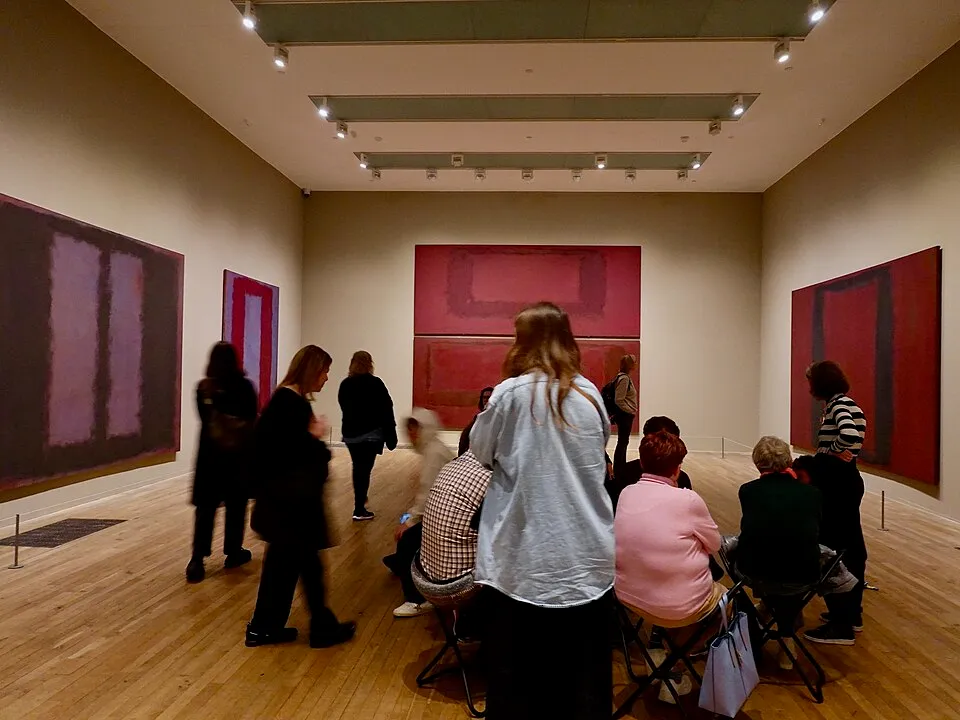
Mark Rothko, Seagram Murals (1958-59). Tate Modern, Natalie Bell Building, Level 4. Wikimedia Commons.
Level 3 is Pop Art. Warhol's "Marilyn Diptych" (1962) is here, 50 silkscreened images of Marilyn Monroe arranged in two panels, one in color and one in black and white. The work was painted in the months after Monroe's death. Lichtenstein's "Whaam!" (1963) is a 172 x 406 cm canvas based on a panel from a DC Comics war comic, showing a fighter jet destroying another plane. The leap from Abstract Expressionism to Pop is one of the most dramatic shifts in 20th-century art, and Level 3 makes it visible.
Level 2 is contemporary. Anish Kapoor's "Ishi's Light" (2003) is a large concave sculpture that reflects and distorts the viewer. The rotating installations on this floor are often Tate Modern's most provocative work, and the galleries are quieter than Levels 3 and 4.
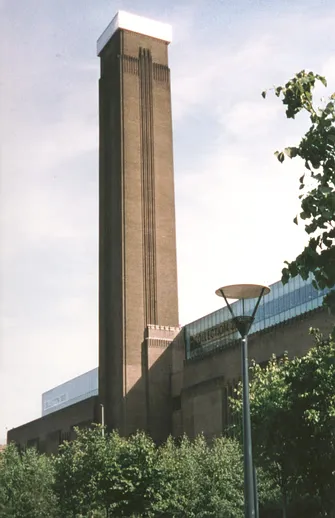
Tate Modern, seen from the south bank of the Thames. The former Bankside Power Station, designed by Sir Giles Gilbert Scott. Wikimedia Commons.
2026 Exhibitions at Tate Modern
Tate Modern's 2026 program is one of its strongest in years, with four major exhibitions running through the year.
Tracey Emin: "A Second Life" (February 27 to August 31, 2026) is a landmark retrospective tracing 40 years of Emin's practice. It is presented in the Eyal Ofer Galleries, in partnership with Gucci. The exhibition includes career-defining works alongside material never exhibited before. Emin came to public attention in the 1990s with "My Bed," a Turner Prize-nominated installation of her unmade bed surrounded by detritus. The retrospective demonstrates her lifelong commitment to painting, showing her recent work as the culmination of a practice that has channeled her life into art. The show includes content guidance: it references underage sex, sexual assault, abortion, miscarriage, and life-threatening illnesses.
Julio Le Parc: "Light. Colour. Action." (June 11, 2026, to May 3, 2027) covers seven decades of interactive installations and op art paintings by the Argentinian artist, born in 1928. Le Parc's work is participatory: visitors become active participants, manipulating light and color through kinetic sculptures and installations. The exhibition is organized in close collaboration with the artist and his atelier.
"Frida: The Making of an Icon" (June 25, 2026, to January 3, 2027) is the first major exhibition to explore how Frida Kahlo became a global cultural phenomenon. Over 30 of Kahlo's most famous works are shown alongside garments, jewelry, photographs, and memorabilia from her archives. The exhibition also includes over 200 works by artists she inspired, from Judy Chicago to Guerilla Girls to Carrie Mae Weems. It is organized by the Museum of Fine Arts, Houston, in collaboration with Tate Modern. Building on Tate's 2005 Kahlo survey, this show goes further by examining "Fridamania": how Kahlo's image has been commercialized and reimagined across the world.
Ana Mendieta (July 15, 2026, to January 17, 2027) presents the Cuban-American artist's film and photographic works, plus installations never seen in the UK. Mendieta's "Silueta" series, in which she pressed her body into earth, mud, and grass to create temporary female silhouettes, is one of the most influential bodies of work in feminist art. The exhibition explores displacement, identity, and relationships to nature. You can read more on the Tate 2026 exhibition highlights press release.
What Most Visitors Miss
The Blavatnik Building Level 10 viewing terrace offers the cleanest free view of St Paul's and the Thames in London. Most visitors do not know it exists. Take the elevator to the top of the Blavatnik Building and walk out. The terrace is open to everyone, no ticket required.
The Tanks are underground spaces in the Blavatnik Building dedicated to live performance and video art. They are the only museum spaces in London permanently dedicated to performance art. The architecture is raw concrete, and the programming is experimental. Check the schedule before your visit.
The Natalie Bell river entrance is quieter than the Turbine Hall entrance. It faces the Millennium Bridge and is the best entrance if you are coming from the St Paul's side of the river. You avoid the west ramp crowds and enter directly at collection level.
Two short visits beat one long one. Do the 2.5-hour collection route on one day, then return on a Friday evening for a special exhibition and the Level 10 view. The Friday late opening runs until 10 PM, and the galleries are dramatically quieter after 7 PM. You can find a recommended route on the Tate Modern essentials guide.
Practical Tips
Admission is free for everyone, every day, for the permanent collection, the Turbine Hall, and the Level 10 viewing terrace. Special exhibitions cost GBP 18 to 22. Hours are 10 AM to 6 PM Sunday through Thursday, and 10 AM to 10 PM Friday and Saturday.
The best time to visit is 10 AM opening on a weekday. Go to Level 4 first. Most groups start in the Turbine Hall and work upward, so the Rothko room is empty at 10:05 AM. This is the single most important timing decision you can make at Tate Modern.
There are three entrances. The Turbine Hall west ramp is the dramatic default. The Natalie Bell river entrance is quieter and faces the Millennium Bridge. The Blavatnik south entrance is best if you are coming from Southwark or Borough Market.
The Millennium Bridge connects Tate Modern to St Paul's Cathedral. It is a 5-minute walk. The bridge is the one that wobbled when it first opened in 2000 and had to be closed for two years while engineers installed dampeners. It is stable now. For more on navigating large museums, see our guide on how to visit an art museum without getting overwhelmed.
Final Thoughts
Tate Modern is the most successful industrial-to-cultural conversion in the world. Herzog and de Meuron's decision to keep the power station's brick shell and turbine hall volume created a museum that feels both monumental and intimate. The Rothko room alone is worth the trip. Nine paintings in dim light, 25 minutes, and you will not think about painting the same way again.
The 2026 program is one of the strongest in any museum this year. Emin, Kahlo, Mendieta, and Le Parc cover four distinct generations and four distinct approaches to what art can be. Go at 10 AM. Start on Level 4 with the Rothko room. Walk the Millennium Bridge to St Paul's afterward. For the broader context of where these artists fit in art history, see the complete guide to art movements and the art history cheat sheet. For more on how to look at art, see how to look at art for beginners. Have you been to the Rothko room? Share your experience in the comments below.


