When Pablo Picasso glued a piece of printed oilcloth onto a canvas in 1912, the result was "Still Life with Chair Caning," a painting with an actual fragment of the world stuck to it. Not a painted chair. A piece of printed oilcloth that depicts a chair. The distinction sounds small. It wasn't. For centuries, painting had operated as a closed system: pigment on canvas, an entirely constructed illusion. Picasso had introduced a hole in that system, and through it the whole of the material world could now, theoretically, enter art.
Collage is now used so widely that it barely gets credit for what it changed. But look at the century between Picasso's oilcloth and today, and it is one of the most politically and formally productive techniques in the history of art. Hannah Höch used it to tear apart Weimar propaganda. John Heartfield used it to attack the Nazis in mass-circulation magazines. Matisse used it, from a wheelchair at eighty-three, to produce some of the most formally sophisticated color work of the twentieth century. Rauschenberg pushed it into sculpture, then into the gap between art and life altogether.
This guide covers how collage developed, what the major practitioners actually did, and how to build a collage practice with technical principles that hold up.
Cubism Invents the Medium: Picasso and Braque
The Cubist collages of 1912 to 1914 were not decorative experiments. Picasso and Georges Braque were already working through Analytic Cubism, breaking objects into interlocking planes that showed multiple viewpoints simultaneously. When they started incorporating newspaper clippings, wallpaper, sheet music, and printed commercial materials into their compositions, they added a new dimension to that fragmentation: the question of what is real and what is represented.
Braque's "Fruit Dish and Glass" (1912) is one of the earliest papier collé works. He glued strips of wood-grain printed wallpaper onto paper and drew charcoal marks over and around them. The result is a still life where some elements are drawn and some are literal fragments of commercial printing. The viewer's eye cannot settle on a unified reading: is the wood-grain real wood? A depiction of wood? A wallpaper depiction of wood? All three at once? That productive instability is the whole point.
What gave these early collages their weight was the newspapers. Several Picasso collages from 1912 and 1913 include fragments of French and Spanish papers covering the Balkan Wars. The news content did not disappear when it was cut up and glued to a still life. The war was now formally embedded in the work, whether Picasso foregrounded it or not. According to MoMA's curatorial notes on Picasso's collages, this approach to mass-media material as aesthetic raw material became foundational to almost every collage movement that followed.
Dada's Radical Turn: Hannah Höch and Photomontage
The Dadaists took Cubism's formal experiment and weaponized it. In Berlin after World War One, Hannah Höch, John Heartfield, Raoul Hausmann, and George Grosz began cutting photographs from mass-circulation magazines and reassembling them into images designed to expose and attack. They called it photomontage, and it was explicitly a political instrument.
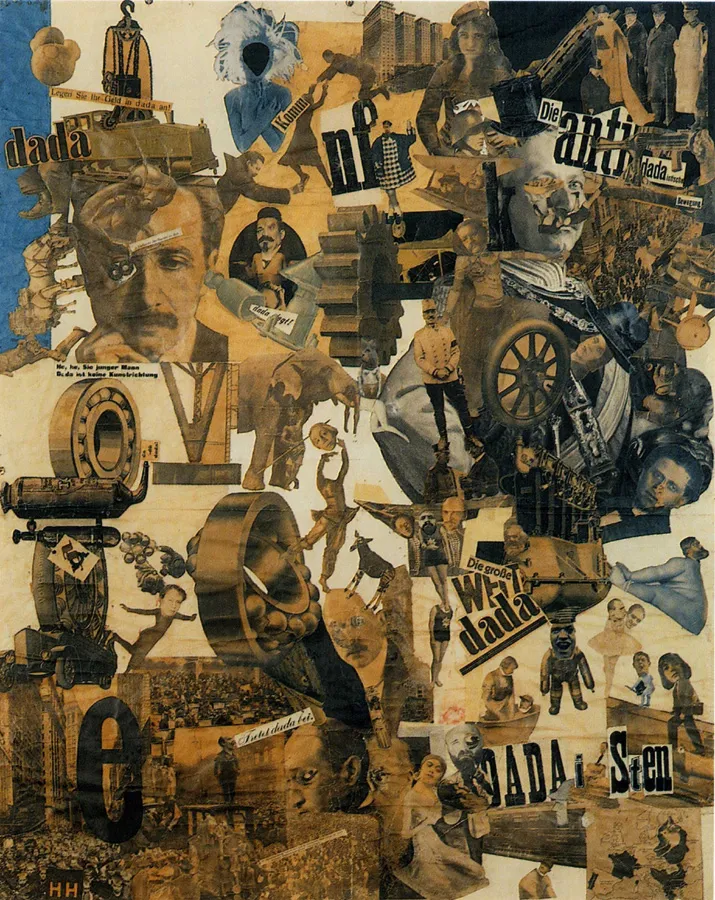
Hannah Höch, "Cut with the Dada Kitchen Knife through the Last Weimar Beer-Belly Cultural Epoch in Germany" (1919-1920), photomontage and collage, 114 x 90 cm. Nationalgalerie, Berlin. Höch assembled fragments from German illustrated magazines into a total critique of Weimar political culture: military figures with machine heads, gender roles scrambled, political and celebrity culture collapsed into each other. Image: Public domain in the US, via Wikipedia
Höch's "Cut with the Dada Kitchen Knife" (1919-1920) is worth spending real time with. At over a meter tall, it is dense and deliberately overwhelming. Military figures have their heads replaced by machines. Sports celebrities appear alongside Weimar politicians. Women's faces appear on male bodies and vice versa. Advertising slogans collide with political speech. The work is not simply critical: it shows how mass media constructed the illusion of coherent political authority, and it deconstructs that illusion by showing you the individual cut pieces. If you can cut an image apart and stick it back together differently, its authority was always constructed. That was Höch's point, and it remains a sharp one.
John Heartfield (1891-1968) took photomontage further into mass communication. Working as a cover designer for the AIZ magazine, then in exile after the Nazis came to power, he made images like "Adolf the Superman: Swallows Gold and Spouts Junk" (1932), combining an X-ray image with a photographic portrait of Hitler. These ran as magazine covers seen by hundreds of thousands of readers across Germany and Austria. They were not gallery art. They were political instruments in circulation. As documented by the Tate's collection notes on Heartfield, his photomontages remain among the most direct examples of art functioning as propaganda counter-propaganda in the twentieth century.
Matisse and the Paper Cutouts
Henri Matisse came to collage through illness and transformed it entirely. In the 1940s, restricted increasingly by the effects of cancer surgery, Matisse began cutting shapes from sheets of paper he had pre-painted with flat gouache and assembling them into compositions. He called the technique "drawing with scissors." The work produced during this period, collected in the artist's book Jazz (1947) and developed into large-scale works like "The Snail" (1953) and "Large Decoration with Masks" (1953), is among the most formally rigorous color work of the century.
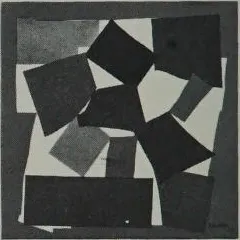
Henri Matisse, "The Snail" (1953), gouache on paper, cut and pasted, 286.4 x 287 cm. Tate Modern, London. Made when Matisse was 83 and working from a wheelchair. The spiral of warm and cool shapes enacts his claim that cutting allowed him to "draw directly in color," removing the intermediary of brush and canvas entirely. Image: Public domain, via Wikimedia Commons
What is remarkable about the cutouts is how unlike the Dada work they are, and yet how much they share the essential gesture. Matisse was not making political critique with found photographs. He was using abstracted colored shapes to explore color relationships with a directness that painting, for him, no longer offered. The cut edge is more precise than a brushstroke. The pre-painted paper gives him flat, uniform color without mixing. He described the method as a liberation, not a compromise forced by illness. The Tate's entry on "The Snail" notes that Matisse developed the cutout technique independently of any prior collage tradition, arriving at it through pure pragmatic necessity and finding in it new formal possibilities he had not reached in painting.
Rauschenberg and the Combines
Robert Rauschenberg's "Combines" of the 1950s dissolved the line between collage and sculpture. "Monogram" (1955-1959) incorporates a taxidermied Angora goat, an automobile tire, paint, and canvas. It sits on a painted platform on the floor. It is not a painting. It is not a sculpture. It is something that did not have a category before Rauschenberg made it. He described his intention as working "in the gap between art and life," and the Combines sit exactly there.
His two-dimensional combine paintings used magazine pages, newspaper clippings, postcards, silkscreened photographs, and gestural paint together, commenting on the visual excess of postwar American consumer culture. The connection to Pop Art is direct: Andy Warhol absorbed Rauschenberg's use of mass-media imagery and turned it into the silkscreen paintings that defined Pop. But Rauschenberg's work is more ambivalent about its own materials than Warhol's. Where Warhol embraced the commodity image, Rauschenberg kept colliding it with paint, gesture, and three-dimensional objects that refused to be flat.
How to Actually Make Collage That Works
Collage is technically accessible, but there are real differences between work that holds together and work that looks like things happened to be near each other.
Support: Work on a firm surface. Heavy illustration board, gessoed panel, or thick watercolor paper resists the buckling that wet adhesive causes in flimsy paper. If you plan to apply adhesive heavily, prime the surface with a layer of acrylic medium first.
Adhesive: PVA (polyvinyl acetate, sold as Mod Podge or similar) is the standard for paper collage. Apply a thin layer to the support, position the paper element, then apply another layer over the top surface to seal it. Too much adhesive at once wrinkles lightweight paper. For heavier materials or three-dimensional elements, gel medium is more reliable.
Visual unity: The most common failure in collage is fragments that just sit near each other without any connective logic. The Dadaists overcame this through sheer density and a consistent critical attitude. Matisse overcame it through a tightly controlled color palette. Rauschenberg overcame it through paint applied over assembled elements. You need a strategy: a consistent palette, a repeated shape or scale, or paint over the assembled surface to link the separate parts. Our guide to mixed media art covers this problem in more detail.
Material choice: The content of your source materials carries meaning whether or not you intended it. A collage built from vintage botanical illustrations reads differently from one built from supermarket advertising inserts, even if the formal composition is identical. The Cubists knew this when they chose newspapers covering active wars. Heartfield knew it acutely. Gathering materials with awareness of what they mean, not just what they look like, gives the work a dimension that pure formalism cannot reach.
Collage in 2026
Contemporary collage practice spans physical and digital work, and the two are not as separate as they might seem. Artists like Mickalene Thomas build figurative works from rhinestones, acrylic paint, and found photographic materials. Wangechi Mutu assembles figures from magazine images, ink, and collage on mylar. Pedro Matos works with archival photographic paper and paint to explore memory and portraiture. The digital collage tradition, using Photoshop-era tools to assemble layered found images, is technically different but conceptually continuous with what Höch was doing with scissors and paste in 1919.
If collage is sometimes dismissed as too accessible, that is a misunderstanding of what accessibility means. The tool is simple. What you do with it is not. Höch had scissors and paste. The question she was asking with them was not simple at all.
For the broader history of how collage connects to the movements around it, the guide to Cubism covers the conceptual context in depth. For how the Surrealists used unexpected juxtaposition to different ends, see the guide to Surrealism and the Subconscious. And for the visual principles that make any assembled composition hold together, the guide to the essential visual elements is worth reading alongside this one. What collage artists do you find most interesting? Share your thoughts in the comments.