In Book XVIII of Homer's Iliad, the god Hephaestus forges a shield for Achilles. Homer describes what is depicted on it in roughly 130 lines: two cities, one at peace, one at war, with weddings and law courts and harvests in the first, and an ambush and battle at a river ford in the second. There are also fields being plowed, a vineyard at harvest, a cattle herd being attacked by lions, and a dancing floor full of young men and women moving in patterns. The shield does not exist. Homer conjures it so completely that readers for three thousand years have imagined it as an actual object. This is ekphrasis: the verbal representation of a visual work of art, real or imagined.
The word comes from the Greek "ekphrazein," meaning to speak out or declare fully, and it names one of the most productive relationships in the history of art and literature. Writing about visual art forces the writer to make explicit what the image leaves implicit: the specific quality of the light, the emotional character of a figure's posture, the way a composition holds or releases tension. That process is also a way of learning to look more carefully. This guide traces the ekphrastic tradition from antiquity through contemporary fiction and asks what it reveals about how visual art actually works.
The Classical Tradition: Imaginary and Real
The ancient world produced two kinds of ekphrasis. The first described imaginary artworks, fictional objects used to demonstrate the writer's verbal dexterity and visual imagination. Homer's Shield of Achilles is the founding example. Philostratus's "Imagines" (c. 200-230 CE), a collection of 65 descriptions of paintings the author claims to have seen in a gallery in Naples, may be partly or entirely invented; scholars still argue about it.
The second kind described real, existing works, usually famous sculptures or public monuments. Ancient descriptions of the Colossus of Rhodes, the Pheidias Zeus at Olympia (one of the Seven Wonders of the ancient world, approximately 12 meters tall), and the Aphrodite of Knidos survive even though the works themselves do not. Without ekphrasis, those objects would be entirely unknown. The literary tradition is sometimes the only record the visual tradition leaves behind, and that fact alone makes ekphrasis a historically significant practice quite apart from its literary interest.
Keats and the Urn: Ekphrasis as Philosophy
John Keats's "Ode on a Grecian Urn" (1819) is the most discussed single poem in the ekphrastic tradition, and what it does with the genre is philosophically unusual. Keats does not describe the urn systematically. He addresses it directly: "Thou still unravished bride of quietness, / Thou foster-child of silence and slow time." He describes figures on the urn frozen in the moment before consummation, a musician whose melody will always be sweeter for being unheard, a lover perpetually approaching but never reaching his beloved.
The argument Keats draws from this imaginary urn is about the specific difference between the stillness of art and the movement of life. Art freezes the moment of highest feeling into permanent form, preserving it from the decay and disappointment that fulfillment brings, but at the cost of the life and movement that made the moment worth preserving in the first place. The urn's famously paradoxical final lines, "Beauty is truth, truth beauty, that is all / Ye know on earth, and all ye need to know," are not a description of what the urn looks like. They are a claim about what the experience of looking at it reveals about the nature of beauty, truth, and time. Ekphrasis here becomes a vehicle for philosophical reflection that the poem could not achieve without the mediation of the art object.
W.H. Auden and Bruegel: Evidence for a Moral Observation
W.H. Auden's "Musée des Beaux Arts" (1938) builds its argument around two Bruegel paintings: "The Massacre of the Innocents" and "Landscape with the Fall of Icarus." In the second painting, Icarus plummets into the sea in the lower right corner of the composition while a ploughman works in the foreground, a ship sails past, and the rest of the world goes entirely about its business. Auden's poem uses this image as evidence: "About suffering they were never wrong, / The Old Masters: how well they understood / Its human position; how it takes place / While someone else is eating or opening a window or just walking dully along."
The poem works by treating the painting as documentary proof of a moral claim. Bruegel noticed that catastrophe happens in the midst of ordinary life and is mostly ignored by those not directly involved, and he recorded that observation precisely. Auden uses the ekphrastic description to make Bruegel's visual intelligence available to readers who have never seen the painting, and simultaneously uses Bruegel's authority to authenticate his own verbal insight. The painting and the poem illuminate each other in both directions. That reciprocal illumination is what good ekphrasis does.
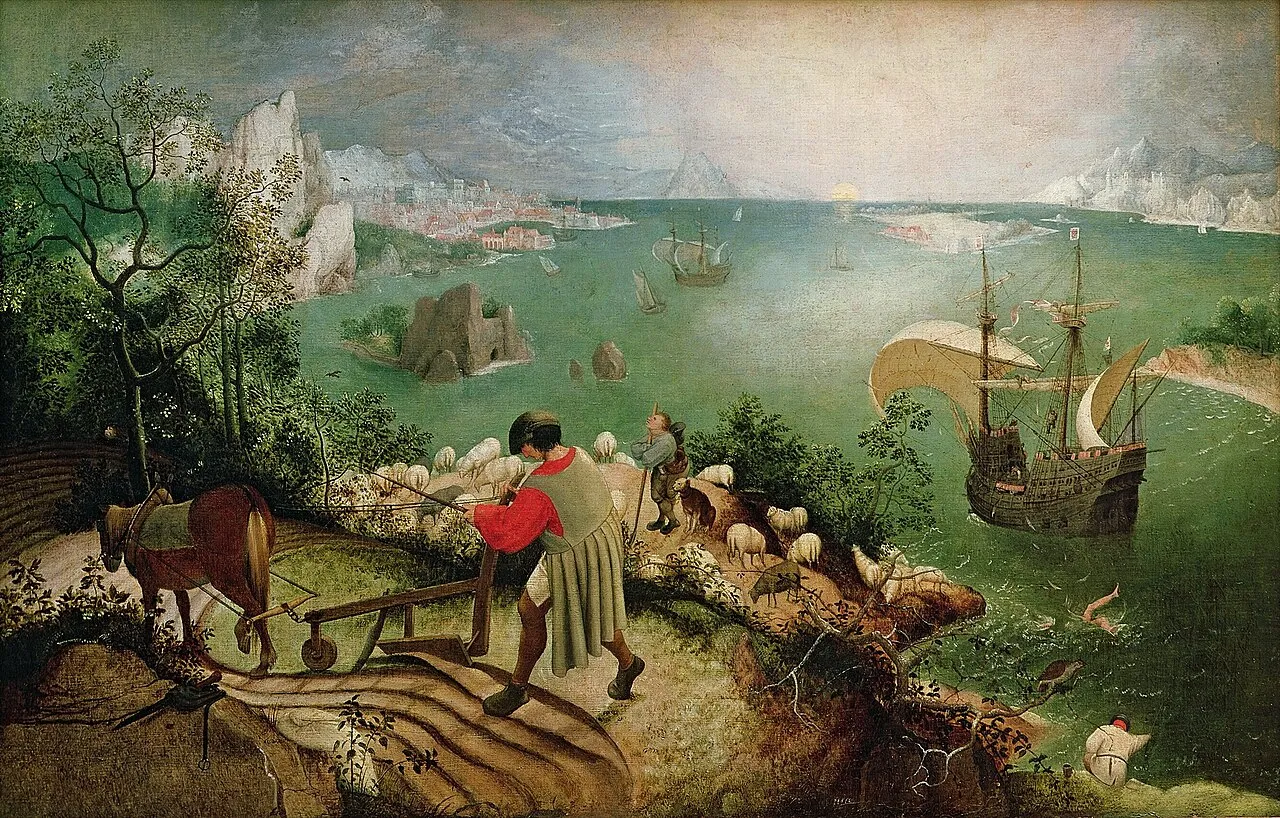
Attributed to Pieter Bruegel the Elder, "Landscape with the Fall of Icarus" (c.1560), oil on canvas transferred from panel. Royal Museums of Fine Arts, Brussels. Icarus's legs are visible in the lower right corner, falling unnoticed while the world continues. The painting that gave Auden his evidence. Image: Public domain, via Wikimedia Commons
Henry James: The Museum as Psychological Mirror
Henry James was one of the first novelists to make the experience of looking at art central to the psychological architecture of his fiction. In "The Wings of the Dove" (1902), a Bronzino portrait in the National Gallery that Milly Theale is said to resemble becomes a mirror for her situation: a beautiful young woman dressed for life who will die young. In "The Ambassadors" (1903), Lambert Strether's encounter in a Paris dealer's window with a small painting that embodies exactly the pastoral French vision he had long admired provides the novel's central moment of self-recognition.
James's ekphrastic passages are not descriptions of what paintings look like. They are accounts of what a specific consciousness experiences in front of a specific painting at a specific moment in a specific emotional state. The same painting means different things to different viewers at different times. This insight, which James dramatized in fiction in the 1890s and 1900s, is the same insight that reception theory and phenomenological aesthetics would not formalize academically until the 1960s and 1970s. James got there first, through fiction rather than theory.
The New York School Poets: Writing About Art as Making Art
The New York School poets of the 1950s and 1960s, particularly Frank O'Hara and John Ashbery, developed a practice of writing about visual art that was inseparable from their own poetic projects. O'Hara worked at the Museum of Modern Art, wrote catalog essays for Pollock, Larry Rivers, and Franz Kline, and produced poems that engaged with Abstract Expressionist painting at the level of method: his poems move with the same improvisatory speed and emotional directness as the paintings he admired.
John Ashbery's "Self-Portrait in a Convex Mirror" (1975), a long poem meditating on Parmigianino's 1524 self-portrait in which the artist painted his own reflection in a convex mirror, is probably the greatest American ekphrastic poem. It uses the painting's distorted mirror surface to think about representation, self-knowledge, and the relationship between the moment of making an artwork and the experience of encountering it centuries later. The poem won the Pulitzer Prize, the National Book Award, and the National Book Critics Circle Award simultaneously, the only book ever to achieve all three. Its success brought ekphrasis into the mainstream of American literary culture and established it as a serious mode for ambitious poetry.
Contemporary Fiction: Art as Structural Principle
Contemporary fiction continues to use visual art as both subject and structural device. Donna Tartt's "The Goldfinch" (2013) builds its entire narrative around a small panel painting by Carel Fabritius that survives a museum explosion. The novel's central argument, about beauty, loss, and the strange permanence of art amid human transience, depends entirely on the reader understanding what it means for a painted object to outlast the human lives connected to it.
Zadie Smith's essay collection "Feel Free" (2018) includes extended ekphrastic essays on paintings by Lynette Yiadom-Boakye and Rineke Dijkstra that rank among the finest art criticism in recent English prose. Smith brings novelistic attention to character and psychological specificity to bear on images that resist conventional art historical analysis, producing readings that reveal what is at stake in looking carefully at contemporary painting. Her ekphrasis is not description. It is an act of attention that creates new meaning in the meeting of the text and the image.
Tracy Chevalier's "Girl with a Pearl Earring" (1999) invented a biographical fiction around Vermeer's famous painting that has shaped how millions of people think about the work, even though the novel is entirely fictional. The novel's remarkable success demonstrates both the power of ekphrasis and its risk: a sufficiently compelling verbal account of a visual work can become the primary experience, displacing the original. If you have read the novel, you cannot look at the painting without the novel's story running under your gaze. The Vermeer spotlight, Johannes Vermeer: Light Through Windows and Domestic Mystery, offers historical context for the actual painting.
Why Writing About Art Still Matters
The ekphrastic tradition matters beyond its literary interest because it demonstrates something fundamental about how visual art works. Visual art produces experiences and meanings that exceed the capacity of purely visual analysis to capture. The attempt to put into words what a painting does forces the writer to make explicit what was previously only felt: the specific quality of the light, the emotional character of a posture, the way a composition builds or releases tension. Writing about art is a discipline of looking, not just a record of having looked.
The guide to How to Read a Painting: A Step-by-Step Framework on this site is itself a form of ekphrastic practice: a verbal system for making the experience of looking at visual art more conscious and communicable. The guide to Mastering Art Descriptions: A 4-Step Guide is another. What painting would you most want to write about, and what would you say? Share in the comments.