In the single year 1900, Vienna had Gustav Klimt painting in his studio on Josefstädterstrasse, Sigmund Freud publishing "The Interpretation of Dreams," Gustav Mahler conducting the Court Opera, Otto Wagner building the Postsparkasse, and a twenty-six-year-old Adolf Loos finishing the Café Museum. The Secession building was two years old. The Wiener Werkstätte was three years away. And all of it was happening inside a city of about 1.7 million people that you could walk across in an afternoon. No city in history has packed that much creative output into that small a space at the same time.
Vienna 1900 was not a movement. It was a condition, a specific density of talent and ideas that produced the Secession, the workshops, the cafes, the music, the psychoanalysis, and the architecture that between them invented the modern look of things. The historian Carl Schorske gave the period its modern name in his 1980 book "Fin-de-Siècle Vienna," but the city's own residents understood at the time that they were living through something unusual.
This guide covers the Secession's break with the establishment, the workshops that followed, the intellectual ferment in the cafes, the catastrophic year of 1918 that ended it, and where to see the evidence today. For the artist at the center of it all, see our post on Gustav Klimt.
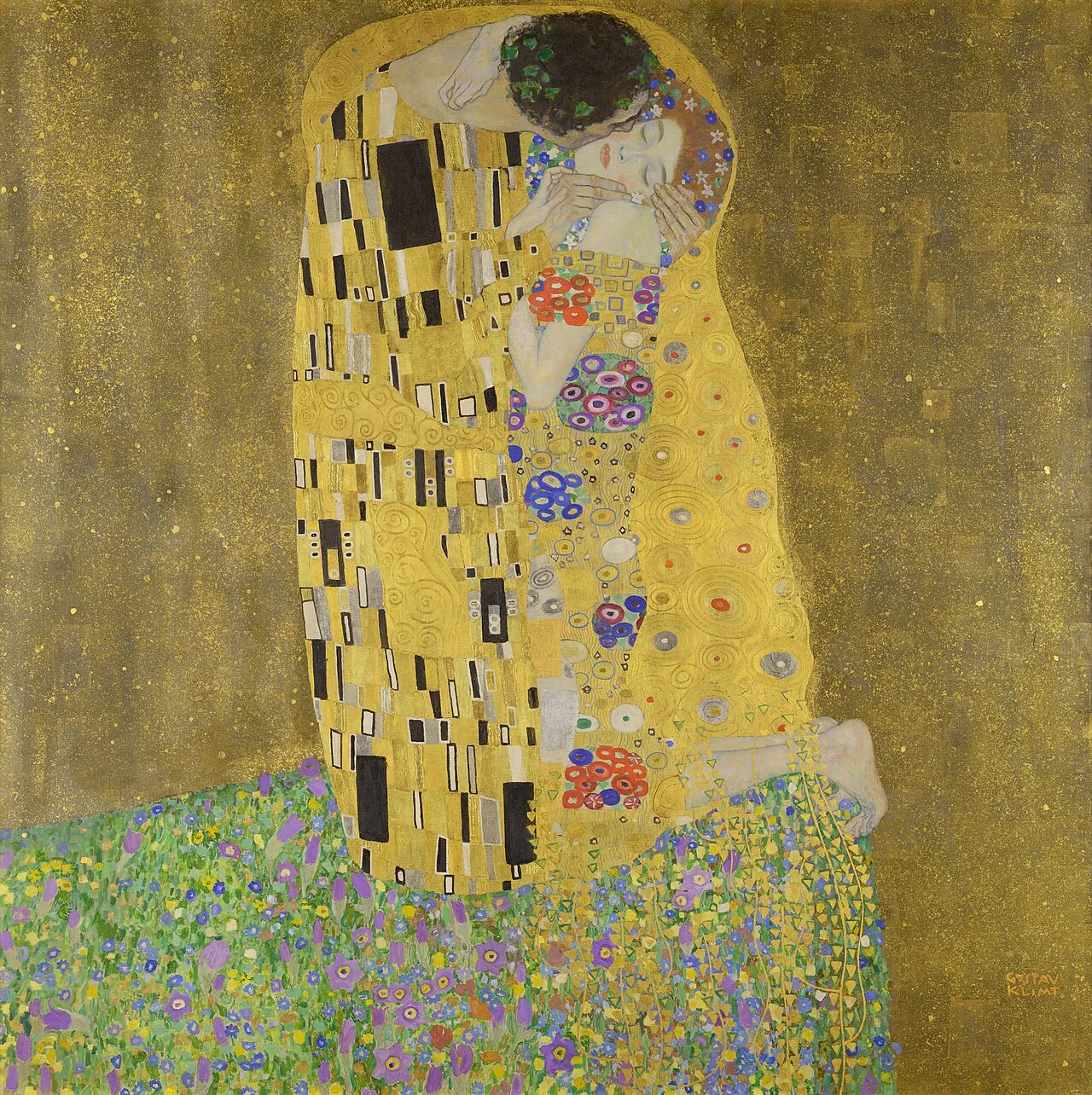
Gustav Klimt, "The Kiss" (1907-1908). Oil and gold leaf on canvas, 180 by 180 cm. Belvedere, Vienna. Painted during Klimt's Golden Phase, it was bought by the Belvedere in 1908, the year it was finished, for the then-record price of 25,000 crowns. It is now the most famous painting in Austria. Image via Wikimedia Commons.
The Secession Breaks the System
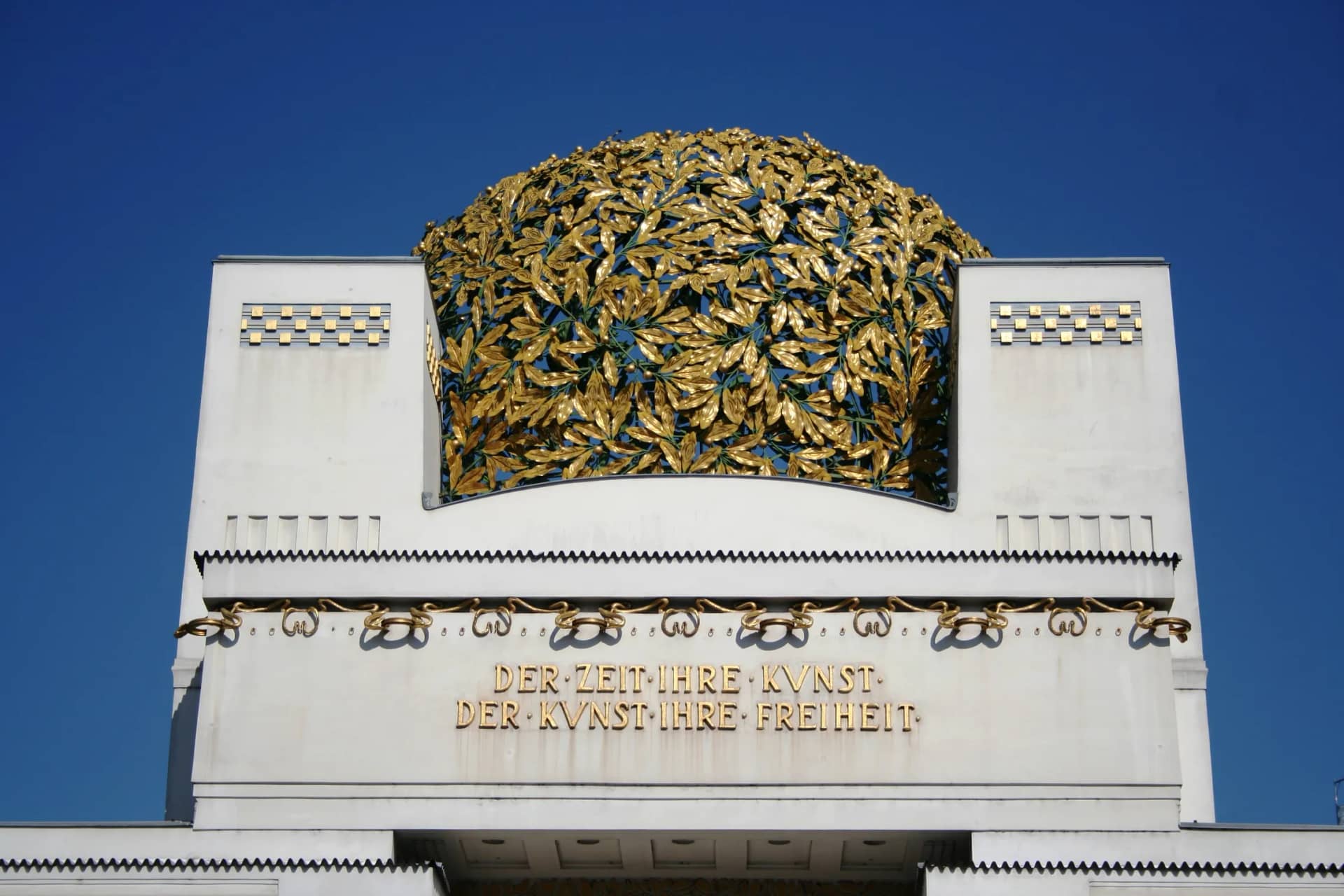
In 1897, nineteen artists led by Klimt, the architect Otto Wagner, the designer Josef Hoffmann, and the painter Koloman Moser resigned from the Künstlerhaus, Vienna's official artists' association, and founded the Vienna Secession. The break was over control: the Künstlerhaus ran the exhibitions, decided what was shown, and kept out the foreign modernists and domestic rebels the founders wanted to exhibit. The Secession built its own exhibition hall in 1898, a white cube designed by Joseph Maria Olbrich topped by an openwork golden laurel dome that Viennese wits immediately named the "cabbage head." The motto above the door reads "To every age its art, to art its freedom."
The Secession's exhibitions were radical for their time. It showed Rodin, Whistler, and the Impressionists to Viennese audiences who had never seen them. In 1902 it mounted the Beethoven exhibition around Max Klinger's polychrome statue, for which Klimt painted the Beethoven Frieze, a 34-meter mural showing humanity's struggle against hostile powers that is still displayed in the building's basement. The group also published Ver Sacrum, its own journal, printed in the square format the movement used for everything from invitations to exhibition catalogs. For the building and the artists who showed in it, see our post on the Vienna Secession.
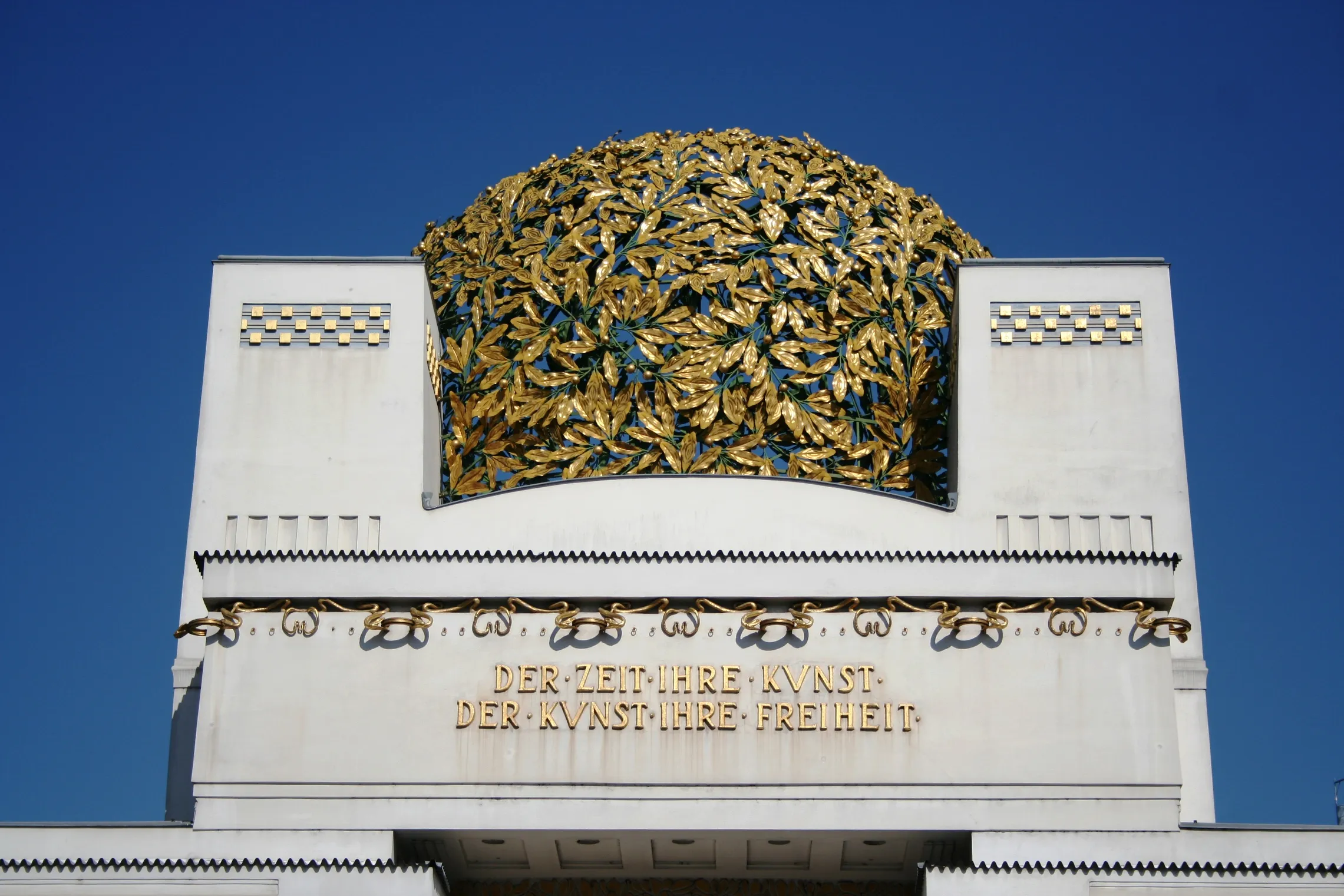
The Vienna Secession building, designed by Joseph Maria Olbrich and completed in 1898. The golden laurel dome earned it the nickname "cabbage head" from skeptical Viennese. The motto above the door, "To every age its art, to art its freedom," became the movement's manifesto. It still operates as an exhibition space. Image via Wikimedia Commons.
The Workshop and the Total Object
The Secession split in 1905 over a dispute about art versus applied art, and Klimt's faction walked out. But the applied-art faction had already produced the other half of Vienna 1900. In 1903 Hoffmann, Moser, and the banker Fritz Waerndorfer founded the Wiener Werkstätte, a production cooperative that made everything from jewelry to furniture to printed fabric under a single aesthetic. Its products were square, geometric, and made by hand at prices only aristocrats could afford. Its masterwork was the Palais Stoclet in Brussels, designed between 1905 and 1911 as a complete environment where Hoffmann did the architecture, Moser the furniture, and Klimt the dining-room mosaics that include the "Fulfillment" frieze.
The Werkstätte's logic was the logic of the whole period: if the world is ugly, you remake all of it, not just the paintings. The same impulse produced Otto Wagner's Postsparkasse, a bank built 1904 to 1906 in riveted aluminum and glass that looks like it was designed in 1960, and Adolf Loos's buildings that stripped ornament entirely and got him denounced as a criminal by the emperor. Loos's essay "Ornament and Crime," delivered in 1908 and published in 1913, argued that decoration was degenerate and modernity was smooth surfaces. It is the most quotable and most wrong idea the period produced, and it won.
The Intellectual Furnace
The art was only the visible half. Vienna 1900 was also producing the ideas that defined the century. Freud's "Interpretation of Dreams" appeared in November 1899 dated 1900, and his psychoanalytic circle met weekly at his Berggasse apartment. Mahler ran the Court Opera from 1897 to 1907 and premiered his own symphonies there. Schoenberg was dismantling tonality in real time. Wittgenstein was growing up in the city's richest family, attending the same schools, absorbing the same visual culture. Karl Kraus published the savage magazine Die Fackel that attacked everything the establishment printed.
The cafes were the infrastructure. The Café Central on Herrengasse was where Trotsky, Freud, and the architects all drank coffee under the same vaulted ceiling, and where Peter Altenberg held a permanent table and received mail. The Café Museum on Operngasse, designed by Loos in 1899 with plain walls and bentwood chairs, was called "Café Nihilism" by the public because it refused the velvet-and-marble decor of every other Viennese cafe. These rooms were not places artists went between work. They were where the work happened, where manuscripts were traded, feuds were conducted, and the ideas that became exhibitions were argued out over a single melange.
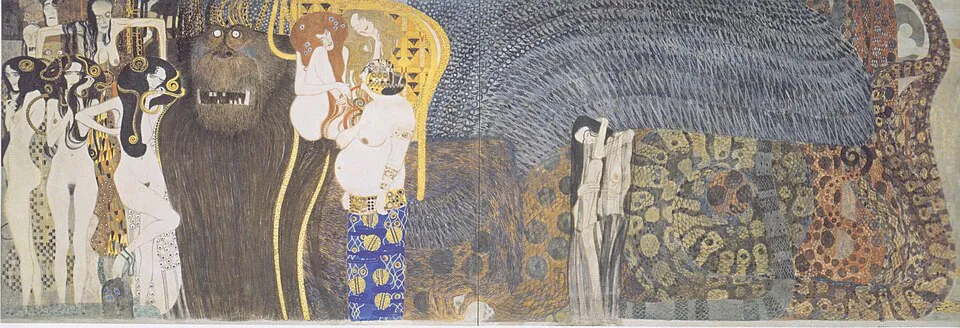
The central wall of Klimt's "Beethoven Frieze" (1902), a 34-meter mural painted for the Secession's Beethoven exhibition. It shows humanity's struggle for happiness against the "hostile powers" that include disease, madness, and death. It is still displayed in the basement of the Secession building where it was painted. Image via Wikimedia Commons.
1918 and the Collapse
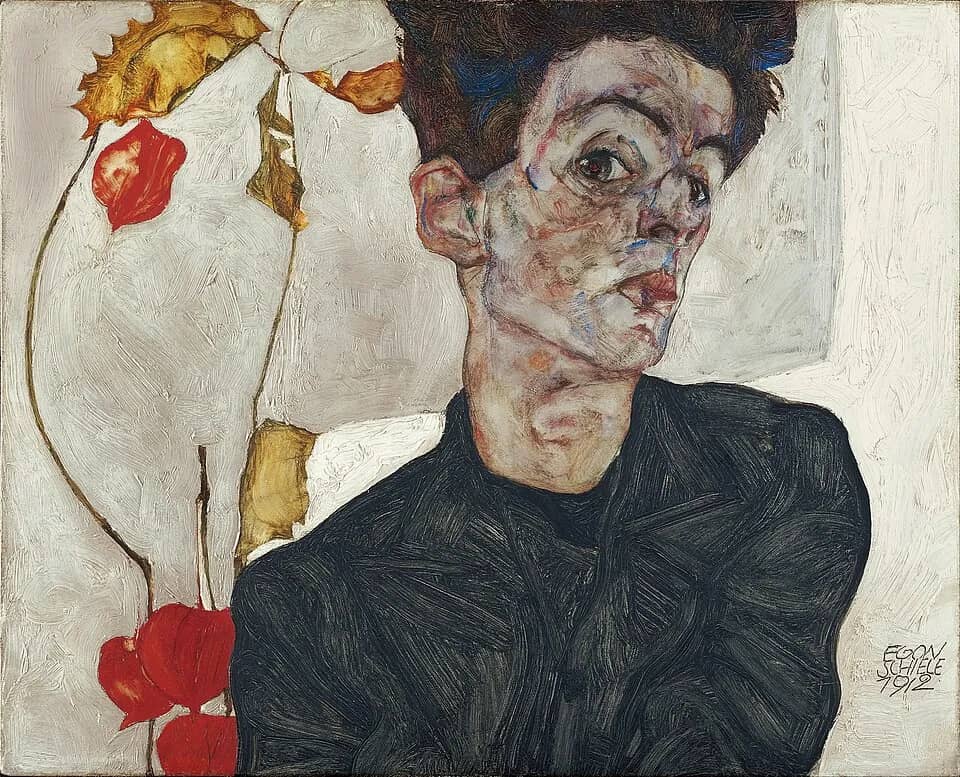
The density did not last. The First World War destroyed the empire the city had been built to administer, and 1918 took the artists with it. Klimt died in February of a stroke at fifty-five. Otto Wagner died in July. Koloman Moser died in October of cancer at fifty. Egon Schiele, the most gifted of the younger generation, died three days after his wife Edith in the October influenza pandemic at twenty-eight, having just achieved his first major exhibition success at the Secession's 49th show that spring. Four central figures in eight months. The city that remained was physically the same and culturally empty.
The aftermath scattered the inheritance. The Secession's artists who survived moved into Art Deco, abstraction, and the international modernism that the workshops had made possible. The Wiener Werkstätte limped into the 1920s and closed in 1932, bankrupt. The Anschluss of 1938 drove out or murdered the Jewish patrons who had funded the whole experiment, and the Nazi regime called Klimt and Schiele degenerate. For the art world Vienna lost in that later collapse, see our post on art under fascism.
Where It Lives Now
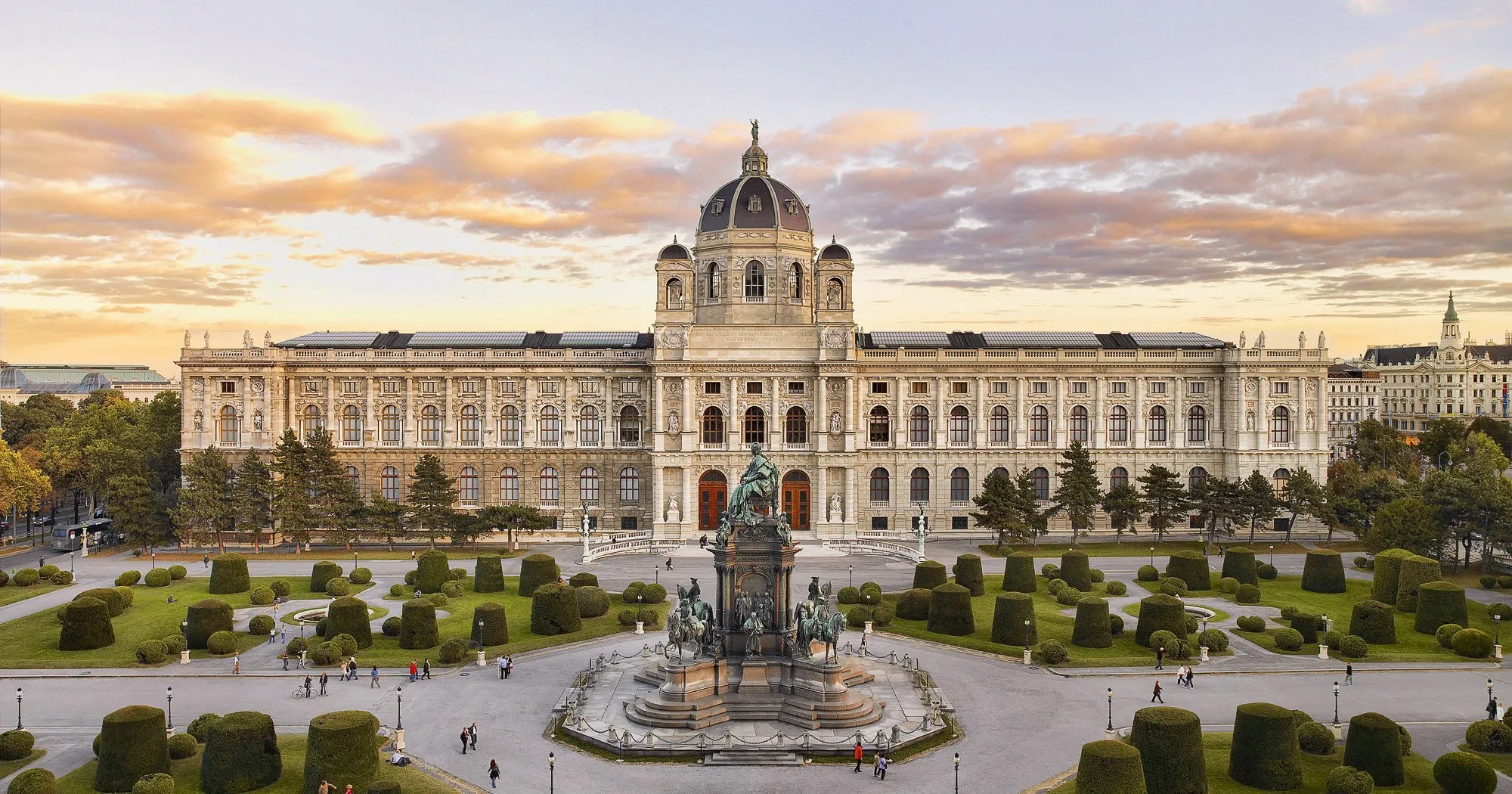
The physical evidence is concentrated and walkable. The Belvedere, Prince Eugene's baroque palace, holds the world's largest Klimt collection, about 24 paintings including The Kiss, Judith, and Adele Bloch-Bauer I before its 2006 restitution and sale to New York. The Leopold Museum in the MuseumsQuartier holds the largest Schiele collection in the world, roughly forty paintings and two hundred works on paper. The MAK, the Museum of Applied Arts, holds the Wiener Werkstätte archives and the original models. The Secession building itself still functions as a contemporary exhibition space, which is what its founders intended.
The Wien Museum on Karlsplatz reopened in December 2023 after a complete rebuild and now shows its Vienna 1900 collection free of charge, including the original café furnishings and the world's largest collection of Klimt drawings. For the wider movement this belonged to, see our guide to Art Nouveau, and for the younger artist who carried it furthest, Egon Schiele.
Final Thoughts
Vienna 1900 proved that a city does not need to be large to be creatively total. It needs to be dense. When painters, architects, musicians, doctors, and philosophers can walk to each other's cafes in fifteen minutes, the ideas compound faster than the individual talents can. The Secession, the Werkstätte, psychoanalysis, and atonal music were not separate movements that happened to coincide. They were the same experiment conducted in different rooms.
See it at the Belvedere for the Klimt rooms, the Leopold for the Schiele rooms, the Secession for the building and the Beethoven Frieze, the MAK for the Werkstätte objects, and the Wien Museum for the free permanent collection that ties it all together. For the two artists who defined the visual output, see our guides to Klimt and Schiele, and for the movement it fed into, Symbolism.
Frequently Asked Questions
What is Vienna 1900?
Vienna 1900 refers to the concentration of artistic and intellectual activity in the city around the turn of the century, when the Vienna Secession, the Wiener Werkstätte, Freud's psychoanalysis, Mahler's music, and Wittgenstein's philosophy all developed within a few streets of each other.
Where can I see Klimt's The Kiss in Vienna?
The Kiss is at the Belvedere Palace in Vienna, which holds the world's largest Klimt collection with about 24 paintings. The Upper Belvedere gallery displays it in the dedicated Klimt rooms alongside Adele Bloch-Bauer I and other major works.
What was the Vienna Secession?
The Vienna Secession was an artists' association founded in 1897 when Gustav Klimt, Otto Wagner, Josef Hoffmann, and others resigned from the traditional Künstlerhaus. Its motto, 'To every age its art, to art its freedom,' is written above the entrance of the Secession building, which still shows contemporary exhibitions.
Who died in Vienna in 1918?
Four of the movement's central figures died in 1918: Gustav Klimt in February from a stroke, Otto Wagner in July, Koloman Moser in October from cancer, and Egon Schiele in October from the influenza pandemic. The year ended the Vienna 1900 era.