
Egon Schiele had twenty-eight years in which to make his mark, and what he made in that time has not been fully absorbed or settled into its place in art history even now. His paintings and drawings of the human figure are among the most psychologically naked objects in Western art. The bodies are contorted, emaciated, and surrounded by empty space. The expressions register states of vulnerability, arousal, fear, and exhaustion simultaneously. The line is as precise and as charged as anything in the history of draftsmanship. And the whole thing is animated by an awareness of death that feels visceral rather than conventionally Romantic.
He died in October 1918, three days after his pregnant wife Edith, both from the Spanish flu that was killing tens of millions of people across Europe in the final weeks of the First World War. He was twenty-eight years old. In the weeks before his death, as Edith lay dying, he made a series of drawings of her that are among the most tender images of his career, a final pivot toward empathy from an artist who had previously directed his most searching attention inward.
Vienna 1900 and the Context
To understand Schiele it is necessary to understand Vienna at the turn of the 20th century: a city simultaneously at the height of imperial culture and in the process of a profound intellectual and cultural revolution. Freud was developing psychoanalysis a few blocks from the opera house. Mahler was conducting. Wittgenstein was formulating his early philosophy. The Secession movement, led by Gustav Klimt, had split from the official academy to pursue a radically different kind of art: ornate, sexually suggestive, philosophically ambitious, and deeply indebted to the applied arts tradition of the Gesamtkunstwerk, or total work of art. Our guide to Art Nouveau covers this Secessionist world in detail.
Schiele enrolled at the Vienna Academy of Fine Arts in 1906 and showed such advanced ability that Klimt took him under his wing. The relationship between the older and younger artist was the defining personal and professional relationship of Schiele's formative years. Klimt introduced him to important collectors, provided artistic models, and helped him understand the Viennese art world. But Schiele's temperament was from the beginning very different from Klimt's: where Klimt used ornament and gold and surface richness to mediate between the body and its representation, Schiele stripped all of that away. His figures are raw, angular, isolated. The ornament is gone. What remains is the body in extremis.
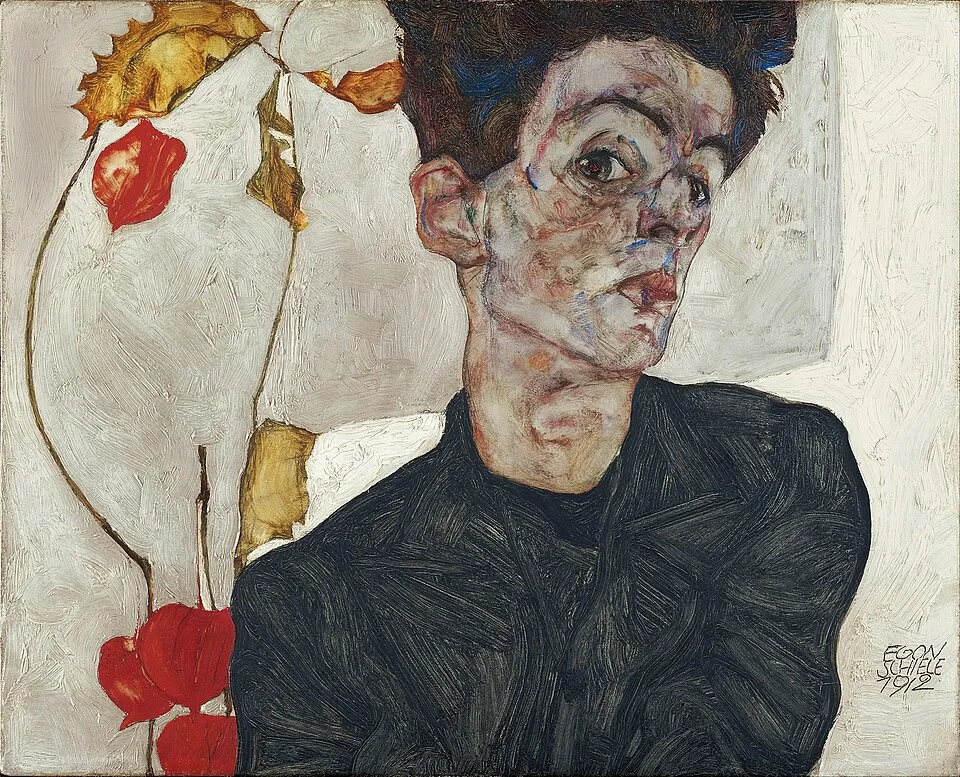
Egon Schiele, "Self-Portrait with Physalis" (1912). Oil and gouache on wood panel. 32.7 x 39.8 cm. Leopold Museum, Vienna. One of Schiele's most searching self-examinations, where the physalis plant, associated with fragility and transience, accompanies a characteristically intense gaze. Wikimedia Commons / Google Art Project.
The Self-Portraits
Schiele made more than one hundred self-portraits in oil, gouache, and watercolor. They are the central documents of his psychological inquiry, and they are unlike any self-portraiture in the Western tradition that preceded them. Where the classic tradition of self-portraiture, from Rembrandt through Cezanne, presents the artist as a dignified, self-possessed consciousness examining its own appearance, Schiele's self-portraits systematically undermine dignity and self-possession. He depicts himself in states of aggression, despair, ecstasy, and exhaustion. He shows himself from unflattering angles, with jutting elbows and twisted torsos, with exaggerated hands, with the kind of physical distortion that in the classical tradition would be reserved for figures representing vice or madness.
The hands are particularly significant. In painting after painting, Schiele's hands, and the hands of his other figures, are oversized, bony, knotted, and intensely expressive. They communicate states of psychological tension that the conventional academic figure painting of the period would have reserved for the face alone. This shift of expressive weight from face to hands and to the articulation of the whole body is one of Schiele's most important contributions to figure painting, and it is visible in the work of almost every serious figurative artist who has engaged with his legacy since.
Eros and Thanatos: The Subject Matter
A significant portion of Schiele's output consists of explicitly erotic drawings of women, often shown in states of arousal or in sexual poses that were at the time genuinely scandalous. In 1912, he was arrested in the Austrian town of Neulengbach on charges related to the seduction of a minor and the display of erotic drawings in a location accessible to children. He spent twenty-four days in prison, during which he made a series of harrowing gouache self-portraits showing himself in the cell, works that are among the most emotionally direct documents of imprisonment in the history of art.
The charge of seducing a minor was eventually dropped, but one charge of displaying erotic art where children could see it was upheld, and the judge ceremonially burned one of the drawings in the courtroom. The episode traumatized Schiele and feeds into the interpretation of his erotic work as a site of genuine transgression rather than mere convention. His drawings of adolescent and young female subjects sit uncomfortably against contemporary standards, and the question of how to engage with the erotic work ethically remains open and genuinely contested among art historians and museum curators.
But Schiele's engagement with the body was not only or even primarily erotic. His most emotionally intense works deal with death, dependency, and the body's fragility. "Death and the Maiden" (1915), held at the Belvedere in Vienna, shows a skeletal male figure in a monk's habit embracing a young woman. "The Family" (1918), unfinished at his death, shows a nude man, woman, and child in a pose of domestic intimacy rendered in the stark angular style of his most searching figure work. These paintings are not about sexuality. They are about the body as a site where love, death, vulnerability, and connection converge simultaneously.
The Drawings
Schiele's drawings may be his most important contribution to art history, and they are where his technical achievement is most concentrated. He drew with a combination of virtuosity and psychological directness that produces figures of extraordinary expressive power. The line in his drawings does not merely describe outline: it registers pressure, anxiety, hesitation, and release. The white ground of the paper is not a neutral space but an active element of the composition, the void against which the figure asserts its existence.
Many of his finest drawings were made in sessions of great speed, with a directness and economy suggesting he was working at the absolute edge of his capability. The gestures and poses he found in these sessions, bodies folded in on themselves, figures isolated in empty space, limbs twisted to expose the body's vulnerability, became the vocabulary of his mature work in paint as well. The Leopold Museum in Vienna, which holds the largest collection of Schiele's work in the world, provides online access to a significant portion of his drawings and a detailed account of the collection's formation.
Legacy and Influence
Schiele's influence on subsequent figurative art has been enormous and is still accumulating. The Austrian painter Maria Lassnig, who died in 2014 at age ninety-four, developed his investigation of the body's internal sensation into her "body awareness" paintings across a career that lasted into her final years, producing work that is unimaginable without Schiele's precedent. The German Neo-Expressionist painters of the 1980s, particularly Markus Lupertz and Georg Baselitz, engaged with the tradition of raw figuration that Schiele had established. Francis Bacon, though primarily influenced by the classical tradition and by his own specific obsessions, produces figure paintings in which the body's vulnerability and distortion read as extensions of the same inquiry Schiele began in Vienna between 1907 and 1918.
More recently, the artist Jenny Saville, whose work is covered in the guide to Jenny Saville, engages explicitly with the tradition of large-scale figurative painting in which Schiele's willingness to show the body in unflattering ways is a significant precedent. At auction, Schiele's works have achieved prices reflecting this enduring relevance: "Reclining Woman with Green Stockings" (1917) sold at Christie's in 2019 for $30.8 million, and the Belvedere retrospective of his work in 2018, marking the centenary of his death, drew record visitor numbers for the museum.
Final Thoughts
Egon Schiele's short life produced a body of work that has no parallel in the intensity of its psychological examination of the body. He found in the act of drawing the human form a method for exploring the states of consciousness that Freud was simultaneously trying to describe in language: the anxiety that underlies desire, the death drive that shadows the life drive, the way vulnerability and aggression coexist in the same moment of experience. Whatever the ethical complications of some of his subject matter, the formal achievement of his drawings and paintings is of the very first order, and the line he opened in the history of figure painting has not been closed.
For context on the city and culture that produced him, the guide to Art Nouveau covers the Secessionist movement that shaped his early career. For the Expressionism that his work helped create, the guide to Expressionism provides broader context. And for the tradition of drawing fundamentals that he both mastered and pushed far beyond conventional limits, that guide is worth reading alongside his work. Which Schiele drawing or painting has made the strongest impression on you? Share in the comments.


