
On April 3, 1897, nineteen artists resigned from the Association of Austrian Artists in a single coordinated walkout. Their grievance was specific: the Association's exhibition policy favored conservative academic painters and shut out younger artists working in new directions. Their solution was to start their own institution. They called it the Vienna Secession.
Vienna in 1900 was the capital of an empire in its final decades, producing art, architecture, music, psychology, and philosophy at a density few cities have ever matched. Sigmund Freud was writing "The Interpretation of Dreams." Gustav Mahler was conducting the Vienna Philharmonic. Adolf Loos was designing buildings without ornament. The Secession was the visual art wing of this creative eruption, and its influence on 20th-century design, painting, and the relationship between fine art and everyday objects is still being traced.
This guide covers the founding, the key artists, the Beethoven Frieze, the split between decorative and expressive tendencies, and why the Secession's ideas about Gesamtkunstwerk, the total work of art, still matter. The Leopold Museum's permanent exhibition "Vienna 1900: Birth of Modernism" spans three floors with approximately 1,300 exhibits, making it the most comprehensive presentation of this period anywhere.
The Founding and What They Were Rejecting
The Academy of Fine Arts Vienna controlled the city's main exhibition spaces and consistently favored historical and academic painting. Artists working in newer styles, influenced by Impressionism, Symbolism, and Art Nouveau, had no way to show their work to the public. The Association of Austrian Artists, which managed the Kunstlerhaus exhibition hall, was dominated by older academicians who saw no reason to change.
Gustav Klimt was elected the first president of the Secession. This was an unusual choice. Klimt was already a successful establishment painter who had received the Emperor's Golden Order of Merit and had completed major public commissions including the ceiling paintings for the University of Vienna's Great Hall. But his work had grown increasingly controversial. The university paintings, completed between 1900 and 1907, were criticized as pornographic and nihilistic, and eighty-seven faculty members signed a petition demanding their removal. Klimt was not an outsider leading a rebellion. He was an insider who had become dissatisfied with the inside.
The Secession Building, designed by Joseph Maria Olbrich in 1897-98, was the movement's physical manifestation. It is a squat, white-blocked structure with a dome made of gilded laurel leaves that locals immediately nicknamed the "golden cabbage." Above the entrance is carved the motto: "Der Zeit ihre Kunst. Der Kunst ihre Freiheit." To every age its art, to art its freedom. That sentence remains one of the best one-line statements of what modern art was trying to do. The journal "Ver Sacrum" (Sacred Spring), published from 1898 to 1903, served as the movement's mouthpiece, reproducing graphics, poetry, and design in a format that was itself a work of art. You can read more about the building and its history at the Secession's official website.
Klimt and the Decorative Turn
Klimt's shift from academic portrait painting to gold-leaf, Byzantine-influenced work happened around 1899, after he visited Ravenna and saw the Byzantine mosaics in the Church of San Vitale. The effect on his work was immediate. He began using gold leaf directly on canvas, creating surfaces that are part painting and part mosaic. "Judith and the Head of Holofernes" (1901) and the first portrait of Adele Bloch-Bauer (1907) are the most famous results of this period.
The Beethoven Frieze (1902) was created for the 14th Secession exhibition, which was a tribute to Beethoven based on Max Klinger's sculpture of the composer. Klimt painted a 34-meter-long frieze on three walls of the exhibition room, interpreting Beethoven's Ninth Symphony through Wagner's reading of it. The narrative follows humanity's quest for happiness through suffering. The middle wall depicts the hostile powers: Typhoeus, a giant ape-like creature surrounded by his daughters, the three Gorgons, and figures representing disease, madness, and death. The final section shows redemption through art and love, with figures embracing in a golden field.
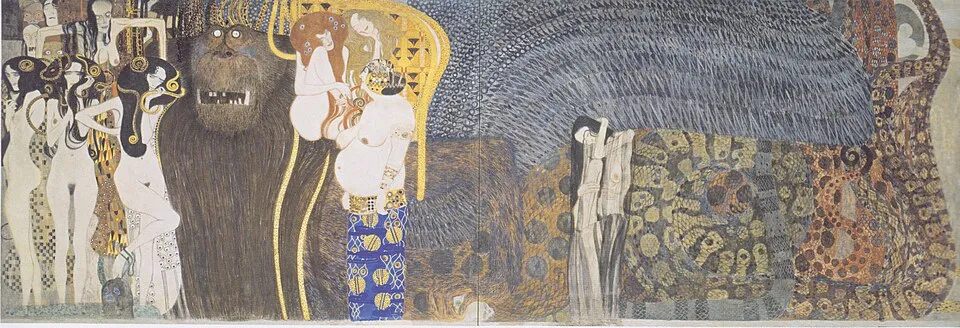
Gustav Klimt, "Beethoven Frieze" (1902), middle wall: The Hostile Powers. Secession Building, Vienna. On permanent loan from the Osterreichische Galerie Belvedere. Wikimedia Commons.
The frieze was meant to be temporary. It was painted on the wall with light materials, not designed to last. It survived by accident: the Secession planned a Klimt retrospective for 1903 and left the frieze in place rather than destroying it. In 1973 it was removed from the wall, conserved, and reinstalled in the Secession Building's basement, where it remains on view today. The fact that one of the most important works of early modernism survived because of a scheduling convenience is a reminder that art history is shaped by logistics as much as by genius. For more on Klimt's career, see our Klimt and the Vienna Secession spotlight.
Schiele and the Expressionist Break
Egon Schiele (1890-1918) admired Klimt and sought him out in 1907, when Schiele was 17 and Klimt was 45. Klimt mentored the younger artist, introduced him to collectors, and gave him access to his network. But Schiele's work diverged from Klimt's almost immediately. Klimt's figures are decorative and ornamental, embedded in patterns of gold and geometric shapes. Schiele's figures are raw, gaunt, and psychologically confrontational. Where Klimt beautified, Schiele exposed.
The "Self-Portrait with Chinese Lantern Plant" (1912) is a good example. Schiele stares directly at the viewer with angular features, sunken cheeks, and a posture that refuses to flatter. The painting is not about looking handsome. It is about the act of looking and being looked at, about the discomfort of self-examination. Schiele's self-portraits from this period are among the most psychologically intense images in European art. He painted himself twisted, gaunt, and sometimes masturbating, with a directness that got him arrested.
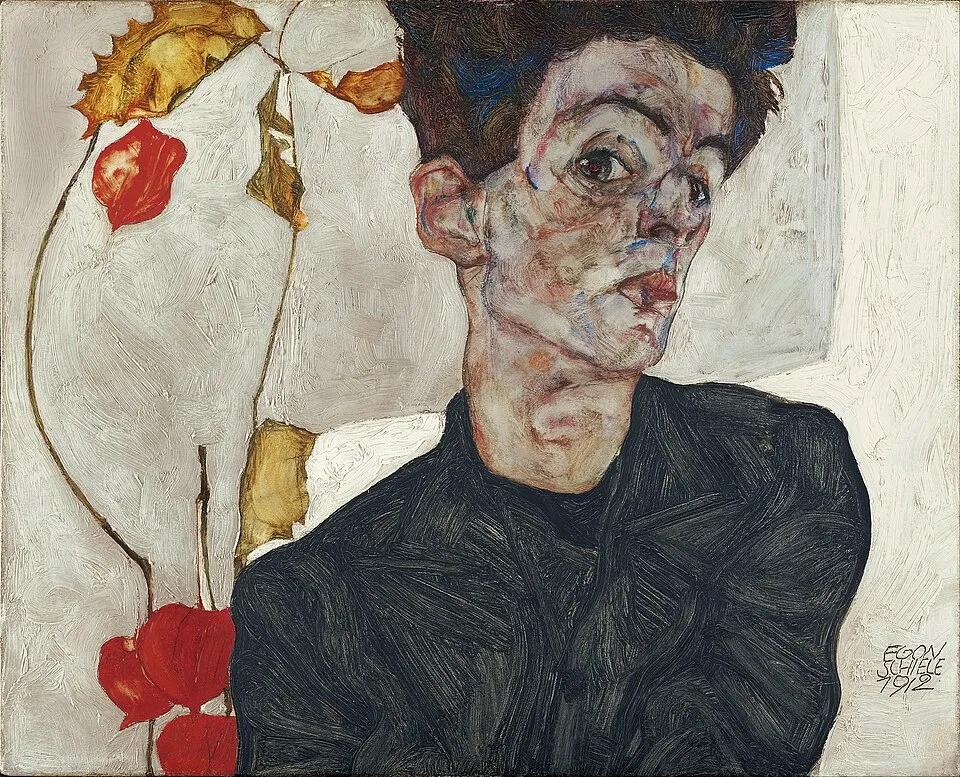
Egon Schiele, "Self-Portrait with Chinese Lantern Plant" (1912). Oil on canvas. Leopold Museum, Vienna. Wikimedia Commons.
In 1912, Schiele was imprisoned in Neulengbach for "immorality" after a young girl claimed he had abducted her. The abduction charge was dropped, but he was convicted of exhibiting erotic drawings in a place accessible to minors. He spent 24 days in jail. The experience marked his work, not by making him more cautious, but by confirming his sense of himself as an outsider persecuted for telling the truth. Schiele founded the New Art Group (Neukunstgruppe) in 1909 as a further break, not just from the Academy but from the Secession itself. He believed the Secession had become the new establishment.
Schiele's work is more historically significant than Klimt's. Klimt perfected a decorative style that was beautiful and influential but did not break new psychological ground. Schiele invented a way of painting the human body that confronted viewers with the subject's inner life, and that invention opened the door for every Expressionist painter who followed. The Leopold Museum's 2025 exhibition "Egon Schiele: Last Years" (March 28 to July 13, 2025) focused on the period 1914 to 1918, incorporating Edith Schiele's previously unpublished diary for the first time. The exhibition presented approximately 130 works and revealed that Schiele's late style became calmer and more empathetic before his death from Spanish influenza in October 1918, at age 28. For more on Schiele, see our Schiele and Viennese Expressionism post.
Koloman Moser, Josef Hoffmann, and the Gesamtkunstwerk
The Secession was not just about painting. Koloman Moser (1868-1918) and Josef Hoffmann (1870-1956) expanded it into design, furniture, graphics, and architecture. In 1903, they founded the Wiener Werkstatte (Vienna Workshops), a firm that produced furniture, textiles, glass, ceramics, jewelry, and graphics designed by artists and made by skilled craftspeople. The idea was that every object in daily life should be designed by an artist. Wallpaper, cutlery, postcards, bookbindings, and clothing were all treated as legitimate subjects for serious design.
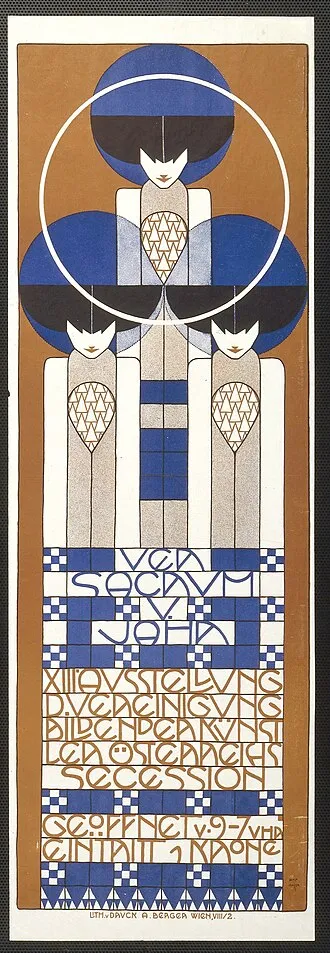
Koloman Moser, poster for the 13th Vienna Secession exhibition (1902). Wikimedia Commons.
The 1902 Beethoven exhibition at the Secession Building was the ultimate Gesamtkunstwerk. Twenty-one artists worked together under Hoffmann's overall direction. Klimt contributed the frieze. Klinger contributed the sculpture. Hoffmann designed the exhibition architecture itself, including the layout, the pedestals, and the decorative elements. The idea was that the visitor would experience the exhibition as a total environment, not as a collection of individual objects. This concept of art permeating daily life connects directly to the Bauhaus, founded in 1919, which took the Gesamtkunstwerk idea further by integrating art, craft, and industrial production into a single educational program.
Oskar Kokoschka and the End of Decorative Optimism
Oskar Kokoschka (1886-1980) was the figure who broke the Secession's decorative spell. His early portraits, painted between 1909 and 1910, use jagged lines and exposed, nervous brushwork. The faces are gaunt, the colors are sickly, and there is no attempt at beauty. His portrait of Adolf Loos (1909) shows the architect with a twisted, tense expression, the paint applied in harsh strokes that make the surface feel like skin under pressure.
The split in the Secession was generational. Klimt's faction wanted beauty and decoration. The younger generation, Schiele and Kokoschka, wanted psychological truth. The two positions are not compatible. You cannot make work that is simultaneously decorative and psychologically raw, because decoration requires smoothing over the rough edges that psychological honesty demands. By 1914, the Secession had dissolved as a coherent movement, overtaken by Expressionism and then by the First World War, which killed the Austro-Hungarian Empire and the cultural conditions that had produced the Secession in the first place. For more on the broader movement, see our post on Expressionism.
The 2024-2026 Exhibition Wave
Vienna 1900 keeps returning as a subject because the concentration of talent was extreme and the moment was brief. The Leopold Museum's permanent exhibition "Vienna 1900: Birth of Modernism" provides the most comprehensive overview, with 1,300 exhibits across three floors. In 2025, the museum presented "Egon Schiele: Last Years" and "Hidden Modernism: The Fascination with the Occult around 1900," which explored theosophy, body culture, and spiritualism in Viennese modernism.
During summer 2026, the Leopold Museum is presenting "A Summer with Klimt," displaying four exceptional masterpieces on loan from the Stiftung Sammlung Kamm in Zug, Switzerland. These include two Klimt landscapes, Richard Gerstl's "Group Portrait with Schonberg," and Schiele's early "Portrait of the Painter Hans Massmann." The works are on view until October 4, 2026, in the permanent Vienna 1900 exhibition, offering a rare chance to see these pieces in dialogue with the museum's own collection.
The National Museum of Korea hosted "Vienna 1900: The Dreaming Artists" from November 2024 through March 2025, featuring 191 works from the Leopold Museum. The exhibition drew over 80,000 visitors in its first month alone, confirming that Vienna 1900 has global appeal that extends well beyond Europe.
Final Thoughts
The Vienna Secession lasted roughly 17 years, from 1897 to 1914, but its ideas about art's relationship to daily life, design, and psychological honesty shaped the entire 20th century. The motto carved above the Secession Building's door, "To every age its art, to art its freedom," is still the best one-sentence statement of what modern art was trying to do. Klimt showed that decoration could be serious art. Schiele showed that the human body could be painted with a psychological directness that previous generations would have called ugly. Moser and Hoffmann showed that a teacup and a painting deserved the same level of creative attention.
If you visit Vienna, the Secession Building still exists and still shows the Beethoven Frieze in its basement. The Leopold Museum has the world's largest Schiele collection, and its permanent Vienna 1900 exhibition is the best single introduction to the period anywhere. You can also explore our posts on Art Nouveau and our art movements timeline for broader context. The Met Museum's Heilbrunn Timeline essay on the Vienna Secession provides additional scholarly background, and our art history cheat sheet situates the movement within the larger story of Western art.


