
In 1900, a group of four Scottish artists exhibited at the Vienna Secession and caused a sensation. The Austrians had never seen anything like it: elongated figures, Celtic-inspired patterns, and a strange combination of organic curves and geometric precision. The Viennese called them "the Glasgow Four" and Secession leader Josef Hoffmann was so impressed that he redesigned his own apartment in their style. The four were Charles Rennie Mackintosh, his future wife Margaret Macdonald, her sister Frances Macdonald, and Frances's future husband J. Herbert McNair. They were all in their late twenties. None of them had ever been to Paris.
Glasgow in 1900 was the second city of the British Empire. A shipbuilding and industrial powerhouse with a booming art school. The Glasgow School of Art, under director Francis Newbery, encouraged experimentation and admitted women on equal terms with men, which was unusual for the period. The Glasgow Style that emerged there was related to Art Nouveau but distinct: more geometric, more austere, more influenced by Celtic traditions and Japanese design.
This guide covers Mackintosh's architecture, Margaret Macdonald's decorative art, the "Four" and their Vienna triumph, the Glasgow Girls, the fire that destroyed the School of Art, and why the Glasgow Style remains Scotland's most distinctive artistic contribution.
The Four and the Making of the Glasgow Style
All four members of the Glasgow Four studied at the Glasgow School of Art in the early 1890s. Mackintosh and McNair were apprentices at the architectural firm Honeyman and Keppie. The Macdonald sisters had their own studio at 128 Hope Street. Their early work included book illustrations, embroidery, gesso panels, and repousse metalwork inspired by Celtic imagery, symbolism, and folklore. The figures are elongated. The patterns are organic but controlled. The palette is muted.
The 1896 Arts and Crafts Exhibition in London gave them their first public exposure, but some critics dismissed them as "the Spook School" because of their eerie, attenuated figures. The nickname stuck for years in the London press.
The 1900 Vienna Secession exhibition was the breakthrough. The Four were given a room of their own. The response was overwhelming. Gustav Klimt attended. The Viennese press praised them as the most original contribution to the exhibition. This connection to the Vienna Secession launched the Glasgow Style internationally, and the cross-pollination between Glasgow and Vienna shaped both movements for years afterward.
Charles Rennie Mackintosh and Architecture
Mackintosh won the competition for the Glasgow School of Art building in 1896, at age 28. The building was constructed in two phases: 1899 and 1909. It combines Scottish baronial massing with Japanese-inspired detail. The east elevation has small windows and heavy stone. The west elevation has large studio windows with ironwork brackets that look like Japanese joinery. The building is simultaneously fortress and lantern.
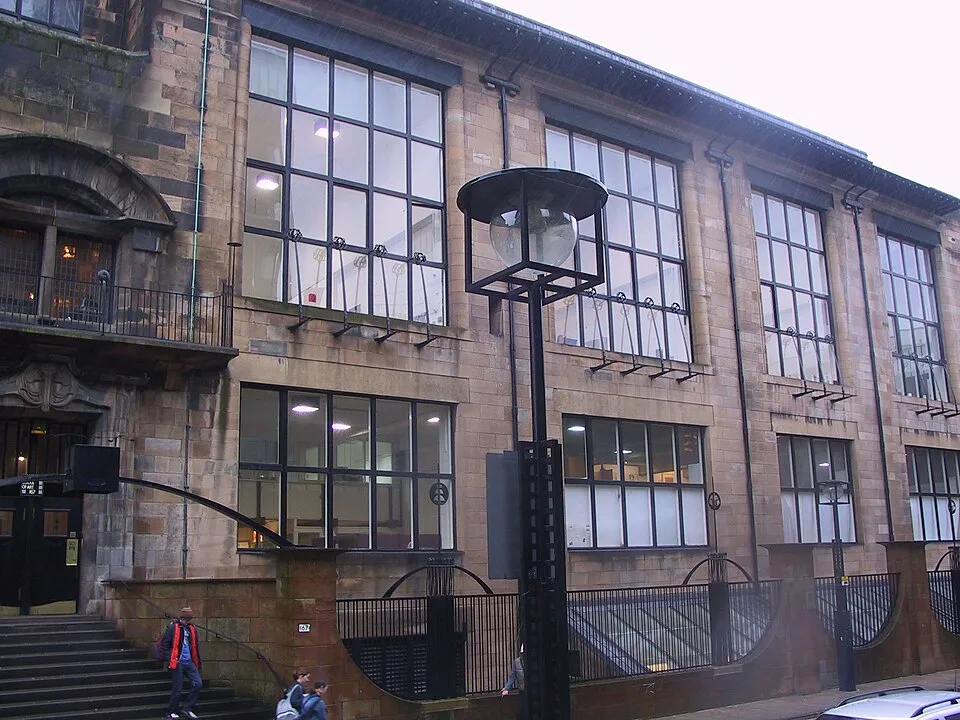
Charles Rennie Mackintosh, Glasgow School of Art (1899-1909). The building suffered two devastating fires, in 2014 and 2018. Wikimedia Commons.
The Willow Tea Rooms (1903) on Sauchiehall Street were Mackintosh's most complete interior commission. He designed everything: furniture, light fixtures, cutlery, waitresses' uniforms. The client was Catherine Cranston, a Glasgow businesswoman who ran a chain of tea rooms. The Salon de Luxe, the most intimate room in the building, was designed in collaboration with Margaret Macdonald, who created a gesso panel titled "O Ye, All Ye That Walk In Willowwood" inspired by Dante Gabriel Rossetti's sonnet cycle on lost love. A July 2025 talk at the restored tea rooms by cultural historian Dr. Robyne Calvert revealed how the Mackintoshes translated Rossetti's poetry into the room's design, connecting the Glasgow Style to Pre-Raphaelite literary sources.
Hill House (1902-04) in Helensburgh was built for publisher Walter Blackie. The exterior is severe, almost fortress-like. The interior is delicate, with white rooms and floral motifs designed by Margaret Macdonald. Since 2019, the house has been encased in a giant steel box to protect it from water damage while conservation work proceeds. In 2025, the National Trust for Scotland announced that the cement render causing decades of water damage has been removed and the walls have dried sufficiently for a breathable replacement render to be applied. The steel box is scheduled for removal by 2028, which will mark the 160th anniversary of Mackintosh's birth and the centenary of his death.
Margaret Macdonald and the Decorative Arts
Margaret Macdonald Mackintosh (1864-1933) is often described as Mackintosh's wife and collaborator. She was a significant artist in her own right before they married in 1900. Her medium was gesso panels: a technique using plaster mixed with glue, built up in layers on a flat surface, then painted and decorated with glass beads, string, and metal leaf. The results are part painting, part relief sculpture, part textile.
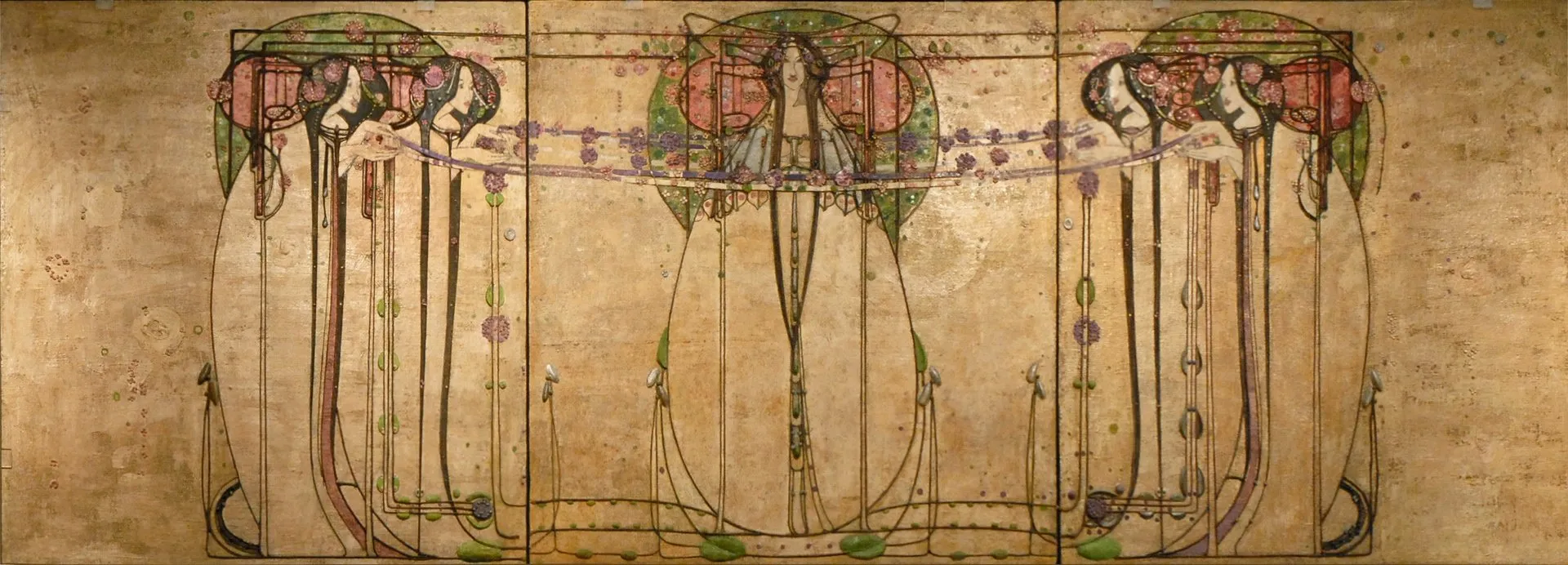
Margaret Macdonald Mackintosh, "The May Queen" (1900). Gesso, glass beads, string, and watercolor. University of Glasgow. Wikimedia Commons.
"The May Queen" (1900) was exhibited at the Vienna Secession. A stylized female figure surrounded by flowers and geometric patterns, in white and gold. Each panel took months to complete. Her contribution to Mackintosh's architecture was substantial: she designed the interiors, the decorative panels, and the furniture details for many of his buildings. Hill House's famous white bedroom is her work as much as his.
The historical problem is that Margaret's work was attributed to "Mackintosh" for decades. The reattribution of her contribution is ongoing. In December 2024, the National Trust for Scotland received a £1.1 million development grant from the National Lottery Heritage Fund for the Mackintosh Illuminated project, which explicitly aims to deepen public understanding of Macdonald as a skilled artist in her own right. An anonymous donation of £625,000 in December 2025 further boosted the project, which is targeting completion by 2028. Margaret Macdonald was the more original artist of the pair. The historical attribution of her work to Mackintosh is a continuing injustice that this project begins to address.
The Glasgow Girls and the Wider Movement
The Glasgow Style was not just the Four. A larger group of women artists, known as the Glasgow Girls, produced ceramics, metalwork, embroidery, and book illustration in the same period. Key figures included Jessie M. King (book illustration), Jessie Newbery (embroidery), Ann Macbeth (needlework), and De Courcy Lewthwaite Dewar (enameling).
The Glasgow Girls achieved international success. They exhibited at the 1901 Glasgow International Exhibition, the Turin International Exhibition of 1902, and the St. Louis World's Fair of 1904. Their work sold across Europe and America.
Why were the Glasgow Girls forgotten? The art history of the period focused on individual male "geniuses" rather than collective female production. The rediscovery of the Glasgow Girls began in the 1980s and is still incomplete. The "Designing the New" exhibition (2018 to 2020, touring) was the first major exhibition to give equal billing to all four members of the Glasgow group, and the Mackintosh Illuminated project continues this reattribution work.
The Glasgow Girls' collective approach to craft connects them to the broader Art Nouveau movement and its ambition to erase the boundary between fine art and applied art.
The Glasgow Style and Japanese Influence
Mackintosh and the Glasgow group were exposed to Japanese design through the collection of Japanese prints and artifacts at the Glasgow School of Art and through the city's trade connections with East Asia. Glasgow was a port city. Japanese goods arrived regularly.
The Japanese elements in the Glasgow Style are specific: asymmetrical balance, emphasis on negative space, the combination of heavy mass and delicate detail, and the preference for natural materials (wood, stone, metal) over applied decoration. Parisian Art Nouveau (Guimard, Mucha) was based on organic, flowing curves. Glasgow Style was based on tension between geometric structure and organic detail. It was closer to Japanese design than to French.
This Japanese connection places the Glasgow Style within the broader history of Japonisme and Japanese influence on Western art, but with a distinctive Scottish filter that combined Celtic and Japanese sources into something neither culture had produced alone.
Why the Glasgow Style Matters
The Glasgow Style was the only British contribution to the international Art Nouveau movement that achieved continental recognition. London was largely indifferent. Vienna, Berlin, and Turin were not. Mackintosh's architecture influenced Frank Lloyd Wright (who visited Glasgow), the Bauhaus (through the Vienna Secession connection), and Scandinavian modernism.
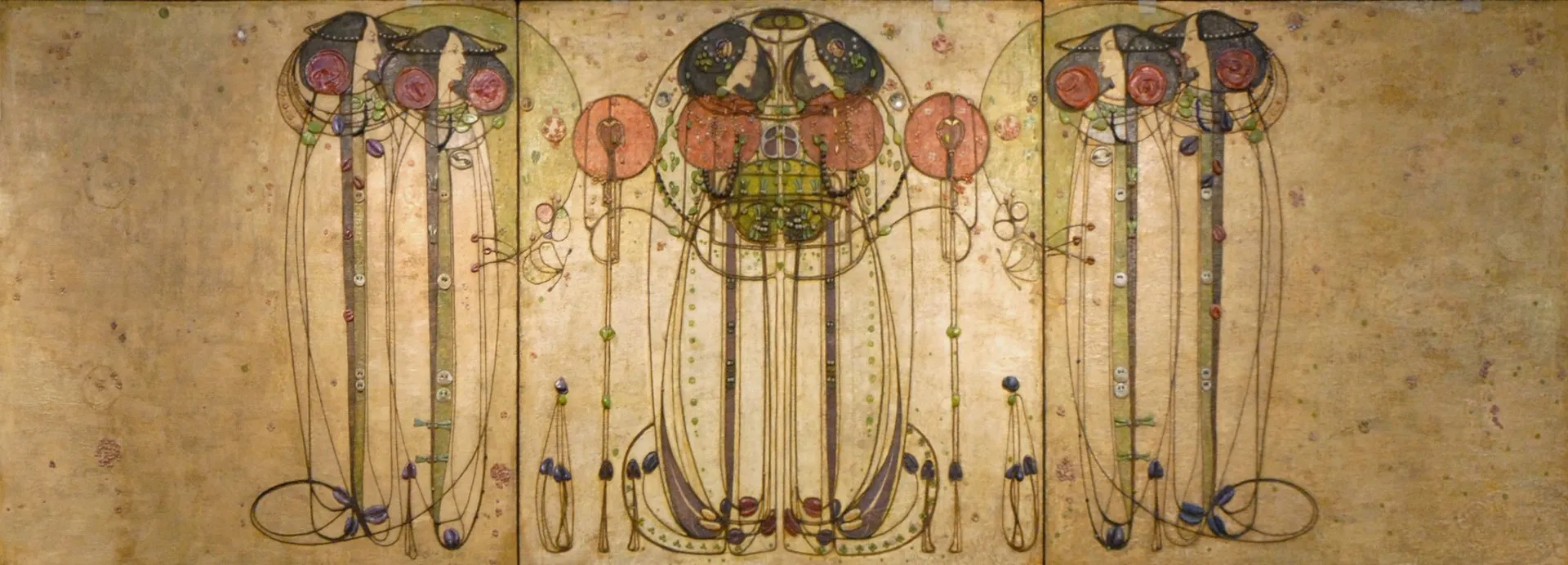
Charles Rennie Mackintosh, "The Wassail" (1900). Gesso and oil on canvas. The Hunterian, University of Glasgow. Wikimedia Commons.
The fires at the Glasgow School of Art destroyed one of the most important buildings in European architectural history. The first fire ripped through the building on May 23, 2014. The second, even more devastating fire broke out in June 2018, near the end of a £35 million restoration project. In December 2025, the Glasgow School of Art published a Strategic Outline Business Case Addendum revealing that a complete faithful reinstatement would cost £265 million, equivalent to five times the institution's annual turnover. The GSA cannot fund this alone. The insurance settlement from the 2018 fire, resolved in late 2025, fell short of the amount needed. The school plans to remove external scaffolding in summer 2027 as a "gateway project" that will stabilize the structure and expose the stone elevations to public view for the first time in nearly a decade. The building's long-term future depends on external funding that is not yet secured.
The loss is comparable to the destruction of the Library of Alexandria for architecture. The Mackintosh Building was not just a building but a manifesto. The ongoing restoration debate, now complicated by the £265 million price tag, remains unresolved. A public inquiry into the fires was rejected in June 2024.
The Glasgow Style's connection to the Arts and Crafts movement is also significant. Both movements insisted on the integration of art and daily life, but the Glasgow Style brought a geometric severity that Arts and Crafts never achieved.
Final Thoughts
The Glasgow Style lasted roughly 20 years (c. 1890 to 1910) and was the product of a specific moment: a booming industrial city with a progressive art school, a group of young artists who combined Celtic, Japanese, and modernist influences, and an international network that connected Glasgow to Vienna and beyond. The destruction of the School of Art building makes the surviving work more precious, not less relevant.
The Mackintosh at the Willow tea rooms on Sauchiehall Street have been restored and are open to the public, now managed by the National Trust for Scotland since January 2024. Hill House in Helensburgh is managed by the National Trust for Scotland and open for tours, with the conservation project visible through the steel box structure. The Hunterian at the University of Glasgow has the largest collection of Mackintosh and Macdonald work. For broader context, see our art movements timeline and art history cheat sheet. The Glasgow Style also connects forward to the Bauhaus, which inherited its geometric discipline through the Vienna Secession connection.


