
Most painters develop their methods intuitively, through accumulated practice and the guidance of teachers. Georges Seurat developed his method through systematic research. Before applying a single dot of paint to the canvas for "A Sunday Afternoon on the Island of La Grande Jatte" (1884-86), he had spent months studying scientific color theory, reading the work of Michel Eugène Chevreul on simultaneous contrast and Ogden Rood on optical mixture, and filling notebooks with analysis of how colors behave when placed adjacent to each other. He was attempting to put painting on a scientific foundation in the same way that other 19th-century disciplines were being rationalized through systematic inquiry.
The result was a technique he called Chromoluminarism and that critics soon named Pointillism: the application of small, distinct touches of pure color that, when viewed at the correct distance, merge in the eye of the viewer to produce the intended optical effect. The technique was based on the theory that colors mixed optically on the retina would be more luminous than colors mixed physically on the palette. Whether this theory is actually correct in all its details is debated by color scientists, but the paintings it produced are undeniably unlike anything made before or since.
Bathers at Asnières: The First Major Statement
"Bathers at Asnières" (1884), now at the National Gallery in London, was the first large-scale work in which Seurat deployed his emerging method. It shows working-class young men lounging by the Seine at Asnières, a suburb northwest of Paris. The figures are simplified to near-geometric forms. The light is even, clear, and sourceless, as if the scene existed in a different kind of time than the Impressionist paintings being shown across Paris at the same moment. The surface combines blocky painted passages in the main areas with his dotting technique in the shadows and transitions.
The painting was rejected by the official Salon in 1884 and shown instead at the first exhibition of the Société des Artistes Indépendants, which Seurat co-founded that year specifically to provide an exhibition space free from the jury system that had blocked innovative work. The Société des Indépendants, operating on the principle of no jury and no prizes, became an important institution for the French avant-garde over the following decades.
A Sunday Afternoon on the Island of La Grande Jatte
"A Sunday Afternoon on the Island of La Grande Jatte" is covered in detail in the guide to this specific painting. For the purposes of Seurat's biography, it is the work that established his reputation, defined the movement he led, and demonstrated the full possibilities of his method. He worked on it for two years, drawing over twenty preparatory studies for individual figures and compositional elements. When it appeared at the eighth and final Impressionist Exhibition in 1886, it provoked controversy and fascination in equal measure. The critic Félix Fénéon, who would become one of Seurat's most important champions, coined the term "Neo-Impressionism" to describe the new movement.
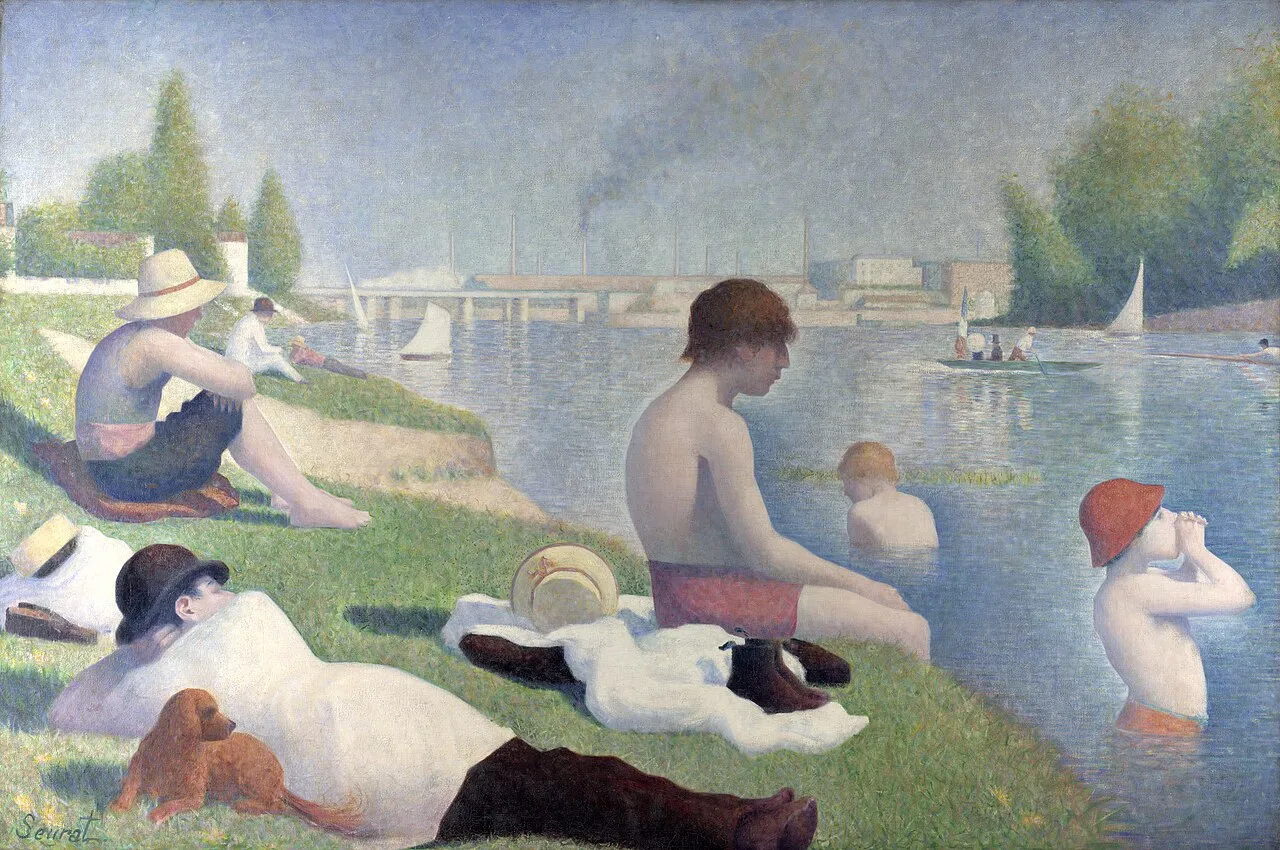
Georges Seurat, "Bathers at Asnières" (1884). Oil on canvas, 201 x 301 cm. The National Gallery, London. Seurat's first large-scale application of his developing method, showing working-class leisure on the Seine. Wikimedia Commons.
The Science Behind the Dots
The theoretical basis for Seurat's technique came primarily from two sources. Chevreul's "De la loi du contraste simultané des couleurs" (1839) described how colors placed adjacent to each other modify each other's appearance: a gray placed next to red appears greenish because the eye generates the complementary of red. Rood's "Modern Chromatics" (1879) discussed the optical mixture of small color areas and argued that pure spectral colors mixed in this way would produce more luminous results than physically mixed pigments.
Seurat's application of these theories involved painting with small, regular touches of pure color, placing complementary colors adjacent to each other in the shadows, and adjusting the warm and cool color relationships across the composition to create the sensation of light and atmosphere without using conventional tonal modeling. The size of the dots was calibrated to the intended viewing distance: each painting has a specific distance from which the optical mixture takes effect. Stand too close to "La Grande Jatte" and you see individual colored dots. Step back ten feet and the image resolves into unified color fields.
Paul Signac, who became Seurat's closest collaborator and the movement's chief theorist after Seurat's death, formalized the technique further and published "D'Eugène Delacroix au Néo-Impressionnisme" (1899), which systematized the scientific claims underlying Divisionism. Signac also extended the technique toward a more decorative application, with larger, rectangular brush marks that moved away from Seurat's small regular dots toward something closer to mosaic.
The Later Works and the Circus Paintings
In the final years of his short life, Seurat made a series of paintings of Parisian entertainment: circus performers, cancan dancers, and sideshow barkers. "Le Chahut" (1889-90) and "The Circus" (1890-91) deploy his Pointillist technique in compositions of radical geometric simplification, with figures rendered in angular lines and the atmosphere of artificial gaslight translated into warm yellows and oranges punctuated by complementary cooler areas.
These late paintings also reflect his engagement with the aesthetic theories of Charles Henry, who had published a treatise in 1885 on the emotional effects of line direction: upward-moving lines produce pleasure, downward lines produce sadness, horizontal lines produce calm. Seurat's circus paintings deliberately use the ascending diagonal lines of the performers' bodies and the steeply raked seating of the circus arena to create compositions that Henry's theory would associate with gaiety and excitement. Whether this theoretical framework actually operates in the paintings is debatable, but it shows the consistency with which Seurat sought a principled basis for every compositional decision.
The Life Behind the Method
Seurat's private life was as systematic as his art. He revealed almost nothing about his personal relationships even to close friends. After his death from a rapid illness (possibly diphtheria) in March 1891 at the age of thirty-one, his family and colleagues discovered that he had maintained a secret household with a young woman named Madeleine Knobloch and their infant son, both of whom had contracted the same illness. The son died shortly after Seurat.
He left behind a body of work of extraordinary quality and extraordinary concentration for a career that lasted only about ten years. The influence of his method extended far beyond the small group of Neo-Impressionists who adopted it directly. The systematic use of complementary color relationships informed the Fauves. The geometric simplification of his figures and the near-complete suppression of tonal modeling influenced Cubism. His insistence that painting could be constructed according to rational principles rather than relying solely on intuition anticipates the whole tradition of abstract art that would follow.
Final Thoughts
Georges Seurat died at thirty-one having made approximately six large paintings, forty smaller ones, and over 400 drawings in his mature style. The economy of output makes the achievement more striking, not less. Each major canvas is the result of an investigation so thorough that it leaves nothing accidental or unresolved. If you stand in front of "La Grande Jatte" at the Art Institute of Chicago or "Bathers at Asnières" at the National Gallery in London, what you encounter is not simply a painting of leisure on a summer afternoon. It is a demonstration that painting could be approached as a systematic science of sensation, and that such an approach could produce images of profound stillness and luminous beauty.
For the most famous painting Seurat made, the guide to A Sunday on La Grande Jatte goes into depth on that single work. For the broader movement Seurat belonged to, the guide to Post-Impressionism provides essential context. For the color theory that underpins his method, the guide to color theory for artists covers the principles he was drawing on.


