
The State Hermitage Museum in St. Petersburg has over 3 million works spanning antiquity to the 20th century. It occupies six historic buildings along the Palace Embankment of the Neva River, the largest of which is the Winter Palace, the former official residence of the Russian tsars. The museum was founded in 1764 when Catherine the Great purchased 225 paintings from a Berlin merchant named Johann Ernst Gotzkowsky to pay off his debts. Catherine called her private gallery the "Hermitage," French for "a place of solitude," and it was initially accessible only to her and her closest circle. It opened to the public in 1852, under Nicholas I. One estimate has it that you would need eleven years to view each exhibit on display for just one minute.
The Hermitage's history is inseparable from the Russian imperial project. Catherine the Great bought art by the shipload: Rembrandt, Rubens, Titian, Raphael, Van Dyck. She used the wealth of the Russian state to build a collection that could rival the Louvre. The collection was expanded by revolution, when private collections were nationalized after 1917, and by survival, when the museum endured the 900-day Siege of Leningrad during World War II with staff living in the basement and protecting the collection. The Hermitage is also a museum with a complicated present. Since Russia's invasion of Ukraine in 2022, international cultural cooperation with the Hermitage has been severely restricted. This guide covers the Winter Palace architecture, the Rembrandt collection, the two Leonardo paintings, the Impressionist and Post-Impressionist galleries in the General Staff Building, what most visitors miss, and practical tips for those who can still visit.
The Winter Palace and the Building
The Winter Palace was designed by Bartolomeo Rastrelli in the Baroque style and built between 1754 and 1762 for Empress Elizabeth. The green-and-white facade stretches 215 meters along the Neva. Catherine the Great moved in and immediately began expanding. She added the Small Hermitage (1764-1775), the Old Hermitage (1771-1787), and the Hermitage Theatre (1783-1787). The complex grew over centuries into the museum campus visible today.
The Jordan Staircase is the ceremonial entrance, restored to its original Rastrelli design. It was named for the annual Epiphany ceremony where the tsar descended to the Neva to bless the water. The staircase is the first thing visitors see, and it sets the tone: gilded stucco, white marble, a ceiling painting by Gaspare Diziani. You are walking into a palace, not a museum.
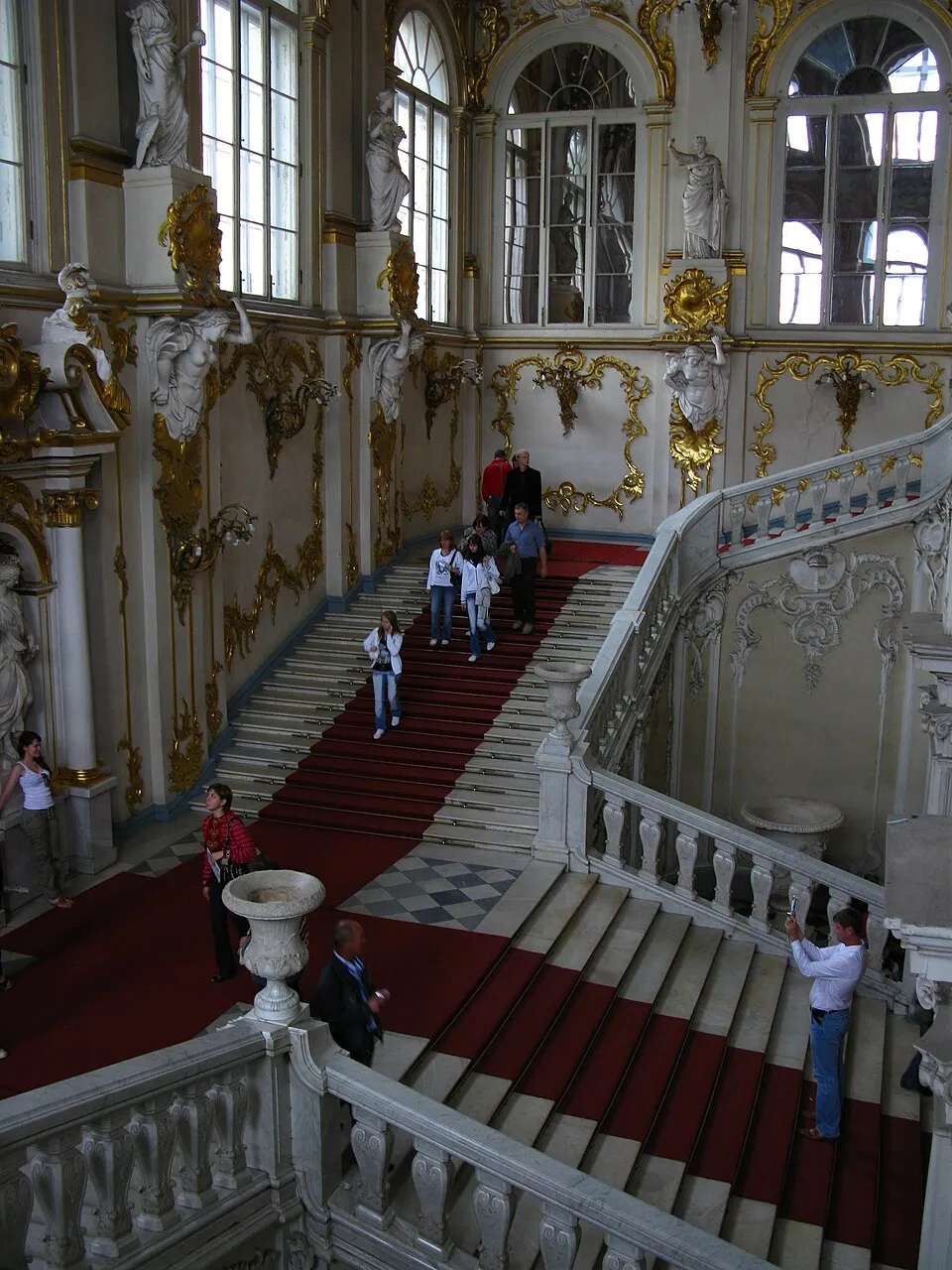
The Jordan Staircase, Winter Palace. State Hermitage Museum. Image: Public domain, via Wikimedia Commons
A fire destroyed the interior of the Winter Palace in 1837. Nicholas I ordered it rebuilt within 15 months, and the reconstruction was so precise that visitors today see the same rooms. The 1837 fire is one of the remarkable stories in museum history: the exterior walls survived, and the interior was rebuilt to Rastrelli's original plans under the supervision of Vasily Stasov and Alexander Briullov. The speed of the reconstruction says something about the priorities of the Russian imperial state.
The Siege of Leningrad (1941-1944) is the other defining event in the building's history. During the 900-day German siege, the Hermitage staff lived in the basement. The most valuable works had been evacuated to Sverdlovsk (now Yekaterinburg) in July 1941, just weeks before the siege began. The staff who remained protected the building from freezing, flooding, and artillery damage. Twelve staff members died during the siege. The building took 17 direct hits from artillery shells and two bombs. When the siege ended, the staff emerged from the basement and began the process of reinstalling the collection. The Hermitage reopened to the public in November 1944, while the war was still ongoing. You can read more about the museum's digital presence and collection access through Google Arts and Culture's Hermitage partnership.
The Rembrandt Collection
The Hermitage has 24 Rembrandt paintings, one of the largest Rembrandt collections in any museum. The Rembrandt Room (Room 254) is a single gallery that contains more Rembrandt paintings than most national museums own in total. The room itself is hung in the 19th-century style: paintings floor to ceiling, gold frames, dark walls. The effect is overwhelming, and it is the closest you can get to seeing Rembrandt the way 18th-century collectors saw him.
"The Return of the Prodigal Son" (c. 1668) is the centerpiece. At 262 x 206 cm, it is Rembrandt's last major painting, completed in the year before his death. The father embraces his kneeling son. The father's hands are different sizes, which scholars have interpreted as representing both a human hand (the left, smaller) and a divine hand (the right, larger). The painting was acquired by Catherine the Great in 1772 as part of the Crozat collection, one of the great French collections of the 18th century. Standing in front of it, you notice the paint handling first: the father's red robe is built up in thick impasto, the son's torn clothes are painted in thin, broken strokes. The contrast between the two textures is the painting's emotional engine.

Rembrandt van Rijn, "The Return of the Prodigal Son" (c. 1668). Oil on canvas, 262 x 206 cm. State Hermitage Museum. Image: Public domain, via Wikimedia Commons
The room also contains "Flora" (c. 1654), "Danaë" (1636-1647), and "The Sacrifice of Isaac" (1635). "Danaë" has its own difficult history. In 1985, a man threw sulfuric acid on the painting and slashed it with a knife. The restoration took 12 years (1985-1997) and was carried out by a team of Hermitage conservators led by Yevgeny Gerasimov. The restoration is considered one of the most complex in museum history. The acid had destroyed areas of paint down to the ground layer, and the conservators had to reconstruct Rembrandt's brushwork from photographs and their knowledge of his technique. The painting is back on display, and if you look closely, you can see where the restoration was done. The areas of reconstruction are slightly smoother than Rembrandt's original paint. For more on Rembrandt's techniques, see our guide to Rembrandt: Light, Shadow, and the Human Face.
The Two Leonardo Paintings
The Hermitage is one of only four museums in the world with two or more Leonardo da Vinci paintings. The others are the Louvre, the National Gallery in London, and the Uffizi in Florence. Having two Leonardos is not a minor distinction. There are fewer than 20 surviving paintings attributed to Leonardo in the entire world.
"Madonna Benois" (c. 1475-1478) is the earlier of the two. At 48 x 31.5 cm, it is a small painting, executed when Leonardo was about 23 years old. The Virgin and Child are absorbed in a game with a flower. The painting demonstrates Leonardo's early chiaroscuro, the lighting and shading technique that made figures appear three-dimensional. The light source comes from the upper left, and the figures emerge from a dark background with soft transitions between light and shadow. The painting entered the Hermitage in 1914, purchased from the Benois family for 150,000 rubles. The Benois family had owned it for nearly a century, believing it was a copy. It was only identified as an authentic Leonardo in 1909 by the art historian Ernst Pfister.
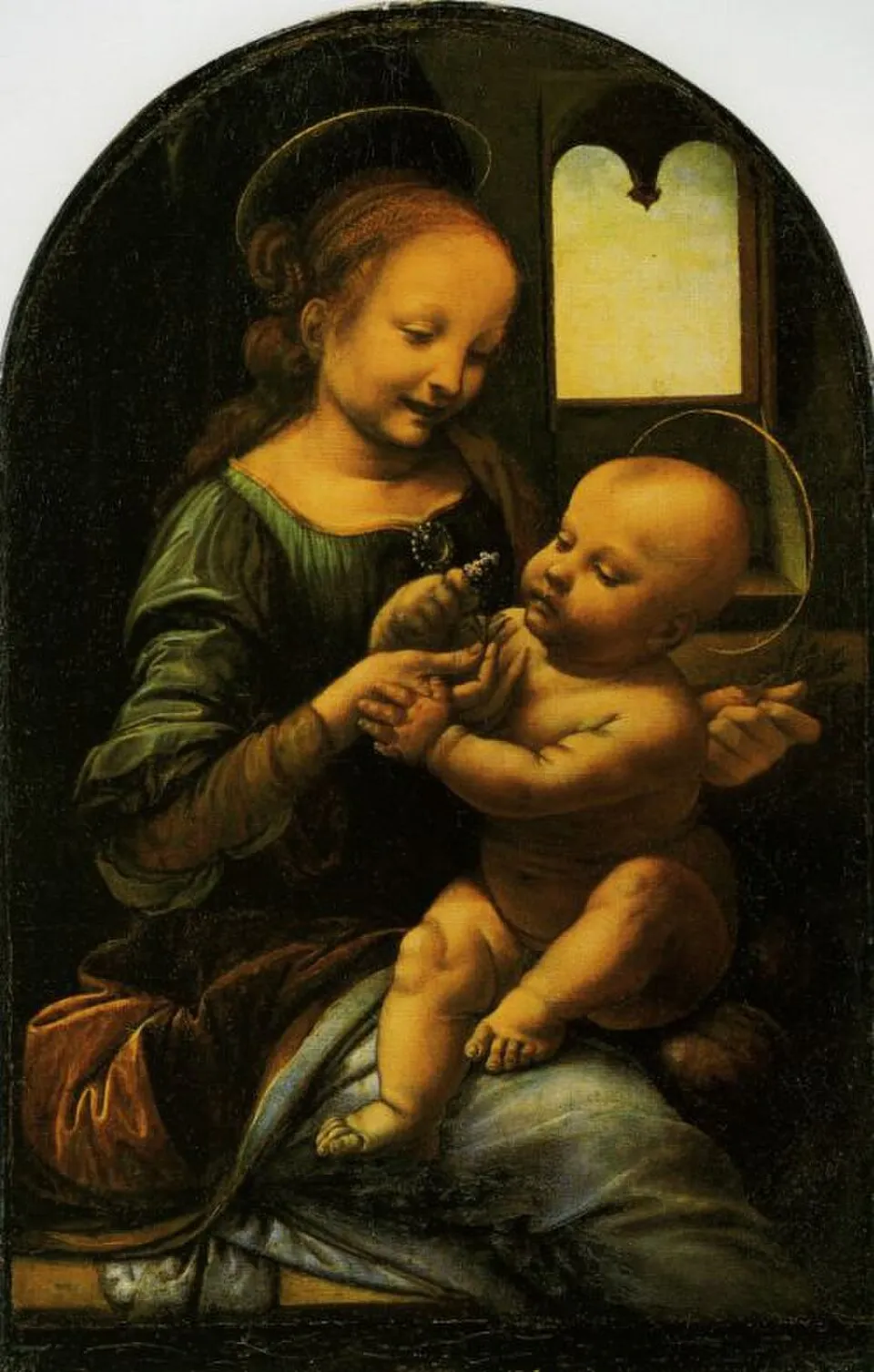
Leonardo da Vinci, "Madonna Benois" (c. 1475-1478). Oil on canvas transferred from panel, 48 x 31.5 cm. State Hermitage Museum. Image: Public domain, via Wikimedia Commons
"Madonna Litta" (c. 1490) is the second Leonardo. At 42 x 33 cm, it shows the Virgin nursing the Christ Child. The painting is sometimes attributed to Leonardo's workshop rather than to Leonardo himself, and scholars disagree. The blue background is unusual for Leonardo, who typically used atmospheric backgrounds. The attribution debate is ongoing, but the Hermitage displays it as a Leonardo, and the quality of the Virgin's face supports that attribution. The child's face is less convincing and may be workshop assistance. For more on Leonardo's career and methods, see our guide to Leonardo da Vinci: Art, Science, and the Ultimate Renaissance Mind.
The General Staff Building: Impressionists and Post-Impressionists
The General Staff Building sits across Palace Square from the Winter Palace, connected by the Arch of the General Staff Building. It was designed by Carlo Rossi and built between 1819 and 1829. The building was converted into Impressionist and Post-Impressionist galleries in 2014, creating one of the most significant museum expansion projects of the 21st century.
The collection is built around the Shchukin and Morozov collections, the two great Moscow merchant collections of late 19th and early 20th century French art. Sergei Shchukin and Ivan Morozov were textile merchants who bought Matisse, Picasso, Monet, Renoir, Cézanne, Van Gogh, and Gauguin in bulk before anyone in Paris took them seriously. Their collections were nationalized after the 1917 Revolution and split between the Hermitage and the Pushkin Museum in Moscow.
The highlight is Matisse's "The Dance" (1906), at 260 x 391 cm. It is one of the most influential paintings of the 20th century. Shchukin commissioned it for his Moscow mansion, along with its companion piece "Music" (1910). The figures are red, the sky is blue, the earth is green. Matisse reduced painting to three colors and a circle of dancing bodies. The paint is applied flatly, without shading or modeling. The figures are crude, almost childlike in their drawing. The painting was considered scandalous when Shchukin first hung it in his dining room. Now it looks like the beginning of everything that followed in 20th century painting.
The General Staff Building is less crowded than the Winter Palace. Most visitors spend all their time in the main complex and never cross the square. This is a mistake. The Impressionist and Post-Impressionist galleries are the best reason to visit the Hermitage in 2026, and you can see them in relative peace. The building also houses contemporary art exhibitions and the Hermitage 20/21 project, dedicated to 20th and 21st century art. For more on Matisse and the movement he led, see our guide to Fauvism: Matisse and the Wild Beasts of Color.
What Most Visitors Miss
The Treasure Gallery, also called the Gold Rooms, is a separate ticketed section in the Winter Palace. It shows Scythian gold, Greek gold, and decorative arts from the imperial collection. The Scythian gold is the finest collection of nomadic goldwork in the world. The deer plaque from the Kul-Oba kurgan (4th century BCE) is a small, perfect object: a leaping deer rendered in gold sheet with antlers sweeping back across its body in a continuous curve. The Scythian gold alone justifies a visit to the Hermitage, and most visitors never see it because they do not buy the separate ticket.
The Peacock Clock is an 18th-century automaton in the Pavilion Hall. The clock's peacock, cockerel, and owl move on the hour. It is one of the few surviving 18th-century automata still in working order. The clock was made by James Cox in London around 1772 and purchased by Potemkin for Catherine the Great. The mechanism is a marvel of 18th-century engineering: the peacock raises and lowers its head, spreads its tail, and turns. The cockerel crows. The owl rotates its head and rings a bell.
The Egyptian Hall contains a complete Egyptian collection including mummies and a reconstruction of a tomb. It is less visited than the painting galleries, which means you can see it in silence. The Hermitage Theatre, Catherine the Great's private theatre (1783-1787), was designed by Giacomo Quarenghi and is still used for performances. The auditorium is one of the most beautiful 18th-century theatre spaces in Europe.
In 2026, the Hermitage is also running several major exhibitions. "Catherine I" (May 19 to September 27, 2026) marks the 300th anniversary of the reign of Catherine I, the first woman to occupy the Russian throne, with over 450 objects including carriages, paintings, costumes, and jewelry. "Baron Stieglitz: A Feat of Enlightened Philanthropy" (June 27 to October 4, 2026) marks the 150th anniversary of the Stieglitz Central School of Technical Drawing with around 800 works of decorative art. Titian's late masterpiece "Saint Sebastian" returned to display in July 2026 after three years of restoration, revealing that the saint had blue eyes and hair in large curls, details that had been hidden under later varnish layers. The painting is on view until August 27, 2026.
Practical Tips
Tickets cost 500 rubles for Russian citizens and 700 rubles for foreign visitors. The museum is free on the third Thursday of each month. Hours are Tuesday through Sunday, 10:30 AM to 6:00 PM, with extended hours on Wednesday, Thursday, and Friday until 9:00 PM. The museum is closed on Mondays.
Plan 3 to 4 hours for highlights: the Winter Palace plus the General Staff Building. A full day is necessary for a thorough visit. The museum has 365 rooms open to the public. Pick 3 or 4 areas and see them properly rather than trying to see everything. Photography is allowed without flash. The Treasure Gallery requires a separate ticket and a guided tour.
International travel to Russia is currently restricted for many nationalities due to the ongoing war in Ukraine. Check your government's travel advisory before planning a visit. The Hermitage's website at hermitagemuseum.org remains operational, and the museum continues to host exhibitions and maintain its collection. Director Mikhail Piotrovsky has emphasized the museum's role in preserving cultural heritage, but international loans and cultural exchanges have been largely suspended since 2022. For those who cannot visit in person, the Hermitage's digital collections are accessible online. For general museum visiting strategies, see our guide on how to visit an art museum without getting overwhelmed.
Final Thoughts
The Hermitage is one of the great museums of the world. Three million works in a former tsarist palace, with Rembrandt, Leonardo, Matisse, and Scythian gold among its highlights. Its history is inseparable from the Russian imperial project, from Catherine the Great's buying sprees to the nationalization of private collections after 1917 to the Siege of Leningrad. The museum's present is complicated by the war in Ukraine, but the collection remains extraordinary and the staff continues to conserve, exhibit, and study it.
The Hermitage is also a museum that forces you to think about where art comes from and who it belongs to. Catherine the Great bought paintings with the wealth of the Russian state. The Shchukin and Morozov collections were nationalized from private owners. The Scythian gold was excavated from burial mounds in Crimea and southern Russia. Every great museum has a complicated relationship with its collection's origins, but the Hermitage's relationship is more visible than most because the political history is still being written.
If you can visit, book online at hermitagemuseum.org. Start with the Rembrandt Room (Room 254), then the Leonardo paintings, then cross to the General Staff Building for the Impressionists. If you cannot visit, the digital collections are worth exploring. For the broader context of art history, see our Complete Guide to Art Movements and our Art History in 10 Minutes. For more on the famous paintings in the collection, see our guide to famous paintings explained.


