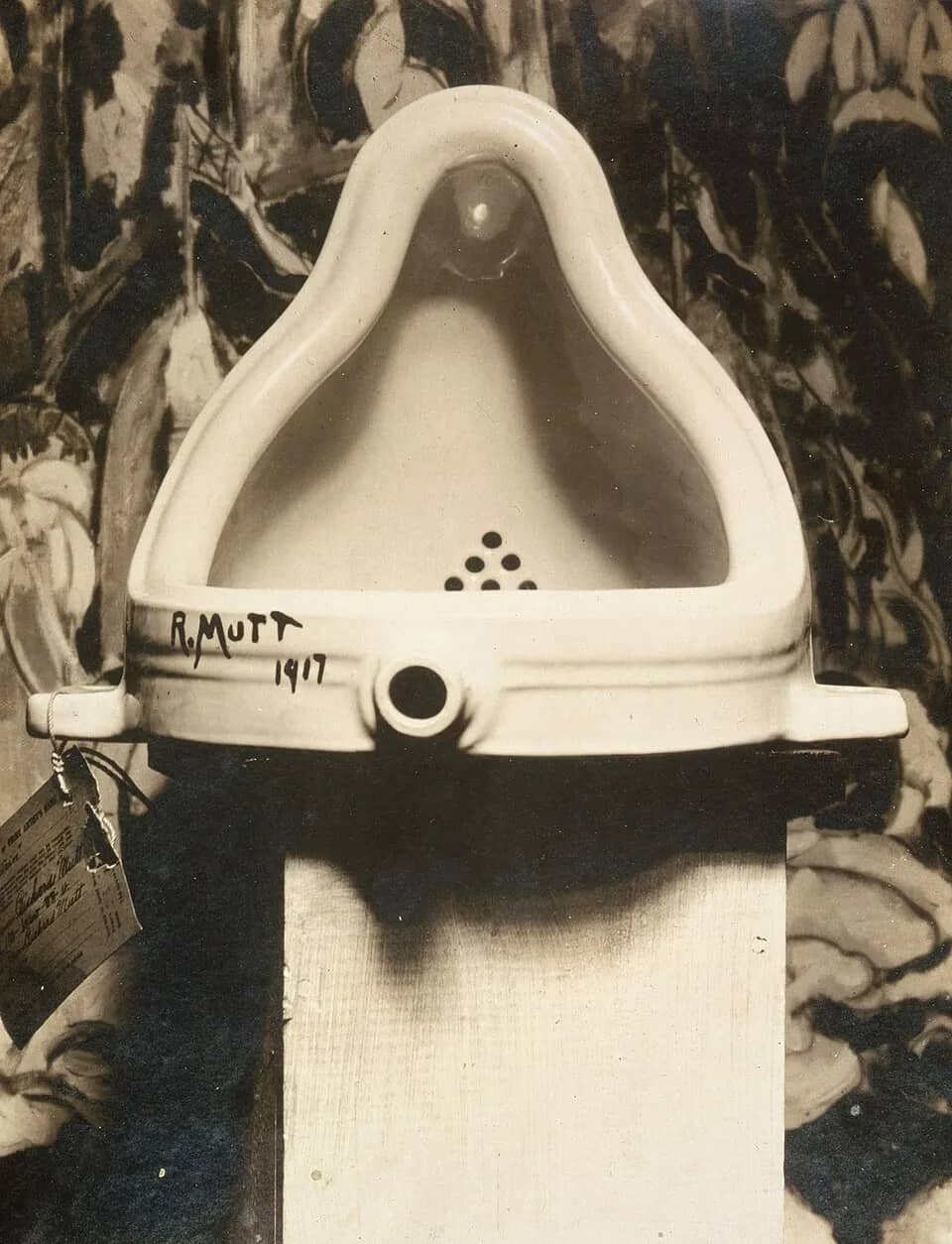
In 1917, Marcel Duchamp purchased a standard commercial urinal from a plumbing supplier in New York, turned it ninety degrees so it rested on its back, signed it with the pseudonym "R. Mutt," dated it 1917, and submitted it to the first exhibition of the Society of Independent Artists under the title "Fountain." The Society had publicly pledged to accept any work submitted with the entry fee, no jury, no selection. The board rejected "Fountain" anyway, deciding it was not a work of art. Duchamp resigned from the board in protest. The original was lost. A photograph taken by Alfred Stieglitz, showing the object on a pedestal against a backdrop of Marsden Hartley's painting, is the primary visual record.
Now consider the same object in a different setting. A urinal in a public bathroom is invisible: no one looks at it as a designed object, no one considers its form, no one thinks about what it represents. It is infrastructure, defined entirely by its function. Move it to a gallery, place it on a plinth, title it, attribute it to an artist, put it in an exhibition, and it becomes visible. You are now looking at its shape, its whiteness, its glaze. You are comparing it to the artworks around it, thinking about what it is doing there, reconsidering what counts as art. The object did not change. The context transformed it completely.
This is the central argument about context in art, and it is more consequential than it might initially appear. Every time you stand in front of a work in a museum, a gallery, a church, or on a screen, the setting is doing active work on your experience of the object. Understanding what that work is, and how it operates, is one of the most useful skills a viewer can develop.
The White Cube and What It Does
The "white cube" is the dominant display format of contemporary art since the early 20th century: white walls, even artificial lighting, minimal contextual information, objects isolated from each other and from their original settings. Brian O'Doherty's influential essays collected as "Inside the White Cube" (1976) described the white cube as an ideology, a deliberate stripping of context intended to produce a condition of pure aesthetic attention, divorced from social, commercial, and historical associations.
The white cube affects meaning in specific ways. It signals that whatever it contains is art, regardless of what that thing is. It asks the viewer to attend to the object's formal properties, its shape, color, texture, and relationships, rather than its practical function or social associations. It implies that the object is special, valuable, and worthy of extended attention. This is so effective that the white cube can make almost anything appear significant: a pile of wrapped sweets (Felix Gonzalez-Torres's candy works), a half-dead shark in formaldehyde (Damien Hirst's "The Physical Impossibility of Death in the Mind of Someone Living"), an unmade bed (Tracey Emin's "My Bed").
But the white cube also strips away context that changes meaning in the other direction. It removes the original social and religious function of sacred objects that end up in Western art museums, it separates artifacts from the cultures that produced them, and it imposes a Western European framework of aesthetic contemplation on objects that were made for entirely different purposes. A Benin bronze plaque displayed in the British Museum is technically visible to millions of visitors who might otherwise never encounter West African court art. It is also removed from the Benin Royal Palace where it was made, stripped of its original function as part of a commemorative program for dead kings, and displayed under institutional conditions that still reflect a history of colonial acquisition that the museum itself has publicly acknowledged.
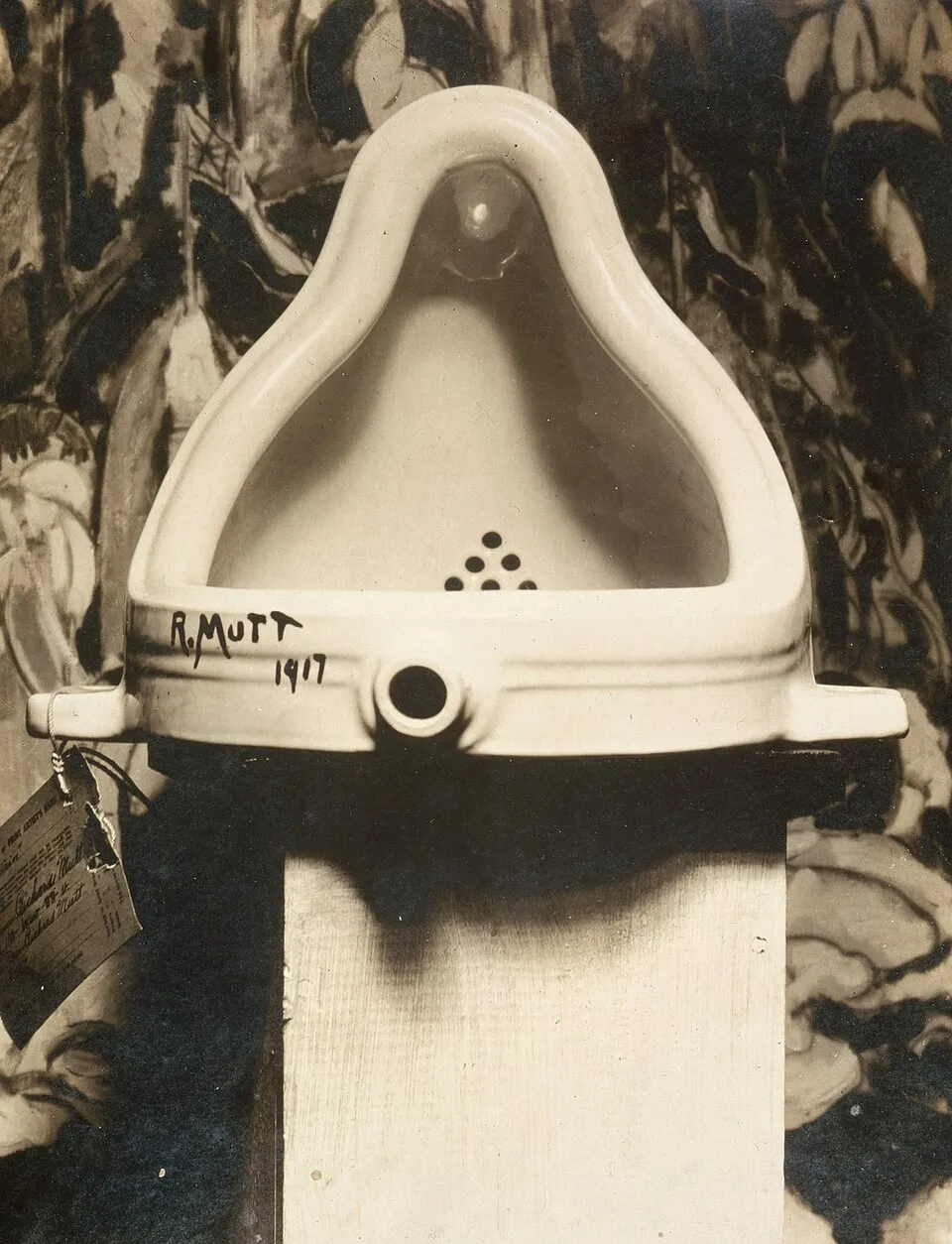
Marcel Duchamp, "Fountain" (1917), photograph by Alfred Stieglitz. The original object was lost; this photograph is the primary record of the readymade as displayed. The backdrop of Marsden Hartley's painting, the plinth, and the gallery setting are all part of what Duchamp was testing: can context alone transform a manufactured object into a work of art? Image: Public domain, via Wikimedia Commons
Hanging Order and Curatorial Argument
Within any exhibition or permanent collection, the sequence and adjacency of works creates meaning that no individual work contains alone. The decision to hang a 17th-century Dutch still life beside a contemporary photograph of consumer goods, or to place a Rembrandt portrait next to a contemporary portrait by Kehinde Wiley, makes a curatorial argument about continuity, contrast, or dialogue. The viewer's experience of the adjacent work colors how they read each painting.
The Museum of Modern Art's permanent collection rehang, completed in 2019, was extensively discussed in the press because it replaced a largely chronological display organized by medium with a thematic display that juxtaposed Western modernist works with non-Western and non-canonical works from the same periods. A Picasso was hung beside an African mask from the Kongo, making explicit the relationship that art historians had always described in text but that the old hang had refused to show spatially. The new arrangement communicated a different history of modernism: one in which African, Latin American, and Asian art were not minor tributaries feeding a European mainstream but parallel and sometimes precedent traditions. This argument was made by context, not by any change to the artworks themselves.
Alfred Barr's original installation of MoMA's collection in the 1930s was equally argumentative. By creating a specific narrative of Western modernism from Post-Impressionism through Cubism to Abstract Expressionism and presenting it in a precisely designed spatial sequence, he effectively defined what counted as the mainstream of 20th-century art for a generation. The works he chose to include and the sequence he imposed shaped not just public taste but academic art history for decades.
The Same Work in Different Countries
Moving a work across national borders changes its meaning even when nothing about the physical object or its display is altered. The Parthenon Sculptures, removed from Athens by Lord Elgin between 1801 and 1812 and now held by the British Museum, are the most discussed example. In Athens, displayed in the Acropolis Museum opened in 2009 specifically to house them if returned, they would be read in the context of the buildings they were made for, the culture that produced them, and the national narrative of Greek civilization. In the British Museum, they are read in the context of British imperial collecting, universal museum ideology, and the question of restitution that their presence there now inevitably raises. The visual and physical object is identical in both settings. The meaning is not.
The same dynamic operates in the debate over African, pre-Columbian, and Indigenous artifacts held by European and North American museums. A Benin bronze in Berlin's Humboldt Forum (opened 2021 with significant controversy over its colonial-era holdings) carries a different burden of meaning than an identical piece held in the new Benin Bronzes collection building in Benin City, Nigeria, where some bronzes have already been returned. Context does not merely color meaning. In cases like this, it is the dominant meaning of a displayed object.
This is not a settled issue. As of 2025, restitution debates are ongoing at virtually every major Western museum, with the British Museum, the Louvre, and institutions across Germany and the US all navigating legal frameworks, diplomatic pressures, and shifting public expectations about what cultural ownership means. The context around these objects is actively changing, which means their meaning in any given display location is also shifting.
Reproduction and Digital Context
Walter Benjamin's 1935 essay "The Work of Art in the Age of Mechanical Reproduction" argued that reproductions strip artworks of their "aura": the quality of presence and uniqueness that derives from their physical existence in a specific place and time. A reproduction of the Mona Lisa, he argued, is not the Mona Lisa. It lacks the aura that attaches to the singular painted object that Leonardo actually touched.
Digital reproduction extends this logic further while also complicating it. An image of a Caravaggio circulating on Instagram, stripped of caption, attribution, date, and gallery context, is encountered as a visual experience without any of the art-historical apparatus that frames it in a museum. Some viewers discover genuine emotional responses to artworks they encounter this way, then seek out the originals. Others absorb the image as a visual sensation detached from any historical or institutional meaning. Both are real responses. Neither is the response a gallery visit produces. Context shapes not only what we think but how we feel.
The rise of AI-generated imagery adds another layer to this question. When photorealistic images that look like artworks circulate without clear attribution or institutional context, the viewer has no reliable cues to distinguish hand-made from machine-generated, historical from contemporary, authentic from fabricated. Context, in this environment, is not just intellectually significant. It is the only mechanism by which meaning can be reliably established at all.
How to Think About Context When You Look at Art
The practical implication for gallery-going is that asking where a work came from, how it got here, what surrounds it, and who arranged it that way, is as important a set of questions as asking what the work depicts. The institution that displays art is not a transparent medium. It is an argument, and reading that argument is a legitimate and rewarding part of the experience of looking.
Start by reading the wall label carefully, not just for the artist's name and date, but for the acquisition history. "Gift of the artist" tells a different story than "acquired 1897." Look at what hangs on either side of the work and ask what relationship the curator is proposing. Visit the same work in different contexts if you can: an artist's retrospective at a major institution presents the same paintings differently from a solo gallery show, which presents them differently again from a group thematic exhibition. The work does not change. Your experience of it does.
Final Thoughts
Context is not a neutral backdrop to meaning. It is a determinant of meaning, and sometimes it is the primary determinant. Acknowledging this does not undermine the value of artworks or make their meanings arbitrary. It is simply an honest description of how meaning is made: through the encounter between an object, a setting, and a viewer whose own context is also part of the equation.
For how the viewer's own presence and perspective contribute to the meaning of any artwork regardless of institutional context, our companion post on the role of the viewer covers this dimension directly. And for the full picture of how museums make the decisions that create these contexts in the first place, our guide to how museums decide what to display explains the politics and pressures behind every curatorial choice.