
In 1931, a Dutch painter named Carel Willink painted four men in modern suits standing among the ruins of Pompeii. Mount Vesuvius smokes in the background. The men do not look at each other. One of them, the philosopher Oswald Spengler, stares at the volcano. The painting is rendered with photographic precision. Every brick, every fold of fabric, every wisp of smoke is exactly rendered. And yet the scene is impossible: these men in 20th-century suits are standing in a Roman city destroyed in 79 AD. The painting is completely real and completely impossible. This is Magic Realism.
Magic Realism emerged in Germany in the 1920s as an offshoot of Neue Sachlichkeit (New Objectivity). The term was coined by German critic Franz Roh in 1925 to describe painters who combined precise, realistic technique with subjects that were strange, unsettling, or impossible. Unlike Surrealism, which painted dreams, Magic Realism painted reality. But reality made strange. The year 2025 marked the centenary of Roh's coinage, celebrated by exhibitions across Europe that revisited the movement's origins and its continuing relevance.
This guide covers Franz Roh's original definition, de Chirico's influence, the German Magic Realists (Radziwill, Schad, Willink), the relationship to Surrealism, the spread to Latin American literature, and why the movement's uncanny precision still feels contemporary.
Franz Roh and the Naming of Magic Realism
Franz Roh's book "Nach-Expressionismus: Magischer Realismus" (1925) is the founding text. Roh was an art critic trying to describe the new post-Expressionist painting that was emerging in Germany. His definition: "enigmas of quietude in the midst of general becoming." He identified 15 characteristics that distinguished Magic Realism from Expressionism: static rather than dynamic, precise rather than loose, cool rather than hot, shallow space rather than deep space.
The relationship to Neue Sachlichkeit was initially close. Magic Realism was at first synonymous with New Objectivity. Over time, the two terms diverged. Neue Sachlichkeit came to mean social critique (Otto Dix, George Grosz), while Magic Realism came to mean the uncanny and mysterious.
The term's migration to literature happened in stages. In 1948, the Cuban writer Alejo Carpentier used "lo real maravilloso" (the marvelous real) to describe Latin American fiction. In 1955, the critic Angel Flores applied "Magic Realism" to the work of Garcia Marquez, Borges, and others. The literary usage is now more famous than the original art historical one. A 2024 academic paper in the journal "In Imag" traced these "allohistories" of Magic Realism, arguing that the mode's hybridity, its ability to move between painting, literature, and film, is what has kept it alive for a century while more rigid movements have faded.
De Chirico and the Metaphysical Foundation
Giorgio de Chirico (1888 to 1978) is the painter whose work made Magic Realism possible. His "Metaphysical Town Square" paintings (1910 to 1917) depict empty Italian piazzas with classical architecture, long shadows, and strange objects. "Gare Montparnasse (The Melancholy of Departure)" (1914) is a train station with impossible perspective: multiple vanishing points, compressed space, and a green sky. The painting is precise but disorienting. Robert Hughes called it "an architectonic masterpiece."
De Chirico demonstrated that precise, realistic painting could produce uncanny effects. The Magic Realists learned from him that the strangeness does not have to come from distortion. It can come from the juxtaposition of precisely rendered but impossible elements. De Chirico's own words: "To live in the world as in an immense museum of strange things."
As MoMA's artist page on de Chirico documents, his influence on both Surrealism and Magic Realism was foundational. The Surrealists claimed him as a precursor. The Magic Realists saw him as a founder. Both were right, because his paintings are simultaneously precise (Magic Realist) and dreamlike (Surrealist).
Franz Radziwill and the Strangeness of the Ordinary
Franz Radziwill (1888 to 1983) was a German painter who settled in the coastal town of Dangast in 1923. He painted beaches, houses, and airplanes. But always with something wrong. "Beach of Dangast with Flying Boat" (1929) is a quiet beach scene with an airplane that seems to lack a propeller, whose body resembles a ship's hull. The lighting is strange. The rocks seem to have fallen from another world. The painting is perfectly realistic and completely enigmatic.
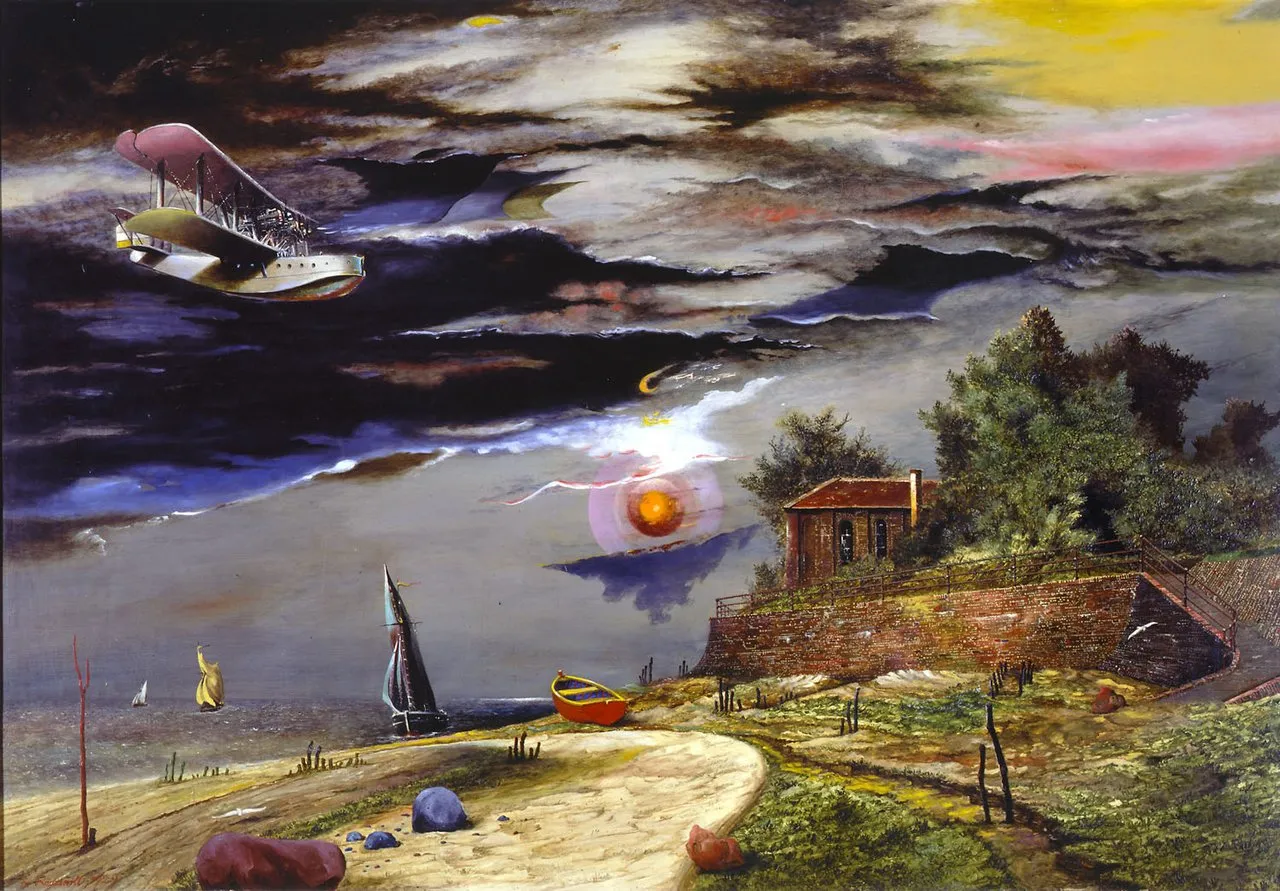
Franz Radziwill, "Beach of Dangast with Flying Boat" (1929). Oil on canvas. Wikimedia Commons.
Radziwill was both fascinated and frightened by the machines encroaching on his small coastal town. His paintings show technology arriving in traditional landscapes without explanation or context. The difference from Surrealism is instructive. A Surrealist would paint the airplane melting. Radziwill paints it precisely. The strangeness comes from the fact that it is there at all, not from how it looks.
The 2025 exhibition "Magic Realisms: Pyke Koch and Cagnaccio di San Pietro" at the MART in Rovereto (April 12 to August 31, 2025) explored this international dimension. Curated by Beatrice Avanzi, the exhibition compared the Dutch painter Pyke Koch with the Italian Cagnaccio di San Pietro, showing how both artists created "a rigorous realism displaying extraordinary technical skill, inspired by 15th-century masters, and particularly those from Northern Europe." The exhibition demonstrated that Magic Realism was not a German phenomenon alone but a European one, with distinct national variations sharing a common commitment to precise technique and unsettling content.
Carel Willink and Imaginary Realism
Carel Willink (1900 to 1983) was a Dutch painter trained in Berlin in the early 1920s where he encountered constructivism. He rejected abstraction and turned to figurative painting inspired by de Chirico. "Late Visitors to Pompeii" (1931) measures 92 x 142 cm. Four men in modern suits at the ruins of Pompeii. The figures are the artist himself at three stages of life (young, middle-aged, old) plus the philosopher Spengler, seen from behind. Spengler's "Decline of the West" inspired the painting's theme: the sense that modern civilization is heading for catastrophe, just as Pompeii did.
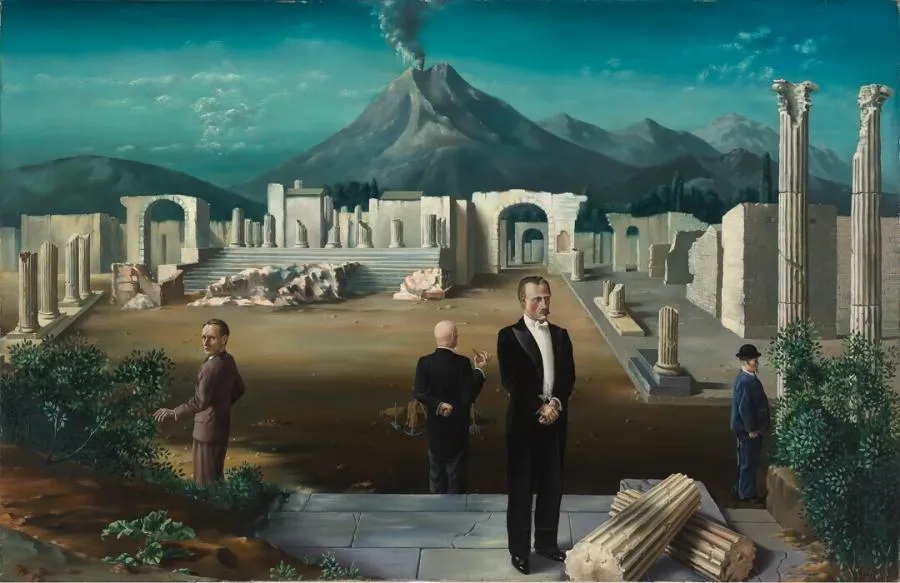
Carel Willink, "Late Visitors to Pompeii" (1931). Oil on canvas, 92 x 142 cm. Museum Boijmans Van Beuningen, Rotterdam. Wikimedia Commons.
Willink preferred the term "imaginary realism" rather than Magic Realism. He wanted to acknowledge that his paintings were not records of observed reality but constructions: realistic in technique, imaginary in content. His work inspired a school of Dutch fantastic realists that continues to this day. Museum Boijmans Van Beuningen in Rotterdam holds "Late Visitors to Pompeii" in its permanent collection.
Christian Schad and the Uncanny Portrait
Christian Schad (1894 to 1982) was associated with the Dada movement in Zurich before returning to Berlin and developing a precise, cold style of portraiture. "Self-Portrait" (1927) shows the artist posing nude with a woman who has a scarred face, beside a model of a stag. A green veil drapes between them. The painting is rendered with surgical precision. Every hair, every scar, every thread is visible. The effect is deeply unsettling, as if a medical illustration has been turned into a portrait.
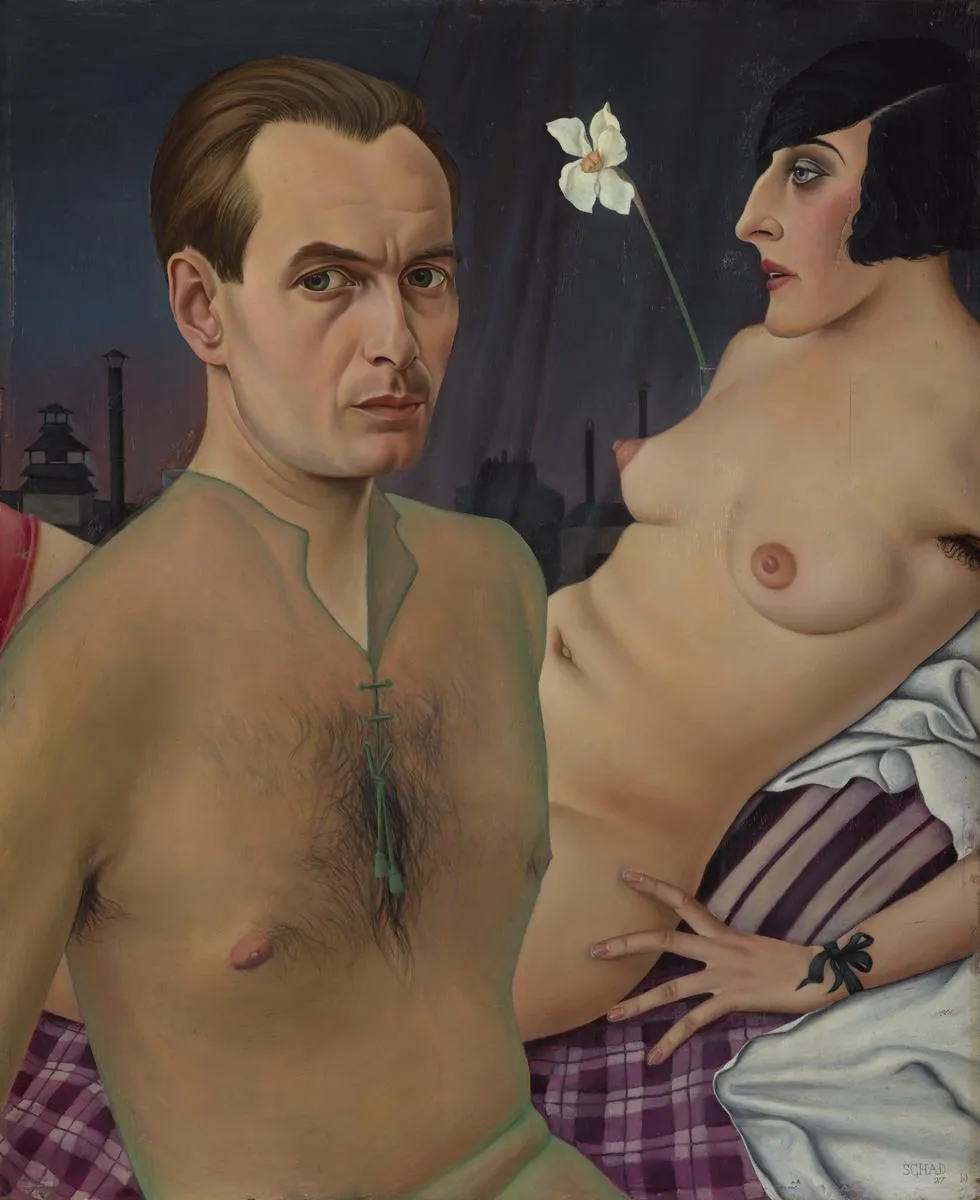
Christian Schad, "Self-Portrait" (1927). Oil on wood. Bayerische Staatsgemaldesammlungen, Munich. Wikimedia Commons.
Schad's "Operation" (1929) is a surgical scene painted with the same cold precision. The patient's body is open, the surgeons are masked, the lighting is clinical. The painting is completely realistic and completely horrifying. Schad is the most extreme of the Magic Realists. His paintings do not just depict strangeness. They make the viewer feel that reality itself is fundamentally uncanny. His Dada background connects him to the broader history of Dadaism and the art of anti-art.
Magic Realism vs. Surrealism
The key distinction: Surrealism (Dali, Magritte, Ernst) painted the irrational. Melting clocks, floating apples, dream landscapes. Magic Realism painted the rational. But made it strange through juxtaposition, lighting, scale, or context.
Technique separates them further. Surrealists often used loose, painterly techniques (frottage, automatism, decalcomania). Magic Realists used precise, controlled, Old Master techniques. The surface is smooth, the detail is exact, the perspective is correct. And yet something is wrong.
Subject matter also diverges. Surrealists painted dreams and the unconscious. Magic Realists painted the visible world, but a version of it where the impossible has quietly entered without announcement. The overlap is de Chirico, who is claimed by both movements. His Metaphysical paintings are precise (Magic Realist) and dreamlike (Surrealist).
Magic Realism is the more durable approach. Surrealism's dream imagery dates quickly. Melting clocks are period pieces. Magic Realism's strategy of making reality strange is permanent, because reality is always available to be made strange. This is why Surrealism feels like a historical movement while Magic Realism feels like a method that can be applied to any era. The 2025 exhibition "Magical Realism: Imagining Natural Dis/order" at WIELS Brussels (May 29 to September 28, 2025) demonstrated this adaptability, bringing together over 30 contemporary artists who use magic realist strategies to examine ecological crisis, climate transformation, and the relationship between science and myth. The exhibition showed that Magic Realism's core technique, precise observation combined with impossible juxtaposition, describes the experience of living in 2026 better than any other artistic category.
This connection to earlier movements that explored the dreamlike also links Magic Realism to Symbolism, the movement that painted dreams before Surrealism.
Why Magic Realism Still Matters
In an age of AI-generated images, deepfakes, and manipulated photographs, the Magic Realist strategy has become the default visual condition of the 21st century. We live inside a Magic Realist painting. Precise realism combined with impossible content is what every deepfake produces. The technique that Roh identified in 1925 as a response to the anxiety of interwar Europe has become the everyday experience of looking at a screen.
The literary legacy is equally significant. Garcia Marquez's "One Hundred Years of Solitude" (1967) is the most famous literary descendant. The novel's matter-of-fact treatment of impossible events (a woman ascending to heaven while folding sheets, a rain of yellow flowers) is pure Magic Realist technique applied to prose. Carpentier's 1948 manifesto "lo real maravilloso" argued that Latin America's reality was already marvelous, already impossible, and that fiction did not need to invent strangeness but merely to report it accurately.
The visual legacy continues through contemporary painters like John Register, Steven Assael, and the New Leipzig School (Neo Rauch), who work in a tradition that descends directly from Magic Realism: precise technique, unsettling content, no explanation. For more on where painting is heading, see our guide to contemporary art trends in 2026, and for a broader framework, our guide on how to read a painting.
Final Thoughts
Magic Realism lasted roughly 20 years as a named movement (c. 1925 to 1945) but its strategy has proven endlessly adaptable. It migrated from German painting to Latin American literature to contemporary art, and it describes the experience of looking at the world in 2026 better than any other artistic category. The centenary exhibitions in 2025, from Rovereto to Brussels, confirmed that the movement Roh named is not a historical curiosity but a living method.
Museum Boijmans Van Beuningen in Rotterdam has "Late Visitors to Pompeii" on permanent display. MoMA in New York has de Chirico's "Gare Montparnasse" in the permanent collection. For the broader context of how Magic Realism fits into the history of art, see our art movements timeline and art history cheat sheet. The movement's centenary in 2025 was not a memorial. It was a confirmation that the strategy Roh identified a hundred years ago is still the most accurate description of what it feels like to look at the world and find it strange.


