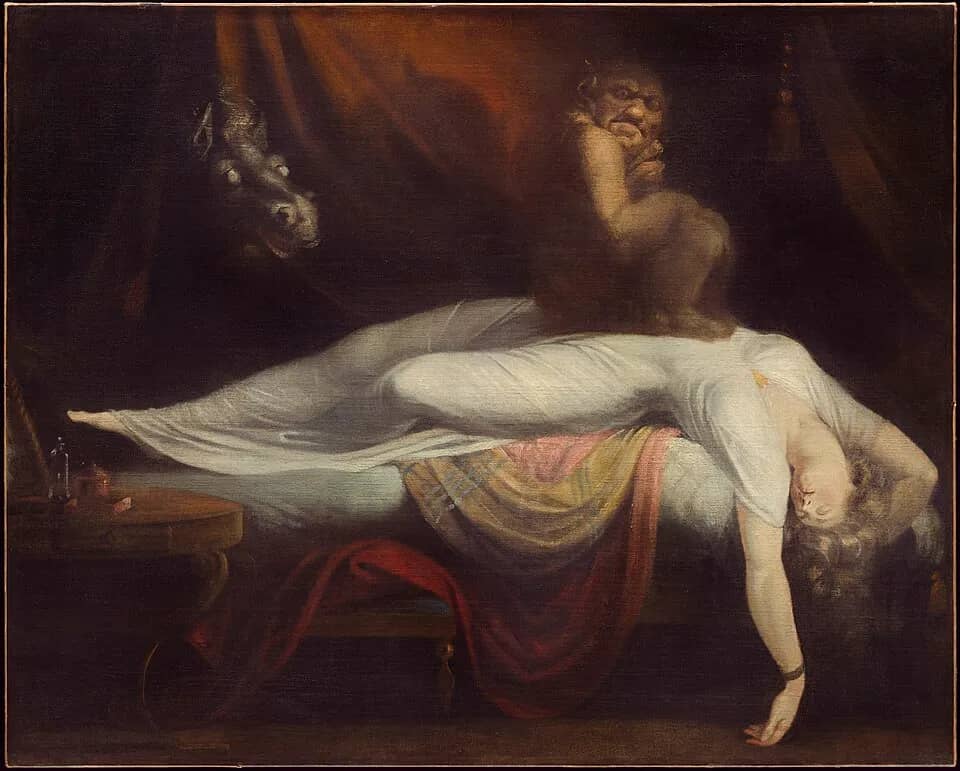
Henry Fuseli painted "The Nightmare" in 1781. A woman lies unconscious across a rumpled bed, her body draped over its edge in a pose that is both abandoned and deeply uncomfortable. Crouched on her chest is a small, dark, grinning creature, the incubus of nightmare folklore. A horse with blank white eyes pushes through curtains in the background. The painting is one of the most reproduced images in the history of Western art and one of the most consistently unsettling. It depicts a nightmare from the outside, showing us what it looks like to be in the grip of terror rather than showing us the terror itself. This displacement, seeing the victim rather than the threat, seeing the body rather than the dream, is part of what makes the image so disturbing. The horror is not in the monster but in the woman's helplessness, in her complete absence of awareness, in the gap between the tenderness of her exposed form and the malignant thing that occupies her chest.
The feeling Fuseli's painting produces is what Sigmund Freud, in his 1919 essay, called das Unheimliche, usually translated as "the uncanny." The word heimlich in German means "homely," "comfortable," "familiar." The prefix un negates it, but in a specific way. Not simply "unfamiliar" but "that which was once familiar and has become strange," or "that which is familiar and secretly threatening." Freud's uncanny is the terror of the almost-right, the nearly-familiar, the thing that seems to be what it is but somehow is not.
Freud's Uncanny: The Theory
Freud's 1919 essay "Das Unheimliche" was unusual for him because it started from aesthetic experience rather than clinical observation. He began by analyzing the word's linguistic history, noting that heimlich gradually acquired meanings that overlapped with its opposite, unheimlich, suggesting that the familiar and the threatening are not as opposed as they seem. He then moved to literary examples, focusing on E.T.A. Hoffmann's story "The Sandman," in which a man becomes obsessed with a mechanical doll he believes to be a real woman.
Freud identified several specific triggers for the uncanny feeling. Automated figures that appear alive (dolls, wax figures, automata). The double or doppelganger. The repetition compulsion, the experience of encountering the same thing in apparently unconnected circumstances. The return of something repressed. Uncertainty about whether something is alive or dead. What all these triggers share is a disruption of the boundary between familiar and threatening, between animate and inanimate, between self and other.
The German psychologist Ernst Jentsch, whom Freud was partly arguing against, proposed an earlier version of the uncanny that centered on "intellectual uncertainty": the discomfort produced by not knowing whether something is alive or not. This simpler definition is actually closer to what the contemporary concept of the "uncanny valley" describes. The well-documented phenomenon in robotics and CGI where near-human figures that are almost but not quite realistic trigger revulsion rather than the acceptance that fully stylized figures or fully realistic ones produce.
Fuseli, Goya, and the Romantic Uncanny
Henry Fuseli (1741 to 1825) was the first major Western artist to make the uncanny his primary subject. His paintings of nightmares, witches, and supernatural visitations are saturated with the specific quality of dream logic. Figures caught in impossible poses, spaces that do not follow architectural rules, the combination of the intensely familiar (a sleeping woman, a bed, curtains) with the grotesquely wrong (the incubus, the eyeless horse). Fuseli painted the experience of being inside an anxiety dream, and the effect is still powerful because he was working from genuine psychological insight rather than mere theatrical horror.
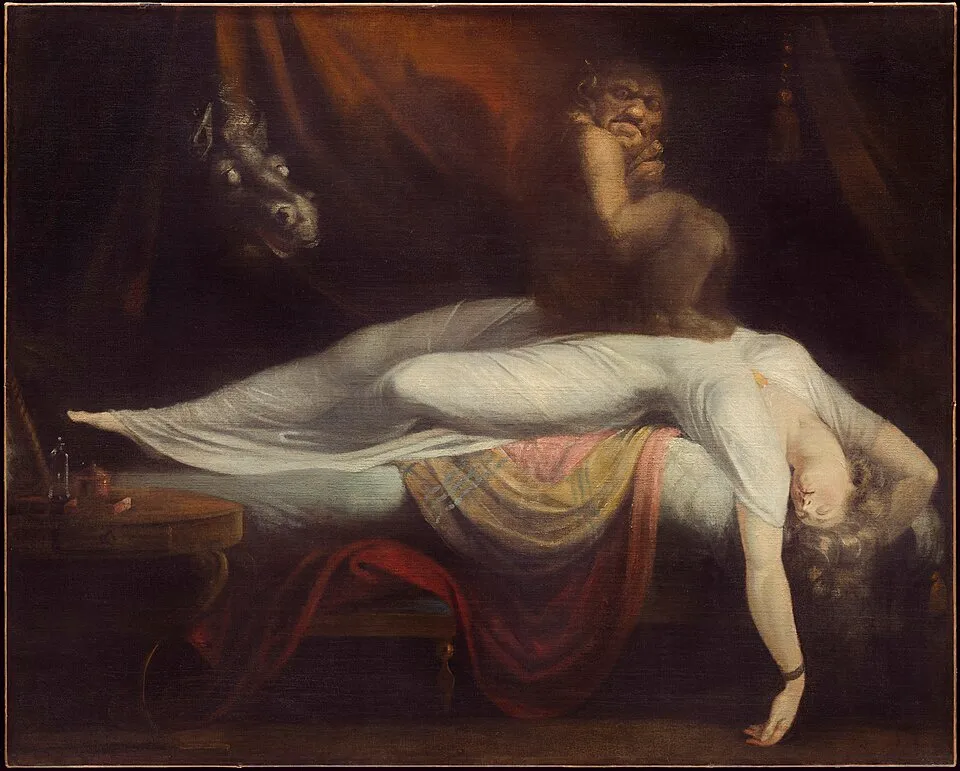
Henry Fuseli, "The Nightmare" (1781), oil on canvas, 101.6 x 127 cm. Detroit Institute of Arts. The painting was exhibited at the Royal Academy in 1782 and became one of the most reproduced images of the 18th century. Its power comes not from depicting the nightmare's content but from showing its effect on the dreamer's unconscious body. Image: Public domain, via Wikimedia Commons
Francisco Goya (1746 to 1828) explored the uncanny through a completely different approach in his "Black Paintings" (c. 1819 to 1823), made directly on the walls of his house near Madrid in his old age. Works like "Saturn Devouring His Son" show mythological subjects treated with a psychological intensity that dissolves the boundary between myth and nightmare. Saturn's manic eyes, his grip on the body he is consuming, his expression that is simultaneously ecstatic and horrified. The painting is not about mythology. It is about an internal state that Goya refused to keep internal.
De Chirico and Metaphysical Painting
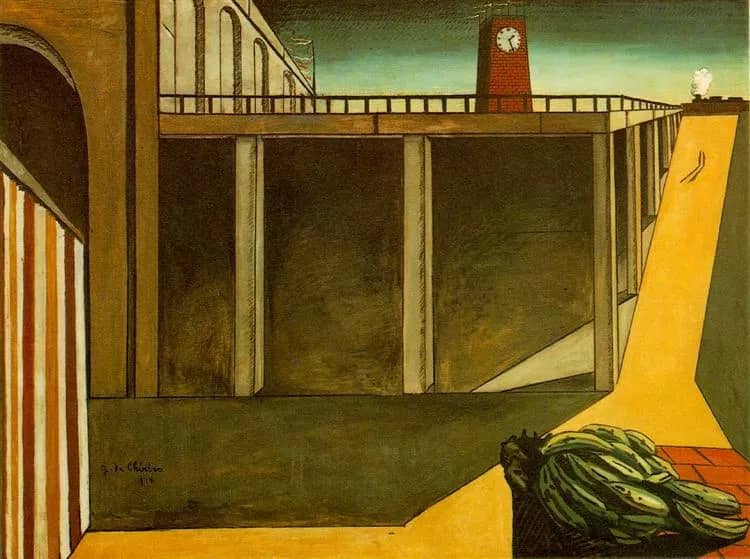
Giorgio de Chirico (1888 to 1978) created the most architecturally precise version of the uncanny in 20th-century art. His "metaphysical" paintings of the 1910s depict Italian piazzas at times of day when shadows are impossibly long and the light is the color of late afternoon in a dream. The spaces are geometrically correct but spatially wrong. Perspective lines that should converge at the same point do not. Clocks show times that do not correspond to the apparent quality of the light. Trains appear in the distance behind archways in city squares where trains have no business being. Classical statues stand in open spaces alongside wooden mannequins without heads or faces.
The effect of these paintings is the feeling of being in a familiar place that has been altered in ways you cannot immediately identify. You know these are Italian squares, recognizable architectural types. You know this is afternoon light. Everything is individually familiar. But the combination is wrong, deeply wrong, in the way that a dream is wrong. Logically consistent on its own terms, but impossible in every other sense. De Chirico described his paintings as visions produced by heightened states of perception, moments when the everyday world became suddenly strange and threatening. He was a crucial influence on the Surrealists, who recognized in his work an image of how the subconscious transforms the familiar into the threatening.
Surrealism and the Systematic Uncanny
The Surrealist movement, founded in Paris in 1924 by Andre Breton, made the production of uncanny effects one of its central goals. Surrealist artists used several deliberate techniques to generate the uncanny. Juxtaposing familiar objects in impossible combinations (Rene Magritte), transforming everyday objects into threatening or erotic versions of themselves (Salvador Dali), and using highly realistic painting techniques to depict impossible or dreamlike scenes (Max Ernst, Yves Tanguy).
Magritte's "The Son of Man" (1964) shows a businessman in a bowler hat standing in front of a low wall, with a green apple floating in front of his face so that it almost but not entirely obscures his features. The apple is real, the man is real, the setting is real, but the combination is deeply wrong. The apple is not metaphorical. It is not symbolic in any established iconographic tradition. It is simply there, blocking the face that should be the focal point of any portrait, making the familiar figure of the bourgeois man strangely threatening. Magritte's paintings consistently do this. Take something real and place it in a context where its ordinariness becomes menacing rather than reassuring. The connection to our post on Surrealism and dream logic is direct.
The Uncanny Valley: From Mori to AI-Generated Faces
The "uncanny valley" was named by the Japanese roboticist Masahiro Mori in 1970. He observed that as robots become more human-like, human acceptance of them increases, but there is a point of near-total human resemblance where acceptance drops sharply into revulsion before rising again for fully realistic figures. The graph of acceptance plotted against human-likeness produces a valley at the near-realistic point, hence the name.
Contemporary hyperrealist sculptors work deliberately in this valley. Ron Mueck (born 1958) creates hyper-detailed figurative sculptures in non-standard scales. A crouching figure the size of a doll, a newborn baby five feet long, an old woman's head six times actual size. The figures are made with such meticulous attention to skin texture, hair, pores, and the specific quality of aging flesh that they feel genuinely alive at first glance. The scale disruption then makes them wrong in a way the eye cannot fully process. Viewers often report a strong desire to touch the surfaces, combined with a mild horror at the impulse.
Duane Hanson (1925 to 1996) worked in actual scale, creating polyester resin figures of American tourists, shoppers, and workers so realistic that museum visitors regularly approach them and attempt to engage them in conversation before realizing their mistake. The moment of recognition, the switch from "person" to "sculpture," produces a jolt that makes ordinary museum-going suddenly strange. Hanson was not trying to produce a simple sensory trick. His figures are always working-class Americans, and the uncanny jolt they produce is also a commentary on who gets to be represented in art museums.
The uncanny valley concept has gained new relevance with the rise of AI-generated images. A 2024 study published in Psychological Science by Amitai Shenhav and colleagues found that AI-generated faces that are perceived as human actually produce stronger eeriness responses than faces that are clearly artificial. The study showed that the uncanny valley effect is driven not by how human-like a face appears but by the perceptual uncertainty it creates. When the brain cannot confidently categorize a face as real or artificial, the resulting ambiguity triggers discomfort. This aligns with what Jentsch proposed in 1906 and what Freud built on in 1919. The uncanny is fundamentally about the failure of categorical certainty.
A 2025 review in Trends in Cognitive Sciences by Maya Cikara and colleagues proposed a predictive coding framework for the uncanny valley, arguing that the brain generates predictions about what it expects to see and that near-human figures violate those predictions in subtle but measurable ways. The eeriness is the brain's error signal, the gap between prediction and input. This framework helps explain why hyperrealist sculpture and AI-generated faces produce similar discomfort despite being completely different media. The brain's prediction machinery does not care whether the source is silicone or pixels. It cares whether the input matches what it expected, and the near-miss is what feels wrong.
Final Thoughts
The uncanny in art is not simply the scary or the grotesque. It is something more specific and more interesting. The familiar made strange, the animate made ambiguously inert, the comfortable made subtly threatening. Artists who work in this register are mapping the territory that exists between the safe and the dangerous, between the known and the unknown, between the self and everything that is not the self. Fuseli, de Chirico, Magritte, and Mueck are all exploring the same psychological space. The place where ordinary perception breaks down and something more unsettling takes over.
The next time an artwork makes you feel vaguely wrong without knowing why, pay attention to that feeling. It is one of art's most specific and carefully produced effects. For more on how art produces specific psychological states, our posts on why artworks give you chills and the neuroscience of aesthetic experience cover adjacent ground. For the broader movement that made the uncanny a central artistic technique, see Surrealism and the subconscious. What artwork has given you the uncanny feeling most strongly? Share in the comments below.