
The estimation for the amount of paintings the German art forger Wolfgang Beltracchi has faked is somewhere between 1,000 and 1,300. The man himself says that he has lost count. Described as the "forger of the century," it is estimated that hundreds of his works are still in circulation, according to Sleek magazine. The authorities caught Beltracchi in 2010, but only because a paint sample from one of his forgeries contained titanium white, a pigment not available during the period the painting was supposed to have been made. Han van Meegeren (1889 to 1947) sold a fake Vermeer to Hermann Göring for the equivalent of $7 million, and confessed only to avoid execution for collaborating with the Nazis. Tom Keating (1917 to 1984) claimed 2,000 fakes, hidden in plain sight in museums and auction houses, each one containing deliberate "time bombs," anachronistic details planted to be discovered by future conservators. John Myatt's forgeries "fooled every major auction house" and were sold through Christie's, Sotheby's, and Phillips. Elmyr de Hory "forged works in the styles of artists such as Picasso, Matisse, and Modigliani. His paintings were sold through galleries and ended up in respected collections," as The Curatoreum records.
Art forgery is as old as art itself, but the 20th century produced the greatest forgers in history, artists whose technical skill and market knowledge allowed them to deceive experts, museums, and collectors for decades. The question is not just how they did it. The question is how they were caught, and why some of their fakes are still on museum walls. A painting attributed to Vermeer is worth millions. The same painting attributed to van Meegeren is worth nothing. The incentive to forge is enormous, and the tools for detecting forgery have evolved from connoisseurship to science. This guide covers the most famous art forgers, Han van Meegeren, Wolfgang Beltracchi, Tom Keating, Eric Hebborn, John Myatt, and Elmyr de Hory, and how each was caught. For more on the works that get faked, see our guide to famous paintings.
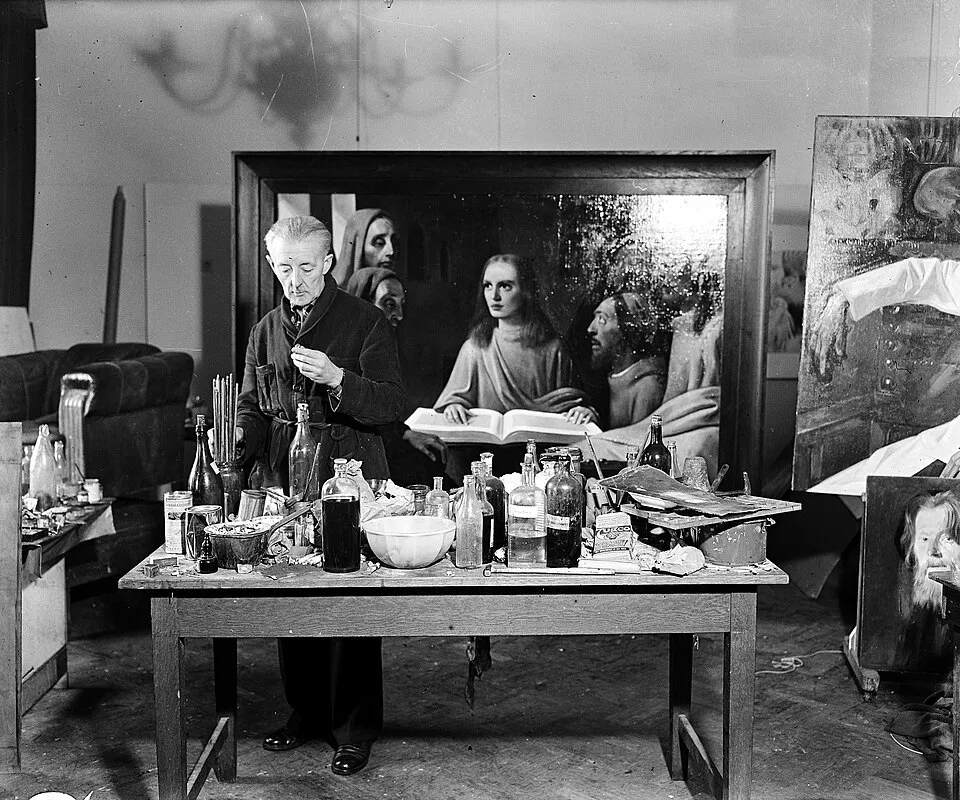
Han van Meegeren on trial, Amsterdam, 1947. "This Dutch artist was notorious for his incredibly accurate recreations of Johannes Vermeer's work" (Sotheby's Institute). "The truth only emerged after World War II, when van Meegeren confessed to avoid charges of collaboration" (HistorySnob). Image via Wikimedia Commons
Han van Meegeren (1889 to 1947): The Fake Vermeers
Han van Meegeren was "notorious for his incredibly accurate recreations of Johannes Vermeer's work," according to the Sotheby's Institute. His career as a forger began in the 1930s, when he created "The Supper at Emmaus" (1937), a painting in the style of Vermeer that was "validated" by Abraham Bredius, one of the leading art historians of the day. Bredius declared it a genuine Vermeer. The painting was acquired by the Museum Boijmans Van Beuningen in Rotterdam. When the leading expert tells you a painting is a Vermeer, the market believes him.
The Göring sale made van Meegeren infamous. He sold "Christ with the Woman Taken in Adultery" to Hermann Göring for the equivalent of $7 million. "The truth only emerged after World War II, when van Meegeren confessed to avoid charges of collaboration." He was charged with collaboration for selling a Dutch national treasure to the Nazis. Facing execution, he confessed that the painting was a forgery, transforming himself from a collaborator into a trickster who had fooled the Nazis. The charge changed from collaboration to forgery. He became, in the words of The Curatoreum, "a National Hero" for tricking Göring.
Van Meegeren was tried in 1947 for forgery. He painted a final "Vermeer" in court to prove his skill. He was sentenced to one year in prison but died of a heart attack before serving his sentence. He was caught not by scientific analysis but by his own confession. His forgeries were later exposed through pigment analysis. His paintings contained phenol formaldehyde resin, sold under the brand name Bakelite, a material not available in Vermeer's time. Van Meegeren had mixed Bakelite into his paints to make them harden in an oven, simulating centuries of aging. The chemistry gave him away, but only after he had already confessed. For more on how the market judges authenticity, see our guide to auction houses and valuation.
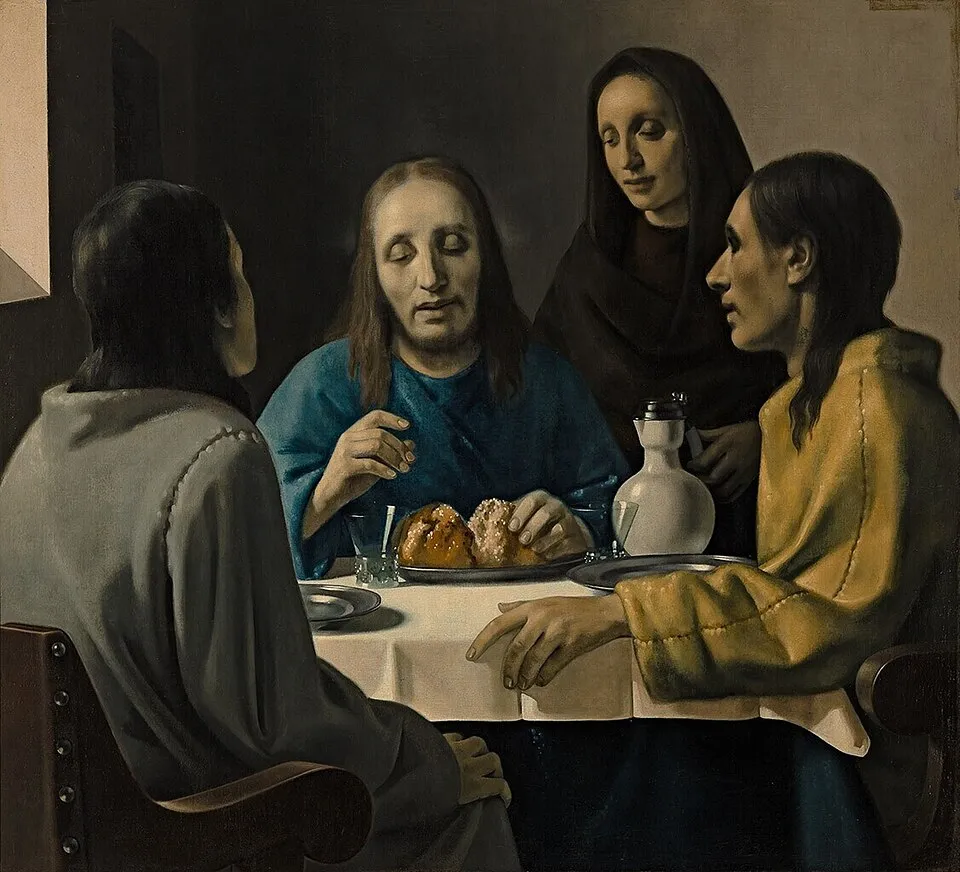
Han van Meegeren, "The Supper at Emmaus" (1937). Sold as a newly discovered Vermeer, "validated" by the leading art historian Abraham Bredius, and acquired by the Museum Boijmans Van Beuningen in Rotterdam. It was a forgery. Image via Wikimedia Commons
Wolfgang Beltracchi: The Forger of the Century
The scale of Beltracchi's output is hard to grasp. "The estimation for the amount of paintings the German art forger Beltracchi has faked is somewhere between 1000 and 1300. The man himself says that he has lost count." Hundreds of his works are still in circulation. Beltracchi did not copy existing paintings. He created new paintings in the style of known artists, Heinrich Campendonk, Max Ernst, André Derain, Fernand Léger, and invented provenance for each one: fake collection stamps, fake labels, fake letters. He and his wife Helke created an entire fictional collection history, claiming the works came from a Jewish collector who had fled Germany in the 1930s. The invented provenance did two things at once. It explained why the paintings had never been seen before, and it made buyers reluctant to ask too many questions about a collection displaced by the Nazis.
Beltracchi's forgeries were sold through major auction houses and galleries. One fake Campendonk, "Tierschläger" (dated 1914), was sold at the Lempertz auction house in Cologne for €2.4 million. Another, attributed to Max Ernst, was exhibited in a Max Ernst retrospective at the Kunstmuseum Bonn. When a forgery passes through a major auction house and a museum retrospective, the infrastructure of the art market has become the forger's accomplice.
Beltracchi was caught in 2010 when a paint sample from "Tierschläger" was analyzed and found to contain titanium white, a pigment not available in 1914. He was sentenced to six years in prison. Helke was sentenced to four. Hundreds of his works are still in circulation, and some may never be identified. The Beltracchi case is the clearest proof that provenance and connoisseurship are not enough on their own. The market believed the fake collection stamps, the fake letters, and the fake labels. Only chemistry caught him.

Wolfgang Beltracchi. "The estimation for the amount of paintings the German art forger Beltracchi has faked is somewhere between 1000 and 1300. The man himself says that he has lost count. Described as the 'forger of the century,' it is estimated that hundreds of his works are still in circulation" (Sleek magazine). Image via Wikimedia Commons
Tom Keating (1917 to 1984): 2,000 Time Bombs
Tom Keating was a London restorer and painter who claimed to have created 2,000 forgeries over his career, what The Curatoreum calls his "Crusade Against the Art World." His motive was not primarily financial. It was ideological. He saw the art world as a corrupt establishment that exploited artists and overpriced paintings. His forgeries were a crusade against the art market.
Keating planted deliberate errors in every forgery. Anachronistic materials, hidden messages, modern pigments. These were "time bombs" designed to be discovered by future conservators. He wrote messages on the backs of canvases in washable paint: "This is a fake by Tom Keating." The idea was that the fakes would eventually reveal themselves. Keating was exposed in 1976 when a journalist discovered one of his fakes at an auction. He was arrested and charged with conspiracy to defraud, but the charges were dropped because of poor health. He became a television personality, hosting a Channel 4 series on painting techniques. He died in 1984. Keating is the rare forger who built self-destruction into his work. For more on how art intersects with public life, see our guide to art and society.
John Myatt, Eric Hebborn, and Elmyr de Hory
John Myatt (born 1945) is the forger of "Genuine Fakes," as The Curatoreum titles his entry. Myatt's forgeries were sold through Christie's, Sotheby's, and Phillips. They "fooled every major auction house." He used household materials, K-Y Jelly, emulsion paint, dirt from the garden, to create paintings in the style of Matisse, Picasso, Chagall, and Giacometti. He was caught in 1995 when his accomplice, John Drewe, was exposed for forging provenance documents. Myatt served four months in prison. He now paints "genuine fakes," openly acknowledged copies, and sells them through his website. The same skill that fooled Christie's now sells openly, with the forgery declared on the label.
Eric Hebborn (1934 to 1996) was "The Forger's Forger." Hebborn was a classically trained artist who faked Old Master drawings, Rubens, van Dyck, Piranesi, Brueghel. His forgeries entered the collections of the British Museum, the Metropolitan Museum, and the National Gallery of Art in Washington. He was exposed in 1978 by a curator at the National Gallery in London who noticed that several drawings shared the same paper and technique. Hebborn published "Drawn to Trouble" (1991), a tell-all memoir. He was murdered in Rome in 1996. The case remains unsolved.
Elmyr de Hory (1906 to 1976) "forged works in the styles of artists such as Picasso, Matisse, and Modigliani. His paintings were sold through galleries and ended up in respected collections. His career exposed the vulnerability of the art market to skilled fakes." De Hory's story was told in Orson Welles's documentary "F for Fake" (1973), a film that turns the question of authenticity back on the viewer. If the film itself lies, how can we trust the paintings? De Hory committed suicide in 1976. For more on approaching unfamiliar work with a critical eye, see our guide to how to look at art.
How Forgeries Are Detected: From Connoisseurship to Science
The traditional method is connoisseurship. An expert examines a painting and judges its style, technique, and materials based on experience. This is how most forgeries were historically detected. But connoisseurship is subjective. As van Meegeren proved, even the leading expert, Bredius, can be fooled. The expert's eye is the first line of defense, and it is the most fallible.
Pigment analysis is the most common scientific method. Paints contain pigments that were invented at specific dates. Titanium white was first manufactured in 1921. Cadmium red dates to 1910. Phthalocyanine blue dates to 1936. If a painting supposed to be from 1914 contains titanium white, it is a forgery. This is how Beltracchi was caught. A single anachronistic pigment can unravel an entire fabricated provenance. Radiocarbon dating measures the age of organic materials, canvas, wood panels, binding media. A painting on canvas from the 1600s should have canvas from the 1600s. X-ray fluorescence, or XRF, identifies the elemental composition of pigments without taking a sample. It is non-destructive and increasingly portable, which means museums can now screen their collections without removing paint.
Provenance research is the documentary method. A forgery often has a fabricated provenance, fake collection stamps, fake labels, fake letters. Provenance research can expose these fabrications, as it did with Beltracchi's fictional Jewish collector. No single method is sufficient. The best authentication combines connoisseurship, scientific analysis, and provenance research. A painting that passes all three tests is probably genuine. A painting that fails any one is suspect. A painting that fails two is almost certainly a forgery. For more on the criminal side of the art trade, see our guide to art theft.
Why Forgery Matters
Forgery undermines trust in the art market. If a painting might be a forgery, its value is uncertain, and an uncertain value is no value at all. This is why auction houses, dealers, and collectors invest heavily in authentication. But the market is the smaller problem. Forgery distorts art history. If a fake Vermeer is accepted as genuine, it changes our understanding of Vermeer's oeuvre, his development, his significance. Van Meegeren's "The Supper at Emmaus" was accepted as a Vermeer for nearly a decade. During that decade, art historians wrote about it as a major Vermeer discovery. Books were revised. Lectures were given. The scholarship was built on a forgery.
Forgery is not just a crime. It is an epistemological challenge. How do we know what we know about art? How do we know a painting is by the artist we think it is? The answer is that we do not know for certain. We rely on a combination of expert judgment, scientific analysis, and documentary evidence, and all three can be fooled. The forgers prove that authenticity is not a fact. It is a judgment, and judgments can be wrong. For more on building the knowledge to make those judgments, see our guide to teaching yourself art history.
Final Thoughts
Beltracchi faked somewhere between 1,000 and 1,300 paintings, and hundreds are still in circulation. Van Meegeren sold a fake Vermeer to Göring and became "a National Hero" for it. Keating planted 2,000 time bombs. Myatt fooled every major auction house. Hebborn's drawings entered the British Museum, the Met, and the National Gallery. De Hory's fakes ended up in respected collections and inspired Orson Welles to make a film about fakery. Detection has moved from the expert's eye to the spectrometer, from connoisseurship to chemistry. Titanium white caught Beltracchi. Bakelite caught van Meegeren. Shared paper caught Hebborn. Forged provenance documents caught Myatt.
Go to the Museum Boijmans Van Beuningen in Rotterdam. It once displayed van Meegeren's "The Supper at Emmaus" as a genuine Vermeer. Go to the Courtauld Institute in London. It holds drawings that may be by Hebborn. Go to the Victoria and Albert Museum. It holds the inventory of Nazi-confiscated art, including works whose authenticity is still debated. Then look at the paintings in your local museum. Ask how we know this is by the artist on the label. The answer is expert judgment, scientific analysis, and documentary evidence. All three can be fooled. The forgers prove it. Hundreds of Beltracchi's fakes are still in circulation. Some may be on museum walls right now, labeled as Campendonk, Ernst, or Derain. The question is not whether there are forgeries in museums. The question is which ones they are, and when we will find them. For a wider view of how art history is constructed, see our guide to the complete guide to art movements.


