
For decades, the 1990 theft of 13 artworks from the Isabella Stewart Gardner Museum, now valued at more than $500 million, has remained unsolved. It remains the largest art theft in history, far surpassing more recent museum thefts, including a daylight heist at the Louvre involving far fewer works that was resolved more quickly, as AP News reports. On March 18, 1990, 13 pieces of art worth more than $500 million were stolen from the museum by thieves posing as police. None of it has been recovered and no one has been arrested. In March 2026, the museum marked the 36th anniversary of the theft. Retired FBI agent Geoffrey Kelly, who investigated the Isabella Stewart Gardner Museum heist for 22 years before retiring two years ago, has published "Thirteen Perfect Fugitives," the first detailed account of how investigators reached that conclusion and publicly identifying the men he believes were involved.
There is a $10 million reward for information leading investigators directly to the missing art, which can be prorated per piece. As Anthony Amore, the Gardner's security director, told CBS Boston: "It's incredibly rare for a stolen painting, especially a masterpiece, be destroyed. The last time a Rembrandt was destroyed was in the 1930s, and there have been 80 thefts since then without any being destroyed." The Gardner heist is the most famous art theft in history, but it is not the only one. Art theft is a persistent, global problem, driven by the same forces that drive the legitimate art market: value, rarity, and desire. The difference is that stolen art cannot be sold openly. Bobby Gentile told Kelly the art was "Worth nothing. It's worthless. Nobody wants it." Which is the irony of stealing high-end art. This guide covers the Gardner heist, the investigation, the stolen works, other famous heists, the black market, and the recovery efforts. For more on the stories behind the works themselves, see our guide to famous paintings.
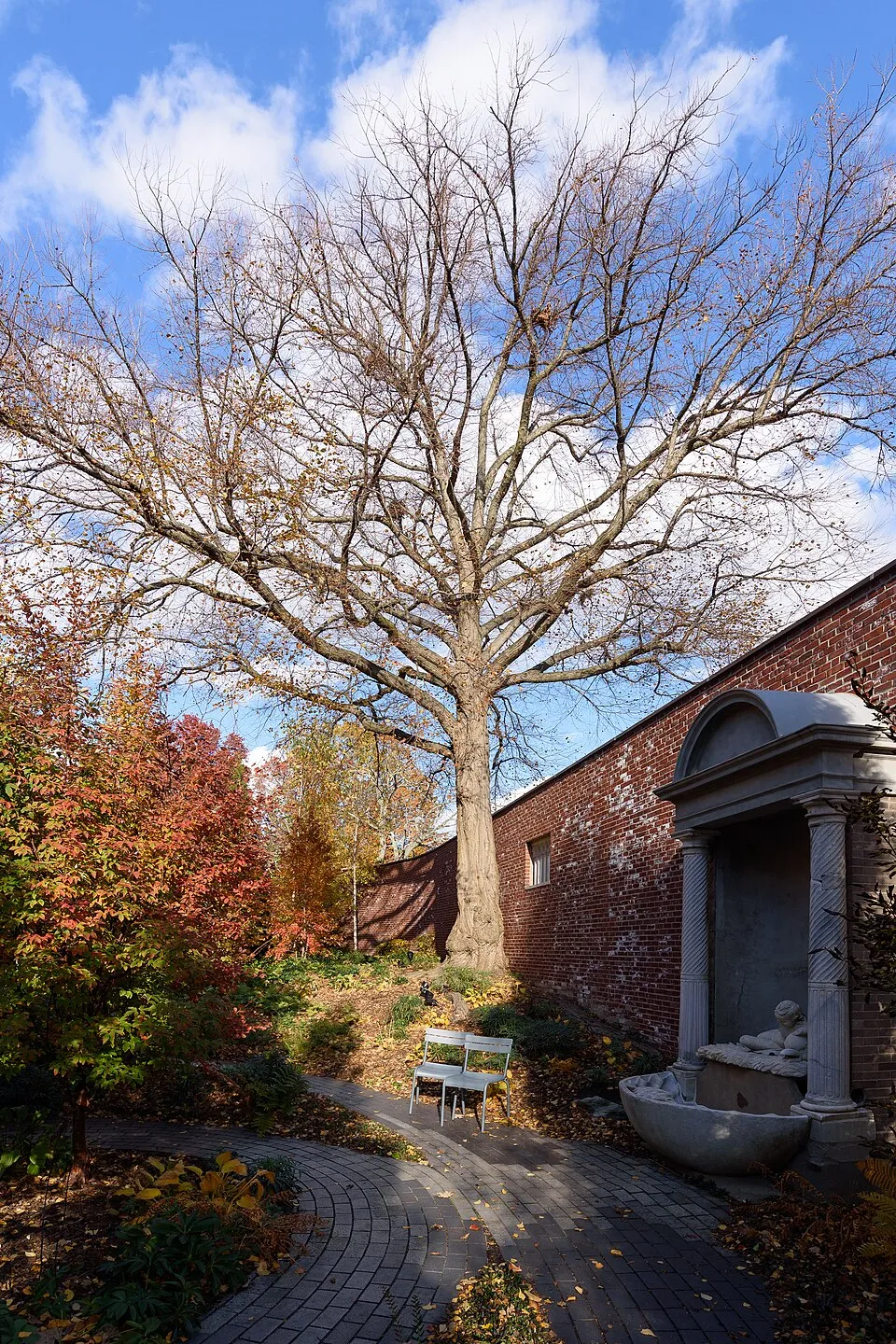
Isabella Stewart Gardner Museum, Boston. For decades, the 1990 theft of 13 artworks from the Isabella Stewart Gardner Museum, now valued at more than $500 million, has remained unsolved. It remains the largest art theft in history. The empty gilded frames of the missing paintings still hang in the museum today, silent witnesses to what was taken. Image via Wikimedia Commons
The Gardner Heist: March 18, 1990
The heist was carried out on March 18, 1990, when two thieves dressed as police officers were let inside by a guard at 1:24 a.m. after claiming to be investigating a disturbance. They tied up the two guards on duty and spent 81 minutes inside, slashing and pulling masterpieces from their frames, as the Boston Globe reports. Early on March 18, 1990, as Boston wound down from St. Patrick's Day celebrations, two men dressed as police officers arrived at the museum and convinced a security guard to let them in, violating protocol.
Besides Rembrandt's "Christ in the Storm on the Sea of Galilee," they stole two other Rembrandts, "A Lady and Gentleman in Black" and a stamp-sized self-portrait; Vermeer's "The Concert"; Flinck's "Landscape with an Obelisk"; five Degas sketches; "Chez Tortoni" by Manet; an ancient Chinese vase; and a bronze finial eagle from atop a Napoleonic flag. None of the works have been recovered, despite a $10 million reward. No one has been charged with the crime. The irony is sharp. Gardner's intention was for the museum to remain frozen in time, stipulating in her will that nothing in the Venetian palazzo-inspired building would be changed after her death. Gardner, who lived in the museum and died there in 1924, intended for the paintings, sculptures and architectural fragments to remain exactly as she had arranged. The empty frames are the only change, and they are the most visible sign of the theft.
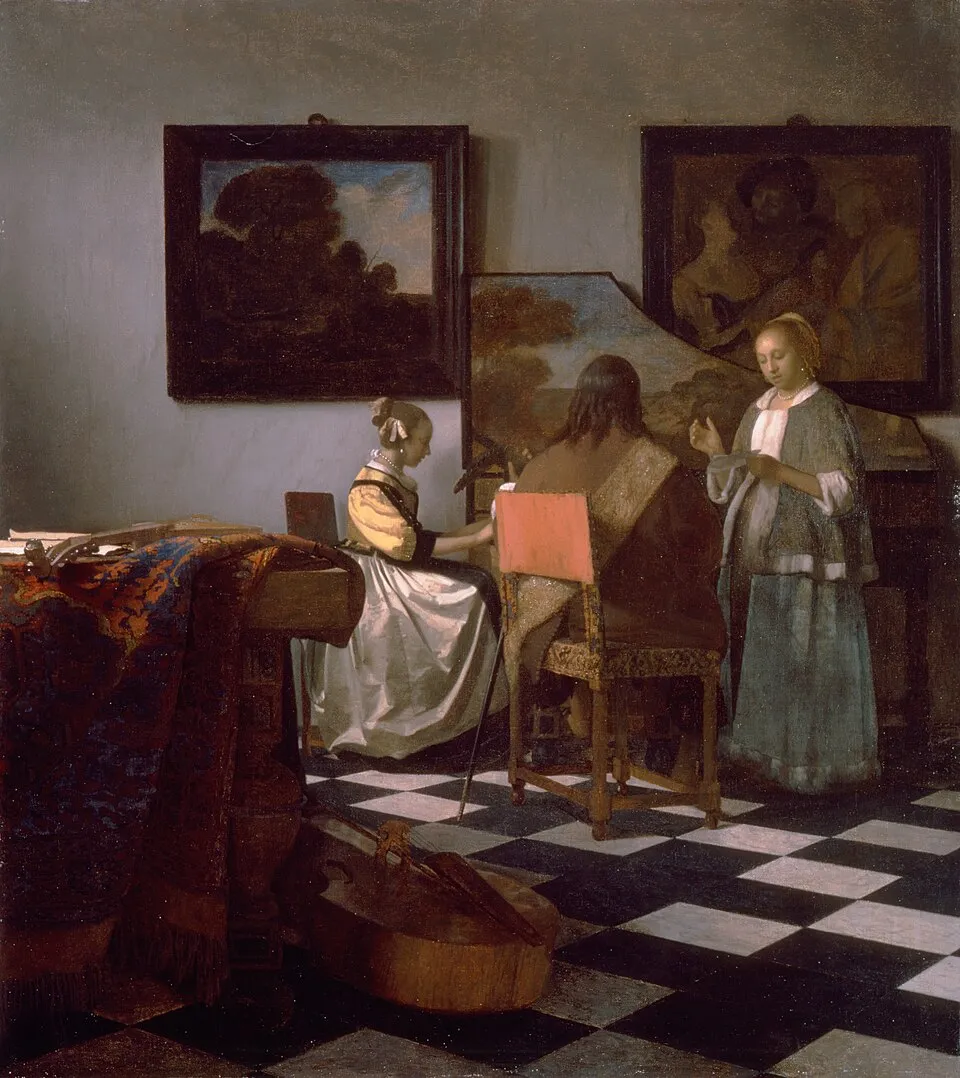
Johannes Vermeer, "The Concert" (c. 1664). One of only 34 known Vermeer paintings. Stolen from the Isabella Stewart Gardner Museum on March 18, 1990. Still missing. "It's incredibly rare for a stolen painting, especially a masterpiece, be destroyed. The last time a Rembrandt was destroyed was in the 1930s, and there have been 80 thefts since then without any being destroyed" (Anthony Amore, CBS Boston). Image via Wikimedia Commons
The Investigation: "Thirteen Perfect Fugitives"
A former FBI agent who led the investigation for more than two decades is now offering the first detailed account of how investigators reached that conclusion and publicly identifying the men he believes were involved. In a new book, "Thirteen Perfect Fugitives," Geoffrey Kelly traces how the artworks moved through criminal networks, where violence took the lives of key suspects and witnesses, and challenges long-circulating theories by revisiting key details. Kelly spent 22 years of his career trying to solve the case. Kelly personifies the missing artworks and describes them as "perfect fugitives." "They don't go to the doctor. They don't get stopped for speeding. They don't leave fingerprints," he said. "They can just disappear."
Kelly wrote that he believed the heist was taken by a mob job crew out of Dorchester. Both men had ties to TRC Auto Electric, a Dorchester shop linked to Charles "Chuck" Merlino's crew. Robert "Bobby" Donati, a Boston mob associate long suspected in the case, was found stabbed to death in 1991, his body left in the trunk of a car after his home had been ransacked. George Reissfelder, who investigators believe owned the getaway car, later died under suspicious circumstances. When investigators searched his home, the painting was gone. The FBI announced more than a decade ago that it believed some of the stolen Gardner artwork went through organized crime circles while moving from Boston to Connecticut to Philadelphia, where the trail went cold. During a court-authorized search of Gentile's home in Manchester, Connecticut, in 2012, agents found a list of the stolen artwork, with their black market values, tucked inside a March 1990 copy of the Boston Herald reporting the theft. They also found weapons, police hats, handcuffs, drugs, and explosives. "Meatball" later told Kelly that Connecticut mobster Bobby Gentile told him the art was "Worth nothing. It's worthless. Nobody wants it." Most likely, Kelly believes, they held onto the Rembrandt they stole as kind of an insurance policy in case they got locked up for something. They use those stolen Rembrandts as leverage to get a break on pending sentences. For more on the cultural stakes, see our guide to art and society.
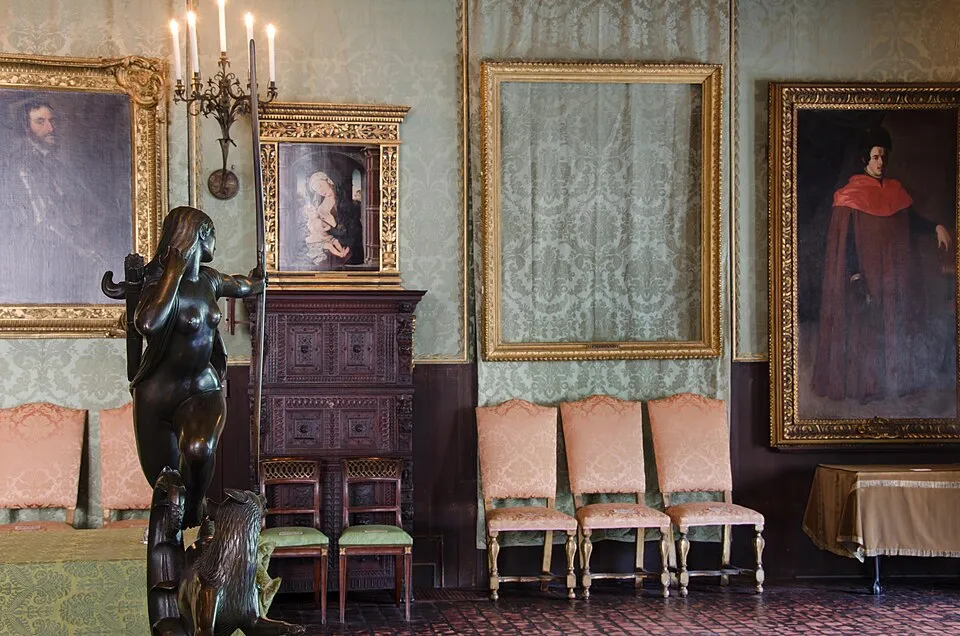
Empty frames, Isabella Stewart Gardner Museum. "The empty gold frames on the walls of the Dutch Room at the museum today might be the most famous empty frames in the world" (CBS Boston). "The empty frames that were on the wall, for me working this case for 22 years... It was always a little haunting to see the empty frames" (Geoffrey Kelly, CBS Boston). Image via Wikimedia Commons
The Stolen Works: Rembrandt, Vermeer, Manet
Rembrandt's "Christ in the Storm on the Sea of Galilee" (1633) is Rembrandt's only seascape. Stolen from the Gardner, still missing. Vermeer's "The Concert" (c. 1664) is one of only 34 known Vermeer paintings. The loss of "The Concert" is particularly devastating. Vermeer's entire output is so small, 34 paintings, that the loss of one represents a 3% reduction in his known body of work. Manet's "Chez Tortoni" has its own trail. Kelly tracked down Reissfelder's brother, a retired military officer who had initially not believed his brother was involved. He broke down after being shown Manet's "Chez Tortoni," saying he recognized it as a painting he himself hung above his brother's bed.
Then there is the Napoleonic eagle finial. They also took a Napoleonic eagle finial, a decorative metal piece of comparatively little value that investigators later found puzzling. Donati visited the Gardner with another known art thief, Myles Connor, to scope it out for a robbery and said that if he ever took the museum's Napoleonic finial, it would be his "calling card." For more on how to look closely at the works that remain, see our guide to how to look at art.
Other Famous Heists
The Mona Lisa was stolen in 1911. Vincenzo Peruggia, an Italian handyman, stole the Mona Lisa from the Louvre in August 1911. He kept it in his apartment in Paris for two years, then tried to sell it to the Uffizi Gallery in Florence. He was arrested, and the painting was returned to the Louvre in 1913. The theft made the Mona Lisa the most famous painting in the world.
The Stockholm National Museum was robbed in 2000. Three armed robbers stole two Renoirs and a Rembrandt from the National Museum in Stockholm in December 2000. They escaped by speedboat. The works were recovered in 2001 and 2005. The robbers were caught and sentenced to prison. The Kunsthal Rotterdam was hit in 2012. Seven paintings were stolen from the Kunsthal in Rotterdam, including works by Monet, Picasso, Matisse, and Gauguin. The theft was carried out by a Romanian organized crime group. The paintings have never been recovered and are believed to have been destroyed by the mother of one of the thieves. Art heists are dramatic, but they are also rare. Most art theft is not from museums. It is from private homes, galleries, and churches. And most stolen art is not recovered. The Gardner heist is the exception in its scale, not in its outcome. For more on the broader history, see our complete guide to art movements.
The Black Market: Why Stolen Art Is "Worthless"
Bobby Gentile told Kelly the art was "Worth nothing. It's worthless. Nobody wants it." Which is the irony of stealing high-end art. Stolen art is valuable in the legitimate market but worthless in the black market, because it cannot be sold. A stolen Rembrandt cannot be displayed, cannot be auctioned, cannot be donated to a museum. Its only value is as leverage, a bargaining chip for criminals seeking reduced sentences. Most likely, Kelly believes, they held onto the Rembrandt they stole as kind of an insurance policy in case they got locked up for something. They use those stolen Rembrandts as leverage to get a break on pending sentences.
Art theft is often connected to organized crime. The Gardner heist was linked to the Dorchester mob. The Stockholm theft was linked to Serbian organized crime. The Kunsthal theft was linked to a Romanian crime group. Art theft is not the work of sophisticated art lovers. It is the work of criminals who see art as a commodity. The black market for art is not a market at all. It is a storage system. Stolen art is hidden, held, and occasionally used as leverage. It is not bought and sold like drugs or weapons. It is too recognizable, too traceable, and too difficult to sell. The irony of art theft is that the most valuable works are the least valuable to the thief, because they are the most recognizable. For more on protecting what you own, see our guide to art insurance.
Recovery Efforts: The $10 Million Reward and the Generational Return
There is a $10 million reward for information leading investigators directly to the missing art, which can be prorated per piece. The museum offered a $5 million reward that they then doubled a decade later. Kelly's theory of recovery is grounded in pattern. "Recoveries usually occur right after the theft occurs or it's going to be generational. Somebody's going to pass away, and the family is going to be going through the attic or the safety deposit box and they're going to come upon something that was stolen at some point." Anthony Amore is more direct: "I envision the day that I recover them and bring them back myself. I know that that's going to happen. I don't know how it's going to happen or when."
Amore said he is not interested in prosecuting anyone. He just wants the return of the stolen works. The museum has made it clear: the reward is for recovery, not for prosecution. This is a pragmatic decision. The goal is to get the art back, not to punish the thieves, most of whom are dead. The museum has a plan. Amore says: "We developed a plan years ago, for every step of the recovery effort, exactly what we would do for everything that would be required for us to do, from how they would get here to how we would speak to you, to how the team would repair them." Holly Salmon, director of conservation, is blunt: "This whole room needs to be restored." For more on what is happening in the art world now, see our guide to contemporary art trends.
Final Thoughts
The 1990 theft of 13 artworks from the Isabella Stewart Gardner Museum, now valued at more than $500 million, has remained unsolved. It remains the largest art theft in history. On March 18, 1990, 13 pieces of art worth more than $500 million were stolen from the museum by thieves posing as police. None of it has been recovered and no one has been arrested. Two thieves dressed as police officers were let inside by a guard at 1:24 a.m. They tied up the two guards on duty and spent 81 minutes inside, slashing and pulling masterpieces from their frames. Stolen: two other Rembrandts, "A Lady and Gentleman in Black" and a stamp-sized self-portrait; Vermeer's "The Concert"; Flinck's "Landscape with an Obelisk"; five Degas sketches; "Chez Tortoni" by Manet; an ancient Chinese vase; and a bronze finial eagle. There is a $10 million reward. Geoffrey Kelly spent 22 years investigating and published "Thirteen Perfect Fugitives." A mob job crew out of Dorchester. Some of the stolen Gardner artwork went through organized crime circles while moving from Boston to Connecticut to Philadelphia, where the trail went cold. Agents found a list of the stolen artwork, with their black market values, tucked inside a March 1990 copy of the Boston Herald. Bobby Gentile told him the art was "Worth nothing. It's worthless. Nobody wants it." They use those stolen Rembrandts as leverage to get a break on pending sentences. It is incredibly rare for a stolen painting, especially a masterpiece, to be destroyed. The last time a Rembrandt was destroyed was in the 1930s, and there have been 80 thefts since then without any being destroyed. Recoveries usually occur right after the theft occurs or it is going to be generational. The empty gold frames on the walls of the Dutch Room at the museum today might be the most famous empty frames in the world.
Go to the Isabella Stewart Gardner Museum in Boston. Go to the Dutch Room. Look at the empty frames, the most famous empty frames in the world. Look at the space where Rembrandt's "Christ in the Storm on the Sea of Galilee" once hung. Look at the space where Vermeer's "The Concert" once hung, one of only 34 Vermeer paintings in existence. Then go to the Gardner Museum's website. There is a $10 million reward, which can be prorated per piece. If you have information, call 617-278-5114. Amore said he is not interested in prosecuting anyone. He just wants the return of the stolen works. 36 years have passed. The thieves are dead. The art may still exist, in an attic, a basement, a safety deposit box, somewhere in Philadelphia. Recoveries usually occur right after the theft occurs or it is going to be generational. We are in the generational phase. Somebody is going to pass away, and the family is going to find something. When they do, call the Gardner. The empty frames are waiting. For more on where to start your own engagement with art, see our guide to art for beginners.


