
Leonardo da Vinci left over 4,000 drawings, studies of hands, faces, machines, birds, water, anatomy, plants. He drew every day. Vincent van Gogh drew every day. His surviving drawings number over 1,000, many of them studies for paintings (the hands holding forks for "The Potato Eaters," the sower for "The Sower," the bedroom for "Bedroom at Arles"). Hans Holbein drew studies of hands separately before painting portraits. Rembrandt drew himself in the mirror dozens of times. The pattern is clear: the greatest artists in history were daily drawers. They did not wait for inspiration. They did not draw only when they felt like it. They drew every day, because drawing is a skill, and skills are built through consistent practice, not occasional bursts of enthusiasm. "Drawing isn't some magical talent you're born with. Nope, it's a skill you can actually develop, and here's the kicker: all it takes is showing up every single day with a pencil in hand" (ArtRoomy). The science agrees: "drawing every day can speed up your motor learning and help you improve your drawing skills more quickly" (Adventures with Art). The question is not whether you have talent. The question is whether you are willing to draw every day.
The "draw every day" movement has been a staple of art education for decades, from Betty Edwards's "Drawing on the Right Side of the Brain" (1979) to the 100 Day Project to Inktober. The principle is simple: daily practice, even for 15 minutes, produces more improvement than occasional marathon sessions. This guide covers what happens when you draw every day: the science of motor learning and skill acquisition, what changes in your brain and your hand, the masters' daily practice (Leonardo, Van Gogh, Holbein, Rembrandt), the 15-minute-a-day method, what to draw (exercises and subjects), common mistakes (burnout, perfectionism, comparison), and how to build a daily drawing habit that lasts.
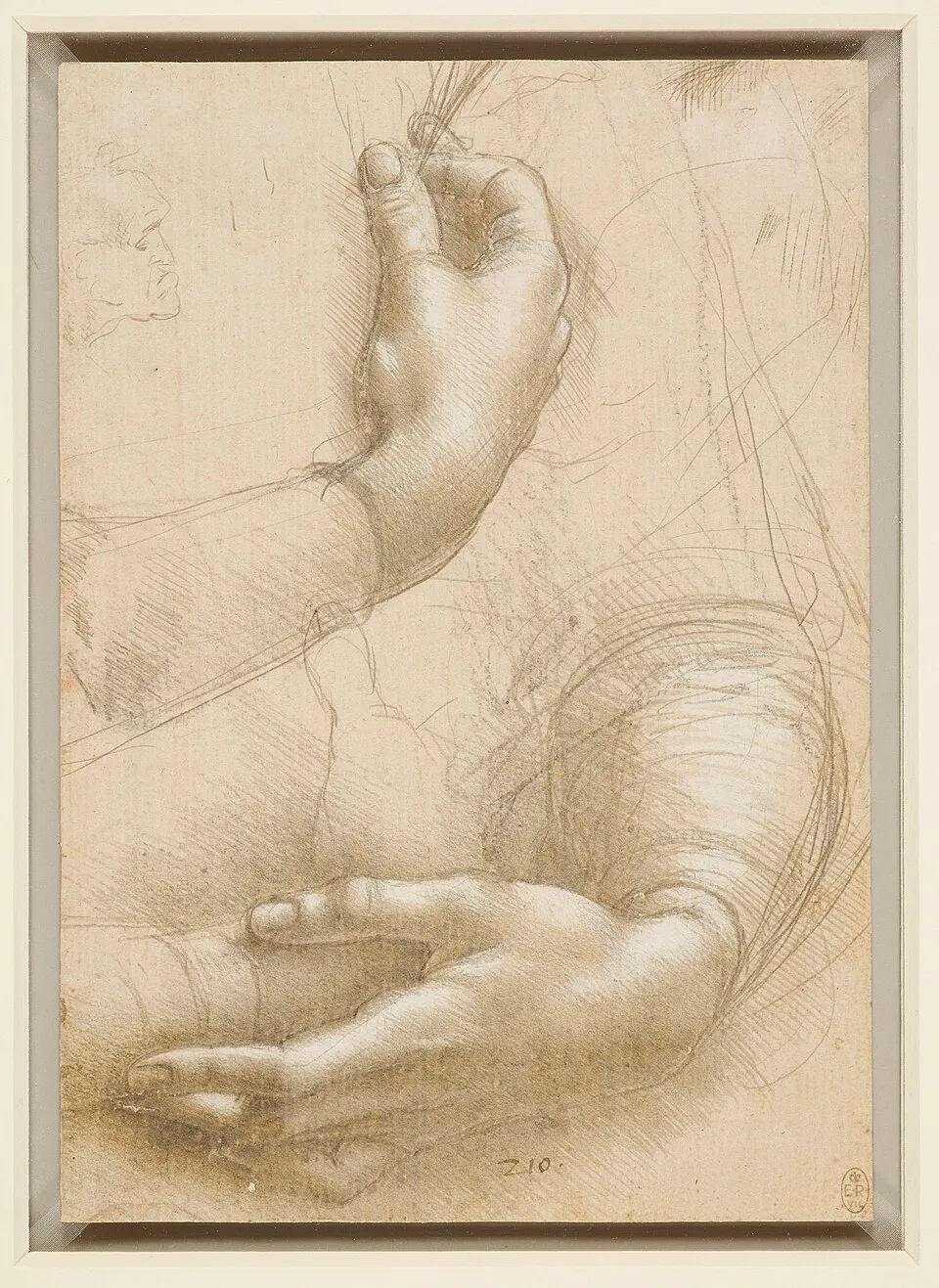
Leonardo da Vinci, "A Study of a Woman's Hands" (c. 1490). Silverpoint, paper, and charcoal. Royal Collection Trust, Windsor. Leonardo left over 4,000 drawings. Daily practice was the foundation of his mastery. Image via Wikimedia Commons.
The Science: Motor Learning and Skill Acquisition
Drawing is a motor skill, a physical action controlled by the brain and executed by the hand. Motor skills are acquired through practice, and the brain consolidates motor learning during sleep. "Drawing every day can speed up your motor learning and help you improve your drawing skills more quickly" (Adventures with Art). Daily practice is more effective than occasional practice because it gives the brain consistent signals to consolidate. Each day's practice reinforces the previous day's learning.
Cognitive science has long known that spaced practice (a little every day) is more effective than massed practice (a lot at once) for learning and retention. A 15-minute daily drawing session produces more improvement than a 105-minute weekly session, even though the total time is the same. The spacing effect applies to motor skills as well as cognitive skills. Malcolm Gladwell's "10,000-hour rule" (from "Outliers," 2008) popularized the idea that mastery requires 10,000 hours of practice. The rule is often misinterpreted. Ten thousand hours is not a threshold but an average, and the quality of practice matters as much as the quantity. But the principle holds: consistent, deliberate practice over time is the path to mastery. At 15 minutes a day, 10,000 hours takes 38 years. At 1 hour a day, it takes 27 years. At 3 hours a day, it takes 9 years. The math is simple, and it explains why most people never reach mastery. They do not put in the time.
The caveat matters. "The question of whether artistic talent is innate or learned is a common debate. Is it nature or nurture? When it comes to drawing, the science suggests that consistent practice and a structured approach are more important than any innate ability" (ArtHelper.ai). Talent exists, but it is a starting advantage, not a substitute for practice. For the broader case that making art heals, see our piece on art therapy.
What Changes in Your Brain and Your Hand
Drawing engages multiple brain regions simultaneously: the visual cortex (seeing), the motor cortex (moving the hand), the prefrontal cortex (decision-making), and the parietal cortex (spatial reasoning). Daily practice strengthens the neural pathways between these regions, making the connection between seeing and drawing faster and more automatic. Over time, what feels effortful becomes effortless. The hand moves before the conscious mind decides to move it.
Drawing builds fine motor control, the ability to make precise, controlled movements with the hand and fingers. Daily practice develops muscle memory. The hand "remembers" how to make specific marks, shapes, and lines. This is why experienced artists can draw a straight line freehand. Their hand has made that movement thousands of times, and the muscle memory is automatic. Drawing also trains observation, the ability to see what is actually there, not what you think is there. "People are born with innate drawing talent or they are not. {Fact? Fiction? Urban Legend? Fairy Tale?}" (Daisy Yellow Art). The answer is: fiction. Drawing is not about talent. It is about seeing. And seeing is a skill that daily practice develops. The person who draws every day sees more than the person who does not, not because their eyes are better but because their brain has been trained to notice.
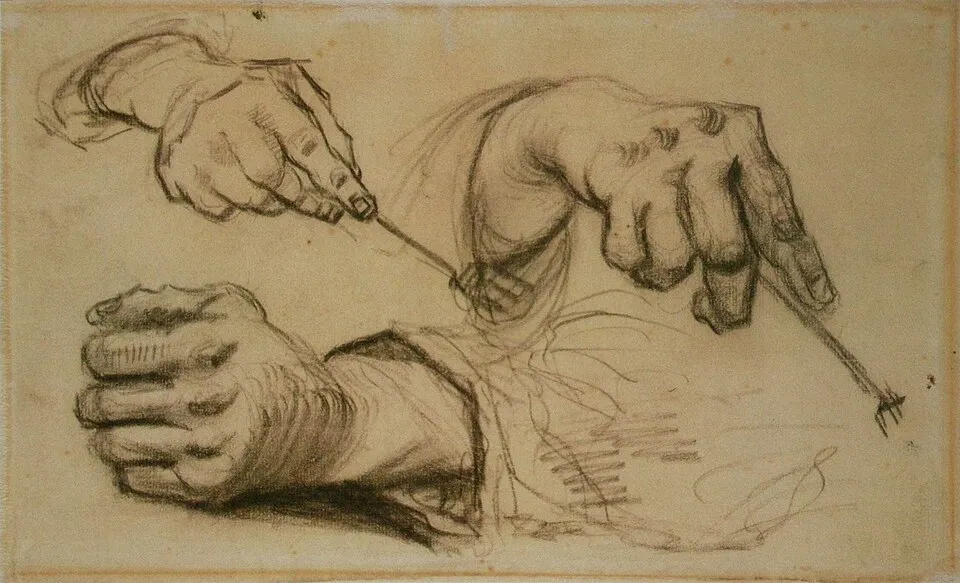
Vincent van Gogh, "Studies of Hands" (March 1885). Drawing, 21.3 x 34.6 cm. Van Gogh Museum, Amsterdam. Studies for "The Potato Eaters." Image via Wikimedia Commons.
Daily practice builds confidence, not because your drawings get better every day (they do not) but because you develop a relationship with failure. Every drawing is an experiment. Some work, some do not. The daily drawer learns that failure is temporary. Tomorrow's drawing will be different. This relationship with failure is the foundation of artistic confidence. If you are just starting, see our guide on art for beginners.
The Masters' Daily Practice: Leonardo, Van Gogh, Holbein, Rembrandt
Leonardo da Vinci (1452-1519) left over 4,000 surviving drawings. He drew everything: hands, faces, anatomy, machines, water, birds, plants. His drawings were not finished artworks but studies, daily observations of the world. "A Study of a Woman's Hands" (c. 1490, silverpoint, Royal Collection Trust) is a study, a practice drawing, not a masterpiece. But the mastery that Leonardo achieved in painting was built on the foundation of thousands of these daily studies.
Vincent van Gogh (1853-1890) left over 1,000 surviving drawings. He drew every day, especially in the early years (1880-1885) when he was teaching himself to draw. "Studies of Hands" (March 1885, 21.3 x 34.6 cm, Van Gogh Museum) are studies for "The Potato Eaters." Van Gogh drew the hands separately, over and over, before painting them. His letters to his brother Theo are full of references to daily drawing: "I draw almost every day." Hans Holbein the Younger (c. 1497-1543) made "Studies of the Hands of Erasmus" (silverpoint, black crayon, and red chalk, 20.6 x 15.3 cm, Louvre), a study for Holbein's portrait of Erasmus. Holbein drew studies of hands, faces, and clothing separately before incorporating them into finished portraits. The studies are not preliminary sketches. They are practice, observation, and mastery. Rembrandt van Rijn (1606-1669) made dozens of self-portrait drawings, etchings, and studies. He drew himself in the mirror constantly, not out of vanity but out of practice. He practiced expressions, poses, lighting, and emotion on his own face before painting them on others. The self-portrait drawings are daily practice, the artist as his own model.
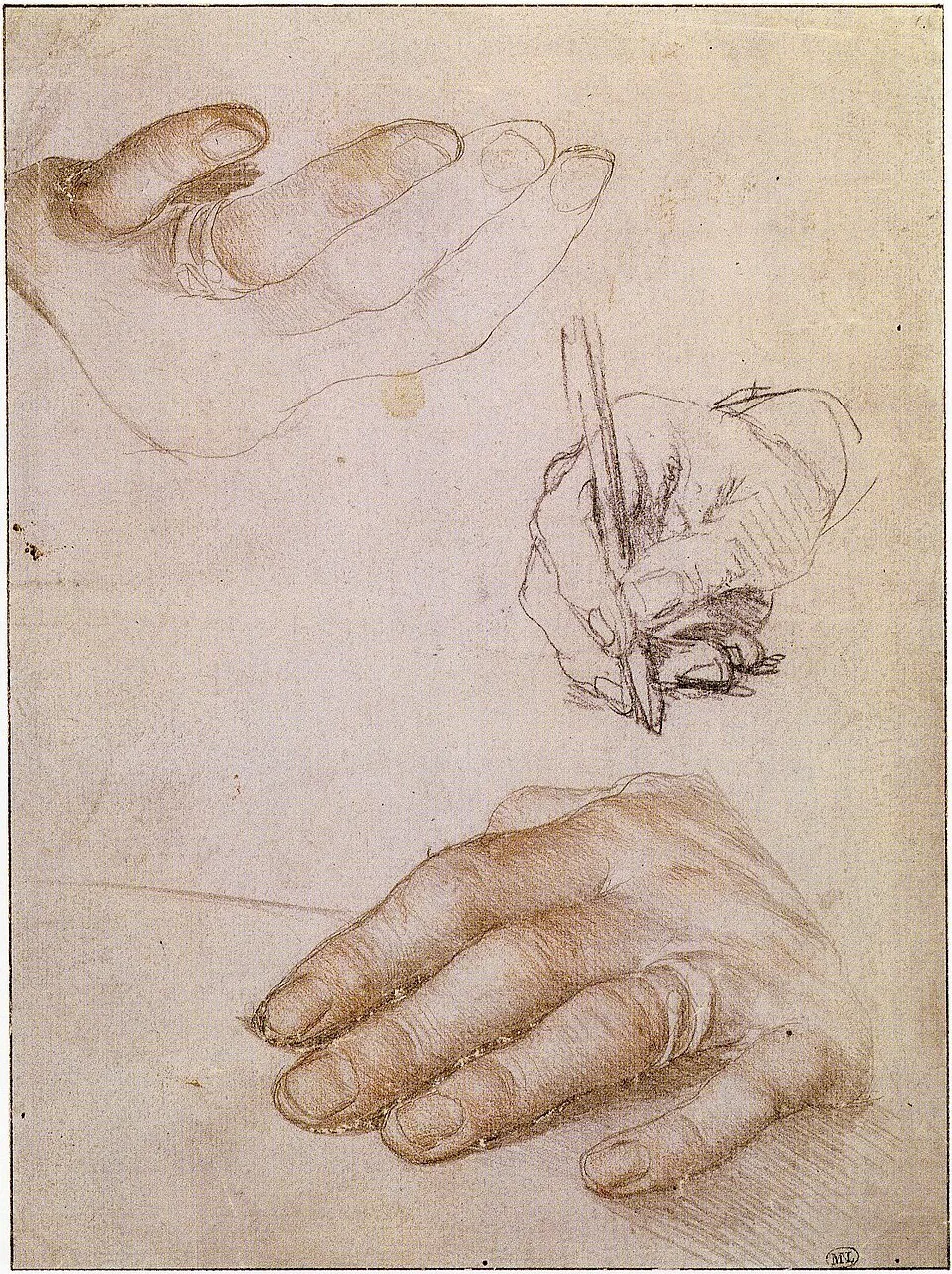
Hans Holbein the Younger, "Studies of the Hands of Erasmus." Silverpoint, black crayon, and red chalk, 20.6 x 15.3 cm. Louvre, Paris. Image via Wikimedia Commons.
The pattern is clear. The greatest artists in history were daily drawers. They did not draw because they were talented. They were talented because they drew. Daily. For more on one of them, see our piece on Rembrandt.
The 15-Minute-a-Day Method
The principle is 15 minutes a day, every day. Not 3 hours once a week. Not 1 hour when you feel like it. 15 minutes, every day, no exceptions. "You can find a free one-page summary of this article to print out at home" (Crave Painting). The 15-minute method is simple enough to fit into any schedule. Why 15 minutes? Fifteen minutes is short enough that you cannot talk yourself out of it. The biggest barrier to daily drawing is not lack of time. It is the psychological resistance to starting. Fifteen minutes is small enough to overcome that resistance. Once you start, you may draw for 30 minutes or an hour, but the commitment is 15 minutes. If you stop at 15, you have kept the commitment.
Pick a time and a place. Morning, before the household wakes up. Lunch break, at your desk. Evening, after dinner. The time does not matter. The consistency does. Pick a place, a corner of the kitchen table, a desk, a chair by the window. The place does not matter. The consistency does. The brain learns through repetition, and repeating the same time and place builds a habit that requires no willpower to maintain. As for materials, a sketchbook and a pencil. That is all. Do not buy expensive materials. They create pressure. A $5 sketchbook and a $2 pencil are better for daily practice than a $30 sketchbook and a $20 pencil set, because the cheap materials give you permission to make bad drawings. And bad drawings are the point. They are how you learn. For a year of structured prompts, see our sketchbook prompts.
What to Draw: Exercises and Subjects
Warm up for 2 minutes. Draw circles. Fill a page with circles, different sizes, different pressures. The circle is the fundamental shape of drawing. Every form can be built from circles. Drawing circles warms up the hand and the eye. Observe for 5 minutes. Draw an object from life, a cup, a shoe, a plant, a hand. Do not draw from imagination. Draw from observation. Observation is the skill that daily practice develops. Look at the object. Look at the paper. Look at the object again. The back-and-forth between looking and drawing is the fundamental rhythm of drawing.
Copy for 5 minutes. Copy a master drawing. Pick a drawing by Leonardo, Rembrandt, Van Gogh, Holbein, any artist whose work you admire. Copy it. Not to sell or display, but to learn. Copying master drawings is the oldest art education method. It teaches you how the master saw, how they composed, how they used line and tone. Use your imagination for 3 minutes. After warming up, observing, and copying, draw something from your own mind, a face, a creature, a scene. The imagination drawing is the reward. It is where the skills you have practiced come together in your own voice. For more ideas, see our sketchbook prompts guide.
Common Mistakes: Burnout, Perfectionism, Comparison
Burnout is the most common reason people stop drawing every day. They start with enthusiasm, draw for 3 hours on day 1, and are exhausted by day 3. The solution is the 15-minute method. Start small, build slowly, and let the habit grow organically. If you want to draw more, draw more, but the commitment is 15 minutes.
Perfectionism is the second most common reason. It is the belief that every drawing must be good. This is wrong. Most drawings will be bad. That is the point. "It removes the white pages from the book and allows you to be more expressive with the drawings on the pages. It also makes the sketchbook less intimidating and shows that every page does not need to be perfect" (Kostich Art). The sketchbook is for practice, not for exhibition. Give yourself permission to make bad drawings. They are the path to good ones.
Comparison is the third most common reason. It is looking at other artists' work and feeling inadequate. Comparison is the enemy of daily practice. Do not compare your day 10 to someone else's year 10. Compare your day 10 to your day 1. The only comparison that matters is with yourself, and if you draw every day, the comparison will be encouraging. For the mental-health side of making art, see our piece on art therapy.
How to Build a Daily Drawing Habit That Lasts
Start small. 15 minutes. Not 30, not 60. Fifteen. The smaller the commitment, the harder it is to skip. Track your days. Mark an X on a calendar for every day you draw. The chain of Xs becomes a visual motivator. You do not want to break the chain. Jerry Seinfeld's "don't break the chain" method is a proven habit-building technique. Share selectively. Share your drawings with one or two trusted people, not on social media (where comparison lurks) but with a friend, a partner, a drawing group. Accountability without comparison is the sweet spot.
Forgive yourself. If you miss a day, do not quit. Missed days are not failures. They are part of the process. The habit is not "never miss a day." The habit is "always come back." The person who draws 350 days out of 365 has a daily drawing habit. The person who draws 30 days, quits, and never returns does not. The 100-day mark matters. Research on habit formation suggests that it takes approximately 66 days to form a habit, but 100 days is the milestone where most people report that drawing feels automatic, like brushing teeth. If you can draw every day for 100 days, you will have a habit that lasts. For finding a group to keep you accountable, see our guide to adult art classes, and for working with kids, our piece on teaching art to children. For the painting side of practice, see our guide to oil painting techniques.
Final Thoughts
Drawing every day is the single most effective thing you can do to improve your drawing skill. The science is clear: "drawing every day can speed up your motor learning and help you improve your drawing skills more quickly" (Adventures with Art). The spacing effect, a little every day beats a lot at once, applies to motor skills as well as cognitive skills. A 15-minute daily session produces more improvement than a 105-minute weekly session. The greatest artists in history were daily drawers: Leonardo da Vinci left over 4,000 drawings, Van Gogh over 1,000, Holbein drew studies of hands separately before painting portraits, Rembrandt drew himself in the mirror dozens of times. "Drawing isn't some magical talent you're born with. Nope, it's a skill you can actually develop, and here's the kicker: all it takes is showing up every single day with a pencil in hand" (ArtRoomy). The 15-minute method, warm-up (2 min), observation (5 min), copy a master (5 min), imagination (3 min), is a complete daily practice in 15 minutes. The common mistakes, burnout (start small), perfectionism ("every page does not need to be perfect"), comparison (compare to yourself, not others), are all preventable. The habit-building techniques, track your days (don't break the chain), share selectively, forgive yourself, aim for 100 days, are proven. The question is not whether you have talent. The question is whether you are willing to draw every day. If you are, everything else follows.
Get a sketchbook. Get a pencil. Set a timer for 15 minutes. Draw a circle. Then draw an object. Then copy a master drawing. Then draw something from your imagination. Do it tomorrow. Do it the next day. Do it for 100 days. At day 100, look at your day 1 drawing and your day 100 drawing. The difference will be visible, not because you discovered talent but because you built skill. That is what daily practice does. That is all it does. And it is enough. For reference, see Adventures with Art on daily drawing, the 15-minute routine at Crave Painting, and ArtRoomy on getting better at drawing.


