
Cy Twombly's paintings look, at first encounter, like they might not be finished. Large gray canvases covered in chalk-like scrawls. White grounds marked with looping lines and smeared pencil traces. The occasional appearance of something that might be a word or a number or a figure, and might be none of these. The work refuses the expectations that most painting brings to a viewer. There is no obvious focal point, no narrative clarity, no moment of resolution at which the eye can rest and say it has understood. And yet the paintings are not arbitrary. The more time you spend with them, the more organized they feel, and the more clearly you can sense the sophistication of the decisions behind each mark.
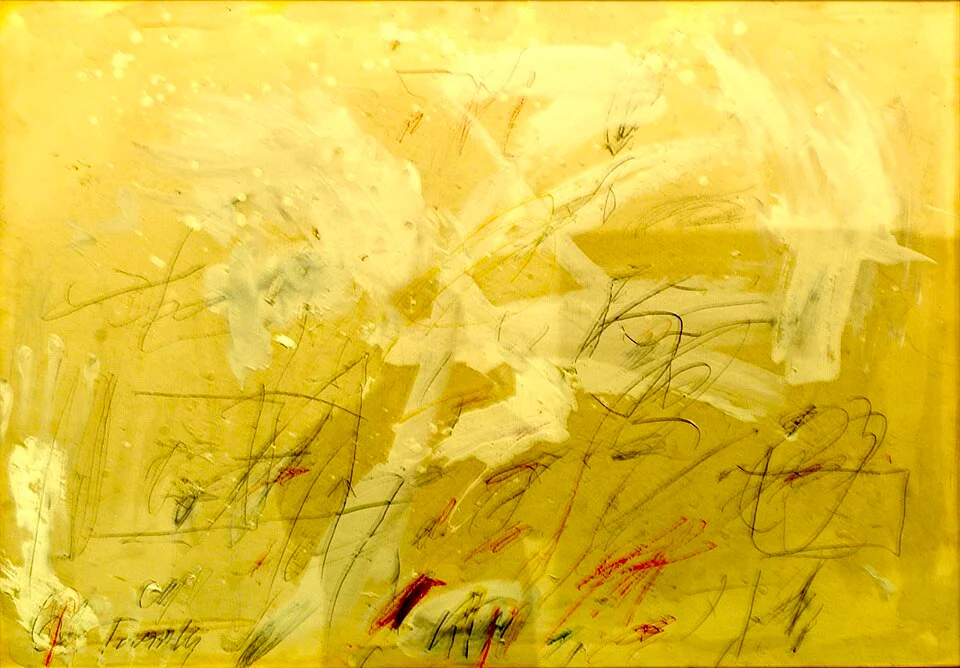
Cy Twombly, Untitled (1957). The expressive drips and scribbled lines that became his signature style, emerging from his time at Black Mountain College. Image: CC BY 2.0, via Wikimedia Commons
Twombly was born in Lexington, Virginia, in 1928. He studied at the Art Students League in New York and at Black Mountain College in North Carolina, then spent most of his adult life in Italy, settling in Gaeta and alternating between Italy and Virginia. Italy was not merely a place he lived. It was a subject of his art: the classical mythology, the Mediterranean light, the history of Rome and Greece, the specific sensory quality of ancient things. He died in Rome in July 2011 at eighty-three. His work is held by every major museum of postwar art, and a 2016 retrospective at the Centre Pompidou in Paris drew over 350,000 visitors, confirming that the work which once looked like a provocation has become canonical.
The Black Mountain Years
Black Mountain College in North Carolina was the most significant experimental educational institution in the history of American art. In the late 1940s and early 1950s, when Twombly studied there, the faculty included Robert Motherwell, Ben Shahn, and John Cage. Robert Rauschenberg was a fellow student, and the two became close friends and collaborators for a period. Cage's philosophical orientation was deeply influential on the generation that passed through Black Mountain: his insistence that meaning could arise from materials and methods rather than being imposed by the artist's intention opened a door that Twombly would spend sixty years walking through.
Twombly also studied with Robert Motherwell, who introduced him to the Abstract Expressionist conviction that a painting's surface could be a record of the act of its making. The marks left by the body's movement through space could be the primary content of the work rather than a means of depicting something else. This conviction stayed with Twombly throughout his career, but he took it in a direction that Abstract Expressionism proper never pursued: toward the historical and the literary, toward painting that gestured at classical culture without illustrating it.
Italy and the Classical World
Twombly moved to Rome in 1957 and remained based in Italy for the rest of his life. The move transformed his work. The encounter with ancient Roman architecture, with Italian painting from the Renaissance through the Baroque, and with the physical presence of a classical Mediterranean culture that was simultaneously living and archaic gave his work a new set of references that would prove inexhaustible.
His mature paintings from the 1960s onward make frequent reference to Greek and Roman mythology, to specific ancient texts, and to the history of the classical world. The titles include "Leda and the Swan," "Achilles Mourning the Death of Patroclus," "Apollo and the Artist," and "The Birth of Venus." But the paintings do not illustrate these subjects in any conventional sense. A line or a loop or a smear of paint might be labeled with a mythological name in the artist's handwriting, but the relationship between the name and the mark is evocative rather than descriptive. It is more like the way a phrase of music might evoke a landscape than like the way a representational painting depicts a scene. The name does the work of a tuning fork: it sets the emotional frequency of the painting without dictating what you should see in it.
The Paintings Up Close
Twombly's technique in his most characteristic works involves layering marks over a prepared gray or white ground. The marks include chalk-like strokes that appear to have been made with the left hand (Twombly was right-handed and deliberately worked with his non-dominant hand for periods), pencil scratches, paint smears, and oil paint applied from tubes or with fingers. The surface builds up through multiple sessions of addition and occasional erasure, and the final state of the canvas records this process the way a palimpsest records successive layers of writing.
The chalk-like quality of many of his marks refers explicitly to handwriting, to the experience of writing on a school blackboard, and to the conditions under which children first encounter the act of making marks that represent language. This reference to a preliterate or barely literate relation to mark-making, combined with the constant evocation of highly sophisticated classical literary culture in the titles and inscriptions, creates one of the productive tensions at the heart of Twombly's work. The most ancient and the most sophisticated aspects of human culture meet in the marks on his canvases. That tension is not a contradiction. It is the subject of the work.
Sculpture and the Late Work
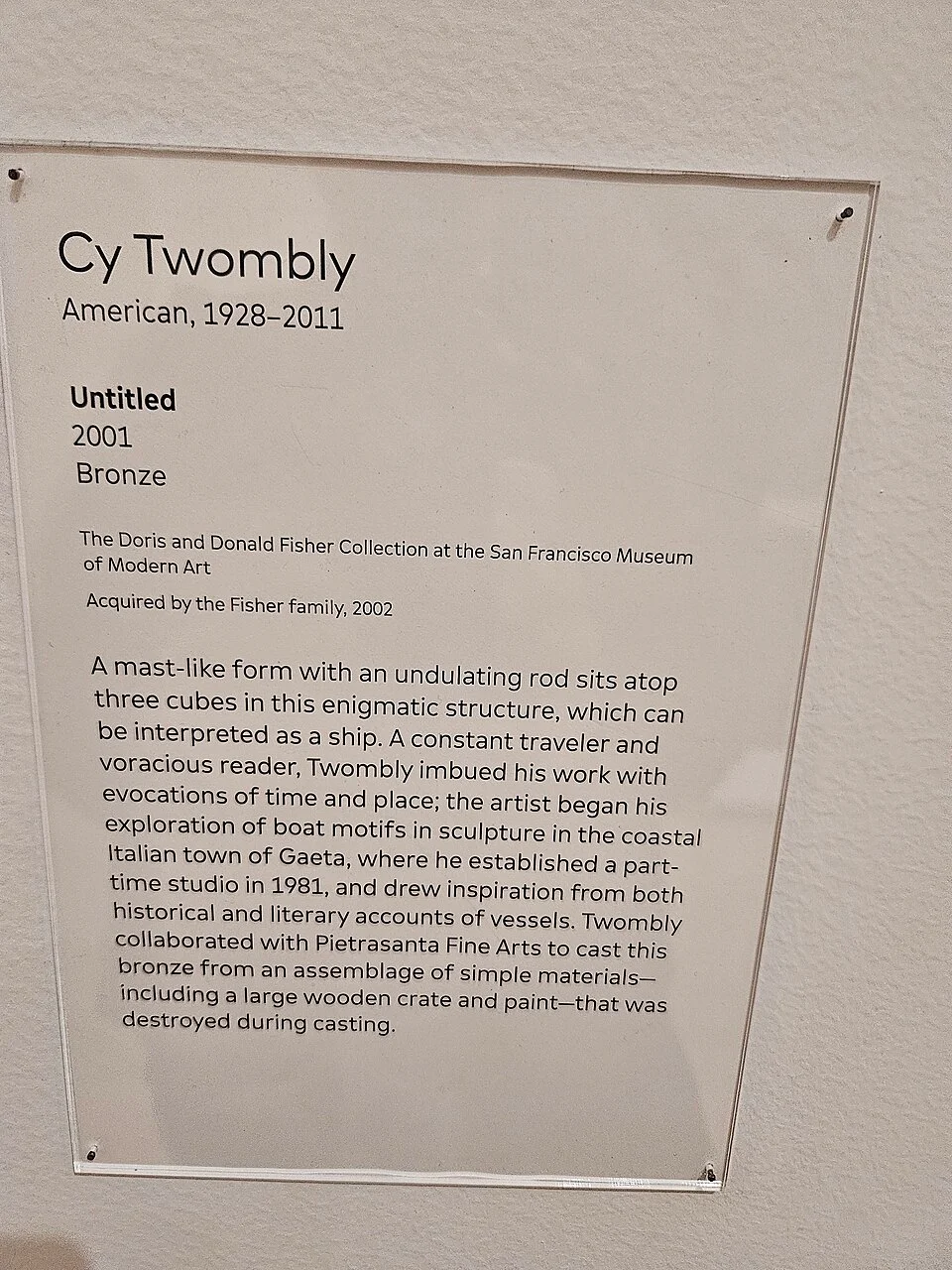
Cy Twombly, Untitled (2001), bronze, SFMOMA. His sculptures, often painted white, suggest classical forms assembled from found materials. Image: CC BY-SA 3.0, via Wikimedia Commons
Twombly's sculpture, made throughout his career but only widely exhibited relatively late, uses found wooden objects, plaster, and bronze to create forms that have the same provisional, accumulated quality as his paintings. The surfaces are typically painted white, covering their materials with a uniform coating that simultaneously conceals and reveals the underlying forms. The Philadelphia Museum of Art holds a significant collection of these sculptures, many assembled from materials Twombly found near his studio in Gaeta.
The Louvre in Paris holds a ceiling painting by Twombly, commissioned in 2010, in the room that houses the Winged Victory of Samothrace. A blue-and-white circular field with the names of classical sculptors inscribed around its circumference, connecting the ancient and the modern in a gesture characteristic of his whole project. It is one of the few permanent installations by a contemporary artist in the Louvre's historic galleries, and it tells you something about how seriously European institutions take his engagement with classical culture.
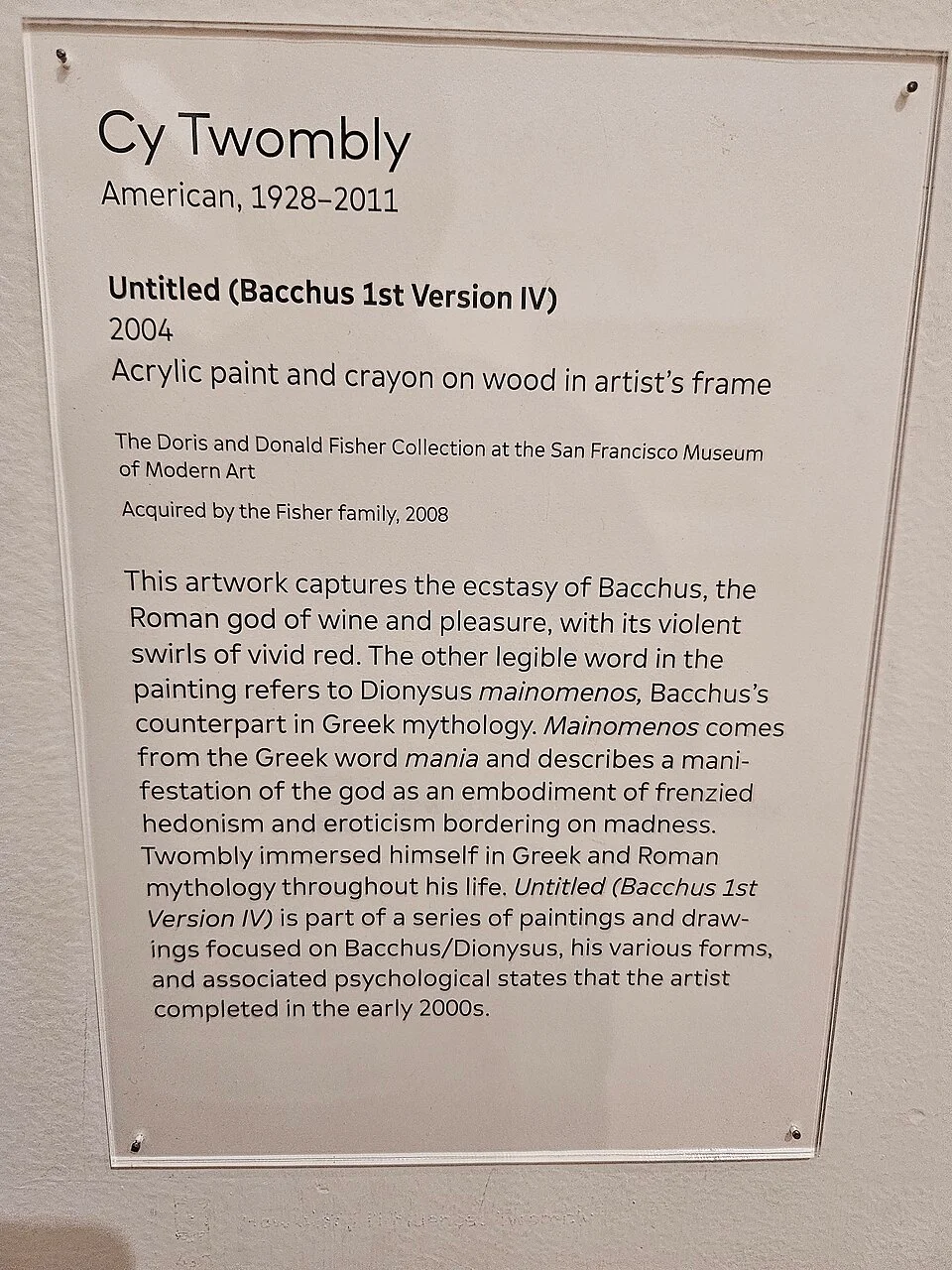
Cy Twombly, Untitled (Bacchus 1st version IV) (2004), SFMOMA. The late "Bacchus" paintings are large red swirling vortices, among the most viscerally powerful works of his career. Image: CC BY-SA 3.0, via Wikimedia Commons
His late paintings from the early 2000s until his death include series based on specific classical subjects. The "Bacchus" paintings (2005-2008) are large red swirling vortices, the paint applied in liquid pours that create circular marks across canvases up to three meters high. These late works abandon the characteristic gray ground for grounds of brilliant white and primary color, and the mark-making becomes more gestural and less calligraphic than in his earlier work. They are among the most viscerally powerful things he made. Standing in front of one, the red paint feels less like a reference to wine or blood than like the physical residue of a body in motion. The hand is gone. The body remains.
The Influence and the Difficulty
Twombly's influence on subsequent art has been substantial. His insistence on the legibility of process, the way the painting's surface documents the act of its making, extends Abstract Expressionism's interest in gesture into territory that later artists working with text, with found materials, and with the relationship between art and writing have continued to explore. Jean-Michel Basquiat's use of text and image in his paintings of the early 1980s has often been compared to Twombly's, and while the social and cultural contexts are very different, the formal relationship is real.
The difficulty of his work, the way it withholds conventional satisfactions of legibility and resolution, has made it a target for the accusation that it is either fraudulent or simply incompetent. This response misunderstands what the work is doing. Twombly's refusal of resolution is not evasion. It is substance. He was exploring the condition of a culture saturated with its own history, trying to make paintings that could hold ancient mythological content in a material form that acknowledged the impossibility of returning to innocence, of making marks as if the history of painting did not exist. The result is some of the most searching painting made in the second half of the 20th century.
Why Twombly Is Worth the Effort
Cy Twombly spent six decades making paintings that most people found confusing on first encounter and that most people who spent serious time with them found deeply rewarding. The apparent simplicity of the marks conceals an extraordinary sophistication of purpose. The classical references, which might initially seem like intellectual decoration, are central to the work's ambition: to make paintings that think about what it means to carry a classical inheritance into a modern world that has both absorbed and lost it.
For the broader postwar American context, the guide to Abstract Expressionism covers the movement he extended and contested. For text's role in visual art, the guide to art and literature offers useful background. And for the wider context of postwar art movements, the complete guide to art movements places Twombly in the larger timeline. Have you spent time with Twombly's work in person? Share what you saw in the comments.


