The largest artwork on earth is a 1.5-mile-long complex of concrete mounds and pyramids in a remote Nevada valley that took fifty years to build and admits six visitors a day. Michael Heizer's "City," opened to the public in September 2022, is the extreme end of a tradition that started when artists in the 1960s and 1970s walked out of the gallery and into the desert, and decided the land itself was the medium. The desert is where art went to get away from the museum, and the results are the least reproducible artworks ever made.
The logic is simple. The desert has no walls, no admission fee, no neighbors, and no light pollution. It has scale, permanence, and a specific quality of light that painters from Georgia O'Keeffe to the Aboriginal artists of Papunya have spent careers trying to hold. This guide covers the earthworks canon, the Arizona crater that is still being built, the Texas town that became an art shrine, the contemporary biennials in the sand, and the much older traditions of desert geoglyphs that the land artists were secretly copying. For the broader movement this belongs to, see our post on land art and earth art.
The Earthworks Canon
Robert Smithson's "Spiral Jetty" is the image everyone knows: a 1,500-foot coil of black basalt and earth bulldozed into the red water of the Great Salt Lake at Rozel Point, Utah, in April 1970. It is not technically desert, but it is the anchor of the whole desert tradition. The lake level controls whether you see it; it was underwater for about five years in the early 2000s and has emerged again in most years since. It is owned by the Dia Art Foundation, which maintains it, and it remains the most photographed earthwork ever made.
Michael Heizer's "Double Negative" (1969-70) is the negation of it: two trenches cut into Mormon Mesa, Nevada, totaling about 240,000 tons of displaced earth, a work made entirely by removal rather than addition. Walter De Maria's "The Lightning Field" (1977), a grid of 400 polished steel poles in Catron County, New Mexico, is the opposite again: precision instead of scale. Dia maintains it, and visits are by overnight reservation only from May to October, which is the closest thing to a pilgrimage the art world offers. For the movement these works belong to, see our guide to minimalism.
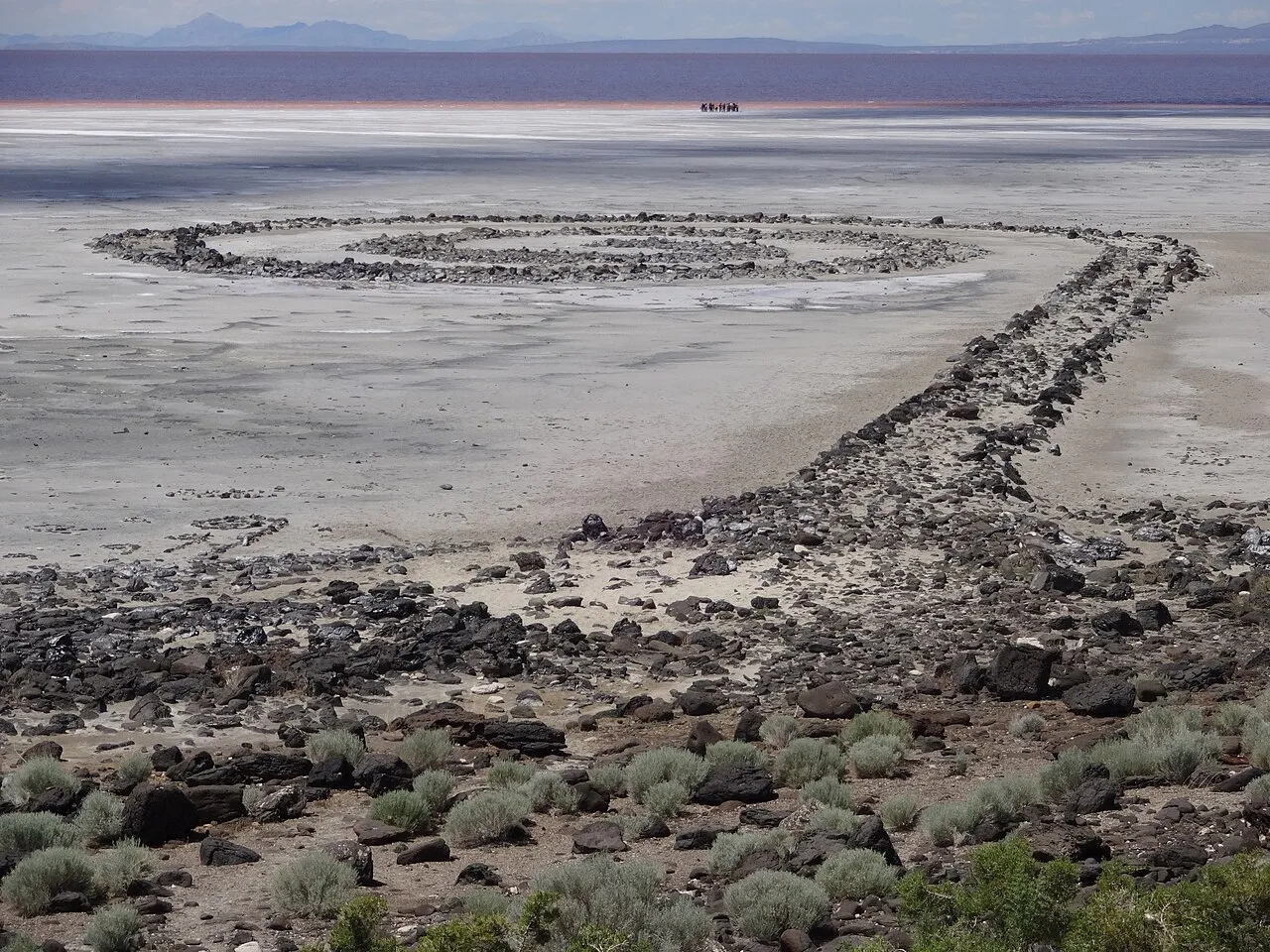
Robert Smithson, "Spiral Jetty" (1970). Black basalt, earth, and salt crystals, Rozel Point, Great Salt Lake, Utah. The most famous earthwork of the land art movement, it is visible or submerged depending on the lake level. The Dia Art Foundation owns and maintains it. Image via Wikimedia Commons.
The Crater That Is Still Being Built
James Turrell's Roden Crater is the longest-running artwork in progress. Since 1977 Turrell has been reshaping a 400,000-year-old volcanic cinder cone in the Painted Desert of Arizona into a naked-eye observatory: a series of underground chambers and apertures aligned to celestial events so that light from the sun, moon, and stars falls into the rooms in specific, measurable ways. It is not open to general visitors. Arizona State University has partnered with Turrell since 2019 to finish it, and access is limited to fundraising and academic programs. When it opens it will be the most controlled sky-viewing space ever built, which is the point: the desert is the only place dark and empty enough to build it.
Michael Heizer's "City," mentioned above, is the finished one: a series of concrete structures, mounds, and depressions in Garden Valley, Nevada, built from 1972 to 2022 on land Heizer bought and defended from a proposed nuclear railroad. It opened in September 2022 through the Triple Aught Foundation, which limits daily visitors to protect the site and the experience. The reservation system makes it the opposite of the mass spectacle; it is deliberately a pilgrimage. For the artist whose whole career is this relationship to land, see our post on Georgia O'Keeffe and the desert.
Marfa and the Art Shrine
Donald Judd left New York for Marfa, Texas, in the early 1970s because he could not stand the city's galleries and wanted permanent spaces for his work. He bought a former army base, Fort D.A. Russell, and filled it with 100 untitled works in mill aluminum installed in two artillery sheds, plus 15 concrete works scattered across 340 acres of desert. The Chinati Foundation, which he founded, opened to the public in 1986 and is now the pilgrimage site for anyone who wants to see minimalism in the conditions it was made for. For the movement Judd helped invent, see our guide to minimalism.
Marfa's second layer is the one that made it famous beyond the art world: Prada Marfa, the 2005 permanent sculpture by Elmgreen and Dragset that looks exactly like a Prada boutique and sits alone on U.S. Route 90 about 26 miles west of town. It holds real Prada shoes and handbags, is never open, and has been vandalized, restored, and photographed so many times it has become its own kind of destination. Ballroom Marfa and the Judd Foundation run the town's other venues, and the whole operation proves that the desert can sustain a real art economy if the art is specific enough to the place.
Desert X and the Contemporary Biennial
Desert X is the contemporary version: a free outdoor exhibition that has scattered site-specific installations across the Coachella Valley every other year since 2017. The fifth edition ran March 8 to May 11, 2025, curated by artistic director Neville Wakefield and co-curator Kaitlin Garcia-Maestas, with thirteen works spread over about thirty miles of desert. The themes were Indigenous futurism, design activism, and the human impress on the land, and the works included Agnes Denes's "The Living Pyramid" and installations by Sanford Biggers, Alison Saar, and Cannupa Hanska Luger.
Desert X AlUla, the Saudi Arabian edition founded in 2020, runs in the sandstone canyons of the AlUla oasis and has become the more spectacular of the two because the scale of the landscape allows pieces that would be impossible in California. The 2026 AlUla edition ran January 16 to February 28 under the title "Space Without Measure." The Coachella tenth-anniversary edition will run October 30, 2027 through May 7, 2028, a longer season designed to engage the desert's shifting light and climate. For the festival logic this follows, see our guide to art fairs and how they work.
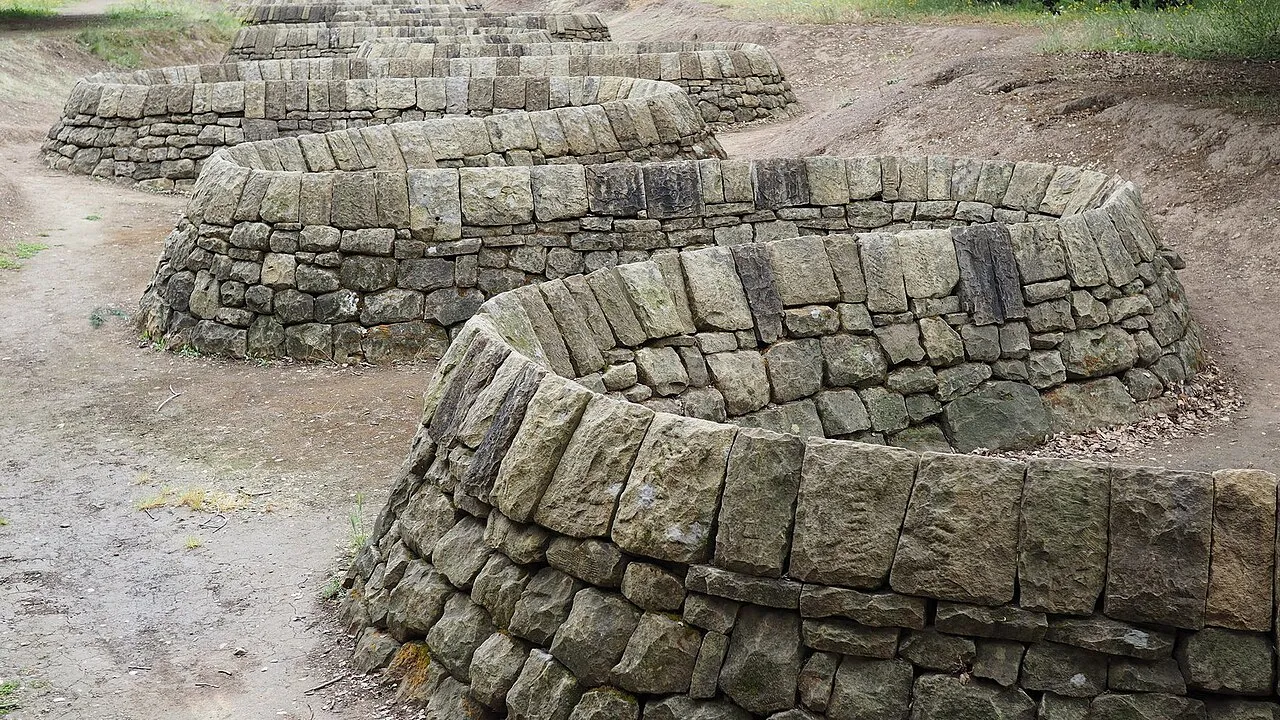
Andy Goldsworthy working with natural materials in the landscape. While not exclusively a desert artist, his practice of making ephemeral work from found materials is the closest living link between the earthworks tradition and the land itself. Image via Wikimedia Commons.
The Much Older Desert Tradition
The land artists were not the first to use the desert as canvas. The Nazca lines of Peru, geoglyphs cut into the desert floor between roughly 500 BC and 500 AD, include a 300-meter hummingbird, a monkey, and hundreds of geometric figures only fully readable from the air. The Papunya Tula movement of 1971-72, when Aboriginal men in the Western Desert settlement of Papunya began painting Dreaming stories in acrylic on board, created the most commercially significant Indigenous art movement in Australia and the visual language of dot painting that the world now recognizes. For the deeper context of that tradition, see our guide to Indigenous Australian art.
And then there are the vernaculars: Salvation Mountain, the adobe-and-latex hillside Leonard Knight painted with religious slogans at Slab City, California from 1984 until his death in 2014; Noah Purifoy's Outdoor Desert Art Museum in Joshua Tree, ten acres of assemblage sculptures made from junk; Burning Man, which has turned the Black Rock Desert into a temporary art city every year since 1990 and functions as the largest experiment in gift-economy art on earth. The desert does not care about the distinction between fine art and folk art, and that is part of what the desert artists found.
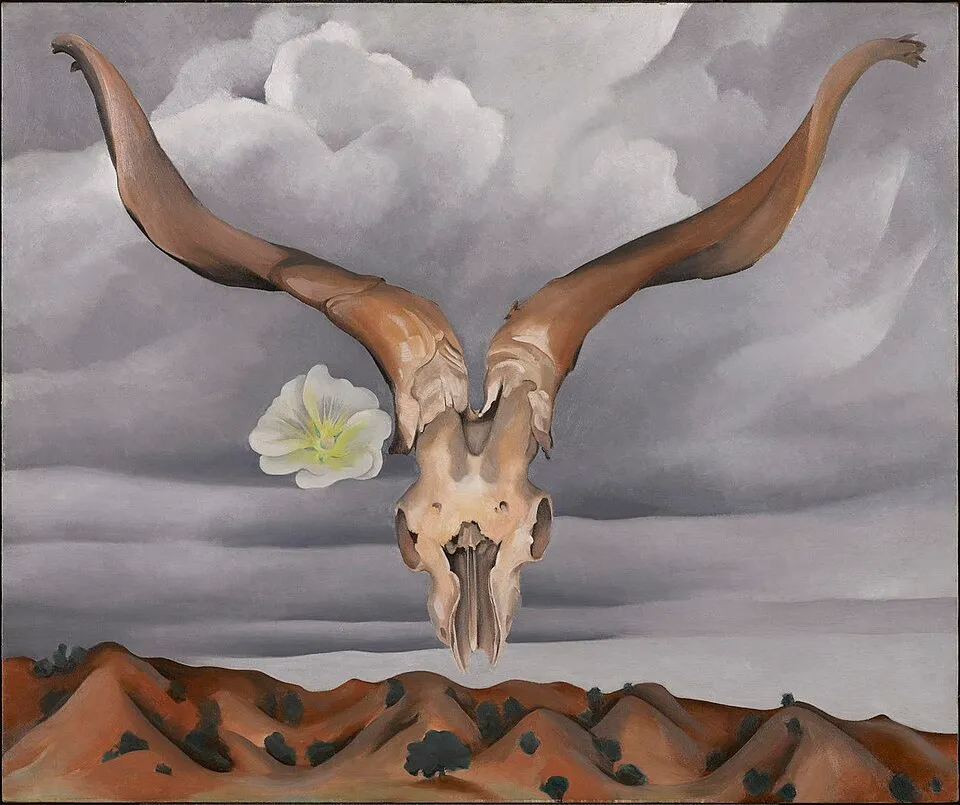
Georgia O'Keeffe, "Ram's Head, White Hollyhock and Little Hills" (1935). O'Keeffe's New Mexico paintings are the clearest proof that the desert could produce a modernism as powerful as the land artists' earthworks, made on canvas rather than in the ground. Image via Wikimedia Commons.
Why the Desert Works
The desert works as an art site because it removes everything the gallery adds. There is no neutral white wall, no climate control, no crowd, no exit sign. The artwork has to hold the viewer's attention against the whole sky and the whole horizon, which is why the successful desert works are either enormous (City, Spiral Jetty) or perfect (Lightning Field, Roden Crater) or both (Double Negative). It also works because it is fragile: the desert forgets. Salt crusts reclaim the Jetty. Wind erodes Double Negative's edges. Prada Marfa is maintained by a foundation because the highway would absorb it. The temporariness is part of the meaning, which is what the gallery system could never provide.
For a deeper account of why artists left the building in the first place, see our post on land art and earth art, and for the artist who proved the desert could be painted as well as bulldozed, Georgia O'Keeffe.
Final Thoughts
The desert is not empty. It is the only place empty enough. That is why the earthworks artists drove bulldozers into it, why O'Keeffe moved her whole life to it, why the Papunya painters put their Dreaming on it, and why Desert X keeps scattering new work across it. The art that comes out of arid land is different because it has to compete with something bigger than the museum: the horizon itself.
Start with the Canon: Spiral Jetty at Rozel Point, then Marfa for Judd's Chinati, then the Lightning Field if you can get the reservation. For the living version, go to Desert X in Coachella or AlUla. For the much older tradition under all of it, read our guide to Indigenous Australian art, and for the painter who made the desert modern, Georgia O'Keeffe.
Frequently Asked Questions
What is the largest artwork in the world?
Michael Heizer's City in Garden Valley, Nevada, is a series of monumental structures stretching roughly 1.5 miles, built between 1972 and 2022. It opened to the public in September 2022 and admits a limited number of visitors per day by reservation.
Is Spiral Jetty visible?
Usually. Robert Smithson's 1970 earthwork at Rozel Point on the Great Salt Lake is visible when the lake level is low, which is most years. It submerged completely for about five years in the early 2000s and reappears when the water drops.
Can the public visit Roden Crater?
Not yet in the normal sense. James Turrell's Roden Crater, a volcanic cinder cone in the Painted Desert of Arizona, has been under construction since 1977. Arizona State University now partners with him on it, and access is limited to fundraising and academic programs.
What is Desert X?
Desert X is a free outdoor art exhibition held across the Coachella Valley in California since 2017, with a sister edition in AlUla, Saudi Arabia since 2020. Site-specific installations are scattered across the desert for two months every other year.