The world's largest arts festival happens every August in a city of half a million people that spent centuries being told it had no art of its own. Edinburgh's Old Town is a medieval tenement spine; its New Town is a Georgian grid of stone and sky. The art of Scotland lives between them, in a collection of museums that most visitors walk past on their way to the castle, and in a history that produced the Enlightenment's greatest portrait painters, the first modern movement named after a British city, and a festival that now sells more tickets than the Olympics.
Scottish art was not made only in Edinburgh. Glasgow produced the Glasgow Style and most of the modernists. But Edinburgh is where Scotland keeps it, shows it, and argues about it. The National Galleries, the Portrait Gallery, the Royal Scottish Academy, the festival that dwarfs them all: this is the city where Scottish art turned into a national identity. This guide covers the Enlightenment painters, the Colourists and the Glasgow Style, the modern makers, the institutions, and the August machinery that brings the world in. For the movement that ran parallel in the other city, see our guide to the Glasgow Style.
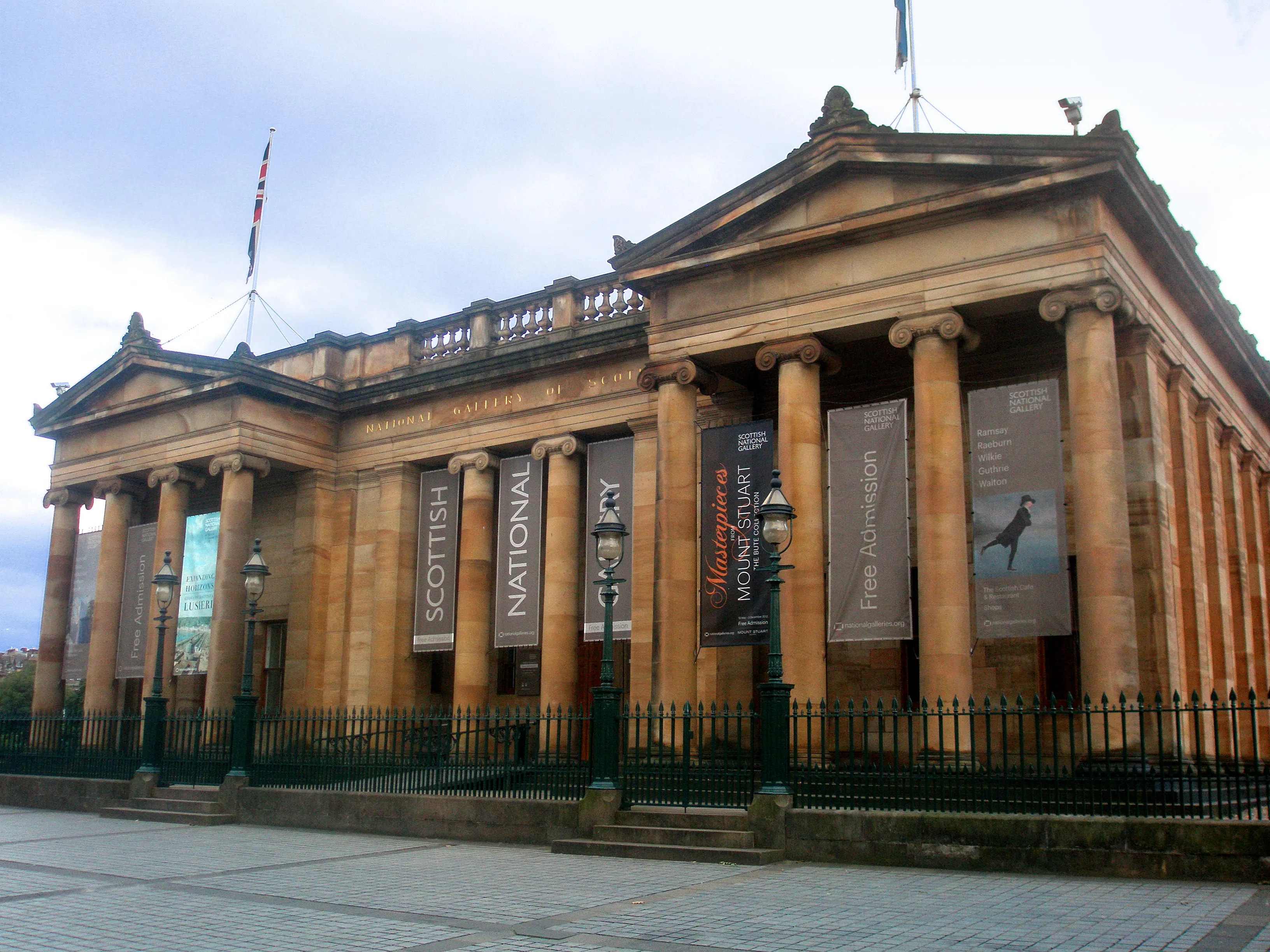
The Scottish National Gallery on the Mound, designed by William Henry Playfair and opened in 1859. It sits on the artificial slope between Edinburgh's Old Town and New Town, literally bridging the two halves of the city that its collection does the same for. Image via Wikimedia Commons.
The Enlightenment and the Portrait Tradition
Edinburgh's art history starts with the Scottish Enlightenment, the 18th-century moment when this small city produced David Hume, Adam Smith, and the intellectual network that ran modern philosophy and economics. The painters of that world were portraitists because the clients were the new professional class who wanted to see themselves. Allan Ramsay was the first great one, the Edinburgh-born painter who became court painter to George III and brought a French naturalism home. Henry Raeburn was the definitive one, the self-taught Edinburgh painter who spent the 1790s and 1800s painting the judges, ministers, and lawyers of the New Town in a style of dramatic light and plain backgrounds that has never gone out of fashion.
Raeburn's "The Reverend Robert Walker Skating on Duddingston Loch," painted around 1795 and known to everyone as the Skating Minister, is now the single most famous painting in the National Galleries of Scotland. The image is so iconic it appears on tea towels and Christmas cards, which is precisely the point: it is the face of Scottish art, painted by an Edinburgh artist, kept in an Edinburgh museum, and instantly recognizable to Scots who have never set foot in the building. For the wider tradition of formal portraiture this belongs to, see our guide to how to read a portrait.
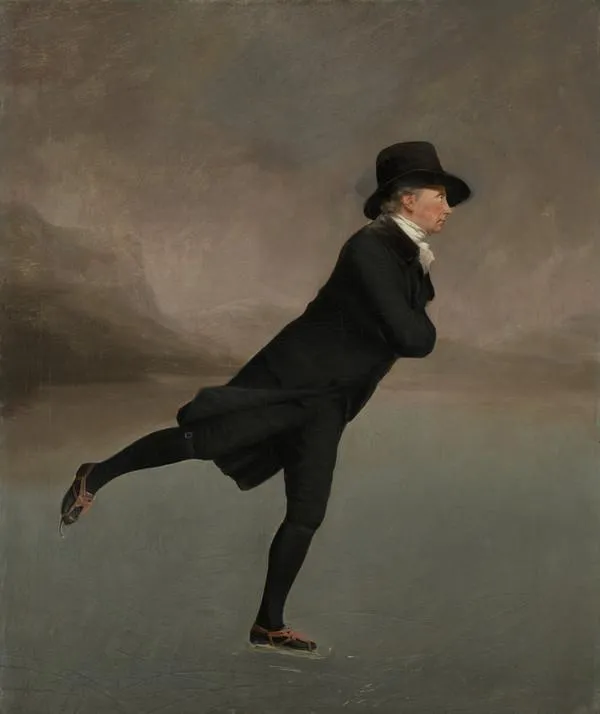
Sir Henry Raeburn, "The Reverend Robert Walker Skating on Duddingston Loch" (ca. 1795). Oil on canvas. National Galleries of Scotland, Edinburgh. The Skating Minister is the most famous painting in the national collection and the unofficial emblem of Scottish art, reproduced on everything from tea towels to Christmas cards. Image via Wikimedia Commons.
The Colourists and the Glasgow Style
The 20th-century story belongs to two groups, one from each city. The Scottish Colourists, Samuel Peploe, John Duncan Fergusson, George Leslie Hunter, and Francis Cadell, were Edinburgh and Glasgow painters who went to France in the 1900s and 1910s and came back with Fauvist color and Post-Impressionist structure. Fergusson lived in Paris for years, knew Matisse, and brought that vocabulary to Scottish subjects. Peploe painted Iona and Kirkcudbright in high-keyed color that looked like nothing Scottish art had produced. They were ignored in Britain for decades and are now the most valuable Scottish modernists at auction.
The Glasgow Style ran parallel and belongs to Glasgow, but Edinburgh shows it because the collection is national. Charles Rennie Mackintosh and his wife Margaret Macdonald, with her sister Frances and Herbert MacNair, made the interiors, furniture, and watercolors that defined the movement. Their work is linear, mystical, and geometric, and it directly influenced the Vienna Secessionists who were working at the same time. For the full account of that parallel movement, see our post on the Glasgow Style.
Phoebe Anna Traquair sits between the two cities in spirit. Born in Dublin and trained in Edinburgh, she became the central figure of the Scottish Arts and Crafts movement. Her masterpiece is the Mansfield Traquair Centre, a former Catholic church on the edge of the New Town that she covered with murals between 1893 and 1901, the largest single decorative scheme in Scotland. It is open to visitors by appointment and is the one Edinburgh artwork that has to be seen in its original building to be believed.
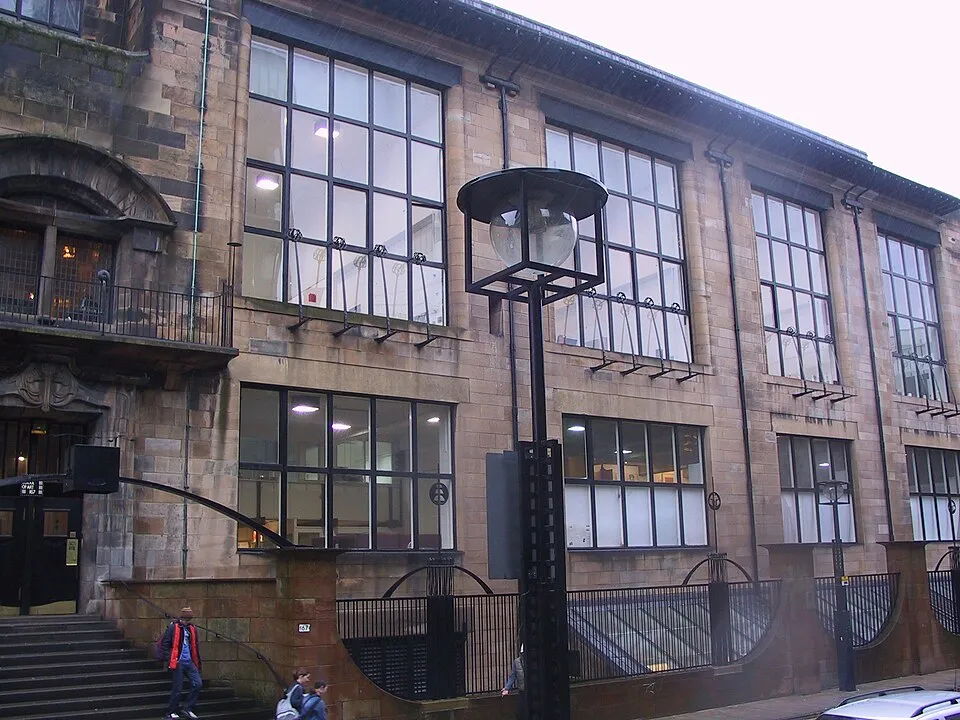
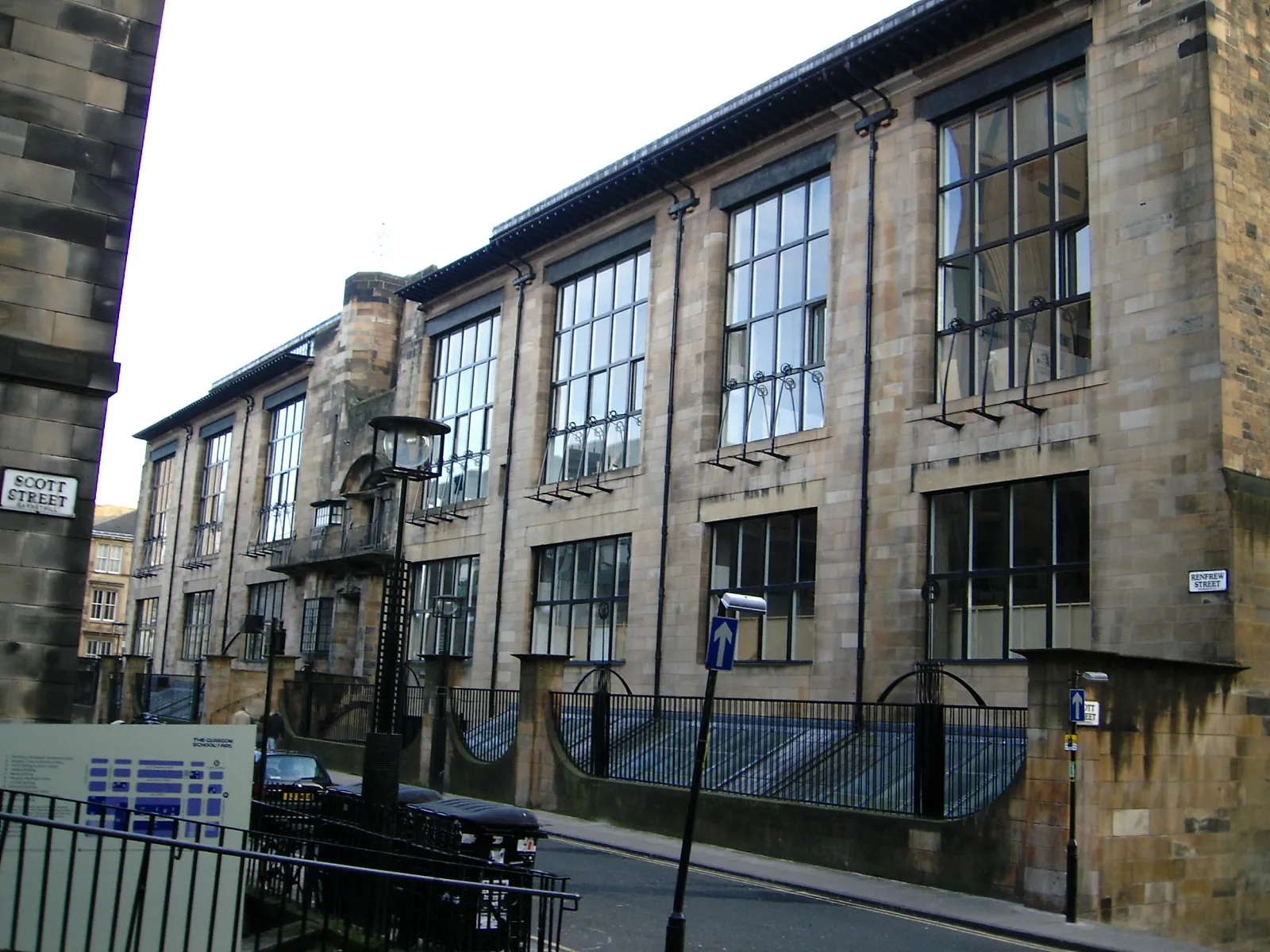
The Glasgow School of Art, designed by Charles Rennie Mackintosh and completed in 1909. Most of the Glasgow Style's physical work is in Glasgow, but Edinburgh's National Galleries hold the Macdonald sisters' watercolors and the movement's collection documentation. The building was seriously damaged by fires in 2014 and 2018 and is still being restored. Image via Wikimedia Commons.
The Modern Makers
The 20th century produced a run of Scottish artists who are better known outside Scotland than in it. Eduardo Paolozzi was born in Leith, Edinburgh's port, in 1924 to Italian immigrant parents. He became the father of British Pop Art, producing the "Bunk!" collages in 1952 that predated Richard Hamilton's definition of the movement, and his giant Newton sculpture outside the British Library is his most famous work. His archive and studio contents are kept at the National Gallery of Modern Art in Edinburgh, and he remains the single most important British sculptor Scotland produced.
The next generation was painterly and urban. John Bellany, born in the fishing village of Port Seton east of Edinburgh, made an entire career out of the symbolism of Calvinist guilt and the sea. Joan Eardley painted the street children of Glasgow and the crashing waves of Catterline in a style so physical the paintings smell of turpentine and salt.
Alan Davie, born in Grangemouth, became the most internationally exhibited Scottish painter of the postwar period, a jazz-playing abstractionist whose work the Tate bought in the 1950s. The 1980s "New Glasgow Boys" around Ken Currie and Peter Howson brought figurative political painting back, and the generation after produced Douglas Gordon, who won the Turner Prize in 1996 and works between Glasgow and Berlin. For the prize that confirmed them, see our guide to the Turner Prize.
The Institutions
Edinburgh's art institutions form a national collection in a single city. The Scottish National Gallery on the Mound, designed by William Henry Playfair and opened in 1859, holds the international and British collection and sits exactly where the Old Town meets the New Town. The Scottish National Portrait Gallery on Queen Street, opened in 1889 as the world's first purpose-built portrait gallery, has a Great Hall covered by William Hole's frieze of Scottish historical figures, a complete visual encyclopedia of the nation's heroes. The National Galleries of Modern Art run two buildings in the west end, one in a former school and one in a former orphanage, with the sculpture gardens and the Paolozzi archive.
The Royal Scottish Academy, founded in 1826, shares the Mound complex and remains the body that elects Scottish artists. The Dovecot Studios on Infirmary Street, founded in 1912, is a working tapestry studio that has woven work for everyone from Henry Moore to contemporary textile artists and still operates as a venue. Edinburgh College of Art traces its history to the Trustees' Academy founded in 1760 and is the oldest art school in Britain. The Collective Gallery, an artist-run space since 1984, occupies the restored City Observatory on Calton Hill and programs the most experimental work in the city. For how these institutions fit the wider British picture, see our guide to how museums decide what to display.
The August Machine
Then there is the festival. The Edinburgh International Festival was founded in 1947 to heal Europe with art, and the uninvited performers who turned up that same year started the Fringe, which is now the largest arts festival on earth. In August the city hosts the International Festival, the Fringe, the Edinburgh Art Festival (founded 2004 as the visual art arm), the Book Festival, and the Tattoo, all at once. The population doubles. The National Galleries extend hours. The Collective runs special exhibitions. It is the single month when Edinburgh stops being a museum and becomes the art world itself.
The point of the festival machinery is that it is the thing the permanent collection cannot do: it rotates. The galleries hold the national collection year-round, and every August the world arrives and shows the collection what is possible next. For the international fair system that festival cities like this connect to, see our guide to art fairs and how they work.
Final Thoughts
Edinburgh did not make all of Scottish art. Glasgow made the Glasgow Style, the Colourists worked in France, and the modernists spread across the country. But Edinburgh is where Scotland decided to keep the evidence, in a collection that runs from Raeburn's skating minister to Paolozzi's pop collages to whatever the Collective is showing on Calton Hill this month. The festival in August is the proof that the city is not only a museum: it is still a place where art is made, argued about, and sold.
Start at the National Gallery on the Mound for the collection, then the Portrait Gallery for the national heroes, then one of the Modern Art buildings for the 20th century. Book the Mansfield Traquair murals if you can. In August, forget the museums and go to the festival, which is the point. For the parallel Scottish movement, see our guide to the Glasgow Style, and for the artists Scotland gave the world, the Turner Prize.
Frequently Asked Questions
What is the most famous painting in the National Galleries of Scotland?
Sir Henry Raeburn's The Reverend Robert Walker Skating on Duddingston Loch, painted around 1795 and known as The Skating Minister, is the most famous work in the collection and an unofficial emblem of Scottish art.
What is the difference between the Edinburgh Festival and the Fringe?
The Edinburgh International Festival, founded in 1947, is the curated official festival. The Fringe, which grew from uninvited performers that same year, is now the world's largest arts festival with thousands of shows each August. The Edinburgh Art Festival, founded in 2004, covers visual art.
Who were the Scottish Colourists?
Four painters, Samuel Peploe, John Duncan Fergusson, George Leslie Hunter, and Francis Cadell, who worked in France in the early 20th century and absorbed Post-Impressionist and Fauvist color. They are now considered Scotland's most important modernist painters.
Where is Charles Rennie Mackintosh's work in Edinburgh?
Most of Mackintosh's work is in Glasgow, not Edinburgh. In Edinburgh the National Galleries of Scotland hold Glasgow Style works, and the collection includes pieces by Margaret and Frances Macdonald, whose collaborations with Mackintosh defined the movement.