
Right now, as you read this, the water level of the Great Salt Lake is lower than at any point since records began. The spiral of black basalt rocks that Robert Smithson pushed into the lake's north shore in April 1970 sits almost entirely exposed, hundreds of feet from the actual water's edge. When Smithson built Spiral Jetty, the lake lapped right up to it. In 1972, rising water covered it completely and it disappeared for nearly thirty years. That fluctuation, driven by drought and water diversion, is now recognized as one of the most vivid measures of climate change in the American West. A work made in 1970 about entropy and geological time has become, by accident, one of the most urgent environmental artworks in existence. This is land art doing what its makers always claimed it could: meaning something that was impossible to foresee at the moment of making.
Land art and earth art are terms that cover a genuinely diverse range of practices, from Smithson's heavy-machinery earthworks to Andy Goldsworthy's solitary arrangements of leaves and ice. What connects them is the decision to leave the gallery and work directly with landscape and natural materials, at scales and in locations that make conventional collecting and display impossible. These works cannot be hung on a wall. They cannot be moved to auction. They require you to travel to remote places, often in difficult weather, to see them at all. For artists in the late 1960s who were increasingly skeptical of the art market and the white cube gallery system, this was precisely the point.
The Context: Rejecting the Gallery in the Late 1960s
Land art emerged alongside conceptual art, minimalism, and performance art in a period when artists on both sides of the Atlantic were questioning what an art object was supposed to be and who it was supposed to serve. The gallery system of the 1960s revolved around collectible, transportable, expensive objects. Artists, dealers, and institutions were locked into a commercial structure that many practitioners found suffocating. Making art that was physically inseparable from a remote landscape was one way to step outside that structure entirely.
The irony, which the artists themselves recognized, is that the gallery system absorbed land art almost immediately. Photographs and films of the works circulated through galleries. Drawings, proposals, and maps for unrealized projects were sold as artworks in their own right. Smithson, Heizer, De Maria, and their contemporaries became celebrated figures within the very institutions they had tried to challenge. The tension between the idea of escaping the market and the practical reality of needing to sustain a practice remains one of the defining tensions in the history of the movement, and it has never been fully resolved.
Robert Smithson and Spiral Jetty
Robert Smithson (1938-1973) was the most theoretically ambitious figure in land art, and Spiral Jetty is his defining work. The 1,500-foot coil of black basalt rock, salt crystals, and earth was built at Rozel Point in the north arm of the Great Salt Lake using 6,650 tons of material over six days in April 1970. Smithson chose the site for its reddish water, which gets its color from halobacteria that thrive in the lake's extreme salinity, and for the visible remains of a failed oil extraction operation nearby. The industrial failure was part of the subject matter, not a distraction from it.
Smithson was preoccupied with entropy: the tendency of complex systems to move toward disorder. He wrote extensively about geology and deep time, and Spiral Jetty was designed to be experienced within those frameworks rather than in terms of conventional aesthetic pleasure. Walking the spiral from its outer edge to the center takes about fifteen minutes. The white salt crystals that coat the rocks in dry periods make the surface feel like walking on a crust of something barely solid. The lake, the salt flats, and the high desert sky are present on all sides in a way that no gallery could replicate.
In 2002, after nearly thirty years of submersion, Spiral Jetty reemerged as the lake level dropped. It has been accessible to visitors ever since, and in 2024 it was added to the National Register of Historic Places. As the Holt/Smithson Foundation noted at the time, the current water levels represent a new dimension of the work's engagement with entropy: the lake itself is retreating, leaving the jetty stranded in a way Smithson never anticipated but would likely have recognized as a continuation of the themes he built into the piece.
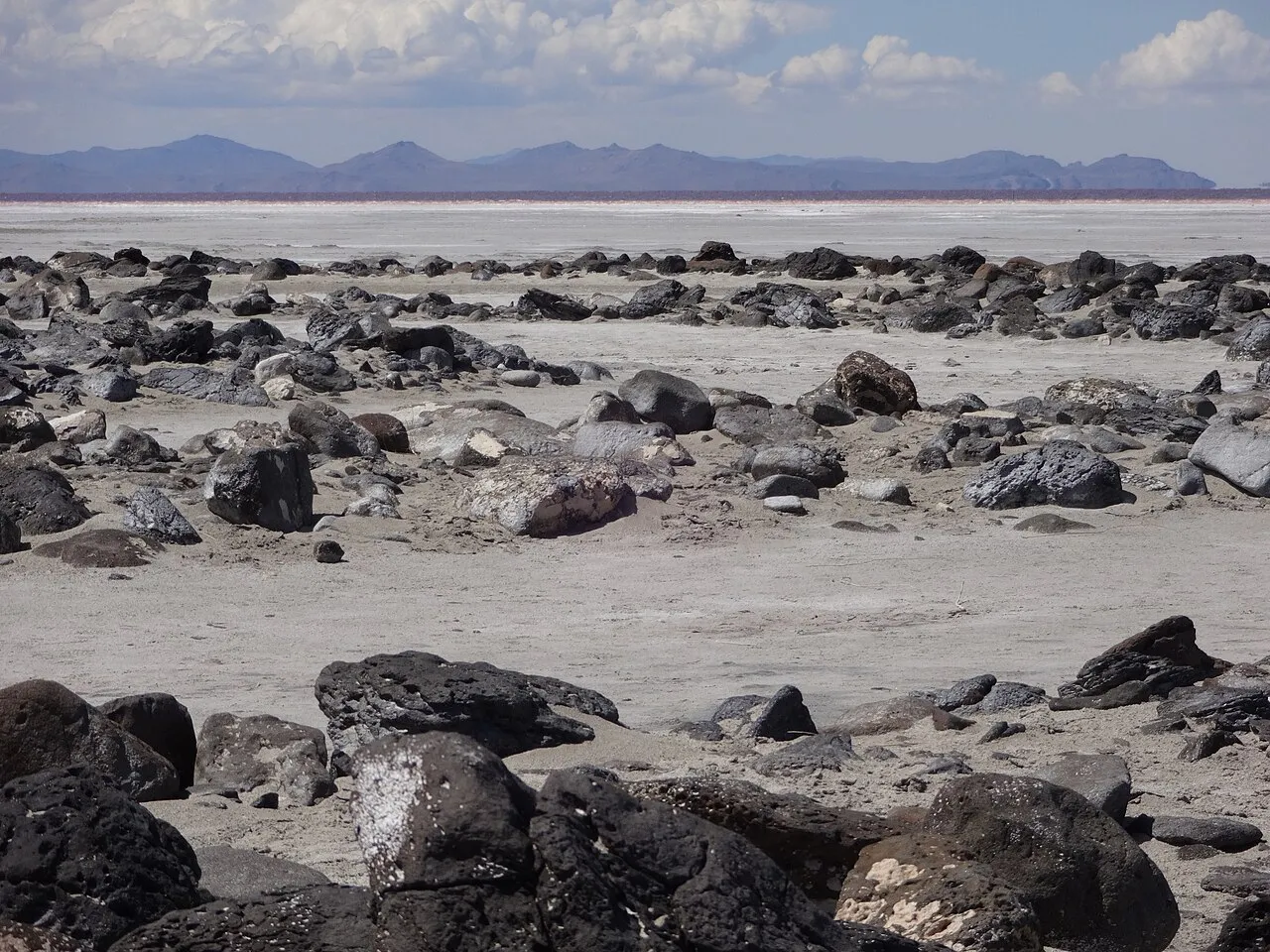
Robert Smithson, "Spiral Jetty" (1970), Rozel Point, Great Salt Lake, Utah. 1,500 feet of black basalt rock, earth, and salt crystals. The reddish water is caused by halobacteria. Managed by the Dia Art Foundation. Photo: CC BY-SA, via Wikimedia Commons
Michael Heizer and Walter De Maria: The Scale of the West
Smithson's contemporaries were working at similarly extreme scales. Michael Heizer's "Double Negative" (1969-70) is two facing cuts, each 50 feet wide and 30 feet deep, blasted into the Nevada desert at Mormon Mesa. Together they displace 240,000 tons of rhyolite and sandstone. There is nothing in the two trenches except the cuts themselves and the view through them across the desert. The work is about absence and presence, about what is displaced and what remains, in ways that only become clear when you stand in one trench and look across at the other.
Heizer's ongoing project "City," begun in 1972 in the Nevada desert and still under construction as of 2026, is on course to be the largest contemporary art installation ever built. At roughly a mile and a half long, it has been compared in scale to the Mall in Washington D.C. The decades of work Heizer has put into it, financed through the sale of smaller studio works, represent a commitment to land art as a life's work rather than a series of projects.
Walter De Maria's "The Lightning Field" (1977) takes a more austere approach: 400 stainless steel poles, each approximately 20 feet tall, arranged in a precise grid across a flat plain in New Mexico. The poles are designed to attract lightning during summer storms. Visitors stay overnight in a cabin on the site and observe the poles over the course of a day and night, watching how they interact with light, weather, and the shifting quality of the desert sky. The Dia Art Foundation, which manages both Spiral Jetty and The Lightning Field, keeps visitor numbers deliberately low to preserve the contemplative quality of the experience.
Christo and Jeanne-Claude: Wrapping the World
Christo Vladimirov Javacheff (1935-2020) and his partner Jeanne-Claude (1935-2009) developed a practice that is formally quite different from the American earthworkers but shares the commitment to scale and to working outside the conventional gallery context. They wrapped things: small objects in the early years, then progressively larger structures, then entire buildings and landscapes.
The Wrapped Reichstag in Berlin (1995) covered the German parliament building in 100,000 square meters of silvery polypropylene fabric and 15 kilometers of blue rope for two weeks. It required 24 years of negotiation with the German parliament before permission was granted. The Gates (Central Park, New York, 2005) installed 7,503 free-hanging saffron fabric panels along 37 kilometers of walkways for 16 days. Both projects were financed entirely by the sale of preparatory drawings, collages, and scale models. Christo and Jeanne-Claude never accepted corporate or government money. This meant the work remained under their complete control but also required enormous personal financial risk.
After Jeanne-Claude's death in 2009, Christo continued working. His final project, "L'Arc de Triomphe, Wrapped" (Paris, September 2021), was completed posthumously according to his own instructions, wrapping the monument in 25,000 square meters of recyclable polypropylene fabric and 3,000 meters of red rope. Approximately 800,000 visitors came to see it in 16 days. The materials were then removed and recycled, leaving no permanent trace, exactly as every Christo and Jeanne-Claude project had been designed to do. The temporariness is not a limitation. It is the condition that makes the presence of the work so concentrated while it exists.
Andy Goldsworthy: Ephemeral and Permanent
Andy Goldsworthy (born 1956) works in a register that feels almost opposite to the industrial scale of the American earthworkers. He goes alone to a specific place, works with materials found there, leaves, ice, stone, twigs, snow, clay, thorns, creates a sculpture or arrangement, photographs it, and then either leaves it to be changed by weather and time or dismantles it himself. Many of his works last hours. Works made from ice or dew-covered leaves may last minutes before the material disperses.
This makes the photograph the primary art object, a record of something that no longer exists in its original form. A cairn of flat stones balanced in a riverbed, visible for a few hours before the current dissolves it, is not a lesser work than a permanent sculpture. It is a work specifically about the conditions of its existence, about how natural processes and human intention interact, and about the difference between a thing and the evidence of a thing.
Goldsworthy also makes permanent work. "Stone River" (2001) at Stanford University is a dry-stone wall made from locally quarried red sandstone that flows through the campus landscape like a river, 320 feet long and entirely unmortared. His "Roof" installation at the National Gallery of Art's sculpture garden in Washington D.C., made in 2004-05, is a series of dry-stone dome structures whose dark interior spaces open to the sky. These permanent works use the same formal vocabulary as his ephemeral pieces, a sensitivity to the grain and color of local stone, a preference for organic curves over geometric forms, but they exist on a different timescale.
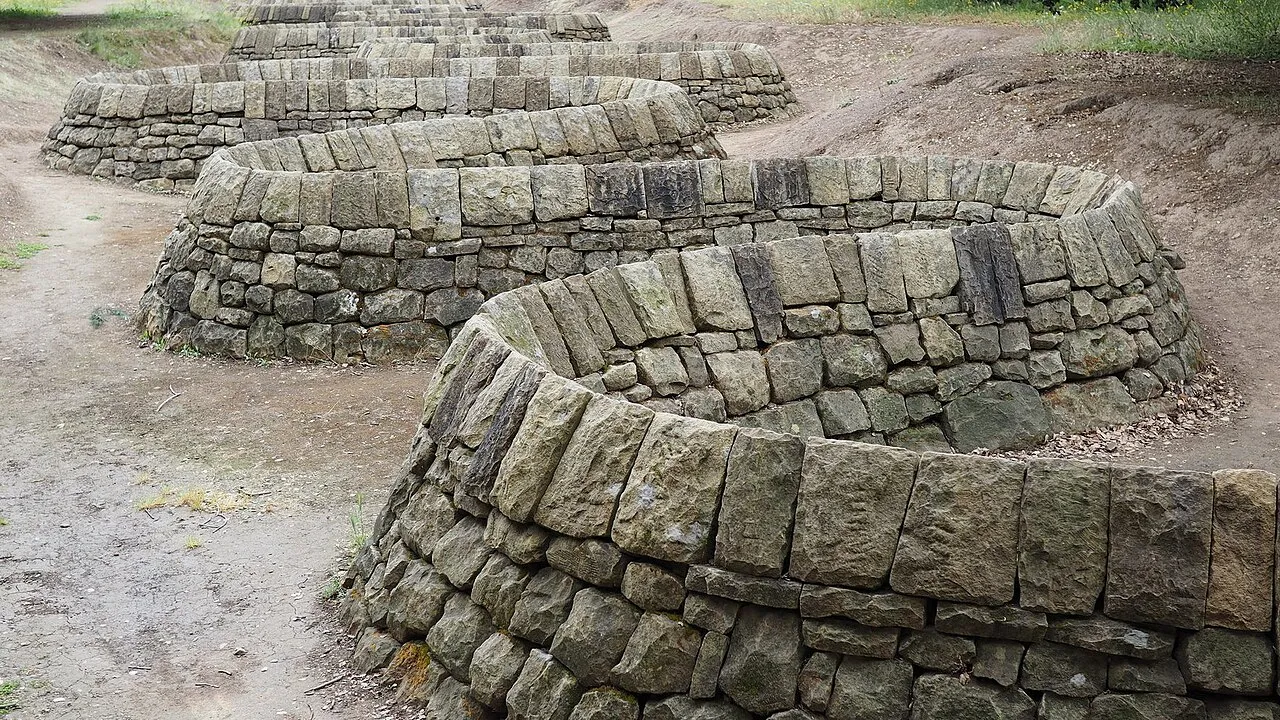
Andy Goldsworthy, "Stone River" (2001) at Stanford University. A permanent dry-stone sculpture that flows through the landscape like a river. Goldsworthy's practice spans the full range from ephemeral works that last minutes to permanent installations like this one. Image: CC BY-SA, via Wikimedia Commons
Land Art, Ecology, and the Question of Intervention
The relationship between land art and environmental concerns is complicated and has shifted considerably over the decades since the movement's origins. The first generation of land art was often physically invasive. Heizer's "Double Negative" involved blasting enormous quantities of rock. Smithson's jetty was built with heavy machinery over six days. This level of physical intervention sits uneasily alongside contemporary ecological thinking, however sophisticated the theoretical engagement with entropy and geological time that accompanied the work.
Later practitioners, including Goldsworthy and the German land artist Herman de Vries, work with materials found on site, make no permanent alterations to the landscape, and treat the land as something to work with rather than something to reshape. Agnes Denes, whose "Wheatfield: A Confrontation" (1982) planted two acres of wheat on a landfill in lower Manhattan, explicitly positioned her practice as environmental activism as much as art-making. Her later work includes large-scale tree planting projects and proposals for ecological restoration that operate at the boundary between art and environmental science.
By 2026, the intersection of art and ecology is one of the most active areas in contemporary practice. Artists, scientists, landscape architects, and activists are working in overlapping territory on questions of rewilding, carbon sequestration, and ecological repair. The question of what counts as art in this expanded field, and who has the authority to make and maintain works in public landscapes, remains genuinely unsettled. For the gallery-based version of the same impulse to put the viewer inside the work, the installation art guide covers that territory. For how the physical scale of a work changes what it means, the understanding scale guide is worth reading alongside any engagement with land art. And for how art has historically engaged with political and environmental questions, the art and protest guide offers broader context.


