The oldest confirmed rock art in Australia is not 5,000 years old. It is not 10,000 years old. Researchers working in the Kimberley region of Western Australia have published findings suggesting certain images are more than 50,000 years old, making them older than the famous cave paintings at Chauvet in France. The people who made those first marks on the rock faces belonged to cultures that have maintained continuous artistic traditions ever since. No other artistic tradition on earth comes close to that span of time.
That fact should change how you approach everything that follows. Indigenous Australian art is not a curiosity. It is not folk craft. It is the longest-running visual tradition in human history, and it produced, in the 20th century alone, artists of international stature whose work hangs in major museums worldwide alongside Picasso and Pollock. The dot paintings that Western audiences tend to recognize as "Aboriginal art" represent only one tradition within a much larger and more diverse world of artistic practice.
This guide covers the major traditions of Indigenous Australian art, from the ancient rock paintings of the Kimberley to the revolutionary canvas painting movement of the 1970s, with attention to what it means to engage this work with genuine understanding rather than superficial appreciation.
The Dreaming: Art as Living Knowledge
The word "Dreamtime" appears constantly in popular writing about Aboriginal culture, but it is frequently misused. The anthropologist W. Baldwin Spencer coined the term in the late 19th century as a translation of the Aranda word alcheringa, and it has been applied loosely ever since to describe the cosmological frameworks of many different Aboriginal groups. The word "Dreaming" is now generally preferred by Indigenous Australians themselves, because "Dreamtime" suggests something that happened in the past, like a dream you wake from. The Dreaming is not past. It is ongoing.
The Dreaming describes a condition in which ancestral beings traveled across the land, creating its physical features, establishing laws, and laying down the patterns of existence that living people are responsible for maintaining. A mountain is not just geology. It is the physical record of an ancestral action, which is why it may be sacred in a direct and literal sense. The patterns in a painting, the songs sung along a ceremonial route, and the specific paths walked across country are all forms of the same fundamental knowledge. Custodianship of that knowledge is a serious cultural obligation, not a casual one.
This is why Indigenous Australian art is not purely aesthetic. A painting depicting a particular stretch of country may encode Dreaming track routes, knowledge of seasonal water sources, territorial boundaries, and ceremonial protocols. The Australian Institute of Aboriginal and Torres Strait Islander Studies (AIATSIS) maintains archives that document how layers of meaning in these works are accessible to different people depending on their cultural authority and initiation status. What looks like an abstract pattern to an outside viewer may be a map, a law, and a ceremony all at once.
Rock Art: The Longest Tradition
Australia has one of the world's densest concentrations of rock art. Hundreds of thousands of known sites are distributed across the continent, and many more have not been formally documented. The traditions are not uniform: styles, subjects, and techniques vary significantly between regions and time periods, reflecting the enormous cultural diversity of Australia's Aboriginal peoples.
The Bradshaw paintings, known to the Ngarinyin people as Gwion Gwion, in the Kimberley region of Western Australia are among the most visually striking. They show elongated human figures in dynamic poses, often wearing elaborate headdresses and ornaments. Some are estimated at more than 17,000 years old, making them older than the cave paintings of Lascaux in France. The figures are rendered with a delicacy and sense of movement that would be impressive in any era.
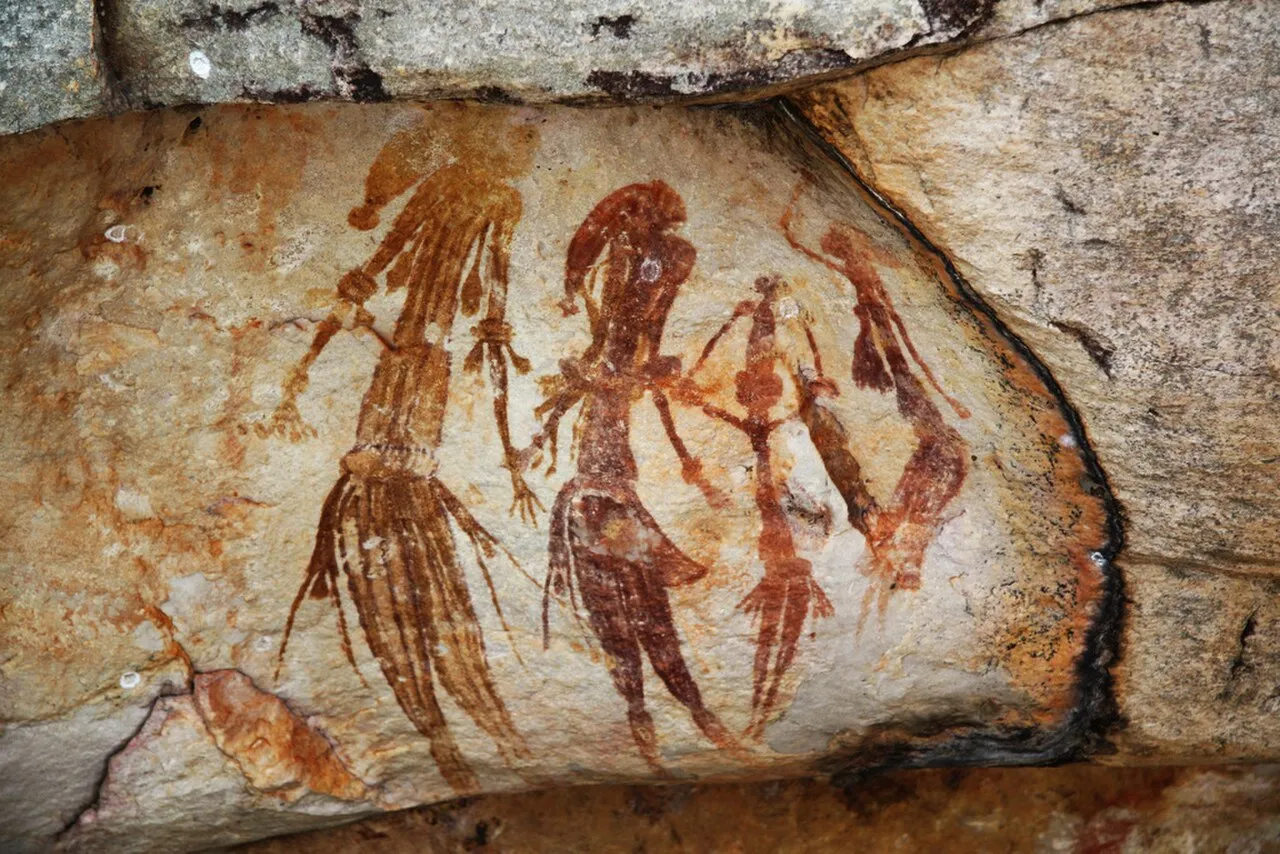
Bradshaw paintings (Gwion Gwion), Kimberley region, Western Australia. These elongated figures, some estimated at over 17,000 years old, are among the world's oldest representational art and are sacred to the Ngarinyin people. Image: Wikimedia Commons, CC BY-SA 3.0
The Wandjina figures, also from the Kimberley, are visually unmistakable: large, rounded forms with white faces, enormous eyes, and no mouths, their headdresses suggesting clouds and rain. The Wandjina are ancestral beings associated with the wet season and fertility. What is significant is that these images are not historical records. They are repainted by custodians in ongoing ceremonies to maintain their power and connection. The tradition is alive.
In Arnhem Land in the Northern Territory, the X-ray style depicts animals and humans with internal organs and skeletal structures visible alongside the outer form. A barramundi shows its backbone, air bladder, and digestive organs as clearly as its scales and fins. This is not naive representation. It is a deliberate choice to show the complete creature, including the anatomical knowledge that makes it useful as food and meaningful in ceremony. Form follows knowledge, not just observation.
Bark Painting: Identity and Country in Arnhem Land
In the tropical forests of Arnhem Land, a tradition of painting on bark developed that remains active today. Bark painters work on the inner surface of stringybark eucalyptus, prepared by removing the outer bark, flattening the piece with heat, and smoothing the surface. Pigments are made from natural materials: white from pipe clay, yellow and red ochre from iron-rich earth, and black from charcoal. These same pigments have been used for tens of thousands of years.
The most technically distinctive element of Arnhem Land bark painting is the cross-hatching pattern called rarrk. Different clans maintain their own specific rarrk patterns as markers of identity and territorial relationship with country. The patterns are not interchangeable decorations but coded information about who made the work and what country it belongs to. When you look at rarrk in a bark painting, you are reading a signature as much as seeing a style.
Bark paintings entered Australian legal history in 1963, when the Yolngu people of northeast Arnhem Land sent a formal petition to the Australian Parliament decorated with bark paintings. The Yirrkala Church Panels, now in the National Museum of Australia, were presented alongside the petition as evidence of Yolngu law and land ownership. They were the first formal recognition by the Australian Parliament of an Indigenous document. The legal demands of the petition were not met for decades, but the panels represent a moment when art was used directly as legal argument, which is not something that happens often in any tradition.
The Papunya Tula Movement and Dot Painting
The dot painting style that most Western audiences associate with Aboriginal art has a specific and recent origin. In 1971, Geoffrey Bardon, a schoolteacher at Papunya in the Western Desert of the Northern Territory, encouraged Aboriginal men to paint their sacred sand designs on the walls of the school building. The resulting work attracted attention, and in 1972 the artists formed the Papunya Tula Artists cooperative, which still operates today.
The characteristic dot-covered surface of Western Desert painting was, in significant part, a strategic decision. Many of the underlying designs were sacred and restricted in their circulation. Covering the essential forms with additional dots and patterns allowed artists to display and sell the works commercially without fully exposing the sacred knowledge encoded in them. It was a form of cultural protection built directly into the visual surface of the work.
Clifford Possum Tjapaltjarri (c. 1932 to 2002) is among the most celebrated Papunya Tula artists. His large-scale paintings map Dreaming tracks across the Central Desert, combining multiple ancestral narratives in a single composition. "Warlugulong" (1977), now in the Art Gallery of New South Wales, depicts the site of a great fire created by a serpent ancestor, rendered in a format that reads simultaneously as aerial map, ceremonial diagram, and abstract painting. It is one of the most significant works in Australian art history, period.
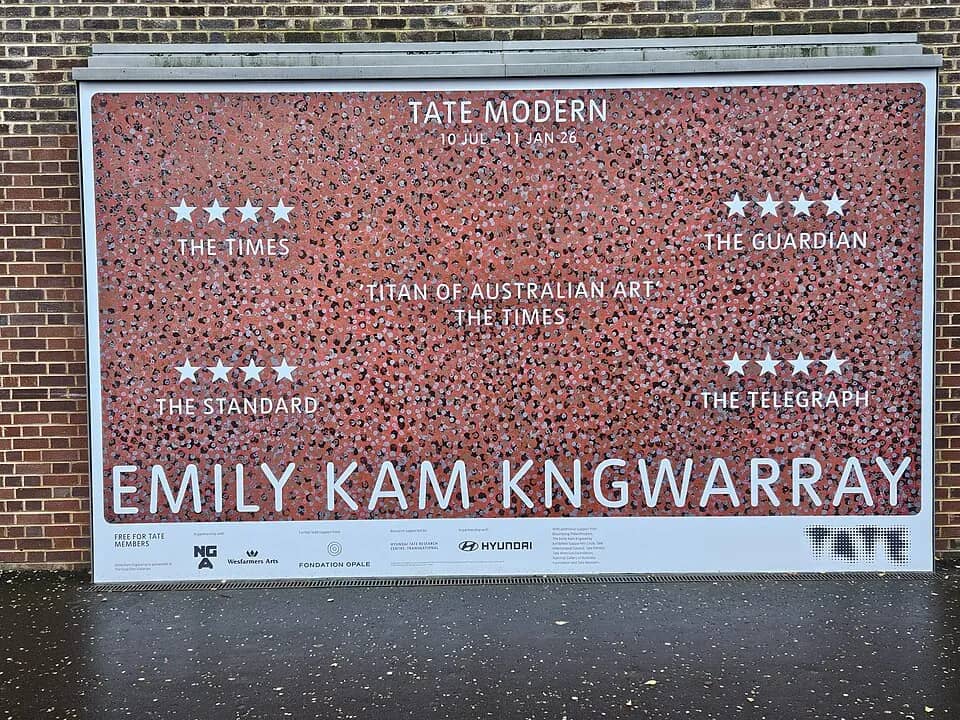
Emily Kame Kngwarreye (c. 1910 to 1996) began painting at roughly 79 years old. In the eight years she worked on canvas, she produced a body of work of extraordinary scope, moving from dense yam-root patterned compositions to nearly pure abstract fields of color that feel simultaneously ancient and entirely contemporary. Her paintings have sold for over a million dollars at auction and hang in the National Gallery of Australia alongside major Western modernists. She is recognized as one of the most important Australian artists of the 20th century, not just in the context of Aboriginal art. The qualifier matters less and less the more closely you look at the work.
Authenticity, Ownership, and the Fake Art Market
A significant and damaging market in counterfeit Aboriginal art has existed since at least the 1990s. Non-Indigenous artists and manufacturers produced works using the visual vocabulary of dot painting without any connection to the cultural knowledge it encodes, selling them as authentic at markets, tourist shops, and eventually online. The economic harm to Aboriginal communities has been substantial. The cultural harm, in terms of decontextualizing sacred visual knowledge and flooding the market with fakes, is harder to quantify but real.
In 2018, the Australian government introduced a mandatory industry code for the Aboriginal and Torres Strait Islander art market, requiring disclosure of artist identity and community affiliation. In 2024, the First Nations Cultural and Intellectual Property in Australia legislation introduced criminal penalties for the production and sale of inauthentic Indigenous art. These measures represent belated recognition that art encoding cultural knowledge belongs to the communities whose knowledge it is.
If you are buying Indigenous Australian art, the rule is straightforward: know the artist's name, their community, and their language group. Buy through community art centers or reputable dealers who can document provenance. The Indigenous Art Code maintains a list of ethical dealers. Anything sold without this information at a tourist market should be treated with serious skepticism.
Final Thoughts
The common framing that places Indigenous Australian art in an "ethnographic" category separate from "real art history" is both intellectually lazy and factually wrong. Emily Kame Kngwarreye's late paintings are formally comparable to the best Color Field abstraction of the 1960s, except they are rooted in sixty thousand years of continuous cultural tradition rather than a decade of New York theory. The Papunya Tula artists solved problems of sacred knowledge and commercial viability that no Western artist had faced in quite the same way, and they did so with remarkable visual intelligence.
The work rewards sustained attention and genuine curiosity about the cultural frameworks that give it meaning. That is not a special requirement. That is exactly what the best art always requires. For context on how art functions differently across cultural traditions, our guides to African art and Japanese art cover traditions where the visual and the spiritual are similarly intertwined. Our guide to how to look at art for beginners will help you develop the patient attention this art rewards. What aspect of Indigenous Australian art compels you most? Leave a comment below.