Peter Draws: Pen, Ink, and Zero Planning
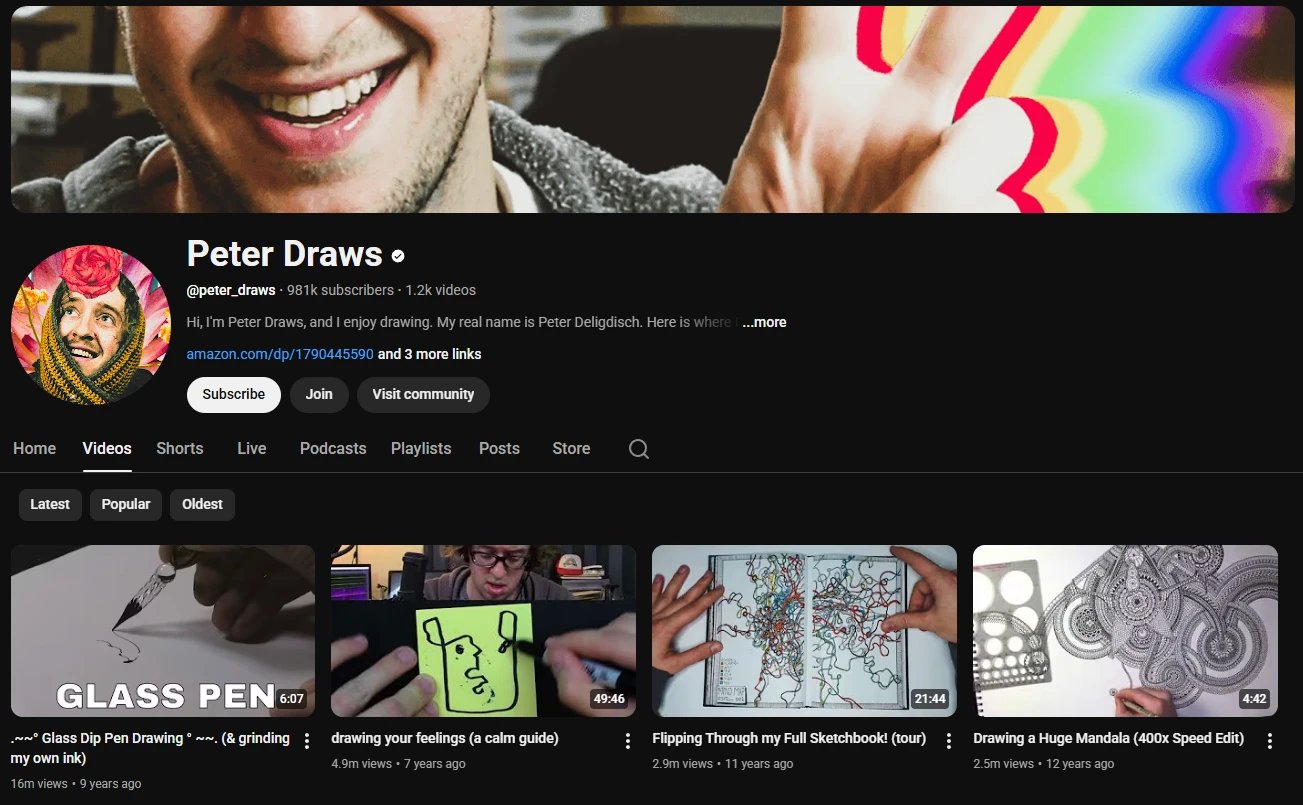
Most art YouTube channels teach you something. Peter Draws does not teach you anything, and that is exactly why nearly a million people keep watching. Peter Deligdisch, who started uploading in 2006, sits at an overhead camera, picks up a pen, and draws. No sketch. No plan. No eraser. Just ink hitting paper, one mark at a time, growing into dense geometric patterns, organic forms, and architectural fantasies that look like they were planned but were not.
His most popular video, a glass dip pen drawing session where he grinds his own ink, has over 14 million views. Not because it teaches technique. Because watching someone commit to permanent marks without flinching is genuinely riveting, and the sound of a nib on paper turns out to be one of the best relaxation aids on the internet.
What You Are Actually Watching
Peter works in permanent ink. There is no pencil underdrawing, no rough layout, no safety net. A line goes down and it stays. If a mark goes somewhere unexpected, he builds around it. If the composition starts feeling unbalanced, he adds weight on the other side. The drawings grow organically, each mark responding to the one before it, and the result is a kind of visual improvisation that you rarely see in any art form.
The format is consistent across his 1,300-plus videos: overhead camera, paper, pen, and Peter talking softly over the scratch of ink. He speeds up the footage in Adobe Premiere Pro and records commentary afterward, which means the philosophical reflections are layered on top of a real-time drawing session rather than performed live. This gives the commentary a thoughtful, unhurried quality that live narration cannot match.
Pen Reviews That Feel Like Wine Tasting
Peter reviews pens the way a sommelier reviews wine. He does not read spec sheets or compare nib widths in a spreadsheet. He draws with each pen and tells you what it feels like: the scratch of the nib on textured paper, the flow of ink through the feed, the weight of the barrel in his hand, the visual character of the line it lays down. His favorites are Rotring Isographs, but his archive covers fountain pens, glass dip pens, brush pens, fineliners, and specialty writing instruments from brands most art supply channels never mention.
This matters because the pen community and the art community overlap more than you might expect. Stationery enthusiasts watch Peter for the pen reviews. Artists watch him for the drawing process. Both groups leave with a better understanding of how tools affect mark-making, which is something no specification page can communicate.
The ASMR Audience
A significant portion of Peter's audience does not identify as artists. They found the channel through ASMR communities, anxiety management forums, or sleep aid playlists. The combination of close-up pen-on-paper audio, Peter's low speaking voice, and the slow visual rhythm of marks accumulating on paper creates a sensory experience that people use for stress relief, focus while working, or falling asleep.
This crossover is worth noting because it explains why a channel with no tutorials, no structured lessons, and no career advice can accumulate 150 million views. The content serves a function that goes beyond art education. It is closer to ambient media, and Peter seems to understand this intuitively.
How It Compares to Other Pen and Ink Channels
Peter Draws occupies a space that overlaps with channels like Teoh Yi Chie, who reviews art supplies with methodical thoroughness, and Aaron Rutten, who covers digital painting hardware. But Teoh approaches pens as a reviewer testing products, while Peter approaches them as an artist exploring tools through use. Teoh gives you a verdict. Peter gives you an experience.
The closest comparison might be James Gurney, who also shares process-focused art content with minimal instruction. But Gurney is a plein air painter working in watercolor and gouache, while Peter works exclusively in ink, indoors, at a desk. The audiences are different, but the philosophy is similar: watch me work, and take from it what you need.
Who Should Watch
Artists who struggle with perfectionism will find Peter's approach genuinely useful. Watching someone draw in permanent ink without planning, and seeing the results look good anyway, is a direct challenge to the idea that art requires careful preparation. If you freeze up before making a mark because you are afraid of ruining the page, Peter's videos are a counterargument in visual form.
Pen and stationery enthusiasts get the most thorough pen reviews on art YouTube, covering brands and instrument types that no other channel addresses with this level of tactile detail.
People looking for relaxation content will find the ASMR quality of the videos effective for focus, stress relief, or sleep. You do not need to care about drawing to enjoy the audio and visual rhythm.
Who Should Skip It
If you want to learn drawing fundamentals, this is not your channel. Peter does not teach construction, perspective, anatomy, or composition in any structured way. You will not find step-by-step tutorials here. Beginners who need instruction should start with Proko or Will Kemp Art School instead.
If you want digital art content, Peter works exclusively in traditional ink. Digital artists will find nothing directly applicable here, though the philosophy of committing to marks without undoing them is relevant regardless of medium.
Insider Tips
- Start with his glass dip pen video to understand the appeal. It is the channel's most viewed video for a reason.
- His pen review archive is searchable on his channel. If you are shopping for a fountain pen or fineliner, check whether he has reviewed it before buying.
- Peter mentions his preferred papers in passing during drawing videos rather than in dedicated reviews. Crescent Rendr and Moleskine sketchbooks come up frequently, as does Bristol board for loose-leaf work.
- The videos work well as background audio. If you paint or draw along to YouTube, Peter's commentary provides company without demanding attention.
Final Verdict: Who Is This Actually For?
Peter Draws is not an art education channel. It is a channel about the pleasure of making marks, the character of drawing tools, and the mental state that comes from working without a plan. For artists battling perfectionism, pen collectors evaluating their next purchase, or anyone who needs 20 minutes of calm in their day, Peter Deligdisch has built something that no other channel replicates. For structured learning, look elsewhere. For inspiration and sensory satisfaction, this is the channel.
Start with his most popular videos and let the pen do the talking.