
For decades, it was thought that the first artist to take the momentous step of painting entirely abstract art was Wassily Kandinsky in 1911. What the historians did not consider was that there was someone else entirely removed from mainstream artistic circles at the time who had beaten Kandinsky to it by half a decade, according to Christopher P Jones. That someone was Hilma af Klint (1862-1944), a Swedish painter who "had created her first abstract painting in her Stockholm studio in 1906, five years before him. What's more, she had taken the same path towards abstraction. Without knowing of each other's existence, the two artists seem to have travelled for a long way like two trains on the same tracks. Klint arrived before Kandinsky," writes Julia Voss for Tate.
The story of who invented abstract art is not just a question of dates. It is a question of who gets remembered, who gets written into the history books, and who gets left out. Kandinsky wrote to his gallerist in 1935, anxious to reassure him once again that he had painted his first abstract picture in 1911: "Indeed, it's the world's first ever abstract picture, because back then not one single painter was painting in an abstract style. A 'historic painting,' in other words." He knew the art world was engaged in a contest. To be acknowledged as having produced the first abstract painting had become a highly coveted prize. Af Klint never made such a claim. She painted in isolation, guided by spiritual beings she called "The High Masters," and instructed that her work not be shown until 20 years after her death. Her paintings were not exhibited until 1986, 42 years after she died, and 75 years after Kandinsky's claimed first abstract. The question is not just who was first. The question is why it took the art world so long to notice. This guide covers Kandinsky's claim, af Klint's counterclaim, the shared spiritual path, why af Klint was forgotten, what the debate means for art history, and why the question matters. For more on specific works, see our guide to famous paintings.
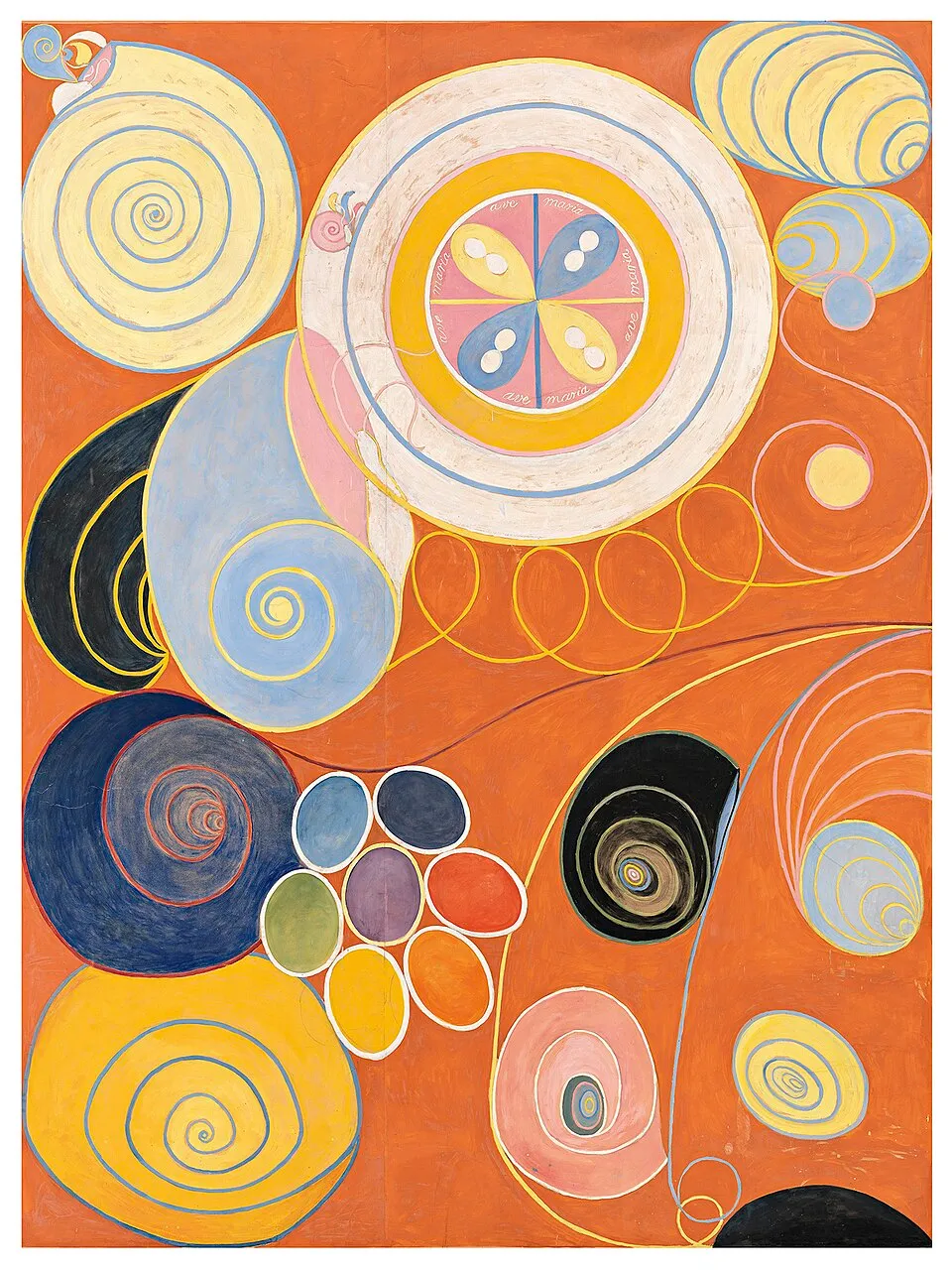
Hilma af Klint, "The Ten Largest, No. 3, Youth" (1907). Egg tempera on paper mounted on linen. Hilma af Klint Foundation. "Hilma af Klint had created her first abstract painting in her Stockholm studio in 1906, five years before him. What's more, she had taken the same path towards abstraction. Without knowing of each other's existence, the two artists seem to have travelled for a long way like two trains on the same tracks. Klint arrived before Kandinsky" (Julia Voss, Tate). Image via Wikimedia Commons
Kandinsky's Claim: 1911 and the "Historic Painting"
When Wassily Kandinsky wrote to his New York gallerist Jerome Neumann in December 1935, he was clearly anxious to reassure him once again that he had painted his first abstract picture in 1911: "Indeed, it's the world's first ever abstract picture, because back then not one single painter was painting in an abstract style. A 'historic painting,' in other words." Sadly, this historic painting was thought lost. The artist neglected to take it with him when he left Russia in 1921 for Germany, before later moving to France.
He knew the art world was engaged in a contest. To be acknowledged as having produced the first abstract painting had become a highly coveted prize. Which modern artist could claim that prize was still being fought over. The other leading candidates were František Kupka, Robert Delaunay, Piet Mondrian, and Kazimir Malevich. For Kandinsky, his artistic drive was premised on the perception of man and nature as deriving from the same cosmic realm, a romantic spiritual whole beyond the tangible world, leading him to think of abstract painting as an access point into that mystical structure. Kandinsky's path to abstraction was spiritual. He believed that art could access a reality beyond the visible world.
The timeline: Kandinsky's first abstract watercolor is dated 1910, though some scholars dispute this and date it to 1913. His "Composition V" is dated 1911. His treatise "Concerning the Spiritual in Art" was published in 1911. The claim is 1911, and it was made repeatedly, insistently, for the rest of his life. For more on specific works, see our guide to famous paintings.
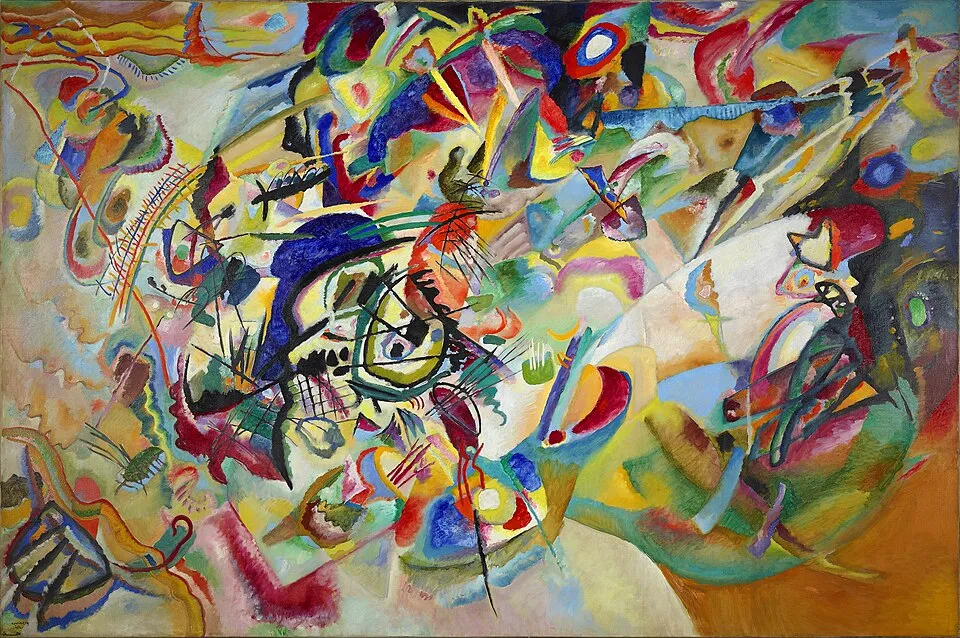
Wassily Kandinsky, "Composition V" (1911). Oil on canvas. "When Wassily Kandinsky wrote to his New York gallerist Jerome Neumann in December 1935, he was clearly anxious to reassure him once again that he had painted his first abstract picture in 1911: 'Indeed, it's the world's first ever abstract picture, because back then not one single painter was painting in an abstract style. A "historic painting", in other words'" (Julia Voss, Tate). Image via Wikimedia Commons
Af Klint's Counterclaim: 1906 and The Paintings for the Temple
A Swedish painter by the name of Hilma af Klint had created her first abstract painting in her Stockholm studio in 1906, five years before him. In 1906, Hilma af Klint embarked upon an extensive body of work that she titled "The Paintings for the Temple." Upon its completion in 1915, the project comprised 193 individual works organised broadly into ten series, some divided further into sub-series, according to the Hilma af Klint Foundation. Years later, af Klint wrote that completing this project had been "the one great task I carried out in my lifetime." She described it as a "commission" received from the spirit guide Amaliel.
The timeline is precise. In January 1906, the spiritual being Amaliel offered her a commission, which she accepted immediately. After a period of preparation, in November she commenced the cycle "The Paintings for the Temple" with its first series, "Primordial Chaos." In 1907, she painted the series "Eros," "The Great Figure Paintings," and "The Ten Largest." In 1915, she completed "The Tree of Knowledge" and "The Swan." Her series "The Dove" followed, then "Altarpieces," completing the cycle "The Paintings for the Temple," which then comprised 193 paintings.
"The Ten Largest" (1907) is the place to start. Hilma af Klint began to work on "The Ten Largest" in the wake of a revelation: her spiritual guides instructed her to make "ten paradisaically beautiful paintings" which would give the world a glimpse of the four stages of life, according to the Guggenheim Bilbao. Each composition took only four days to paint. With a format that was somewhat unusual at the time and painted with tempera, a medium that harks back to the Renaissance and the altarpieces of the Florentine churches. The works are monumental, over 2 meters tall, and predominantly abstract.
At the Academy of Fine Arts, af Klint befriended Anna Cassel, one of the four women with whom she established "The Five," a group exploring spiritual realms through meditation and séances. The other members were Cornelia Cederberg, Sigrid Hedman, and Mathilda Nilsson. "The Five," active between 1896 and 1908, recorded messages from higher spirits referred to as "The High Masters." In trancelike states, the group believed they could communicate with mystic beings with names such as Amaliel, Ananda, and Gregor. For more on building your knowledge, see our guide to teaching yourself art history.
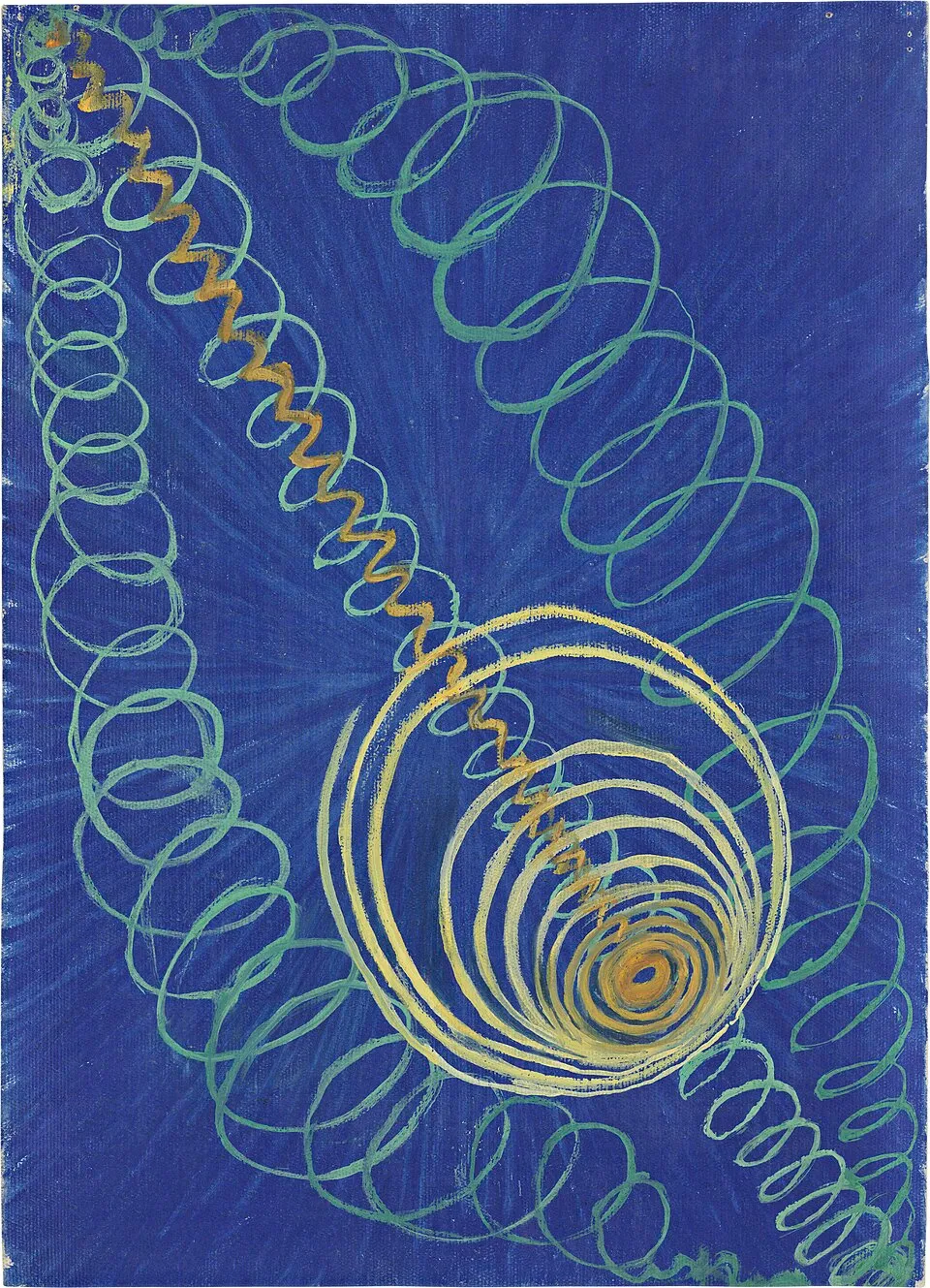
Hilma af Klint, "Primordial Chaos" series (1906-07). "In 1906 Hilma af Klint embarked upon an extensive body of work that she titled The Paintings for the Temple. Upon its completion in 1915, the project comprised 193 individual works organised broadly into ten series" (AGNSW). Image via Wikimedia Commons
The Shared Spiritual Path: Two Trains on the Same Tracks
What is striking about the arrival of abstraction for both af Klint and Kandinsky is its relationship to their philosophical outlook. Af Klint had taken the same path towards abstraction. Without knowing of each other's existence, the two artists seem to have travelled for a long way like two trains on the same tracks. Klint arrived before Kandinsky. For Kandinsky, his artistic drive was premised on the perception of man and nature as deriving from the same cosmic realm, a romantic spiritual whole beyond the tangible world, leading him to think of abstract painting as an access point into that mystical structure.
Both af Klint and Kandinsky were deeply engaged with spiritualism, Theosophy, and the idea that art could access a reality beyond the visible world. Af Klint was a spiritualist who conducted séances with "The Five." Kandinsky was a Theosophist who wrote "Concerning the Spiritual in Art" in 1911. Both believed that abstraction was not an aesthetic choice but a spiritual one, a way of accessing the unseen. The difference is that Kandinsky wrote about his spiritual beliefs. He published treatises, gave lectures, and explained his theories. Af Klint did not. She painted in isolation, guided by spirits, and instructed that her work not be shown until 20 years after her death. Kandinsky's abstraction was accompanied by theory. Af Klint's was accompanied by silence.
The shared spiritual path suggests that abstraction was not invented by a single genius. It was a response to a cultural moment, the spiritualist movement of the late 19th and early 20th centuries, that multiple artists arrived at independently. The "invention" of abstraction was not a singular event but a convergence. For more on how art interacts with culture, see our guide to art and society.
Why Af Klint Was Forgotten
Af Klint worked in Stockholm, outside the mainstream art centers of Paris, Munich, and Moscow. She was not part of the avant-garde networks that promoted Kandinsky, Kupka, Delaunay, Mondrian, and Malevich. She was a woman in a male-dominated art world, working in a country that was not a center of the avant-garde. Her work was inseparable from her spiritualism. The paintings were not "art" in the conventional sense. They were communications from spirits, intended for a temple that was never built. She described it as a "commission" received from the spirit guide Amaliel, and intended to display the paintings in a spiral-shaped temple that embodied spiritual evolution. The spiritual framing made the work difficult for the art world to categorize. Was it art? Was it religion? Was it something else entirely?
Af Klint instructed that her work not be shown until 20 years after her death. She died in 1944. The work was not exhibited until 1986, at the Los Angeles County Museum of Art's "The Spiritual in Art: Abstract Painting 1890-1985." Since 2013, when Moderna Museet held the first-ever retrospective of her work, af Klint's oeuvre has received renewed attention from the public. Known in her lifetime as a landscape painter and portraitist, af Klint's abstract work was invisible during her life. The art history of the 20th century was written by men, about men, for men. The rediscovery of af Klint is part of a broader revision of art history that has brought women artists, from Artemisia Gentileschi to Lee Krasner, into the canon.
The MoMA exclusion tells the story. MoMA's 2012-13 "Inventing Abstraction" exhibition traced the invention of abstraction without including af Klint. The exclusion sparked a debate about who gets written into art history and who gets left out. For more on getting started, see our guide to art for beginners.
What the Debate Means for Art History
The debate is not really about who was first. It is about what "first" means. If "first" means the earliest dated abstract painting, af Klint wins, 1906 to Kandinsky's 1911. If "first" means the first artist to present abstraction as a public artistic practice, with theory, exhibitions, and influence on other artists, Kandinsky wins. The two definitions produce different answers.
Kandinsky's abstraction influenced generations of artists, from the Bauhaus to Abstract Expressionism to contemporary abstraction. Af Klint's abstraction influenced no one for 80 years, because no one saw it. Influence is not the same as priority. Kandinsky was not first, but he was the one who made abstraction matter to the art world. The rediscovery of af Klint is part of a broader revision of art history. The canon, the list of artists who are studied, exhibited, and valued, is not fixed. It is constantly being revised as new works are discovered, new perspectives are applied, and new voices are heard. The af Klint revision is one of the most significant in recent art history.
The "lone genius" narrative, a single artist inventing a movement, is seductive but misleading. Abstraction was not invented by one person. It was a convergence. Af Klint, Kandinsky, Kupka, Delaunay, Mondrian, Malevich, all arriving at abstraction independently, driven by similar spiritual and aesthetic concerns, in the same decade. The "invention" of abstraction was a cultural event, not a personal one. For more on approaching art, see our guide to how to look at art.
Why the Question Matters
Who we credit as the inventor of abstraction determines who we study, who we exhibit, and who we value. If the answer is "Kandinsky," the history of abstraction is a history of male, European, theory-driven art. If the answer is "af Klint and Kandinsky," the history is broader. It includes women, spiritualism, and the idea that abstraction was not just an aesthetic movement but a spiritual one.
Af Klint's work is now in major museum collections. The 2013 Moderna Museet retrospective was the first-ever. The 2018 Guggenheim exhibition "Hilma af Klint: Paintings for the Future" was the most-attended exhibition in the museum's history. Since 2013, when Moderna Museet held the first-ever retrospective of her work, af Klint's oeuvre has received renewed attention from the public. The question of who invented abstract art is not just about dates. It is about who gets to be part of the story. For 80 years, af Klint was not part of the story. Now she is. The story is richer for her inclusion, not because she displaces Kandinsky, but because she joins him. The history of abstraction is not a solo. It is a duet. For more on building your knowledge, see our guide to teaching yourself art history, and for the broader context, see our complete guide to art movements.
Final Thoughts
For decades, it was thought that the first artist to take the momentous step of painting entirely abstract art was Wassily Kandinsky in 1911. What the historians did not consider was that there was someone else entirely removed from mainstream artistic circles at the time who had beaten Kandinsky to it by half a decade. Hilma af Klint (1862-1944) had created her first abstract painting in her Stockholm studio in 1906, five years before him. She had taken the same path towards abstraction. Without knowing of each other's existence, the two artists seem to have travelled for a long way like two trains on the same tracks. Klint arrived before Kandinsky. Kandinsky's claim: in December 1935, he wrote to his gallerist Jerome Neumann: "Indeed, it's the world's first ever abstract picture, because back then not one single painter was painting in an abstract style. A 'historic painting,' in other words." He knew the art world was engaged in a contest. Af Klint's counterclaim: in 1906 she embarked upon "The Paintings for the Temple," which upon its completion in 1915 comprised 193 individual works organised broadly into ten series. "The one great task I carried out in my lifetime." "The Ten Largest" (1907): "ten paradisaically beautiful paintings," each composition took only four days to paint. The shared path: both were spiritualists, both believed abstraction accessed a reality beyond the visible world. Why af Klint was forgotten: isolation in Stockholm, the spiritual context, the instruction not to exhibit until 20 years after her death (died 1944, first exhibited 1986), gender. The MoMA 2012-13 "Inventing Abstraction" excluded her. The 2013 Moderna Museet retrospective was the first-ever. The 2018 Guggenheim "Paintings for the Future" was the most-attended exhibition in the museum's history.
Go see af Klint's work. The Hilma af Klint Foundation in Stockholm holds the collection. The Moderna Museet in Stockholm has shown her work. The Guggenheim's 2018 exhibition "Paintings for the Future" was the most-attended in the museum's history, and it may travel again. If you cannot see the work in person, look at it online. "The Ten Largest" (1907) is the place to start: ten monumental paintings, each over 2 meters tall, depicting the four stages of life in egg tempera, painted in four days each. Then look at Kandinsky's "Composition V" (1911), the painting he called "the world's first ever abstract picture." Look at them side by side. Two trains on the same tracks. One arrived first. The other got the prize. The history of abstraction is large enough for both. For more on what is current, see our guide to contemporary art trends.


