
The paint tube was invented in 1841 by the American portrait painter John G. Rand. Before that, every artist had to make their own paint, every day, from scratch. They ground minerals on stone slabs with mullers, boiled insects and plants to extract dyes, kneaded lapis lazuli paste under water to separate the blue pigment from colorless rock, and mixed everything with egg yolk, animal glue, or linseed oil. The process was laborious, dangerous, and slow. A painter in 15th-century Florence might spend a full day preparing pigments before touching a brush. The earliest written paint recipes date from the 17th century BCE, cuneiform tablets from Assyria describing glazing techniques. The Mappae Clavicula, a medieval compilation of roughly 300 recipes for pigments, dyes, and metalwork, opens with the declaration: "the first task of a painter is the preparation of his pigments." For 30,000 years, from the charcoal drawings of Chauvet cave to the egg tempera panels of the Renaissance, artists were not just painters but chemists, alchemists, and material engineers.
The shift from hand-made to manufactured paint was one of the most consequential changes in art history. When paint became available in tubes, painters could work outdoors, and Monet's Impressionism would have been impossible without portable paint. When pigments were standardized, the individual character of each painter's palette, the result of their personal grinding, washing, and mixing, disappeared. The hand-made pigment is not just a material but a relationship between the artist and the color. This guide covers the history of natural pigment preparation from prehistory to the 19th century: the tools, the sources, the binders, the recipe books, and what was lost when paint was industrialized.

Pigments and a glass muller on a grinding slab. Photo by Dcoetzee, via Wikimedia Commons, CC BY-SA 3.0.
The Tools: Muller, Slab, and Pestle
The grinding slab was a flat piece of stone, usually porphyry, marble, or granite, on which pigments were ground. The surface had to be smooth but not polished. A rough surface breaks down pigment particles; a polished surface does nothing. The muller was a flat-bottomed glass or stone tool used to grind pigment against the slab, moved in circular motions to crush the particles to the desired fineness. The process can take hours. Azurite, for example, "does not readily submit to fine grinding" and "remains gritty" even after extended work. If ground too fine, azurite loses its splendor.
The pestle and mortar handled the initial crushing of hard minerals like lapis lazuli, cinnabar, and malachite before transfer to the slab. The mortar was typically bronze or stone; the pestle was wood or metal. After grinding, pigments were washed in water to remove impurities. The pigment was mixed with water, allowed to settle, and the finest particles were decanted off. The Brussels Manuscript, a 17th-century technical treatise, describes the process: "Wash it in clear water and with a sponge remove the colored water after it starts to go to the bottom, and in this manner you will extract the very delicate flower."
These tools were the painter's primary instruments, not the brush. A painter's skill was measured by their ability to prepare pigments as much as by their ability to apply them. The workshop was a laboratory before it was a studio. The same grinding and washing logic still underpins the oil painting techniques that came later, only the painter stopped doing the grinding themselves.
Mineral Pigments: Lapis, Cinnabar, Malachite, and Azurite
Lapis lazuli produced ultramarine, the most laborious pigment to prepare. The stone was ground to a powder, then made into a pastille with resin and beeswax. The pastille was kneaded under water containing potash. The ultramarine particles sank; the colorless minerals like sodalite and pyrite floated or remained in the pastille. The process was repeated over and over again in fourteenth, fifteenth, and sixteenth century manuscripts. Each washing produced a different grade. The finest, called ultramarine ash, was pale and translucent; the first washing produced the deepest, most expensive blue. A single preparation could take days.
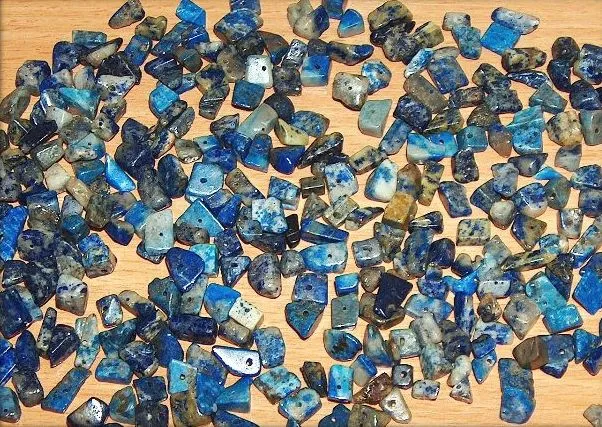
Raw lapis lazuli, the mineral source of natural ultramarine. The golden flecks are pyrite, iron sulfide. Photo by Rob Lavinsky, iRocks.com, via Wikimedia Commons, CC BY-SA 3.0.
Cinnabar produced vermilion. The mineral, mercury sulfide (HgS), was mined and ground. Synthetic vermilion was made by heating mercury and sulfur in a sealed container, a process invented in China by the 4th century BCE and described by Zosima of Panopolis in the 4th century CE and Jabir ibn Hayyan in the 8th century. The process is dangerous. Mercury fumes are toxic, and the alchemists who perfected it were poisoning themselves to make a red. Malachite, a copper carbonate mineral, was ground and washed into a stable, bright green used in Egyptian wall paintings and Chinese art. Azurite, another copper carbonate, was ground and washed with little other preparation. But azurite does not readily submit to fine grinding; if ground too fine, it loses its color. It was used in European painting until the 17th century, when it was replaced by the cheaper Prussian blue in 1704.
Mineral pigments were the most expensive and the most stable. They were the colors of the elite: ultramarine for the Virgin's robes, vermilion for Christ's Passion, gold leaf for haloes. The cost of minerals determined the hierarchy of subjects. A painting with large areas of ultramarine was more expensive than one without, and patrons specified the amount of ultramarine in their contracts. You can read more about this in our history of blue.
Organic Pigments: Plants, Insects, and Shellfish
Plant pigments were cheaper than minerals but less stable. Madder produced red from Rubia tinctorum roots. Woad produced blue from Isatis tinctoria leaves. Indigo came from Indigofera tinctoria. Weld produced yellow from Reseda luteola. Brazilwood produced red from Caesalpinia echinata. The oldest plant-based pigments date from 3000 BCE in Egypt. Plant pigments fade with light exposure, which is why so many old paintings look quieter now than they did when they were made.
Insects produced the most prized reds. Cochineal, from Dactylopius coccus, was introduced to Europe in 1523. Kermes came from Kermes vermilio. Lac came from Kerria lacca. Cochineal lakes were "first mentioned by Matthioli in 1549." The Paduan Manuscript, written in the 16th or 17th century, gives the recipe: "Take 12 grains of powdered cochineal, add to it 2oz of ley; leave the infusion for about 2 hours; strain it through a linen cloth and put it over hot cinders; when it boils add pulverized roche alum... then the ley will make a thick red scum... throw it all onto a stretched linen cloth... the coagulum must afterwards be dried and made into tablets."
Shellfish produced Tyrian purple, from Murex brandaris, the most expensive dye in antiquity. According to Bede, Irish monks knew the secret of preparing the dye from the Purpura shellfish found on Irish and English coasts. The pigment appears on Byzantine, Irish, and Carolingian manuscripts. As one historian noted, "its presence in Carlovingian manuscripts is easily accounted for, as it was probably brought by Byzantine artists, but that the knowledge of how to prepare it existed in Ireland is certainly curious."
Organic pigments were the democratic colors, cheaper, more available, and more varied than minerals. But they were also fragile. The reds in many Renaissance paintings that are now pink or brown were originally deep crimson. The cochineal or madder lakes have faded. The colors we see in museums are often ghosts of the colors the painters intended. Our history of red goes deeper into this fading problem.
Binders: Egg, Glue, Oil, and Gum
The binder determines the character of the paint. Egg tempera was the standard binder in European painting from the 12th to the 15th century. Egg yolk, which contains lecithin, a natural emulsifier, is mixed with pigment and water. The paint dries quickly, creates a hard, durable surface, and has a luminous quality that oil paint cannot match. Tempera is applied in thin layers, building up color gradually, and each layer must dry before the next is applied. A tempera panel can take months.

Carlo Crivelli, "Madonna di Macerata" (c. 1470-1473). Egg tempera on panel. The luminous surface is a direct result of the tempera binder. Image via Wikimedia Commons.
Animal glue, either rabbit-skin glue or fish glue, was used for distemper, a water-based paint for walls and canvas, and as a size for panels and canvas. Glue is hygroscopic, meaning it absorbs moisture and swells, which causes cracking. It is the binder of fresco secco, painting on dry plaster, and was used in Egyptian wall paintings. Linseed oil is the binder of oil painting, introduced to European art in the 15th century and traditionally attributed to Jan van Eyck, though oil painting existed earlier. Linseed oil dries by oxidation. It absorbs oxygen from the air and polymerizes into a hard, flexible film. The drying time is slow, days to weeks, which allows blending and layering, the technique that made the smooth transitions of Renaissance and Baroque painting possible. Gum arabic, the sap of the Acacia senegal tree harvested in Sudan, is the binder of watercolor. It is water-soluble, transparent, and rewettable, so watercolor can be lifted and reworked with a wet brush. Gum arabic was used in Egyptian painting, medieval illumination, and is still the binder of modern watercolor.
The history of painting is partly a history of binders. Egg tempera is fast, hard, and luminous, the paint of icons and altarpieces. Oil is slow, flexible, and blendable, the paint of the Renaissance and Baroque. Watercolor is transparent and fluid, the paint of sketches and landscapes. Each binder enables different techniques, subjects, and aesthetics.
The Recipe Books: Theophilus, Cennini, and the Mappae Clavicula
The oldest written paint recipes are cuneiform tablets from 17th-century BCE Assyria describing glazing techniques. Pliny, in the 1st century CE, mentions "various books on the imitation of precious stones," now lost. Zosimos of Panopolis, in the 4th century CE, noted "thousands of writings on diverse chemical topics, among them on the preparation of paints" in the temples of Alexandria.
The Mappae Clavicula, compiled in the 9th century, is a compilation of roughly 300 recipes for pigments, dyes, inks, gilding, and metalwork, drawn from older Assyrian, Greek, Egyptian, and Arabic sources. It opens with: "the first task of a painter is the preparation of his pigments." Theophilus Presbyter wrote "De diversis artibus" (On Divers Arts) in the 12th century, three books on painting, glass, and metalwork. Theophilus describes the preparation of vermilion, verdigris, lead-tin yellow, and other pigments. He also describes the construction of organ pipes and the staining of glass. The workshop was not divided into "art" and "craft."

Theophilus Presbyter, "De diversis artibus" (On Divers Arts), 12th century. A medieval treatise on painting, glass, and metalwork. Image via Wikimedia Commons.
Cennino Cennini wrote "Il Libro dell'Arte" (The Craftsman's Handbook) around 1390, the most detailed surviving account of medieval painting technique. Cennini describes how to draw, how to prepare panels, how to grind pigments, how to mix tempera, how to apply gold leaf, and how to paint draperies, flesh, and landscapes. He also gives advice on the painter's life: "always go to work with a light heart, for if you go to it sadly, you will make but a poor business of it." A Portuguese Hebrew illuminator's manual, Ms. Parma 1959, copied in the 15th century from 13th-century sources, describes the preparation of mosaic gold, red lead, verdigris, brazilwood lake, lac dye, vermilion, and parchment glue. Written in Portuguese in Hebrew characters, it is a unique record of Sephardic workshop practice.
These recipe books are the closest we can get to the medieval workshop. They reveal that painting was a technical practice, a set of procedures, recipes, and skills passed down from master to apprentice. The "secrets" of the workshop were not artistic inspiration but chemical knowledge: how to grind, how to wash, how to mix, how to bind. The painter was a maker before they were a creator. You can trace this technical lineage through the whole art movements timeline.
The Paint Tube (1841) and What Was Lost
John G. Rand was an American portrait painter working in London. He invented the collapsible tin paint tube in 1841. Before Rand, paint was stored in animal bladders, usually pig bladders, which had to be pierced with a tack to extract paint and could not be resealed. The tin tube was squeezable, resealable, and portable.
The impact was immediate. The paint tube made plein air painting practical. Monet, Pissarro, and Renoir could carry tubes of pre-mixed paint into the countryside. Impressionism, the art of painting outdoors in changing light, would have been nearly impossible without portable paint. Renoir said: "Without paints in tubes, there would have been no Impressionism." He was not exaggerating. You can see the results in our piece on Impressionism.
But something was lost. When paint was industrialized, the painter's relationship to color changed. The painter no longer knew the source of their pigments, the mineral, the insect, the plant. The painter no longer ground their own colors, and the individual character of each painter's palette, the result of their personal grinding, washing, and mixing, disappeared. The standardized paint tube produced standardized color. The hand-made pigment, with its variations and imperfections, was replaced by the manufactured product, with its consistency and uniformity.
The paint tube is not just a convenience. It is a transformation of the painter's craft. The painter who makes their own paint has a different relationship to color than the painter who buys it. The hand-made pigment is a material that the painter understands: its weight, its texture, its smell, its origin. The manufactured pigment is a product, anonymous, standardized, and detached from the process of making. The history of natural pigments is not just a history of materials but a history of the painter's craft, a craft that was, for 30,000 years, inseparable from the chemistry of color. For more on how color itself works, see our color theory guide, and for the strange story of green pigments, our history of green.
Final Thoughts
For 30,000 years, painters made their own paint. They ground minerals on stone slabs, boiled insects and plants to extract dyes, kneaded lapis lazuli paste under water, and mixed everything with egg yolk, animal glue, or linseed oil. The tools were the muller, the slab, and the pestle. The sources were minerals, plants, insects, and shellfish. The binders were egg tempera, animal glue, linseed oil, and gum arabic. The recipe books, from Theophilus to Cennini to the Mappae Clavicula, recorded the procedures. The paint tube of 1841 industrialized color and made Impressionism possible, but it also severed the painter's relationship to the material of paint.
Next time you squeeze paint from a tube, consider what it took to make that color. The blue may come from a synthetic version of lapis lazuli. The red may come from a synthetic version of cochineal. The white may be titanium dioxide, a pigment that did not exist before 1918. The tube is a convenience, but it is also a distance, between the painter and the material, between the color and its source. You can read more about historical pigments at the Natural Pigments archive, the stack process white lead reference, and the Mappae Clavicula entry.


