
Frida Kahlo is the most famous Latin American artist in the world. Her self-portraits are on tote bags, T-shirts, and phone cases. But Kahlo is one artist, not a continent. Latin American art is enormous: it spans centuries, countries, and traditions, from the Anthropophagic Movement of 1920s Brazil to the Surrealist exile community in Mexico City to the geometric abstraction of Joaquín Torres-García in Uruguay. The MALBA (Museo de Arte Latinoamericano de Buenos Aires) exhibition "Tercer Ojo" (Third Eye) brings together more than 220 iconic works of Latin American art by Frida Kahlo, Diego Rivera, Tarsila do Amaral, Xul Solar, Joaquín Torres García, Emilio Pettoruti, Wifredo Lam, Roberto Matta, Maria Martins, Remedios Varo, Antonio Berni, and Jorge de la Vega, among others. The NSU Art Museum Fort Lauderdale's "Shared Dreams" exhibition (September 21, 2025 to September 13, 2026) celebrates a transformative gift of 88 works of 20th-century Latin American art featuring Leonora Carrington, Diego Rivera, Frida Kahlo, Wifredo Lam, Fernando Botero, Remedios Varo, Joaquín Torres-García, Roberto Matta, and Alice Rahon. The Philadelphia Museum of Art's "Dreamworld: Surrealism at 100" (November 8, 2025 to February 16, 2026) highlights Latin American surrealism's role in the movement. The broader picture is not just about adding names. It is about understanding that Latin American art is not a peripheral tradition. It is a central one, with its own modernist movements, its own avant-garde, and its own theoretical frameworks.
The problem with Kahlo's dominance is not that she is overrated. She is a great artist. The problem is that her fame has obscured the broader tradition. When people think "Latin American art," they think Kahlo. They do not think Tarsila do Amaral, who painted "Abaporu" (1928), the painting that inspired the Anthropophagic Manifesto, one of the most important theoretical texts in 20th-century art. They do not think Remedios Varo or Leonora Carrington, who built a Surrealist community in Mexico City. They do not think Wifredo Lam, who made Surrealism "more surreal than the Surrealists" (Artnet). This guide covers Latin American art beyond Kahlo: Tarsila do Amaral and Brazilian Anthropophagy (Abaporu 1928, the Cannibalist Manifesto, "Tupi or not Tupi"), Remedios Varo and Leonora Carrington (Surrealism in Mexico City, the exile community), Wifredo Lam (Afro-Cuban Surrealism, The Jungle 1943), Joaquín Torres-García and geometric abstraction (Constructive Universalism, the inverted map of South America), the current exhibitions (MALBA's "Tercer Ojo," NSU's "Shared Dreams," Philadelphia's "Dreamworld"), and why the broader picture matters.
Tarsila do Amaral, "Abaporu" (1928). Oil on canvas. MALBA, Buenos Aires. "Abaporu, a word constituted by two Tupi-Guarani words meaning 'the man who eats human flesh,' was painted by Tarsila in 1928 in order to be given as a birthday gift to her husband, Oswald de Andrade" (MoMA). "This painting actually became the signature illustration of the Anthropophagic Manifesto written by Oswald de Andrade" (MoMA). Image via Wikimedia Commons.
Tarsila do Amaral and Brazilian Anthropophagy
"Abaporu, a word constituted by two Tupi-Guarani words meaning 'the man who eats human flesh,' was painted by Tarsila in 1928 in order to be given as a birthday gift to her husband, Oswald de Andrade" (MoMA). Tarsila herself described the moment: "I wanted to make a picture that would startle Oswald, something really out of the ordinary. The Abaporu was that monstrous figure, the little head, the skinny little arm supported by an elbow, those enormous long legs, and next to it a cactus that looked like a sun." This painting actually became the signature illustration of the Anthropophagic Manifesto written by Oswald de Andrade.
With the now famous phrase "Tupi or not tupi, that is the question," de Andrade opens his Cannibalist Manifesto making a reference to Shakespeare's Hamlet while asking a question about Brazilian cultural identity. He argues that artists should be free to cannibalize, or appropriate, the many cultural influences that surrounded them in modern Brazil, be they Indigenous, popular, or foreign. After a process of digestion, or synthesis, he believed this consumption would yield new cultural products, both original and genuinely Brazilian. Foreign culture should not be denied, but it should not be imitated. In his works, Oswald de Andrade ironized the Brazilian elite's submission to developed countries and proposed the "cultural absorption of imported techniques in order to elaborate them autonomously, and convert them into an export product."
Anthropophagy is not just a Brazilian movement. It is a theoretical framework for post-colonial cultural production. The idea that you do not reject foreign influence, but you do not imitate it either. You "swallow" it, digest it, and produce something new. Tarsila (1886-1973) studied in Paris with Fernand Léger. "Tarsila disembarked from the 'Massilia', a luxury ship arriving from Paris, bringing in her luggage beautiful paints, many elegant dresses and a great deal of renewal." She was one of the foremost painters of São Paulo's modernist movement in the first half of the twentieth century. "Abaporu" is in the collection of MALBA, Buenos Aires. For the wider movement context, see our complete guide to art movements.
Remedios Varo and Leonora Carrington: Surrealism in Mexico City
Remedios Varo (1908-1963) was a Spanish-born Surrealist who fled Nazi-occupied France and landed in Mexico City. Leonora Carrington (1917-2011) was a British-born Surrealist who also fled to Mexico City. Her friendship with Remedios Varo shows the strength of artistic networks in exile. They supported each other, showing how teamwork is vital in art.
Remedios Varo's art mixes magic and science in a unique way. Her work is a blend of scientific study and mystical exploration. In "Useless Science or The Alchemist" (1955), at the Museo de Arte Moderno in Mexico City, Varo shows us machines that don't work. These machines are run by figures doing mysterious tasks. MALBA holds "Armonía (Autorretrato sugerente)" (1956). Leonora Carrington's work is filled with creatures that question old gender roles. She started to build her unique artistic style in Mexico City. MALBA holds "Las distracciones de Dagoberto" (1945).
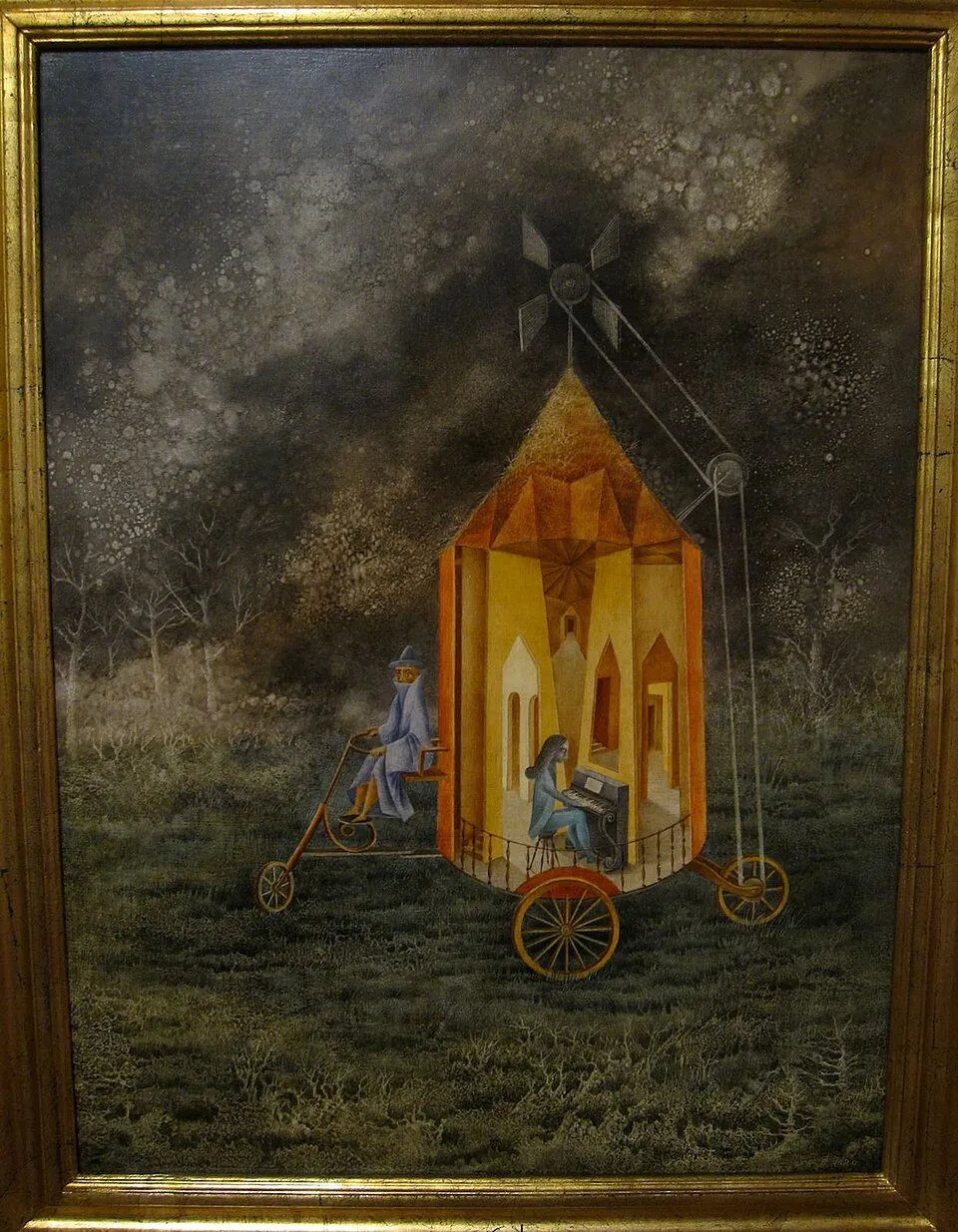
Remedios Varo, "Armonía" (1956). MALBA collection. "Remedios Varo's art mixes magic and science in a unique way. Her work is a blend of scientific study and mystical exploration" (The Surrealists). Varo and Leonora Carrington formed a close friendship in Mexico City, "showing the strength of artistic networks in exile" (The Surrealists). Image via Wikimedia Commons.
Varo and Carrington did not just practice Surrealism in Mexico. They transformed it. European Surrealism was largely male-dominated (André Breton, Salvador Dalí, Max Ernst). In Mexico City, Varo and Carrington created a Surrealism that was female, mystical, scientific, and deeply engaged with the local culture. They were not peripheral to Surrealism. They were at its center, in exile. For more on the individual works that anchor this history, see our guide to famous paintings explained.
Wifredo Lam: Afro-Cuban Surrealism
Wifredo Lam (1902-1982) was born in Cuba, the year of the island's formal independence from Spain, to a mother of African and Spanish heritage and a much-older Chinese immigrant father. He went to art school at the Academia Nacional de Bellas Artes San Alejandro in Havana. Lam spent most of his twenties and thirties in Spain. He absorbed painting in the Prado (Goya, El Greco, Bosch). In 1938 fled for Paris, where he shortly befriended Picasso and then the Surrealists.
MoMA acquired his famous painting The Jungle in 1946, a few years after he made it. His canvasses teem with creatures that you can link to various orisha spirits of Santería, the folk religion that descendants of enslaved Africans innovated in Cuba. There is a long tradition of celebrating Lam as "Cuba's Picasso." He was personally close with Picasso, and many elements of The Jungle (1942-43) read as a head-on confrontation with Les Demoiselles d'Avignon (1907). If there's one issue that hovers in the background of the exhibition, it's how to fit together two facts of Lam's biography: his intense engagement with Europe's interwar Modernist avant-gardes versus his view of his art as a self-conscious project of cultural decolonization, throwing off imposed European cultural values.
Wifredo Lam, "The Jungle" (1942-43). Gouache on paper. MoMA. "MoMA acquired his famous painting The Jungle in 1946, a few years after he made it" (Artnet). "His canvasses teem with creatures that you can link to various orisha spirits of Santería, the folk religion that descendants of enslaved Africans innovated in Cuba" (Artnet). Image via Wikimedia Commons.
Lam is not "Cuba's Picasso." He is Wifredo Lam, an artist who used Surrealism and Cubism as tools to express an Afro-Cuban worldview that European modernism could not contain. For the social framework behind this, see our piece on art and society.
Joaquín Torres-García and Geometric Abstraction
Joaquín Torres-García (1874-1949) was a Uruguayan artist who lived in Barcelona, New York, and Paris before returning to Montevideo in 1934. He developed "Constructive Universalism," a synthesis of European Constructivism and pre-Columbian American art. Torres-García's famous drawing of an inverted map of South America, with the south at the top and the north at the bottom, is a visual manifesto. "Our North is the South," he wrote. The map asserts that Latin American art does not need to look to Europe or North America for validation. It has its own tradition, its own direction, its own north.
Torres-García's influence on Latin American art is enormous. His Constructive Universalism influenced generations of Latin American abstract artists, from the Madí group in Argentina to the Neo-Concrete movement in Brazil. MALBA holds his work. The exhibition features key works of Latin American modernity, including Joaquín Torres García. For a structured way to study this material, see our guide on how to teach yourself art history.
The Current Exhibitions: A Broader Picture Emerging
MALBA "Tercer Ojo" (Third Eye) is an exhibition bringing together more than 220 iconic works of Latin American art by Frida Kahlo, Diego Rivera, Tarsila do Amaral, Xul Solar, Joaquín Torres García, Emilio Pettoruti, Wifredo Lam, Roberto Matta, Maria Martins, Remedios Varo, Antonio Berni, and Jorge de la Vega, among others. The exhibition features key works of Latin American modernity, including Autorretrato con chango y loro (1942) by Frida Kahlo, Armonía (Autorretrato sugerente) (1956) by Remedios Varo, Abaporu (1928) by Tarsila do Amaral, Baile en Tehuantepec (1928) by Diego Rivera, Omi Obini (1943) by Wifredo Lam, Las distracciones de Dagoberto (1945) by Leonora Carrington.
NSU Art Museum "Shared Dreams" (September 21, 2025 to September 13, 2026) is a transformative gift of 88 works of 20th-century Latin American art from collectors Stanley and Pearl Goodman. The exhibition features pieces by Leonora Carrington, Diego Rivera, Frida Kahlo, Wifredo Lam, Fernando Botero, Remedios Varo, Joaquín Torres-García, Roberto Matta, and Alice Rahon. Philadelphia Museum of Art "Dreamworld: Surrealism at 100" (November 8, 2025 to February 16, 2026) highlights Latin American surrealism's role in the movement. These exhibitions are part of a broader shift, from treating Latin American art as peripheral to treating it as central. The broader picture is emerging, one exhibition at a time. If you are new to this material, start with our guide on art for beginners.
Why the Broader Picture Matters
Kahlo's fame is not the problem. The problem is that her fame has become a substitute for knowledge. When people think "Latin American art," they think Kahlo, and stop. They do not think about the Anthropophagic Movement, which proposed a theoretical framework for post-colonial cultural production that is still relevant today. They do not think about the Surrealist exile community in Mexico City, which transformed Surrealism from a European movement into a global one. They do not think about Lam, Torres-García, Matta, or the dozens of other artists who made Latin American modernism one of the most innovative and theoretically sophisticated traditions of the 20th century.
The broader picture is not about displacing Kahlo. It is about adding context: the artists, movements, and ideas that surrounded her, preceded her, and followed her. Kahlo is part of the broader picture, not a substitute for it. Latin American art is not a peripheral tradition. It is a central one, with its own modernist movements (Anthropophagy, Constructive Universalism, Madí, Neo-Concretism), its own avant-garde (Torres-García, Lam, Matta), and its own theoretical frameworks (the Cannibalist Manifesto, "Tupi or not Tupi"). The broader picture is not just about adding names. It is about changing the map. For where this sits now, see our guide to contemporary art trends, and for how to read the work, see our guide on how to look at art.
Final Thoughts
Frida Kahlo is the most famous Latin American artist in the world, but she is one artist, not a continent. Tarsila do Amaral (1886-1973) painted "Abaporu" (1928), which "became the signature illustration of the Anthropophagic Manifesto" (MoMA). "Tupi or not tupi, that is the question" (Oswald de Andrade). "Artists should be free to cannibalize, or appropriate, the many cultural influences that surrounded them in modern Brazil, be they Indigenous, popular, or foreign" (SmARTHistory). Remedios Varo (1908-1963) and Leonora Carrington (1917-2011) built a Surrealist community in Mexico City. "Her friendship with Remedios Varo shows the strength of artistic networks in exile" (The Surrealists). Wifredo Lam (1902-1982) made "The Jungle" (1942-43), acquired by MoMA in 1946, "a head-on confrontation with Les Demoiselles d'Avignon" (Artnet). Joaquín Torres-García (1874-1949) developed Constructive Universalism and drew the inverted map of South America: "Our North is the South." MALBA's "Tercer Ojo" brings together "more than 220 iconic works" by "Frida Kahlo, Diego Rivera, Tarsila do Amaral, Xul Solar, Joaquín Torres García, Emilio Pettoruti, Wifredo Lam, Roberto Matta, Maria Martins, Remedios Varo, Antonio Berni, and Jorge de la Vega" (MALBA). NSU Art Museum's "Shared Dreams" (September 21, 2025 to September 13, 2026) features "88 works of 20th-century Latin American art" (Codex). Philadelphia's "Dreamworld: Surrealism at 100" (November 8, 2025 to February 16, 2026) "highlights Latin American surrealism's role in the movement" (The Surrealists). The broader picture is not about displacing Kahlo. It is about adding context: the artists, movements, and ideas that surrounded her, preceded her, and followed her. Latin American art is not a peripheral tradition. It is a central one.
Go to MALBA in Buenos Aires. Go to the "Tercer Ojo" exhibition, "more than 220 iconic works of Latin American art." Look at "Abaporu" (1928), the painting that inspired the Cannibalist Manifesto. Look at "Armonía" (1956) by Remedios Varo. Look at "Omi Obini" (1943) by Wifredo Lam. If you are in Fort Lauderdale before September 13, 2026, go to NSU Art Museum for "Shared Dreams," "88 works of 20th-century Latin American art." If you are in Philadelphia before February 16, 2026, go to the Philadelphia Museum of Art for "Dreamworld: Surrealism at 100." Then read the Anthropophagic Manifesto: "Tupi or not tupi, that is the question." The broader picture is not just about adding names. It is about changing the map. "Our North is the South." For reference, read the MALBA Tercer Ojo page, the Artnet feature on Wifredo Lam, and the Codex report on NSU's Shared Dreams.


