
The conventional history of abstract art begins in the early 20th century with Wassily Kandinsky, who made what is generally described as the first fully abstract painting around 1910-11, or with Piet Mondrian, who arrived at pure geometric abstraction through a sustained analysis of landscape and natural form. This history is not false, but it is incomplete. Hilma af Klint, a Swedish painter born in 1862, was producing large-scale abstract paintings in 1906, several years before either Kandinsky or Mondrian, and the paintings she made were among the most formally ambitious and spiritually searching abstract works produced in the early 20th century by anyone.
The reason she was absent from the conventional history of abstraction is that she kept the works secret. Instructed, she believed, by spiritual forces through automatic writing sessions conducted with a group of women she called "The Five," she sequestered the most ambitious series of her works, "The Paintings for the Temple," with instructions that they were not to be shown publicly for at least twenty years after her death. She died in 1944 following an accident. The paintings remained with her estate and were largely unknown outside a small circle until the early 1980s, when her nephew Erikson began limited exhibition of them. The first major international exhibitions came in the 2000s and 2010s, and the 2018-19 retrospective at the Guggenheim Museum in New York, which drew over 600,000 visitors, was one of the most attended exhibitions in the museum's history.
The Life: Training and Early Work
Af Klint trained at the Royal Academy of Fine Arts in Stockholm and graduated in 1887 with distinction. She was one of the few women admitted to the Academy and one of the first in Sweden to receive formal training in the most advanced available techniques. Her early career was conventional: she produced portraits, botanical illustrations, and topographical drawings, and she shared a studio with Anna Cassel in central Stockholm. She was a skilled conventional painter who also maintained a sustained practice of spiritual investigation throughout her professional life.
From the early 1890s, she was involved in spiritualist practices common in educated European circles of the period: automatic writing, seances, and other attempts to communicate with non-physical entities. These practices were not marginal or disreputable in the intellectual culture of the 1890s but were pursued by significant numbers of educated Europeans, including scientists, philosophers, and artists, as a serious investigation of the boundaries of consciousness. The Theosophical Society, founded by Helena Blavatsky in 1875, had attracted a large following that included figures significant to the development of Modernism: Kandinsky, Mondrian, Frantisek Kupka, and others had all engaged with Theosophical ideas about the spiritual dimensions of color and form.
The Five and the Commission
"The Five," the group of women af Klint met with regularly from 1896, conducted sessions of automatic writing and drawing in which they believed themselves to be in contact with higher spiritual beings. In 1904, af Klint received what she described as a commission from these beings to create a series of paintings for a future temple, large-scale works that would depict the spiritual evolution of humanity and the laws governing the relationship between matter and spirit.
She began work on "The Paintings for the Temple" in 1906 and continued until 1915, producing 193 paintings in various related series. The largest group within the series, "The Ten Largest" (1907), consists of ten paintings each approximately three meters tall, depicting the stages of human life from childhood through old age as abstract organic forms in luminous color. These paintings have no precedent in the Western tradition. They are not simplified or stylized versions of natural forms but pure visual organizations of color, shape, and line that convey meaning through purely formal means.
The Visual Language: Forms, Color, and Polarity
Af Klint's visual language is organized around principles of polarity and complementarity drawn from her spiritual investigations. Male and female principles are represented by specific colors and forms: orange and pink represent the female, blue and yellow the male. Spiral forms suggest spiritual evolution and growth. Biomorphic shapes that suggest flowers, cells, and other natural forms at the threshold of recognizability evoke the processes of organic life. Large circular compositions suggest totality and the completion of cycles.
The scale of the works is deliberately monumental. The largest paintings in "The Ten Largest" are over three meters tall, a scale associated in Western art with history painting and religious altarpieces. By working at this scale in a completely abstract visual language, af Klint claimed the prestige and authority of the largest ambitions of Western painting for a practice that had nothing to do with the conventional subjects, the historical narratives and religious scenes, that had previously justified painting at monumental scale.
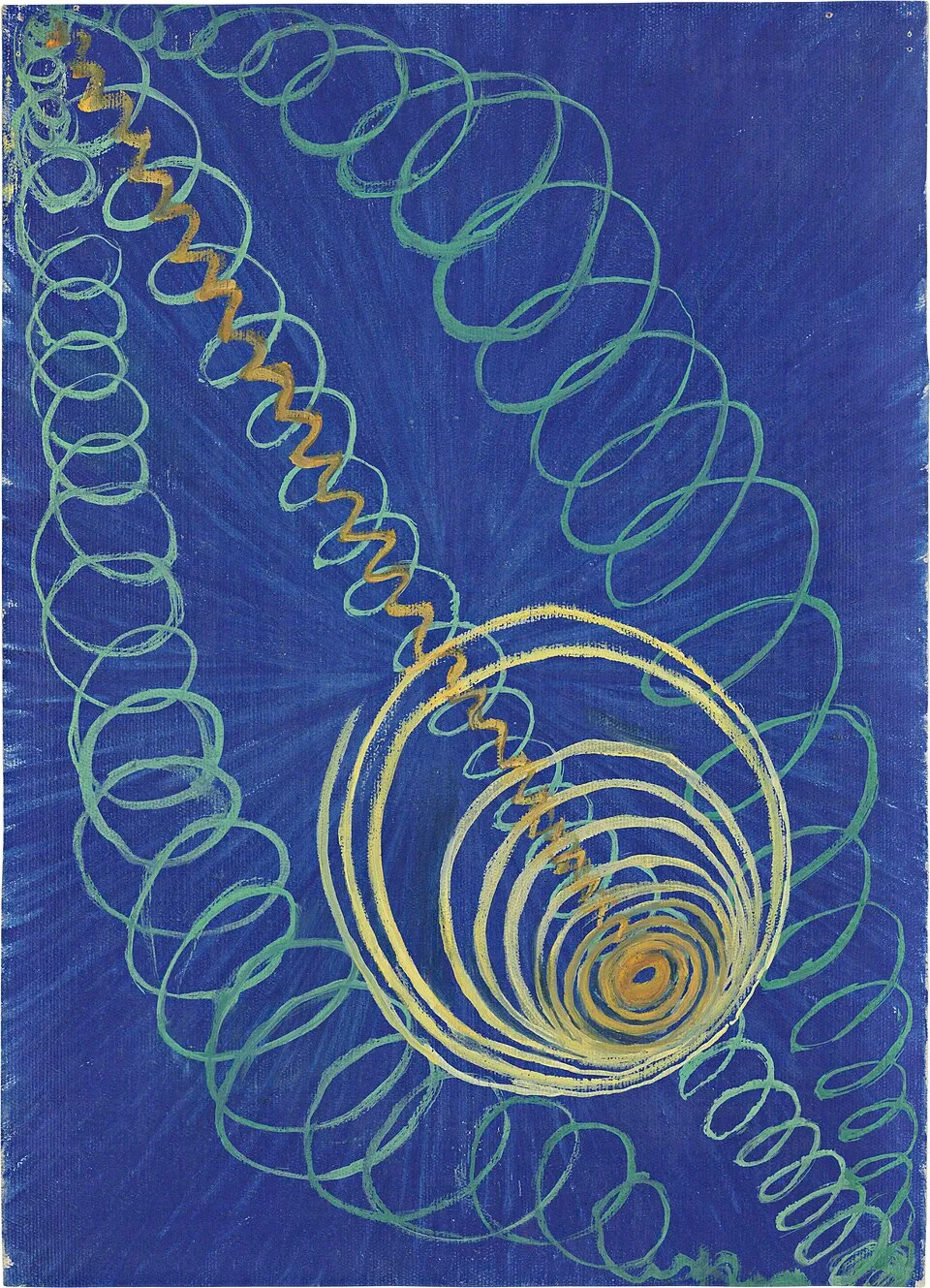
Hilma af Klint, "Primordial Chaos, No. 16" (1906-07). Oil on canvas. 53 x 37 cm. Hilma af Klint Foundation. Part of the earliest group of works within The Paintings for the Temple, depicting chaos as the generative condition preceding form. Wikimedia Commons.
Why She Stayed Hidden
Af Klint's decision to keep the works secret until after her death was not primarily a commercial or strategic calculation but a response to the spiritual instructions she believed she had received. She did show the work to Rudolf Steiner, the founder of Anthroposophy, hoping for validation from someone who operated in a compatible spiritual framework. Steiner's response was encouraging but cautious: he suggested the world was not yet ready for the works. She also showed them briefly at a Theosophical congress in London in 1928, where they were received without the recognition she hoped for.
The art world of her time was not equipped to encounter them. The abstract art that Kandinsky was making in Munich and that Mondrian was developing in Paris belonged to a conversation about painting's formal properties that was embedded in the specific institutions and critical discourse of the European avant-garde. Af Klint was working outside those institutions, in Stockholm, without connection to the networks of galleries, critics, and collectors that determined which art became historically visible. The conditions for the reception she deserved did not exist in her lifetime.
The Rediscovery and Its Implications
The full rediscovery of af Klint's work has had genuine implications for the history of abstract art. If she was producing abstract paintings in 1906, several years before the work that had previously been described as the origin of abstraction, then the history of abstraction needs to be rewritten to include her. The rewriting is complicated by the specificity of her practice: her abstractions emerged from spiritual investigation rather than from the formal analysis of perception that drove Kandinsky and Mondrian, and the question of whether these different routes to abstraction constitute the same achievement or different achievements is genuinely open.
The rediscovery also raises the question of how many other significant artists, particularly women, have been lost to the history of art because the institutional conditions for their visibility did not exist in their lifetimes. Af Klint's case is unusual because the works survived intact and because the foundation established in her name has worked actively to promote them. How many others did not survive, or are still waiting to be found?
Final Thoughts
Hilma af Klint spent decades making paintings for a temple that has never been built, on a commission she received from spiritual forces that art history cannot verify. The paintings themselves are verifiable and extraordinary: large, luminous, formally inventive works that deserve their place at the beginning of the history of abstract art rather than as a footnote to a history written without them. For the abstract tradition she helped originate, the guide to abstract art provides the broader context. For the spiritual dimensions of early abstraction that she shared with Kandinsky and others, the guide to Kandinsky and the spiritual is the essential companion piece.


